


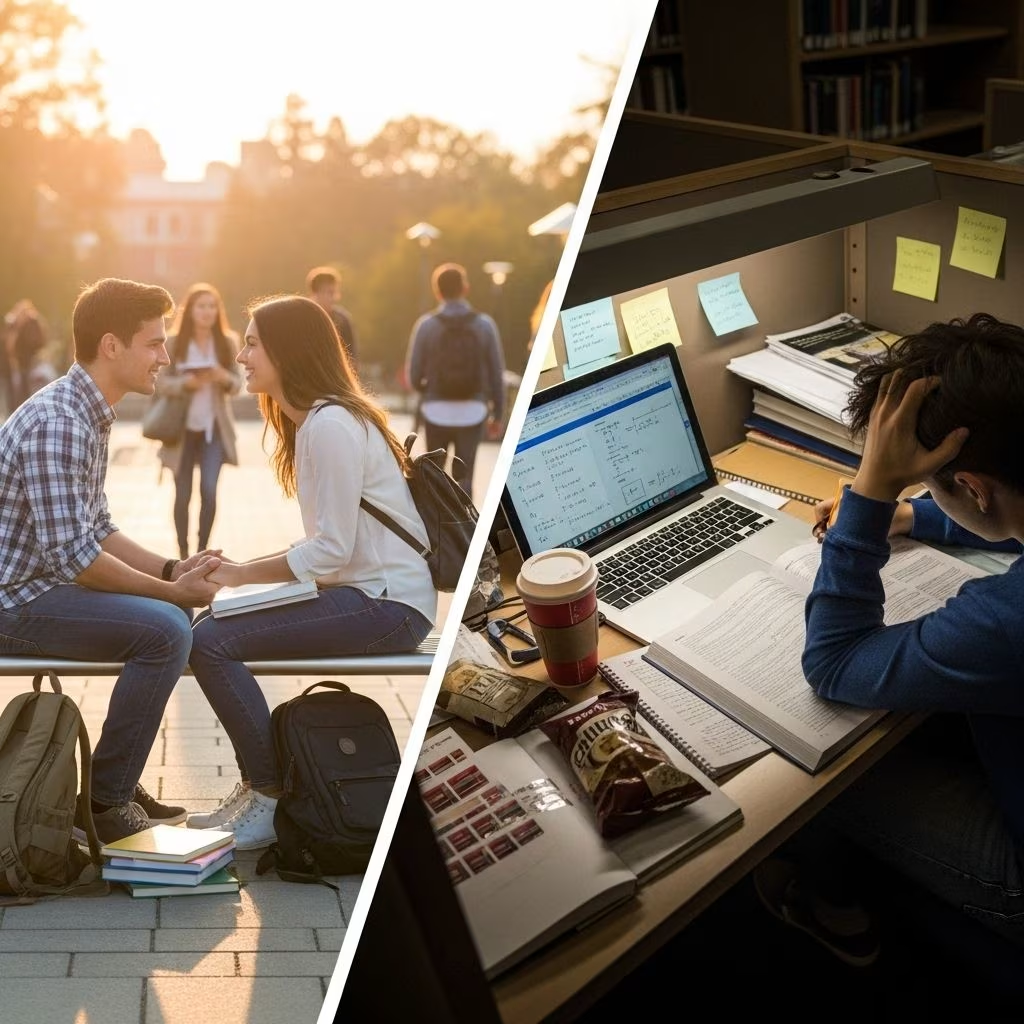
Picture this: You’re sitting in a crowded lecture hall, your professor enthusiastically explaining the fundamentals of psychology, but your mind is elsewhere. Your phone buzzes underneath your desk with another text from your significant other, and suddenly, what should be an engaging introduction to your chosen field becomes background noise to yet another relationship argument. This scenario plays out in college classrooms everywhere, raising an important question: Can students truly have a fulfilling college experience while maintaining a serious romantic relationship?
College represents a transformative period in young adults’ lives, a time designed for self-discovery, academic pursuit, and personal development. Yet when romantic relationships enter the equation, the delicate balance between personal growth and partnership becomes increasingly difficult to maintain. The reality is that juggling a serious relationship alongside academic responsibilities, extracurricular activities, and personal development can feel like carrying an overwhelming burden that threatens to compromise the very essence of what college is meant to provide.
The Hidden Costs of College Romance
When students envision their college years, they imagine discovering their passions, forming lifelong friendships, and building the foundation for their future careers. However, serious romantic relationships during this critical period can inadvertently shift focus away from these essential developmental goals. The emotional investment required to maintain a healthy relationship demands significant time, energy, and mental bandwidth—resources that college students desperately need for their academic and personal pursuits.
The comparison to taking an additional course with an insurmountable workload of emotional homework isn’t far from reality. Every relationship requires constant nurturing, communication, and effort to thrive. When you’re already managing a full course load, perhaps 17 credits per semester, adding the equivalent of a relationship “class” can push students beyond their capacity. The final exam in this metaphorical course—making the relationship work—becomes an ongoing test that students are perpetually studying for, often at the expense of their actual academic examinations.
Personal Growth Versus Partnership Growth
One of the most significant challenges of maintaining a relationship during college is the fundamental conflict between individual development and partnership dynamics. While relationships certainly teach valuable lessons about love, compromise, and emotional intelligence, they inherently involve sharing your growth experience with another person. This shared journey, while beautiful in many contexts, can dilute the focused self-discovery that college uniquely facilitates.
The college years serve as a rare opportunity for young adults to be deliberately selfish with their time and attention in service of their own development. It’s a period where experimenting with different interests, taking academic risks, and exploring various career paths should take precedence. When romantically involved, students naturally devote substantial portions of their emotional energy and time to their partner, which inevitably diminishes the resources available for personal exploration and individual growth.
Recent experiences demonstrate how dramatically life can shift after ending a college relationship. Students often report experiencing accelerated personal growth in the weeks following a breakup compared to years spent in the relationship itself. This isn’t to diminish the value of what was learned during the partnership, but rather to highlight how singular focus on oneself can catalyze rapid development during these formative years.
The Academic Impact of Romantic Relationships
Academic performance rarely improves when students are navigating the complexities of a serious relationship. The mental distraction alone can be devastating to grades and academic engagement. When relationship conflicts arise—as they inevitably do in any partnership—students find themselves unable to concentrate during lectures, struggling to complete assignments, and lacking the mental clarity needed for effective studying.
The opportunity cost is substantial. Hours that could be spent in the library, attending professor office hours, or engaging in meaningful academic projects instead get allocated to relationship maintenance, conflict resolution, and emotional processing. For students pursuing demanding majors or professional programs, this trade-off can have long-lasting consequences on their academic records and future opportunities.
Furthermore, the stress generated by relationship challenges compounds the already considerable pressure of college academics. Students are expected to manage multiple classes, each with their own deadlines, examinations, and requirements. Adding relationship stress to this equation creates a perfect storm of anxiety that can overwhelm even the most capable students.
When Relationships Compromise Future Ambitions
Perhaps the most concerning aspect of serious college relationships is their potential to derail carefully planned career trajectories and educational goals. Real-life examples abound of students who prioritize their relationships over their academic and professional aspirations, sometimes with devastating consequences. One particularly striking case involves a student who chose to drop out of college entirely to move in with her boyfriend, abandoning her degree program and career path in the process.
When that relationship inevitably ended, she found herself lost and directionless, forced to rebuild her life from scratch. The career trajectory she had once envisioned was now a distant memory, requiring exponentially more effort to reclaim. Her educational goals, once clear and achievable, now demanded starting over with the added challenges of time lost and momentum forfeited.
This scenario, while extreme, illustrates a pattern that manifests in subtler ways throughout college campuses. Students may choose colleges closer to their partners rather than institutions that better serve their academic interests. They might select majors or career paths that accommodate their relationship rather than pursuing their genuine passions. Some turn down internship opportunities, study abroad programs, or research positions because these opportunities would require physical separation from their partners.
The Two Paths: Staying Together or Moving Forward
Students in college relationships essentially face two fundamental choices, each with distinct implications for their future. The first option is to maintain the relationship throughout college, accepting the compromises and challenges that come with it. For some couples, this proves to be the right decision, and they successfully navigate college together while supporting each other’s growth.
However, this path requires honest assessment of whether the relationship truly enhances or hinders individual development. Students must ask themselves difficult questions: Is my partner supportive of my academic goals? Do I feel free to pursue opportunities that interest me? Am I maintaining my own identity and friendships outside the relationship? If the answers suggest that the relationship is becoming a roadblock rather than a support system, continuing may come at too high a cost.
The second option involves ending the relationship to fully embrace the college experience as an individual. While breakups are inherently painful and emotionally challenging, they can also be liberating, particularly when the relationship has been consuming excessive energy and attention. Ending a relationship doesn’t diminish the love that existed or the value of time spent together, but rather acknowledges that timing matters tremendously in life, and college might not be the optimal time for serious romantic commitment.
The Reality of Timing and Destiny
One of life’s difficult truths is that love alone doesn’t guarantee relationship success—timing plays an equally crucial role. Two people can genuinely love each other while simultaneously recognizing that their current life circumstances make a relationship impractical or detrimental to their individual growth. The college years represent such a circumstance for many students.
The notion that “if it’s meant to be, it will work out” offers comfort during difficult decisions about relationships. While this might sound like a platitude, there’s wisdom in recognizing that forcing a relationship to work during an inopportune time often causes more harm than good. If two people are genuinely compatible and meant to be together long-term, that connection will survive a period of separation focused on individual growth.
Conversely, relationships that cannot withstand the pressures of college life or that require constant sacrifice of personal goals and ambitions may not have been sustainable long-term regardless. In this sense, college serves as a testing ground, revealing whether a partnership can coexist with individual ambition or whether it demands compromises that ultimately breed resentment.
Managing Stress and Priorities
College students already contend with substantial stress from academic pressures, financial concerns, career uncertainty, and the general transition to adulthood. The student experience includes managing multiple classes, potentially working part-time jobs, participating in extracurricular activities, maintaining friendships, and handling various adult responsibilities for the first time. Adding a serious romantic relationship to this already full plate can push stress levels into unhealthy territory.
The comparison to taking an extra class that doesn’t count for credit aptly captures the frustration of investing significant energy into a relationship that ultimately doesn’t contribute to college goals. Students naturally resist putting effort into coursework that doesn’t advance their degree progress, yet many pour countless hours into relationships that actively impede their academic success. Recognizing when a relationship has become more burden than benefit is crucial for maintaining overall well-being during college.
Making the difficult decision to end a relationship, particularly when love still exists, requires maturity and long-term thinking. It means prioritizing future goals over present comfort, which contradicts our natural inclination toward immediate emotional satisfaction. However, this ability to delay gratification and make difficult choices in service of long-term success represents exactly the kind of personal growth that college is designed to foster.
The Value of Single Years in College
Being single during college isn’t something to fear or view as a deficit—it’s an opportunity. These years offer a unique window for complete self-focus that rarely exists elsewhere in life. Before college, young people live under parental guidance and household rules. After college, career demands, financial responsibilities, and potentially family obligations compete for attention. The college years represent a brief period where individuals can be intentionally self-centered in their development without apology.
Single students have the freedom to say yes to spontaneous opportunities without consulting a partner. They can accept that semester abroad in a country their partner would never visit. They can throw themselves completely into an academic project or research opportunity that demands irregular hours. They can build diverse friendships without the complications of jealousy or neglect. They can discover who they are as complete individuals before attempting to merge their life with someone else’s.
This independence fosters confidence, self-knowledge, and capability that serve individuals throughout their entire lives. Students who fully embrace their single status during college often emerge with clearer self-understanding, stronger personal identity, and better preparation for healthy relationships in the future precisely because they took time to develop as complete individuals first.
Making the Right Choice for Your Situation
Despite the arguments presented here, the decision about whether to maintain a relationship during college remains deeply personal. Every relationship is unique, and some partnerships genuinely enhance rather than detract from the college experience. The key is honest self-assessment about whether your relationship falls into this category.
Students should regularly evaluate whether their relationship supports or hinders their academic performance, personal growth, and future ambitions. Ask yourself: Has my GPA suffered since entering this relationship? Have I turned down opportunities because of my partner? Do I spend more time managing relationship conflicts than pursuing my interests? Am I becoming more or less like the person I want to be? The answers to these questions provide crucial guidance.
Additionally, consider whether your partner actively supports your individual growth or whether they view your development as threatening to the relationship. Healthy partnerships encourage individual flourishing, while unhealthy ones demand stagnation in service of relationship stability. A partner who celebrates your successes, supports your ambitions, and encourages you to pursue opportunities even when inconvenient for the relationship might be worth keeping. One who creates guilt around your goals or demands you limit yourself for their comfort is not.
Frequently Asked Questions
Q: Is it possible to successfully maintain a relationship throughout college?
A: Yes, some couples successfully navigate college together, but it requires both partners to actively support each other’s individual growth, academic goals, and personal development without creating dependency or limiting opportunities.
Q: How do I know if my relationship is affecting my academic performance?
A: Warning signs include declining grades, difficulty concentrating in class, missing assignments due to relationship issues, choosing easier courses to have more relationship time, and feeling constantly distracted by relationship concerns during study time.
Q: What if I still love my partner but recognize the relationship is holding me back?
A: Love and timing are separate considerations. It’s possible to love someone while recognizing that the relationship timing doesn’t serve your current life stage. If it’s truly meant to be, the connection can survive a period of individual focus.
Q: Should I avoid dating entirely during college?
A: Not necessarily. Casual dating can be part of a healthy college experience. The concern primarily involves serious, committed relationships that demand significant emotional investment and potential compromise of personal goals and academic priorities.
Q: How can I focus on personal growth while in a relationship?
A: Maintain strong boundaries, pursue individual interests and friendships, say yes to opportunities even when inconvenient for your partner, ensure regular alone time for self-reflection, and regularly assess whether you’re developing as an individual or only as part of a couple.
Q: What if my partner dropped out or changed schools to be with me?
A: This creates unhealthy pressure and imbalance in the relationship. If the relationship ends, your partner faces serious consequences for their sacrifice, which can create guilt and obligation rather than genuine connection. This dynamic rarely produces healthy long-term outcomes.
Q: Is breaking up with someone I love selfish?
A: Prioritizing your education, career development, and personal growth during college isn’t selfish—it’s necessary. College represents a unique opportunity for self-focus that serves you throughout life. Making choices that support your long-term well-being demonstrates maturity, not selfishness.
References
- https://www.elitedaily.com/dating/intro-dating-relationships-college-dont-mix-well/798893
- https://www.youtube.com/watch?v=wS15nSjUjok
- https://www.elitedaily.com/p/how-to-come-out-in-college-according-to-advice-from-experts-12157103
- https://smudailycampus.com/1019368/opinion/lesson-learned-magazines-do-not-serve-as-accurate-sources-for-relationship-advice/
- https://baylorlariat.com/2015/03/03/blog-this-isnt-just-another-click-bait-article/


