


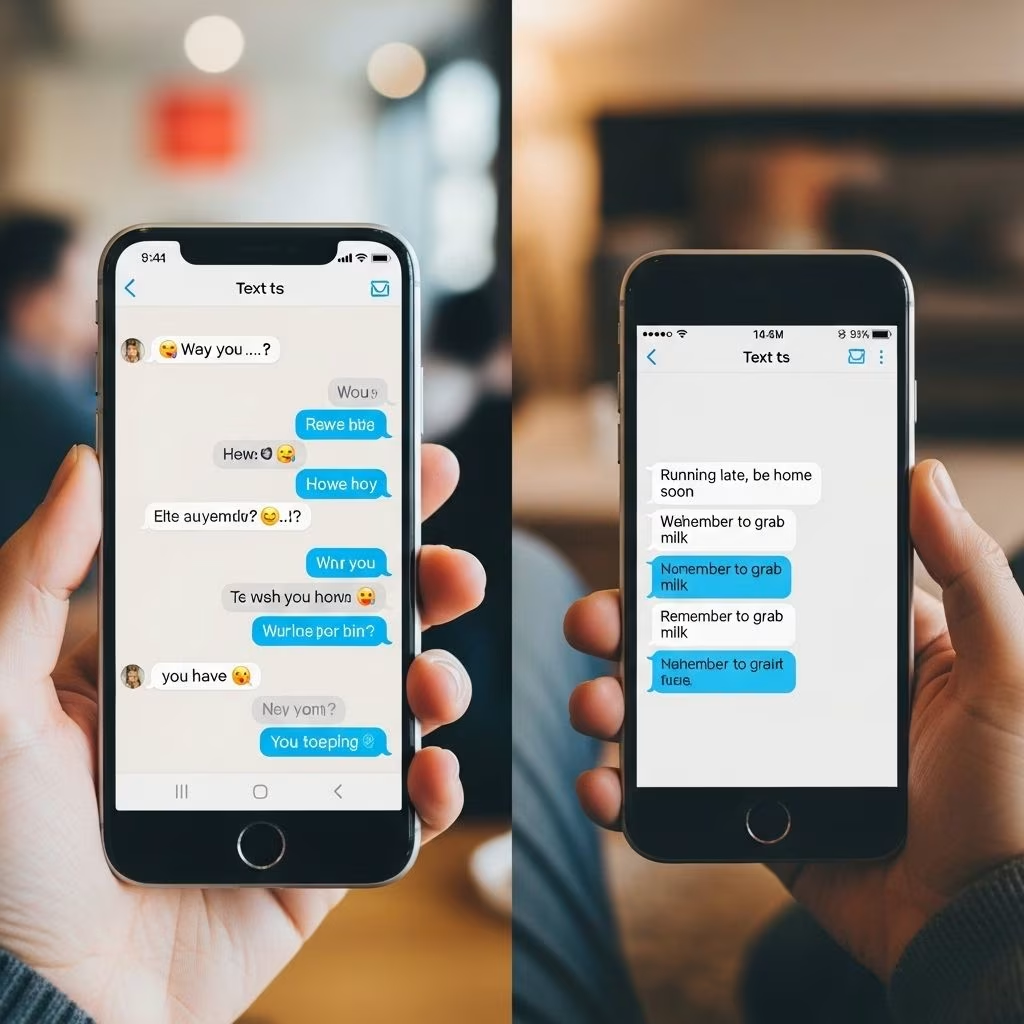
When you first start talking to someone new, every text message feels like it carries enormous weight. You carefully craft each response, deliberate over emoji choices, and might even wait a strategic amount of time before hitting send. But as relationships deepen and become more established, something fascinating happens to the way we text. The formality fades, authenticity increases, and communication patterns shift in meaningful ways that reflect the growing intimacy between partners.
Understanding how texting evolves throughout a relationship isn’t just an interesting observation—it’s a window into the deepening emotional connection between two people. Research shows that our digital communication patterns transform significantly as relationships progress through different stages, from casual dating to serious commitment. These changes reveal important insights about trust, vulnerability, and the developing bond between romantic partners.
The Science Behind Texting Evolution
Linguistic researchers have discovered that couples don’t just talk more as their relationship develops—they actually begin to communicate more similarly. This phenomenon, known as linguistic alignment, occurs across multiple dimensions of language use. When researchers analyzed text messages from new romantic couples over time, they found something remarkable: partners increasingly mirror each other’s communication styles, vocabulary choices, and even sentence structures as their relationship deepens.
The changes follow a predictable pattern that researchers describe as exponential growth. Linguistic alignment increases rapidly during the early stages of relationship formation, then gradually levels off to reach an optimal point. This isn’t random—it reflects the natural progression of intimacy and comfort between partners. Three specific types of alignment have been identified: syntactic alignment (how sentences are structured), semantic alignment (the meanings and topics discussed), and overall linguistic similarity.
Michelle McSweeney, a researcher and linguist specializing in digital communication, explains this evolution succinctly: texting changes as the intimacy level increases, and as the relationship becomes more solidified, the texting becomes less novel. This transformation isn’t just about frequency—it’s about authenticity, vulnerability, and the comfort that comes with truly knowing another person.
The Early Stage: Casual Texting and First Impressions
When you first connect with someone, whether through a dating app or in person, texting serves as a primary tool for building initial rapport. During this casual stage, conversations typically focus on surface-level topics—what you did today, interesting things you encountered, light humor, and general getting-to-know-you exchanges. There’s an exploratory quality to these early texts, as both individuals assess compatibility and mutual interest.
This stage is characterized by careful consideration of every message. You might find yourself rereading texts before sending, adjusting tone, or managing the perceived enthusiasm level. Gender scripts and social norms often guide behavior during this phase, with both parties presenting somewhat curated versions of themselves. The uncertainty is high, and so is the stakes-feeling of each interaction.
Interestingly, research indicates that even during these early exchanges, linguistic alignment begins to occur. Couples start unconsciously matching each other’s communication patterns, though this alignment is still in its nascent stages. The text exchanges are characterized by novelty—every message feels significant, and there’s heightened attention to response times, word choices, and emoji usage.
Moving Toward Intimacy: The Somewhat Serious Stage
As relationships progress into what researchers call the somewhat serious stage, texting patterns undergo noticeable shifts. Conversations move beyond superficial topics and begin to explore values, attitudes, and more personal subject matter. There’s increased interaction frequency, and partners develop inside jokes, shared references, and communication shortcuts that reflect their growing familiarity.
During this stage, uncertainty about the other person decreases significantly. You begin to understand their texting style, recognize their humor, and can better interpret tone through digital messages. The careful calculation that characterized early texting starts to relax, replaced by more spontaneous and authentic communication. Partners feel more comfortable sending silly photos, sharing vulnerable moments, or texting about mundane daily experiences.
The linguistic alignment that began in the casual stage accelerates dramatically during this phase. Research shows that syntactic, semantic, and overall linguistic similarity all exhibit strong positive growth as couples transition from casual dating to more serious involvement. Partners unconsciously adopt each other’s vocabulary, mirror sentence structures, and increasingly discuss similar topics in similar ways.
Negotiation becomes a critical component of communication during this stage. Couples work out expectations around texting frequency, response times, and the types of conversations that happen digitally versus in person. This negotiation process, while sometimes challenging, helps establish the foundation for long-term communication patterns.
The Serious Stage: Deep Connection and Authentic Communication
When relationships reach the serious stage, texting transforms into something fundamentally different from those early, carefully crafted messages. This stage is characterized by increased feelings of trust, attraction, love, and interdependence. The relationship has established enough security that both partners can communicate with complete authenticity.
Greater perspective-taking occurs during this stage because of increased self-disclosure through both text and in-person conversations. Partners develop a better understanding of each other’s thoughts, feelings, and communication preferences. This deeper understanding manifests in texting through more nuanced exchanges—partners can detect subtle mood shifts, understand context without extensive explanation, and communicate complex emotions through digital channels.
The linguistic alignment that researchers track reaches significant levels during the serious stage. Studies using multiple metrics—including Language Style Matching (LSM) for syntactic alignment, Latent Semantic Analysis (LSA) for semantic alignment, and cosine similarity for overall alignment—all show that couples’ text messages become increasingly similar as relationships solidify. This isn’t conscious mimicry; it’s the natural result of two people developing a shared communication style.
Texting in serious relationships also becomes more functional and less performative. Partners text about logistics, daily coordination, and practical matters alongside emotional check-ins and intimate exchanges. The pressure to constantly be interesting or entertaining disappears, replaced by comfortable, authentic communication that serves the relationship’s actual needs.
Long-Term Commitment: Comfortable Communication Patterns
As relationships move into long-term commitment—including engagement and marriage—texting patterns stabilize at what researchers describe as an optimal asymptote. The exponential growth in linguistic alignment levels off, not because the relationship stops developing, but because partners have reached a high level of communication synchrony.
At this stage, texting becomes deeply integrated into the relationship’s communication ecosystem. Couples develop highly personalized texting languages complete with abbreviations, emoji codes, and references that would be incomprehensible to outsiders. These private communication systems reflect the intimacy and shared history of the relationship.
The novelty that characterized early texting is largely gone, but this isn’t a negative development. Instead, it reflects the security and comfort of an established relationship. Partners can send brief, casual texts without overthinking, communicate efficiently about practical matters, and maintain connection throughout the day without the pressure of crafting perfect messages. Emojis, GIFs, and casual language flow freely because there’s no longer anxiety about being judged or misunderstood.
Research indicates that couples in long-term relationships maintain high levels of linguistic alignment across all measured dimensions—syntactic, semantic, and overall similarity. This sustained alignment reflects not just communication habits but the deep psychological and emotional connection between partners.
What These Changes Mean for Your Relationship
The evolution of texting patterns throughout a relationship isn’t arbitrary—it’s a meaningful indicator of relational health and development. When communication becomes more authentic, aligned, and comfortable, it typically signals growing trust and intimacy. Conversely, if texting patterns remain formal, distant, or anxiety-inducing well into a relationship, it might indicate unresolved uncertainty or emotional distance.
Understanding these patterns can help you assess where your relationship stands. Early-stage overthinking about texts is completely normal and reflects the natural uncertainty of new connections. As relationships progress, you should notice yourself feeling more comfortable with spontaneous, authentic communication. If you find yourself still carefully crafting every message months into a relationship, it might be worth examining whether the emotional intimacy is developing as expected.
The linguistic alignment that researchers have documented isn’t something you need to consciously create. When it happens naturally, it’s a positive sign that you and your partner are developing a shared communication style and perspective. This alignment facilitates understanding, reduces miscommunication, and strengthens the emotional bond between partners.
Practical Insights for Digital Communication
While texting evolution happens naturally, understanding these patterns can help you navigate digital communication more effectively. During early stages, give yourself permission to be thoughtful about messages without becoming paralyzed by overthinking. Remember that some level of uncertainty is normal and actually part of the excitement of new connections.
As relationships progress, prioritize authenticity over perfection in your texts. The goal isn’t to impress your partner with every message but to maintain genuine connection. Share mundane moments, send silly photos, and let your true personality come through in digital communication. This authenticity facilitates the intimacy development that characterizes healthy relationship progression.
Pay attention to how comfortable you feel with texting as the relationship develops. Increasing ease, spontaneity, and naturalness in digital communication are positive indicators. If you notice yourself becoming more anxious or calculated about texts as time goes on, it’s worth exploring why—either individually or with your partner.
Also recognize that every relationship develops at its own pace. While research identifies general patterns, there’s significant variation between couples in how quickly linguistic alignment occurs and how texting patterns evolve. What matters most isn’t matching some predetermined timeline but that communication feels progressively more comfortable and authentic for both partners.
The Role of Individual Differences
While research identifies overall patterns in how texting changes throughout relationships, it’s important to acknowledge that significant individual differences exist. Some people are naturally more verbose texters, while others prefer brevity. Some express emotion easily through digital channels, while others find it awkward or limiting.
These individual preferences don’t disappear as relationships develop, but successful couples find ways to accommodate each other’s communication styles. One partner might prefer frequent check-in texts throughout the day, while the other saves up stories for longer evening conversations. Neither approach is inherently better—what matters is that both partners understand and respect each other’s preferences.
The linguistic alignment that occurs in healthy relationships doesn’t mean partners become identical in their communication. Rather, they develop complementary styles that work together effectively. One person might become slightly more expressive in texts, while the other becomes slightly more concise, meeting somewhere in the middle that serves the relationship well.
When Texting Patterns Signal Problems
While this article focuses on the positive evolution of texting in healthy relationships, it’s worth noting that communication patterns can also signal problems. If texting frequency dramatically decreases without explanation, if one partner becomes increasingly distant or formal in messages, or if the natural linguistic alignment begins to reverse, these might indicate relationship difficulties.
Similarly, if anxiety about texting persists or intensifies as a relationship progresses, it might reflect underlying insecurity or trust issues that need addressing. Healthy relationship development should generally involve decreasing uncertainty and increasing comfort, so persistent texting anxiety warrants attention.
Communication mismatches—where one partner feels the texting is too frequent or not frequent enough, too casual or too distant—can also create friction. These issues often resolve through open conversation about preferences and needs, but persistent mismatches might indicate deeper compatibility concerns.
Frequently Asked Questions
Q: Is it normal to overthink texts at the beginning of a relationship?
A: Yes, completely normal. Early-stage texting anxiety reflects the natural uncertainty and high stakes of new romantic connections. As intimacy develops and the relationship becomes more secure, this overthinking typically decreases significantly.
Q: Should couples text the same amount throughout their relationship?
A: No, texting frequency naturally changes as relationships evolve. Early stages often involve frequent texting as couples get to know each other, while established relationships may text less frequently but with greater depth and authenticity.
Q: What is linguistic alignment and why does it matter?
A: Linguistic alignment is when partners begin to communicate more similarly, matching vocabulary, sentence structure, and topics. It matters because it indicates growing intimacy, shared perspective, and effective communication—all signs of healthy relationship development.
Q: How long does it take for texting to become comfortable in a relationship?
A: This varies by couple, but research suggests linguistic alignment—a marker of communication comfort—grows rapidly in the first few months and reaches optimal levels within several months of relationship formation. Individual experiences vary considerably.
Q: Does less frequent texting mean a relationship is in trouble?
A: Not necessarily. Established relationships often text less frequently than new ones because the novelty decreases and partners have other ways to stay connected. What matters more is whether the texting feels comfortable and authentic to both partners.
Q: Should I change my texting style to match my partner?
A: Linguistic alignment happens naturally in healthy relationships—you don’t need to force it. Focus on authentic communication rather than consciously mimicking your partner’s style. Natural convergence will occur as intimacy develops.
References
- https://pmc.ncbi.nlm.nih.gov/articles/PMC8315721/
- https://engagedscholarship.csuohio.edu/cgi/viewcontent.cgi?article=1652&context=etdarchive
- https://www.elitedaily.com/p/how-does-texting-change-throughout-a-relationship-a-linguist-explains-18013178
- https://corplinguistics.wordpress.com/2016/04/23/a-peek-inside-text-message-patterns/
- https://rex.libraries.wsu.edu/view/delivery/01ALLIANCE_WSU/12350045450001842/13350045440001842


