


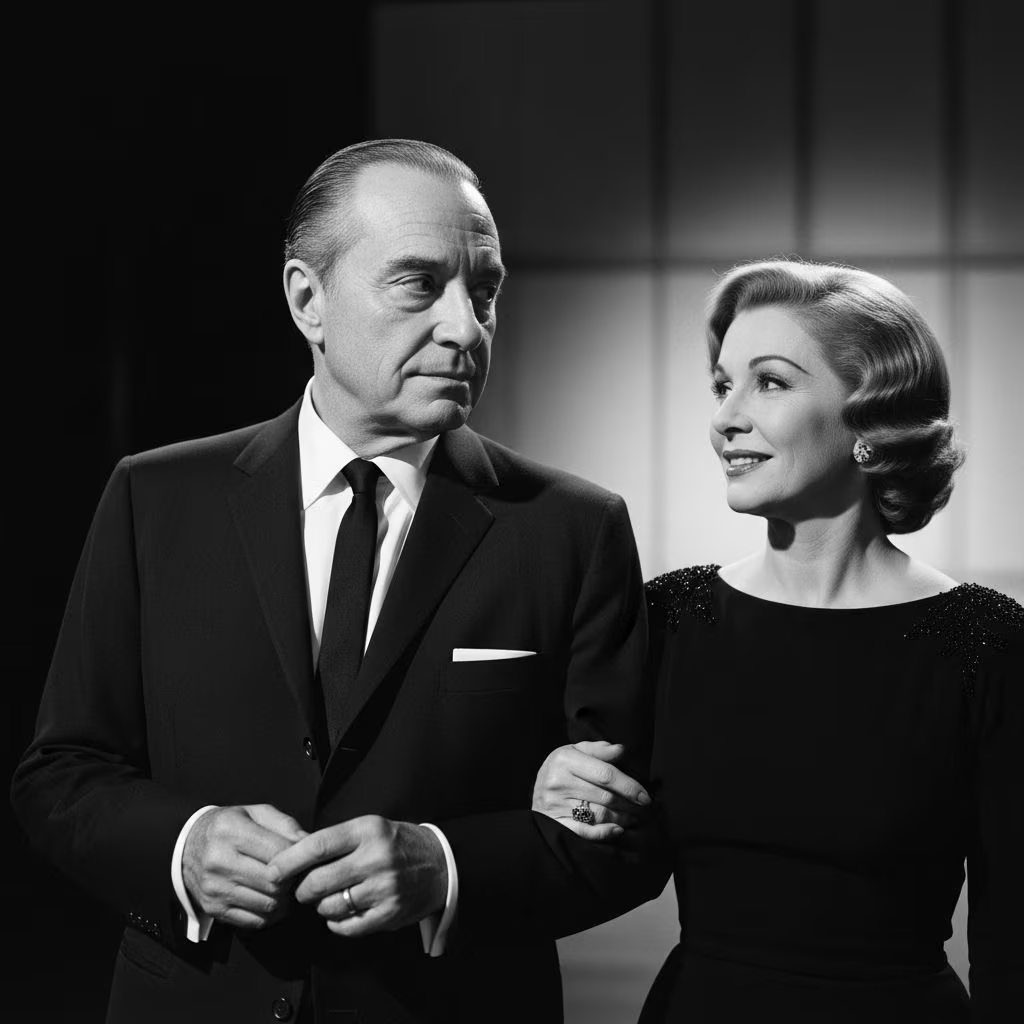
The relationship between Bob Fosse and Gwen Verdon stands as one of the most fascinating and complicated partnerships in entertainment history. Their story encompasses romance, artistic collaboration, betrayal, and an enduring connection that transcended the boundaries of traditional marriage. While the FX miniseries Fosse/Verdon brought their relationship to modern audiences, the reality of their union was even more complex, nuanced, and dramatic than what could be portrayed on screen.
These two titans of Broadway created some of the most memorable musicals of the 20th century while navigating a relationship that defied conventional definitions. Their connection was forged in rehearsal rooms, tested by infidelity and professional pressures, yet remained unbreakable until death. Understanding their relationship requires examining not just the romance, but the artistic symbiosis that made them inseparable collaborators even when their marriage crumbled.
The First Encounter: A Meeting of Artistic Minds
Bob Fosse and Gwen Verdon’s paths first crossed in 1953 at a party hosted by choreographer Michael Kidd. At the time, both were already established figures in the entertainment world, though neither had yet achieved the legendary status they would later attain. Verdon had worked as choreographer Jack Cole’s assistant at MGM and had earned recognition as a talented dancer, while Fosse was a contracted dancer at the same studio, honing his craft and developing his distinctive style.
Their conversation that evening was reportedly lengthy and engaging, suggesting an immediate intellectual and artistic connection. The two had actually crossed paths even earlier, at the audition for the stage musical Alive and Kicking in 1949, where Cole was choreographing and Fosse was auditioning with his then-wife and dance partner Mary Ann Niles. However, it was the 1953 party where they truly connected on a deeper level, recognizing in each other a kindred spirit who shared their obsessive dedication to dance and performance.
This initial meeting planted the seeds for what would become one of Broadway’s most significant partnerships. Both possessed an uncompromising approach to their art, a perfectionism that would later prove to be both the foundation of their success and a source of tension in their relationship. Verdon had already developed a reputation for being difficult, which she openly acknowledged stemmed from her inability to tolerate poor dancing. Fosse, similarly driven and exacting, would prove to be her perfect match in ambition and artistic vision.
Damn Yankees: Where Professional Became Personal
The real transformation in Fosse and Verdon’s relationship occurred in 1955 when they reunited for the Broadway musical Damn Yankees. Verdon had been cast to play Lola, and Fosse was brought on as choreographer. This collaboration would mark a turning point not just in their careers, but in their personal lives. The professional partnership quickly evolved into something far more intimate and consequential.
In a 1991 interview on CUNY Television, Verdon recalled their first working session together with vivid detail. Fosse, aware of her reputation for being demanding, admitted his nervousness. They were working late at night in a studio at Walton warehouse, as Fosse was a confirmed night person who preferred rehearsing after dark. When Verdon expressed her own anxiety, Fosse responded by demonstrating the number he had devised for Lola, performing it himself with such skill and charisma that Verdon was immediately captivated.
What struck Verdon most about Fosse’s performance was its unique combination of sexiness and humor. She had no trouble being sexy herself, but Fosse brought a sense of wit, whimsy, and comedic timing that elevated the choreography beyond mere sensuality. This blend of qualities spoke directly to Verdon’s own sensibilities as a performer. She possessed an innate sense of humor and lightness that made her irresistible to audiences, and working with Fosse allowed her to give full expression to these qualities. The artistic chemistry between them was undeniable and electric.
Their connection was immediate, and as biographer Sam Wasson notes, their affair was inevitable. The intensity of their work together, the long nights in rehearsal, and their shared perfectionism created an environment where professional admiration rapidly transformed into romantic passion. They were soon living together, having found in each other not just a lover but a true artistic partner who understood and complemented their creative process in ways no one else could.
Marriage and Collaboration: A Delicate Balance
By 1960, Fosse and Verdon had decided to formalize their union, marrying after years of living and working together. This would be Verdon’s second marriage; she already had a son, Jim, from her previous marriage to tabloid reporter James Henaghan. For Fosse, it was his third attempt at matrimony, following his marriages to Mary Ann Niles and Joan McCracken. In 1959, Fosse and McCracken had officially divorced, paving the way for him to marry Verdon. Their union would produce one child, a daughter named Nicole, born in 1963.
The couple had already proven their collaborative prowess before the wedding. They originated New Girl in Town together in 1957, a musical for which Verdon won another Tony Award, adding to her growing collection of accolades. Their partnership represented a unique dynamic in show business: they were simultaneously spouses, colleagues, and artistic collaborators, each role influencing and complicating the others.
However, marrying Fosse meant accepting the totality of who he was, including his considerable vices and character flaws. Fosse was well-known throughout the industry for his chain-smoking, prescription drug use, and most notably, his chronic infidelity. Having grown up around strip clubs, Fosse viewed women as his hobby, and his womanizing was both compulsive and unapologetic. Verdon reportedly understood this aspect of her husband’s character, once observing that he would even cheat on his mistresses. She recognized that part of him felt guilty about his infidelity, while another part was ecstatic about it, suggesting a deeply conflicted personality.
The Unsung Contributions: Verdon’s Hidden Role
While Fosse received public acclaim as a choreographer and director, Verdon’s contributions to his work were often far more significant than official credits suggested. She frequently served as the vital conduit between Fosse and the casts he directed, teaching dancers their moves and translating his vision into teachable steps. Her role went far beyond being merely his muse or interpreter; many have argued that Verdon deserved equal credit with Fosse for several of his most celebrated projects, including productions where she received no official recognition.
This professional dynamic reflected the complicated nature of their relationship. Fosse relied heavily on Verdon’s talent, insight, and ability to execute his choreographic vision, yet the public recognition and credit overwhelmingly went to him. Verdon’s willingness to work behind the scenes, to support Fosse’s career sometimes at the expense of her own recognition, spoke to the depth of her commitment to both the work and to him. She believed in his genius even when it came at personal cost.
The couple’s working relationship was characterized by an intensity that Fosse himself acknowledged was unmatched in his life. He once said that the best times in his life were working in a rehearsal room with Gwen, and that if he could have put a bed and refrigerator in the rehearsal room and lived there, everything would have been perfect. The trouble, he admitted, started when he left the rehearsal room. This telling statement reveals that their connection was most pure and uncomplicated in the creative space, where their shared passion for dance and performance created a kind of harmony that eluded them in other aspects of their relationship.
Sweet Charity: Success and Disappointment
In 1966, Fosse and Verdon opened the celebrated Neil Simon musical Sweet Charity together, with Verdon starring in the title role and Fosse serving as director and choreographer. The production was a triumph, earning Verdon a Tony nomination for best actress and Fosse nominations for both best director and best choreography. Fosse won the prize for best choreography, adding another accolade to his growing list of honors. The musical’s success cemented their status as Broadway’s most formidable creative couple.
However, when Sweet Charity was adapted into a film in 1969, the experience highlighted the inequities in their professional relationship. While Fosse seized the opportunity to direct his first film, making his cinematic directorial debut, Verdon did not reprise her acclaimed role as Charity. Instead, the part went to Hollywood star Shirley MacLaine, a decision that must have been deeply disappointing for Verdon, who had originated the role and made it her own on Broadway.
Verdon did work with Fosse on the film’s choreography, contributing her expertise and insight to the production. However, her name remained uncredited for this work, rendering her contributions invisible to audiences and film historians. This pattern of Verdon’s uncredited work on Fosse’s projects would repeat throughout their relationship, raising questions about recognition, credit, and the way creative partnerships were acknowledged in an era that often privileged male directors and choreographers over their female collaborators.
Separation: When Partnership Outlasts Marriage
The challenges inherent in their personal and professional lives gradually eroded the foundation of their marriage. The constant pressure of working together, Fosse’s persistent infidelity, his drug use and self-destructive habits, and the inequities in recognition for their collaborative work all took their toll. In 1971, after more than a decade of marriage, the couple officially separated. The separation marked the end of their romantic relationship but not their artistic partnership or their profound connection to each other.
Remarkably, despite the separation, Verdon and Fosse continued to collaborate on major projects. Their ability to maintain a working relationship after their marriage dissolved speaks to the primacy of their artistic connection over their romantic one. They had discovered that while they couldn’t successfully navigate the demands of traditional marriage, especially given Fosse’s inability to remain faithful, they could continue to create extraordinary work together. The bond forged in rehearsal rooms proved more durable than the marriage certificate.
Verdon collaborated with Fosse on his film directorial debut, the 1972 masterpiece Cabaret, which would go on to win eight Academy Awards including Best Director for Fosse. The film demonstrated Fosse’s genius for translating his distinctive choreographic style to cinema, and Verdon’s contributions, though again largely uncredited, were instrumental in achieving that vision. Their continued collaboration showed that whatever had brought them together artistically remained intact, even as their personal relationship had fundamentally changed.
Chicago and Beyond: A Partnership That Endured
In 1975, Fosse returned to Broadway to direct and choreograph Verdon in what would be her final starring stage role: Roxie Hart in Chicago. This collaboration, occurring four years after their separation, demonstrated that their artistic partnership had not just survived their marital breakdown but had in some ways been strengthened by it. Free from the complications of trying to be both spouses and collaborators, they could focus purely on the work that had always been at the heart of their connection.
Chicago showcased both Fosse’s mordant, cynical sensibility and Verdon’s ability to blend sex appeal with comedy and pathos. The musical’s dark humor and satirical edge suited them both perfectly, and despite the personal history between them, they were able to create something that has endured as one of Broadway’s most revived and beloved musicals. The production demonstrated that the alchemy between them, forged decades earlier in a warehouse rehearsal space, remained potent and powerful.
Throughout the years following their separation, Fosse and Verdon maintained a connection that was deeper and more complex than most people could understand. There was a thread between them that ran through everything – their work, their history, their shared daughter Nicole, and the intimate knowledge they had of each other’s artistic processes and personal demons. This connection was so profound that even those closest to them struggled to fully comprehend it.
The Mystery of Bob Fosse
Despite their decades together and their intense collaboration, Verdon maintained that Fosse remained fundamentally unknowable even to her. In a 1998 interview on TVO, she reflected on this enigmatic quality, stating emphatically that nobody really knew Bob. She had been with him for over 40 years, and yet she felt she didn’t truly know him. Even Ann Reinking, who had been Fosse’s partner for seven or eight years and danced with him extensively, wouldn’t claim to really know him, according to Verdon. The reason, she believed, was that Fosse didn’t know himself.
This observation reveals something essential about Fosse’s character and about the nature of their relationship. Despite the intimacy of their collaboration, despite the years of marriage and the continued partnership that followed, Fosse maintained an inner mystery that even his closest companions couldn’t penetrate. His self-destructive tendencies, his compulsive womanizing, his artistic brilliance, and his personal insecurities existed in a complex tangle that he himself couldn’t fully understand or explain.
Verdon’s willingness to acknowledge this unknowability rather than claim special insight speaks to her honesty about their relationship. She understood that loving Fosse meant accepting that there would always be parts of him she couldn’t reach or understand. Their connection was real and deep, but it existed alongside, rather than eliminating, the essential mystery of who Bob Fosse was as a person.
Life After Fosse: Verdon’s Later Career
After their separation, Verdon continued to build her career beyond Broadway. Before her death in 2000 at age 75, she found success in film and television, demonstrating that her talents extended far beyond the stage. She appeared in notable films such as Cocoon, The Cotton Club, and Marvin’s Room, showing her range as a dramatic actress. On television, she had roles in popular series including Magnum P.I., Homicide: Life on the Street, and Walker, Texas Ranger.
These later career achievements gave Verdon opportunities to be recognized for her work independent of Fosse, though she never sought to distance herself from their shared history. She spoke about their relationship and collaboration with honesty, acknowledging both its difficulties and its magic. Her reflections on Fosse in the years after his death in 1987 revealed a woman who had made peace with the complexity of their relationship, accepting both its gifts and its costs.
The Legacy of a Complicated Partnership
The relationship between Bob Fosse and Gwen Verdon challenges simple categorization. They were lovers who became spouses, spouses who became separated partners, and collaborators whose connection transcended all other definitions. Their story reveals the complications that arise when artistic partnership and romantic relationship become intertwined, when professional ambition intersects with personal need, and when two powerful talents attempt to share both a life and a creative vision.
What made their relationship work, even after the marriage failed, was their shared commitment to the work above all else. The rehearsal room was their sacred space, where differences could be set aside in service of creating something beautiful and meaningful. That commitment sustained them through infidelity, separation, and the many pressures that came with being two of Broadway’s most prominent figures. Their legacy includes not just the incredible productions they created together, but also a model of how creative partnerships can evolve and endure even when romantic relationships cannot.
The FX series Fosse/Verdon brought renewed attention to their story, introducing new generations to these Broadway legends and the complicated relationship they shared. While any dramatization necessarily simplifies and condenses reality, the series succeeded in capturing the essential truth of their connection: that it was passionate, difficult, creative, and ultimately unbreakable. The real story, as is often the case, was even more nuanced and complicated than what could be shown on screen.
Frequently Asked Questions
Q: When did Bob Fosse and Gwen Verdon first meet?
A: Bob Fosse and Gwen Verdon first met at a party hosted by choreographer Michael Kidd in 1953, though they had crossed paths earlier at MGM studios and at auditions. Their significant professional collaboration began in 1955 with Damn Yankees.
Q: How long were Bob Fosse and Gwen Verdon married?
A: Fosse and Verdon married in 1960 and officially separated in 1971, making their marriage last approximately 11 years. However, they never divorced and remained connected personally and professionally until Fosse’s death in 1987.
Q: Did Gwen Verdon receive proper credit for her work with Bob Fosse?
A: While Verdon received credit for many collaborations, she often worked uncredited on Fosse’s projects, particularly on film choreography. Many historians believe she deserved equal credit for several of Fosse’s acclaimed works, as she frequently served as the bridge between his vision and the performers.
Q: What was Bob Fosse’s most significant flaw in the relationship?
A: Fosse’s chronic infidelity was perhaps his most damaging trait in the relationship. He was a compulsive womanizer who would reportedly cheat on his mistresses, creating a pattern of betrayal that ultimately contributed to the couple’s separation in 1971.
Q: Did Fosse and Verdon continue working together after their separation?
A: Yes, remarkably, they continued collaborating on major projects after their 1971 separation. Verdon worked on Cabaret in 1972, and Fosse directed and choreographed her final starring stage role in Chicago in 1975, demonstrating the enduring nature of their artistic partnership.
Q: What did Gwen Verdon say about really knowing Bob Fosse?
A: In a 1998 interview, Verdon stated that despite being with Fosse for over 40 years, she didn’t really know him. She believed this was because Fosse didn’t know himself, suggesting that he remained an enigma even to those closest to him throughout his life.
References
- https://www.ranker.com/list/bob-fosse-gwen-verdon-true-story/ryan-sargent
- https://www.biography.com/artists/bob-fosse-gwen-verdon-relationship
- https://www.harpersbazaar.com/culture/film-tv/a27021451/fosse-verdon-true-story-timeline/
- https://www.townandcountrymag.com/leisure/arts-and-culture/a27008914/bob-fosse-gwen-verdon-relationship/
- https://en.wikipedia.org/wiki/Gwen_Verdon
- https://en.wikipedia.org/wiki/Fosse/Verdon
- https://www.factinate.com/people/facts-gwen-verdon


