


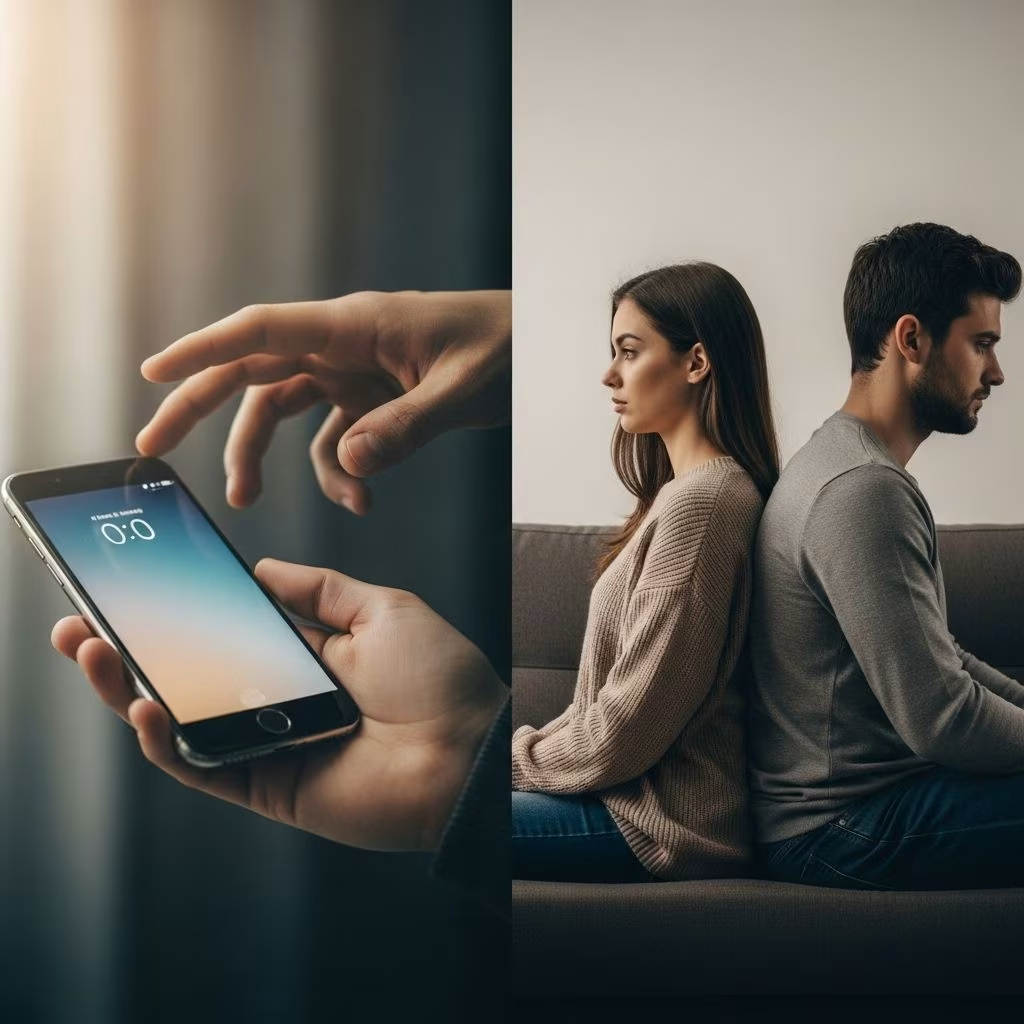
Could Snooping On Your Partner’s Phone End Your Relationship?
Smartphones have become deeply integrated into modern relationships. While they help couples stay connected, they also house a vast trove of private, personal information. This means that the temptation—and risk—of checking a partner’s phone without permission brings new challenges to trust and intimacy. According to recent research, snooping on a partner’s phone can seriously threaten the foundation of many relationships, sometimes even leading to their breakdown.
Key Study: The Effects of Snooping on Relationships
A landmark study conducted by researchers from the University of British Columbia and the University of Lisbon examined how and why people snoop on their partners’ phones, and the impacts of those actions. The research, which collected the experiences of 102 individuals who had either snooped or been snooped on, offers a revealing look at digital privacy and trust between partners.
- Of the 102 participants, 46 shared specific outcomes affecting their relationships.
- An alarming 21 stated that snooping contributed to ending the relationship.
- The remaining 25 maintained the relationship but often under changed circumstances or strained trust.
How Personal Is Your Phone?
Smartphones today act as digital diaries, storing everything from messages and emails to personal photos and contact lists. The study’s authors note that “smartphones can be understood as extensions of self” because of the intimate information they contain. This makes unauthorized access a significant invasion, often felt more deeply than other forms of privacy breach.
Why Do People Snoop on Their Partner’s Phones?
The motivations behind snooping are rarely simple or innocent. The study identified four main reasons why people accessed someone else’s phone without permission:
- To control a partner’s interactions: Many snoopers wanted to monitor or influence who their partner could contact or communicate with.
- Pranks or jokes: Occasionally, people snooped to play harmless jokes, though the impact often wasn’t as light-hearted.
- Convenience: Some accessed devices simply for convenience, like using a contact or checking a message.
- Personal gain: In the most troubling cases, snooping aimed at stealing money or valuable information.
Around two-thirds of reported incidents were motivated by a desire to control, an action that sometimes reflected deeper patterns of emotional abuse.
What Really Happens After Snooping?
When snooping is discovered, the emotional fallout can be swift and severe. Notably:
- Betrayal of trust was the most common reason cited for ending a relationship post-snooping.
- In relationships that survived, some partners rationalized or excused the snooping.
- In a significant number of cases, the act was brushed aside or the victim even blamed themselves, believing they had not been reassuring enough or transparent in the relationship.
According to Dr. Ivan Beschastnikh, a computer science professor and co-author of the study, the damage often comes from the feeling of being betrayed—sometimes more so than any specific private information discovered. In other words, even if nothing incriminating is found, the very act of snooping is a breach that can undermine the entire relationship.
Outcomes Table: Post-Snooping Consequences
| Outcome | Description | Likely Emotional Impact |
|---|---|---|
| Relationship ends | Trust irreparably broken, often coupled with existing issues | Betrayal, resentment, loss |
| Relationship survives | Snooping rationalized or excused, sometimes with lingering distrust | Guilt, anxiety, need for reassurance |
| Continued snooping permitted | Victim gives up privacy for perceived harmony | Insecurity, ongoing tension |
Key Findings From Related Research
Snooping as a Predictor of Breakup
Additional scholarly research corroborates these findings. A study published by researchers at the University of Ilorin found that snooping on a partner’s cell phone is a significant predictor of intention to break up in romantic relationships. The research highlighted that those who engaged in snooping experienced lower relational commitment and increased turbulence—key factors that can lead to relationship dissolution.
- Snooping is tied to low emotional commitment.
- It can lead to relational turbulence: emotional instability, suspicion, and arguments.
- Both low commitment and turbulence predict higher intentions to break up.
The researchers observed: “Cell phone snooping has quite a strong and negative outcome in a romantic relationship because an intention to break up in a relationship indicates that the individuals involved have reached a breaking point.”
Patterns in Who Snoops—and Who Forgives
The original study noted that partners who had previous relationship doubts or experienced prior conflicts were more vulnerable to feeling betrayed by snooping, resulting in a higher probability of breakup. In less serious relationships—or where the bond was weak to begin with—snooping was often the final straw.
Conversely, in relationships with higher levels of forgiveness or codependency, some victims excused the behavior, rationalizing the snooping as stemming from a partner’s insecurity or as a signal to offer reassurance.
Is Snooping Ever Justified?
Relationship and sex therapists, as well as the vast majority of advice columnists, tend to agree: Snooping is rarely justified. Even when partners suspect infidelity or secrecy, bypassing communication in favor of covert surveillance is generally seen as a breach of respect and personal boundaries. The damage often extends far beyond what is discovered—it is the broken trust and sense of violation that lingers.
What If You Find Something Incriminating?
The dynamics get even more complicated if snooping does uncover a betrayal, such as evidence of cheating. While this can validate suspicions, it rarely leads to constructive solutions. The relationship is now burdened both by the initial issue and the privacy breach, making honest, productive conversations far more difficult.
Phones as Extensions of the Self: Why Snooping Hurts
Psychologists and researchers point out that for many, a smartphone is an extension of identity and autonomy. This means unauthorized phone access can feel as violating as reading a partner’s personal diary or eavesdropping on a private therapy session. Snooping undermines:
- Trust: The core of all healthy romantic and platonic relationships.
- Individual autonomy: The right to keep thoughts, communications, and digital artifacts private.
- Sense of security: Feeling safe and respected within a partnership.
When digital boundaries are crossed, even for reasons that seem trivial or justified in the moment, the psychological impact can echo through every facet of the relationship.
Statistics: How Common Is Snooping?
While not every act of snooping leads to a breakup, it is far from rare. Surveys indicate that up to 50% of people admit to checking a partner’s phone or device without consent at least once, often rationalizing it as a way to ‘reassure’ themselves or resolve suspicions.
How Should Couples Handle Digital Boundaries?
If snooping is so damaging, how can couples navigate digital privacy and establish trust? Experts recommend clear communication and the mutual setting of boundaries as early as possible. Key strategies include:
- Open dialogue: Partners should clearly express their comfort levels and boundaries regarding digital privacy.
- Avoid assumptions: Address suspicions directly rather than going behind a partner’s back.
- Build trust incrementally: Trust is an ongoing process, strengthened by transparency and respect for autonomy.
- Set shared guidelines: Couples may agree on what devices, messages, or social media accounts—if any—are appropriate to share or keep private.
If you feel tempted to snoop, consider what underlying issues—like insecurity or lack of trust—might be prompting that impulse. Address those issues together, rather than resorting to covert actions that could permanently compromise the relationship.
Frequently Asked Questions (FAQs)
Q: Is snooping on a partner’s phone always a sign of a troubled relationship?
While not always a symptom of serious problems, snooping nearly always indicates an underlying lack of trust or emotional insecurity. It is strongly associated with relationship dissatisfaction or anxiety.
Q: Can a relationship recover after one partner snoops?
Some couples manage to rebuild trust through honest conversation and setting new boundaries, but research suggests the risk of continued tension or repeat violations remains high. Acknowledging the impact and taking responsibility are crucial steps.
Q: Why do some people forgive or rationalize snooping?
Many factors can contribute to excusing the behavior, including a history of codependency, anxiety about being abandoned, or a belief that the relationship is worth saving despite the breach. Insecure partners, in particular, may blame themselves rather than the snooper.
Q: Are there healthier alternatives to snooping if you suspect issues?
Yes. Experts recommend open, honest communication as well as seeking external support (such as counseling) if trust issues persist. It’s always better to address suspicions directly rather than breach a partner’s privacy.
Q: What motivations are most strongly associated with negative outcomes?
Snooping designed to control or restrict a partner’s autonomy is most likely to damage or end relationships, whereas motives based on curiosity, convenience, or pranking—while still inappropriate—tend to have varied outcomes heavily influenced by the overall strength and openness of the relationship.
Conclusion: Why Digital Respect Matters
The modern relationship is challenged by new forms of connection and vulnerability introduced by technology. Snooping on a partner’s phone—far from being a harmless act—can irreparably harm trust, emotional security, and even the future of the relationship. As smartphones become ever more personal, respecting a partner’s digital privacy is vital to maintaining both intimacy and autonomy.
If you find yourself tempted to snoop, consider what it says about your relationship and whether the answers you seek could be found through honest, open conversation. In the end, respect for privacy may be the most important sign of love in the digital age.
References
- https://www.dpublication.com/wp-content/uploads/2022/08/15-1640.pdf
- https://www.bustle.com/p/could-snooping-on-your-partners-phone-end-your-relationship-a-new-study-says-yes-17941736
- https://www.southampton.ac.uk/news/2025/08/phone-snubbing-more-damaging-to-insecure-partners-study-finds.page
- https://kvia.com/news/2025/08/12/dont-snoop-through-your-partners-phone-learn-to-sleuth-instead/
- https://www.bustle.com/p/is-snooping-in-a-relationship-ever-ok-heres-what-a-sex-therapist-says-18747519
- https://www.psychologytoday.com/us/blog/naked-truth/202508/snooping-to-catch-a-cheating-mate
- https://www.youtube.com/watch?v=_b9OVttHRjQ
- https://www.news4jax.com/video/morning-show/2023/08/18/do-you-snoop-50-of-people-admit-to-snooping-on-their-partners-phone-survey-finds/
- https://www.relateni.org/news-events/couple-advice-how-phone-snubbing-is-impacting-on-our-intimate-relationships/
- https://www.bankmycell.com/blog/snooping-on-your-phone


