


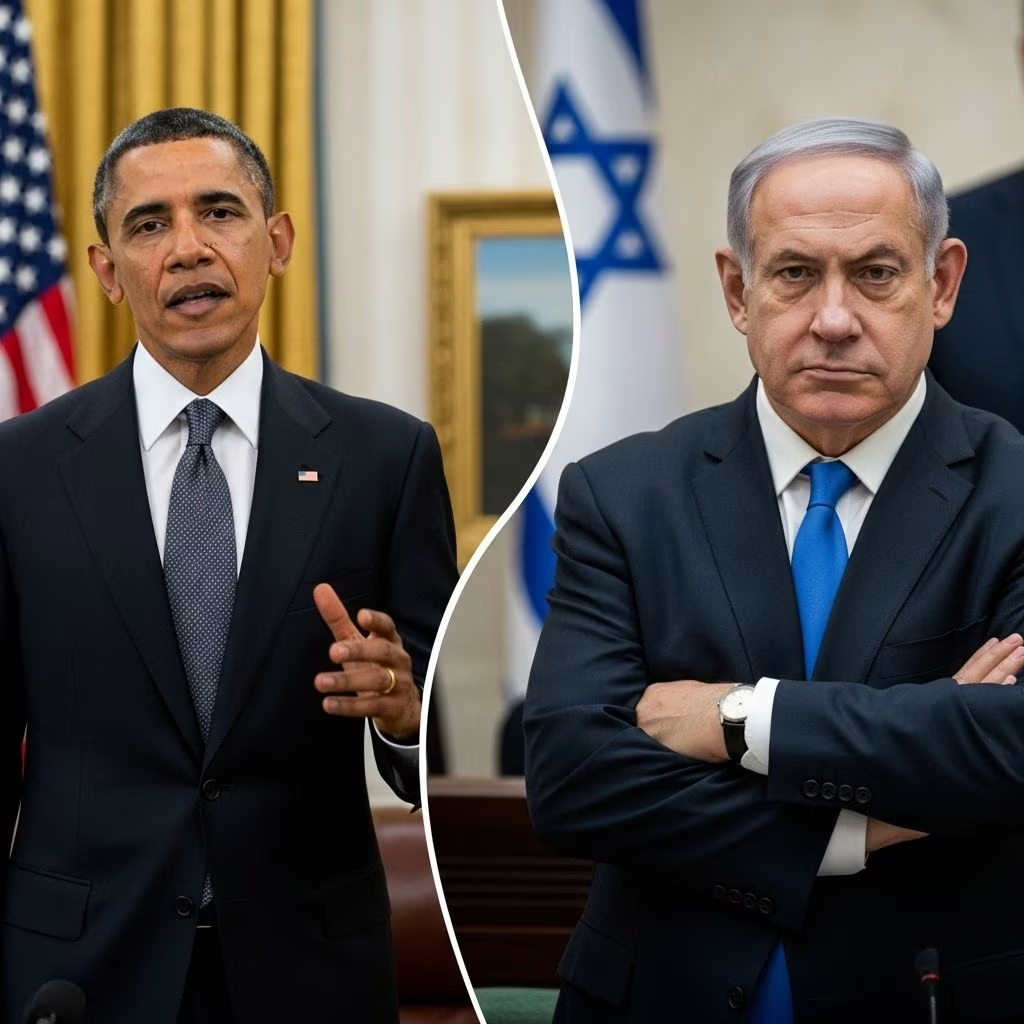
A Timeline of Benjamin Netanyahu and President Obama’s Tumultuous Relationship
The relationship between President Barack Obama and Israeli Prime Minister Benjamin Netanyahu was one of the central dynamics in American foreign policy throughout Obama’s presidency. Marked by recurring tension, public disagreements, and crucial diplomatic turning points, the two leaders’ interactions offer a revealing window into the dilemmas and challenges of U.S.–Israel relations in the 21st century.
Introduction: Allies Divided by Vision
Although the United States and Israel have long been close strategic partners, personal relations between their leaders do matter. Obama and Netanyahu shared functional ties, especially in military cooperation, but fundamentally disagreed on core diplomatic issues: most notably, Israeli settlements in occupied territory and the Iran nuclear issue. Their relationship repeatedly swung from cold professionalism to open confrontation, capturing headlines around the globe.
2009: First Meetings and Early Sparks
- January 2009: Barack Obama is inaugurated as President of the United States, promising a renewed push for Middle East peace and improved U.S. standing globally.
- March 2009: Benjamin Netanyahu returns as Israel’s prime minister after a decade, leading a right-leaning coalition.
- May 2009: Their first meeting at the White House is cordial but reveals underlying tension. Obama issues a strong call for a halt to Israeli settlement expansion, a point Netanyahu receives tersely but noncommittally.
- Obama says: “Settlements have to be stopped in order for us to move forward… I recognize that, but it’s an important one and it has to be addressed.”
The meeting leaves Netanyahu reeling at the bluntness and detail of Obama’s demands, with an aide later describing the experience as an “ambush”. Despite diplomatic pleasantries, the seeds of discord are sown.
2010: Confrontation Over Settlements
- March 2010: During a U.S. visit by Vice President Joe Biden, Israel announces a major new housing project in East Jerusalem, infuriating the Obama administration and halting the peace process.
- Obama and Netanyahu hold a frosty meeting in Washington—press is barred, the leaders meet without usual protocol or photo-ops, and the White House insists on written commitments before any public rapprochement.
- Late 2010: Netanyahu imposes a 10-month freeze on new West Bank settlements—viewed as a reluctant nod to Washington. However, the freeze is not extended after its expiration, drawing rebuke from Obama and the Palestinians alike.
2011: Sharp Differences Laid Bare
The rift deepens in 2011, when Obama calls for peace negotiations using the pre-1967 borders as the basis for a two-state solution, with “mutually agreed swaps.” Netanyahu counters in a passionate White House press conference, bluntly rejecting a full return to 1967 lines or the return of Palestinian refugees, stating:
“Everybody knows it’s not going to happen. And I think it’s time to tell the Palestinians forthrightly, it’s not going to happen.”
Obama calmly replies that differences in phrasing between friends are to be expected, but the public contrast is stark and widely interpreted as humiliating for the administration.
2012: Election-Year Diplomacy and Calculations
- Obama’s reelection campaign and Netanyahu’s own political calculations become intertwined. Netanyahu is perceived by many as favoring Obama’s rival, Mitt Romney, even hosting him warmly during a visit to Israel.
- Despite sensitive events and tough rhetoric, both leaders try to avoid open conflict during U.S. and Israeli election cycles.
2013: Promotion and Routine of Communication
- March 2013: Obama returns to the Middle East, visiting Israel for the first time as President. He receives a warm public welcome, and approval ratings rise briefly in Israel.
- The public charm offensive—highlighting America’s commitment to Israel’s security and the Iron Dome missile defense system—helps cool tensions, but core disagreements on negotiations and Iran persist.
- Obama and Netanyahu develop a routine of regular phone conversations, often mixing personal courtesies and deep policy disagreements. As aides note, their fundamental policy differences remain unchanged despite better personal rapport.
2014: Iran and Gaza—Discord Reignites
- Tensions rise again as the Obama administration intensifies its diplomatic efforts for an Iranian nuclear deal, which Netanyahu fiercely opposes, repeatedly warning against any arrangement that would leave Iran with enrichment capability.
- The 2014 Gaza war strains relations, as U.S. officials criticize the high Palestinian civilian casualty toll and Netanyahu accuses Obama of insufficient understanding of Israel’s security dilemmas.
- Israel’s announcement of more settler housing—just after a high-level U.S.-Israeli meeting—sparks another round of condemnation from Washington.
2015: The Iran Nuclear Deal Showdown
- March 2015: Netanyahu delivers a highly controversial address to the U.S. Congress, arranged without White House coordination, to lobby directly against the imminent Iran nuclear agreement.
- The Obama administration openly criticizes Netanyahu’s speech as destructive to U.S.–Israel ties and highlights the unprecedented nature of Netanyahu’s political intervention on Capitol Hill.
- July 2015: World powers and Iran reach the Joint Comprehensive Plan of Action (JCPOA). Netanyahu calls the deal a “historic mistake”; Obama defends the agreement as the best way to prevent a nuclear-armed Iran.
This period marks perhaps the nadir of the relationship, as both sides stake out irreconcilable public positions.
2016: Final Rift and A Lasting Legacy
- December 2016: The United States, for the first time in decades, abstains rather than vetoes a key United Nations Security Council resolution condemning Israeli settlements. The move allows the resolution to pass, infuriating Netanyahu’s government.
- Netanyahu publicly blames the Obama administration, accusing it of orchestrating the resolution behind the scenes and launching a new era of open diplomatic confrontation.
Despite the unprecedented rift, long-term U.S. military aid to Israel continues, with the signing of a record $38 billion military package in September 2016. The contradiction between strategic partnership and political discord becomes a defining feature of their legacy.
Major Sources of Disagreement
| Issue | Obama’s Stance | Netanyahu’s Stance |
|---|---|---|
| Israeli Settlements | Push for complete halt in expansion to enable peace talks with Palestinians. | Resists full freeze, allows limited moratorium, prioritizes Israeli security and coalition politics. |
| Iran Nuclear Program | Negotiation and multi-lateral diplomacy to limit Iran’s nuclear capacity while relaxing sanctions gradually. | Total opposition to a negotiated deal, seeking complete dismantlement of Iran’s nuclear program and maintained sanctions. |
| Peace Process | Advocates a two-state solution based broadly on pre-1967 borders with swaps. | Resists return to 1967 lines, firm on Israeli security and identity; demands recognition as Jewish state. |
| UN Diplomacy | Occasionally uses U.N. diplomacy to put pressure on Israel or abstains from vetoing resolutions. | Insists U.N. is biased against Israel, expects U.S. to veto anti-Israel resolutions. |
Ten Notable Public Diplomatic Confrontations (Selected Examples)
- Obama’s call for “1967 borders plus swaps” triggers public pushback from Netanyahu at the White House.
- The U.S. harshly criticizes Israeli settlement announcements during Biden’s visit.
- Obama administration breaks with tradition by supporting international nuclear transparency resolutions.
- Netanyahu addresses U.S. Congress without White House approval, attacking nuclear negotiations with Iran.
- U.S. abstains on UNSC resolution condemning Israeli settlements in 2016.
Frequently Asked Questions (FAQs)
Q: Why did Obama and Netanyahu disagree so profoundly on key issues?
A: Their clash revolved around different visions for resolving the Israeli-Palestinian conflict and the best approach toward Iran. Obama consistently supported a negotiated two-state solution and diplomacy with Iran, whereas Netanyahu was skeptical of Palestinian intentions and fiercely opposed the Iran nuclear deal, fearing it left Israel vulnerable.
Q: Did their disagreements affect military and intelligence cooperation between the U.S. and Israel?
A: No, despite political discord, the Obama administration consistently maintained and even expanded military and intelligence cooperation, including the largest-ever U.S. security aid package to Israel.
Q: Was there ever a personal rapprochement between the two leaders?
A: At times, both leaders tried to project warmth and even routine communication, especially during state visits in 2013. However, deep policy differences always overshadowed attempts at personal camaraderie, and aides on both sides admitted that friendship alone could not resolve their strategic disagreements.
Q: How did domestic politics in the U.S. and Israel influence their relationship?
A: Each leader faced political pressures at home. Netanyahu’s coalition dynamics pushed him toward hardline stances, while Obama navigated complex American Jewish and evangelical constituencies as well as Republican opposition. Both leaders exploited the relationship for domestic advantage at various points.
Q: What is the long-term impact of the Obama-Netanyahu relationship?
A: The legacy is one of robust U.S.–Israel ties in security, but growing partisanship and a normalization of diplomatic confrontation. Many analysts argue that their open disagreements shaped how subsequent administrations approached U.S.–Israeli engagement and the broader Middle East peace process.
Conclusion: A Relationship That Shaped an Era
The Obama-Netanyahu years were defined by both strategic cooperation and public discord. Ultimately, their relationship reflected the challenges of balancing two nations’ interests when personalities, politics, and worldviews collide. The echoes of their encounters continue to reverberate in American, Israeli, and regional politics today.
References
- https://abcnews.go.com/Politics/inside-barack-obama-benjamin-netanyahus-strained-relationship/story?id=44414492
- https://highline.huffingtonpost.com/articles/en/bibi-obama/
- https://obamawhitehouse.archives.gov/blog/2013/09/30/president-obama-meets-israeli-prime-minister-netanyahu
- https://imeu.org/resources/key-issues/ten-egregious-israeli-snubs-of-the-obama-administration/243


