


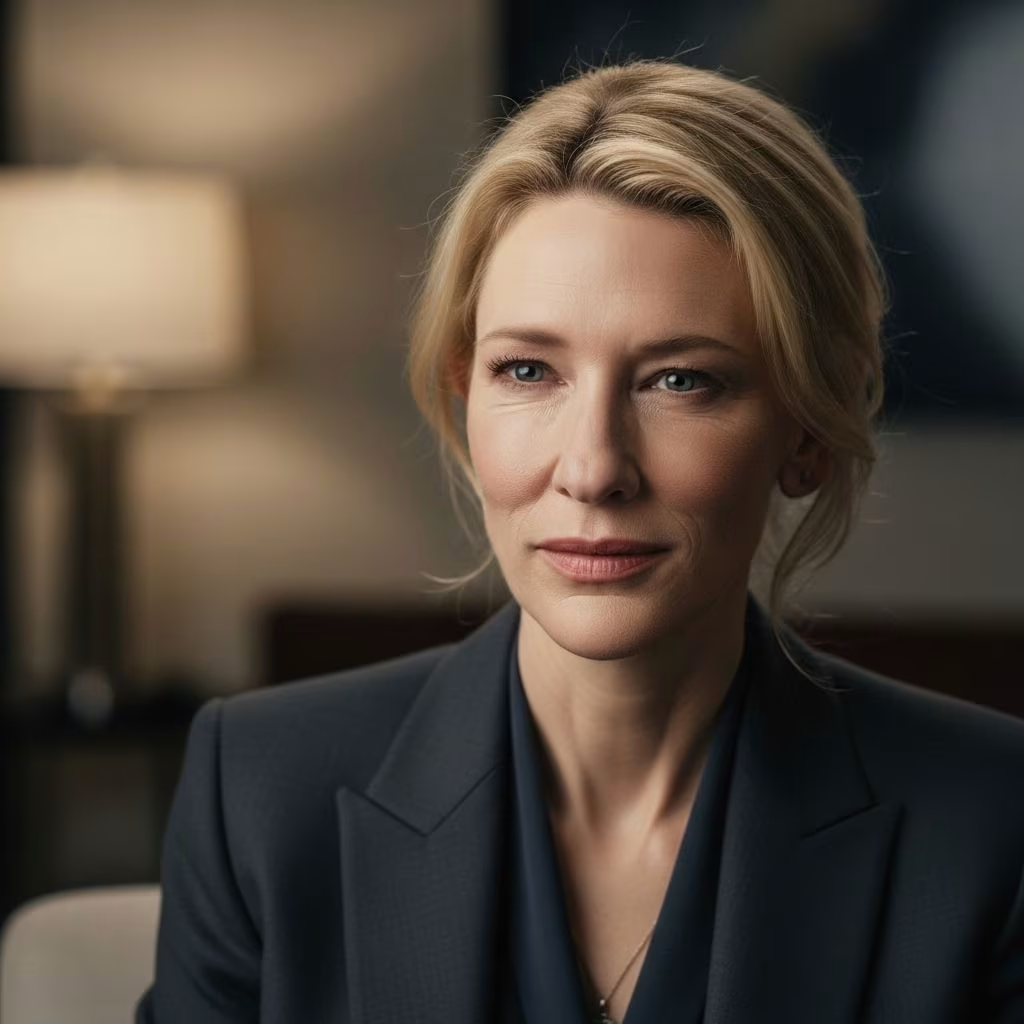
Cate Blanchett Had ‘Many’ Relationships With Women — and Here’s Why That Matters
The entertainment world buzzed in 2015 when Cate Blanchett, the Academy Award-winning actress known for her formidable screen presence, revealed—in an interview promoting her film Carol—that she’d had “many” relationships with women. The revelation, delivered with characteristic offhand elegance, was quietly disruptive. Rather than triggering a furtive apology or a clarifying press release, Blanchett’s matter-of-fact tone left room for nuance and signaled a broader cultural shift in how sexuality, especially bisexuality, is understood in the public eye.
Blanchett’s disclosure didn’t just matter to the queer community—though it certainly resonated there. It also mattered to everyone who believes in privacy, nuance, and the slow dismantling of boxes and categories that have historically defined (and limited) our conversations about identity. Her statement reflected both her own complicated relationship with public scrutiny and the ongoing evolution of Hollywood’s approach to sexuality.
The Revelation in Context
Blanchett made the comment while being interviewed by Variety ahead of the Cannes debut of Carol, a critically acclaimed film in which she portrayed a married woman who falls in love with a younger woman. When asked if this was her first time playing a lesbian, Blanchett replied, “On film — or in real life?”—a playful deflection that suggested there was more to the story. When pressed, she confirmed, “Yes. Many times,” without elaborating further.
Absent from her response was the hand-wringing, qualifying, or apologizing that often accompanies such revelations from public figures, especially women. There was no “But I’m not a lesbian!” or “It was just an experiment.” There was just her, her privacy, and her unruffled candor.
Why Cate Blanchett’s Statement Resonates
1. It’s the Opposite of the “Gasp, No, Not Me!” Response
Blanchett’s answer was remarkable, in part, because of what she didn’t say. Unlike many celebrities who have distanced themselves from queer identities—even after being open about same-sex attraction—Blanchett declined to repudiate or qualify her answer.
For bisexual women in particular, this mattered. Because while some women are asked, “Have you ever been with a woman?” as though experiencing attraction to both men and women is a betrayal of some unarticulated rule, Blanchett’s reply was refreshingly free of caveats. It was a clear departure from the idea that relationships with women are “experimental”—a word often deployed to erase the validity of bisexuality, especially among women who later end up in relationships with men.
2. It Expands the Conversation About Bisexuality
Bisexuality remains one of the most misunderstood sexual identities, both inside and outside LGBTQ circles. Blanchett’s casually dropped revelation was illuminating because it didn’t rely on labels—like “bisexual” or “pansexual”—but simply stated an experience.
For people who identify as bisexual, the very existence of women who have had relationships with both men and women—but who don’t wear a label—is both validating and frustrating. Validating because it affirms the reality of attraction to multiple genders; frustrating because, without visible “allies,” bisexuality can still feel invisible.
3. It Doesn’t Discredit Her Marriage
Blanchett has been married to Andrew Upton, a screenwriter, since 1997. In many narratives, especially outside progressive spaces, a woman’s relationship with a man is seen as “proving” that her attraction to women was a phase or a stunt, and that her “real” orientation is heterosexual.
Blanchett’s long, seemingly successful marriage to a man does nothing to invalidate her past relationships with women. It simply demonstrates what bisexual people have always known: that being attracted to more than one gender doesn’t make a person “greedy,” “confused,” or any less capable of commitment.
4. It’s a Step Forward for Hollywood Representation
In Hollywood, LGBTQ roles are still rare, and authentic LGBTQ actors landing those roles even more so. Blanchett’s willingness to discuss her own experiences in the context of a high-profile, lesbian-themed film was significant. It showed that, even in an industry that often categorizes and commodifies identity, there is a place for subtlety and privacy.
Blanchett’s performance in Carol was widely praised for its emotional depth and nuance—a nuance that was likely informed, in part, by her personal history. While Hollywood still struggles with genuine on-screen representations of bisexuality, Blanchett’s candidness about her own life was an incremental step toward broadening the kinds of stories that get told, and who gets to tell them.
5. It Challenges the Idea That Sexuality Is a Public Commodity
Blanchett is famously private—she has said she never Googles herself and doesn’t watch her own films. Her admission was not part of a calculated PR campaign, nor was it delivered in search of attention. Instead, it appeared almost incidental, a matter-of-fact detail in a larger conversation about her work.
In an era of oversharing, Blanchett’s reserve was itself a statement. It reminded audiences that sexuality is not a headline, nor is it anyone’s business unless someone chooses to share it. For queer people, who are often expected to come out—not just once, but repeatedly—Blanchett’s refusal to perform visibility was a refreshing contrast.
6. It Matters to Queer Women—and Especially Bisexual Women
For queer women—and particularly bisexual women—Blanchett’s comments were more than just trivia. They were a signal, however small, that our experiences are real, even if they don’t fit neatly into categories. They were a reminder that attraction isn’t something to apologize for, qualify, or explain.
As a bisexual woman married to a man, Blanchett’s experience is a common one, but not one often represented in the media. Her willingness to acknowledge her past relationships with women—without apology or qualification—is both radical and mundane, which is what makes it so powerful.
The Broader Impact of Her Statement
Blanchett’s comments did more than briefly trend on social media. They sparked conversations about bisexuality, privacy, and the limitations of labels—conversations that are still ongoing nearly a decade later.
Her refusal to be boxed in, either by Hollywood or by the binary expectations of sexual identity, is a reminder that people are complex, and that there is power in speaking your truth—even if you don’t have all the answers, even if you don’t owe anyone a label.
Sexuality and Privacy: What’s Next?
Blanchett’s revelation is part of a larger trend in which public figures are increasingly open about their sexualities—but not always in the ways we expect. Some come out with a press release; some, like Blanchett, mention it almost in passing, as part of a larger conversation about their art or their lives.
What’s clear is that, as culture evolves, the expectation that everyone must declare their identity—or that those identities must be simple—is shifting. Blanchett’s approach is a reminder that privacy is a right, not a privilege, and that there is more than one way to exist as a queer person in the public eye.
FAQs
What did Cate Blanchett say about her relationships with women?
Cate Blanchett said, in a 2015 interview, that she had had “many” relationships with women. Her statement was delivered without further detail, and she has not expanded on it publicly since.
Is Cate Blanchett bisexual?
Blanchett has not labeled herself as bisexual or any other specific sexual identity. She described having had relationships with women “many times,” but has not used any particular term to describe her sexuality.
Is Cate Blanchett still married to Andrew Upton?
Yes, Blanchett and Andrew Upton have been married since 1997 and have children together.
Why did Cate Blanchett’s statement matter?
Her comments mattered because they represented a rare public validation of bisexuality in Hollywood, challenged stereotypes about attraction and marriage, and highlighted the right to privacy and nuance when discussing personal identity.
Does Cate Blanchett publicly identify as a member of the LGBTQ community?
Blanchett has not publicly identified as a member of the LGBTQ community, nor has she used any specific sexual identity label.
Representation in Media: A Brief Primer
| Entity | On-Screen LGBTQ Characters | Behind-the-Scenes Representation |
|---|---|---|
| Hollywood | Increasing, but still rare | Improving, but LGBTQ creators remain underrepresented |
| Bisexual Characters | Exceptionally rare, often misrepresented or erased | Bisexual writers/directors even less visible |
Key Takeaways
- Blanchett’s revelation was delivered without fanfare or labels, reflecting her privacy and nuance.
- Her marriage to a man does not invalidate her past relationships with women.
- Bisexual people, especially women, often face skepticism and erasure; public statements like Blanchett’s help counter these narratives.
- Blanchett’s approach to sexuality and privacy challenges industry and cultural norms about coming out and public disclosure.
- Representation of bisexuality in Hollywood remains limited, but statements like Blanchett’s are a step toward greater visibility.
Cate Blanchett’s comments about her relationships with women were more than just a Hollywood curiosity—they were a quiet but seismic intervention in conversations about sexuality, privacy, and authenticity. For a generation of queer women—and for everyone who values nuance over neat categories—her words mattered then, and still matter now.
References
- https://www.latimes.com/entertainment/gossip/la-et-mg-cate-blanchett-lesbian-relationships-women-carol-20150513-story.html
- https://m.naharnet.com/stories/en/178734-cate-blanchett-reveals-many-relationships-with-women
- https://afterellen.com/cate-blanchett-relationships-women/
- https://www.bustle.com/articles/82949-cate-blanchett-had-many-relationships-with-women-and-here-are-6-reasons-that-actually-matters
- https://www.youtube.com/watch?v=CSkkbCWW2cw
- https://www.autostraddle.com/sorry-yall-cate-blanchett-didnt-actually-have-many-relationships-with-women-290346/


