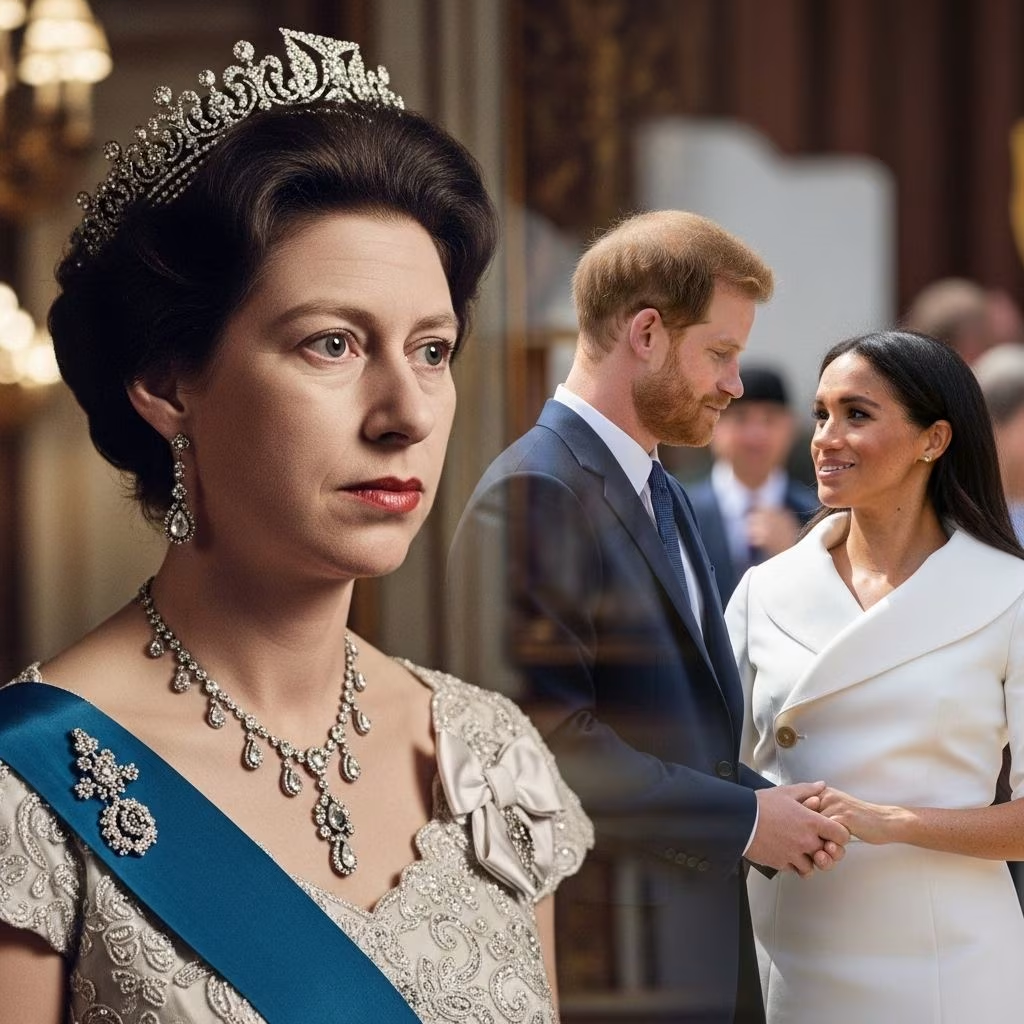
What Princess Margaret’s Royal Dilemma Reveals About Prince Harry & Meghan Markle
As the British monarchy adapts to a changing world, the personal stories of its family members often serve as cultural touchstones. Princess Margaret’s heart-breaking decision to give up love for royal duty and Prince Harry’s decision to follow his desires by marrying Meghan Markle reflect not only their personal values, but also the evolving expectations placed on the royal family. Their choices, decades apart, invite questions about tradition, rebellion, loyalty, and what it means to choose love—or sacrifice it—for the Crown.
Background: Margaret and Harry, The Spares
The British monarchy has long used the informal terms “heir” and “spare” to describe siblings born into royalty. The “heir” is first in line to the throne; the “spare” is born both into privilege and into a role that is fundamentally undefined, often marked by less purpose and greater freedom, yet weighed down by enormous expectation.
Princess Margaret, the younger sister of Queen Elizabeth II, and Prince Harry, the younger son of Charles III and Diana, Princess of Wales, each grew up in the shadows of their elder siblings. This unique royal status impacted their personalities, choices, and their public lives in profound ways.
- Both lived with intense public scrutiny from birth.
- The “spare” experience made them more likely to form their own identities—sometimes in rebellion to royal convention.
- Both, at different times, were seen as the more “unruly” or “rebellious” royal.
- Each found love with partners considered unsuitable by traditional royal standards.
Royal Rebels: The “Spare” Dynamic
Those not destined to rule often become either steadfast supporters of the Crown or persistent challengers to its boundaries. For Margaret and Harry, the “spare” role was a source of both privilege and frustration.
According to royal biographer Andrew Morton:
“Margaret put duty before herself. The wheel turns, 70 years later, and we have another couple having to make a decision: Do they put duty first or their own ambitions and desires first? And they put their own ambitions and desires first. That is the change we have witnessed during the Queen’s reign.”
Margaret and Harry’s shared outsider status contributed to similar patterns:
- Margaret was known for her wit, artistic flair, and rebellious social choices, which often set her at odds with stiff royal protocol.
- Harry experienced a highly publicized “rebellious phase” before carving out a new public identity focused on causes he personally champions.
The tension between royal obligation and personal fulfillment intensified as both found themselves drawn to unconventional romantic partners, positioning their love lives at the center of national—and, in the case of Harry, global—debate.
Forbidden Love: Margaret, Townsend, and Royal Rules
In the 1950s, Princess Margaret fell deeply in love with Group Captain Peter Townsend, a Royal Air Force officer and divorcé. Their romance, immortalized in both popular history and the dramatization “The Crown,” quickly drew controversy.
- Townsend’s divorced status made him an unacceptable match for a royal by the standards of the time, rooted in both the Church of England’s reluctance to recognize remarriage after divorce and strict royal family expectations.
- Margaret could have married Townsend only by renouncing her rights to the throne and, by implication, giving up much of her royal life.
Her public statement, broadcast on the BBC on October 31, 1955, outlined her sacrifice:
“I have been aware that, subject to my renouncing my rights of succession, it might have been possible for me to contract a civil marriage … But, mindful of the Church’s teaching that Christian marriage is indissoluble, and conscious of my duty to the Commonwealth, I have resolved to put these considerations before any others.”
Margaret’s choice to break off her engagement—and remain a royal—came to symbolize the tension between personal happiness and the demands of monarchy.
A Modern Shift: Harry, Meghan, and Breaking the Mold
More than sixty years later, Prince Harry faced a decision that in some ways mirrored Margaret’s. When he fell in love with Meghan Markle—an American actress, a divorcée, and a biracial woman—he encountered resistance from both the institution and the wider British public. Yet unlike his great-aunt, Harry ultimately chose love over tradition by stepping down as a senior royal, taking his new family to North America and charting an independent path.
- Meghan Markle’s background challenged many unspoken royal conventions; her presence was historic on multiple fronts, from race to profession and nationality.
- Harry and Meghan’s decision to “step back” from royal life, rather than sacrifice their relationship, represents a new precedent in royal history.
This break with tradition highlighted how the cultural landscape—and the monarchy itself—has gradually shifted.
| Aspect | Princess Margaret | Prince Harry |
|---|---|---|
| Partner | Peter Townsend (divorced commoner) | Meghan Markle (divorced, biracial, actress) |
| Royal Response | Engagement forbidden; required to give up royal status to marry | Scrutiny, pressure to conform; ultimately stepped down independently |
| Outcome | Broke off engagement, chose royal duty over love | Chose relationship and family, gave up royal role |
The “Heir and Spare” Dynamics in Two Generations
The relationship between the “heir” and the “spare” is often one of both alliance and rivalry. The parallels run through both generations:
- Queen Elizabeth and Princess Margaret were seen as the dutiful monarch and the artistic, sometimes controversial younger sister. Despite public perceptions, their relationship was marked more by loyalty than rivalry, as described by Margaret’s lady-in-waiting.
- Prince William and Prince Harry similarly represent different responses to royal expectation—William embodying tradition, Harry pushing boundaries.
This “heir/spare” contrast is not simply about personalities but about the roles sustained by and reflected in a centuries-old institution.
- Both younger siblings have at times been the face of royal modernization or controversy.
- Both have been compared unfavorably to their heirs in terms of duty and decorum, despite deep personal loyalty.
Duty Versus Desire: The Generational Gap
The tempest faced by Margaret and Harry underscores a generational change in how duty and desire are balanced inside the royal family:
- Margaret’s era demanded total adherence to duty, faith, and precedent. Her personal unhappiness was publicly subsumed beneath her loyalty to the monarchy.
- Harry’s choice to step away from royal duties for personal fulfillment—following his own desires and ambitions—reflects shifting cultural norms about self-fulfillment and personal boundaries within elite institutions.
This generational gap is reflected in the public discourse around Harry and Meghan’s decision:
“That is the change we have witnessed during the Queen’s reign.”
Parallels and Contrasts: Margaret, Diana, and Meghan
In his own memoir, Harry draws unconventional parallels between Princess Margaret and his mother, Princess Diana—both women he described as “rebels, both labeled as sirens.”
Some key similarities and differences:
- Both Margaret and Diana broke with royal expectations through their relationships and the choices they made in private life.
- Margaret and Diana’s relationships with the Crown involved public heartbreak and often tabloid-fueled judgment.
- Meghan Markle now draws similar comparisons, facing intense media attention and struggles over her role in (and outside) the monarchy.
Though Diana and Margaret’s relationship was fraught—Margaret called Diana “the girl who married my nephew”—their public roles as outsiders, and subjects of intense scrutiny, echo in Meghan’s royal experience.
Impact on the Monarchy
The disparate paths taken by Margaret and Harry have rippled throughout the monarchy and wider society. Their stories collectively challenge the notion that royalty is an unchanging institution.
- Margaret’s sacrifice reaffirmed the absolute demands of duty—at the cost of personal fulfillment.
- Harry’s break redefined what it means to be royal in the modern world—prioritizing individual happiness and autonomy.
- Their stories prompt ongoing conversations about the relevance, adaptability, and very humanity of the monarchy in an era of rapid cultural change.
The monarchy’s gradual willingness to accommodate personal happiness over rigid tradition reflects broader societal shifts, even as each new generation faces its own particular set of challenges and judgments.
Frequently Asked Questions (FAQs)
Q: Did Princess Margaret regret choosing royal duty over her love for Peter Townsend?
A: Princess Margaret never publicly stated she regretted her decision, though many biographers and historians have suggested her later-life struggles with unhappiness and health were at least partly related to this early sacrifice for royal obligations.
Q: In what ways did Harry’s actions differ from Margaret’s?
A: Unlike Margaret—who sacrificed her personal relationship to remain within royal expectations—Harry chose to leave his formal royal duties in order to pursue his love and build a new, more independent life with Meghan Markle. This reflects a significant cultural and generational shift.
Q: Was there tension between Princess Margaret and Queen Elizabeth similar to that between Harry and William?
A: While public perception has often painted Margaret and Elizabeth as rivals, contemporaries and Margaret’s lady-in-waiting insist their relationship was characterized more by loyalty than by visible rivalry. The dynamic between Harry and William has been considerably more public and scrutinized.
Q: Did Princess Margaret interact much with Prince Harry?
A: According to Prince Harry, he knew Margaret only distantly, calling her “Aunt Margo,” and described their relationship as polite but not especially close.
Q: How has the monarchy been influenced by these two stories?
A: The contrasting experiences of Margaret and Harry have challenged centuries of expectation, gradually opening the door for greater flexibility and personal fulfillment within royal life. Their stories highlight enduring debates about duty, love, and the future of the monarchy.
References
- https://www.marieclaire.com/celebrity/a36022852/princess-margaret-gave-up-love-for-royal-life-prince-harry-didnt/
- https://www.thelist.com/1245265/prince-harry-princess-margaret-all-the-details-about-their-relationship/
- https://www.townandcountrymag.com/society/tradition/a42558983/prince-harry-princess-margaret-comparison-spare/