


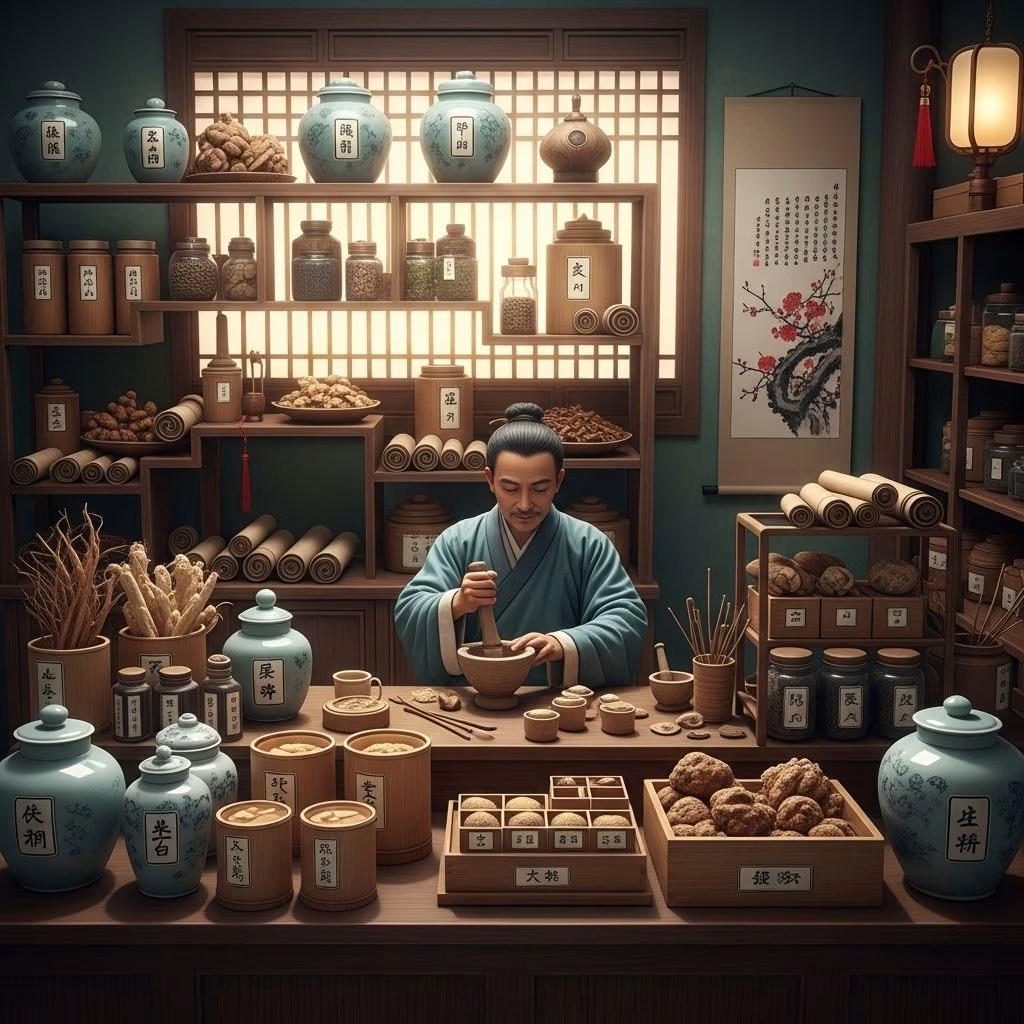
Know Your Remedies: Pharmacy and Culture in Early Modern China
Know Your Remedies examines the profound transformation of pharmacy in early modern China, tracing its evolution from the sixteenth to the eighteenth centuries. This period saw pharmacy become a focal point of culture, commerce, and intellectual inquiry, enabling new approaches to medicine and the natural world. Through this lens, the book reveals pharmacy’s dynamic interplay between elite and popular culture and challenges the narrative of Chinese pharmacy as intellectually stagnant or static over time.
Overview: Pharmacy as a Cultural Lens
Pharmacy in China resisted easy characterization, acting both as a commercial enterprise and as a branch of classical medicine. The tradition of compiling bencao (pharmacopeias) under imperial patronage faded after the sixteenth century, but Chinese pharmacy’s significance endured, as evidenced by its global presence today. Know Your Remedies explores how pharmacy became a terrain for knowledge creation, trade, and social transformation during China’s early modern era.
- Commercial expansion: Pharmacy shops proliferated in urban centers, fueled by long-distance trade and urbanization.
- Intellectual shifts: Debates over bencao and pharmacological knowledge reflected changing attitudes toward science and state power.
- Elite vs. popular culture: Literati and commoners alike contributed to the collection and dissemination of remedies, with shifting boundaries between “official” and “folk” knowledge.
Universalism and Territoriality: The Origins of Pharmacopeia
Pharmacy’s roots in China are deeply entwined with state-sponsored knowledge production. During the Tang and Song dynasties, the compilation of state-commissioned pharmacopeias established a universalistic tradition: the idea that medicine and pharmacy should serve the health of all under the empire. These standardized texts bore broad implications for knowledge, governance, and the mapping of the natural world.
- Bencao (materia medica): Imperially backed works that aimed to catalogue, standardize, and authenticate medicines drawn from the whole of the known world.
- Integration of local remedies: These efforts incorporated folk knowledge from diverse regions, balancing imperial authority with local specificity.
The State’s Role and Legacy
Although state-commissioned bencao declined in influence after the sixteenth century, their legacy persisted—providing a backdrop for later transformations. The state’s attempt to universalize medical knowledge left ongoing tensions between centralizing and decentralizing cultural forces.
Bencao and the Periodization of Chinese Science
The history of bencao played a crucial part in the periodization of Chinese scientific development. Earlier scholarship often struggled to explain why the state-centered tradition of pharmaceutical documentation diminished, framing later periods as marked by intellectual decline or the triumph of unchanging folk practices. Know Your Remedies argues instead for a nuanced approach: pharmacy’s evolution reflects an inclusive, dynamic category of knowledge, shaped by changing social, political, and market conditions.
- Discontinuity and change: The shift away from state-centric bencao was not a rupture but a transformation—an embrace of new ways to investigate and circulate remedies.
- Inclusive knowledge: Pharmacy in early modern China comprised empirical experimentation, literary scholarship, oral traditions, and commercial practice.
The Ming-Qing Transition: A History of Knowledge
China’s transition from the Ming (1368–1644) to the Qing dynasty (1644–1912) is analyzed through three central themes:
- Decentralization and book culture (16th century): Widespread private publishing broke the state’s monopoly on medical texts, allowing knowledge to flow more freely and reach broader audiences.
- Factional politics and literati amateurism (early 17th century): Scholarly debate and experimentation flourished, particularly among the literati, as intellectual independence grew.
- Reclassification and natural history (18th century): The Qing state moved away from medicalized frameworks and toward a broader, demedicalized natural history, setting the stage for new scientific developments.
The Sixteenth Century: Reconstituting the Center
The sixteenth century marked a turning point for pharmacy in China. This period was characterized by:
- Declining imperial control: Fiscal pressures and administrative challenges weakened the state’s direct involvement in pharmacy and related trades.
- Decentralization of publishing: Privately printed medical texts—often focused on local or regional remedies—multiplied, contributing to a richer, more diverse knowledge landscape.
- Expansion of commerce: The rise of urban centers and the growth of long-distance trade networks enabled pharmacy shops to flourish, leading to greater circulation of medicines and ideas.
This era saw the pharmacy trade shift from being regulated primarily by the state to being shaped by market forces and civil society. Pharmacists and medical shop owners became important agents of expertise and innovation.
The Seventeenth Century: Literati Amateurism and Its Discontent
By the seventeenth century, an era of remarkable intellectual dynamism had emerged. Several important trends characterize this period:
- Literate investigation: The literati (scholar-officials) engaged in widespread amateur pharmacological inquiry—documenting, experimenting with, and circulating new remedies.
- Public discourse and critique: Debates over medical efficacy, authenticity, and the value of classical knowledge became heated in public forums, driven by factional politics and a critical reading culture.
- Epistemic uncertainty: The rapid expansion of knowledge also produced uncertainty and skepticism—disputes over what counted as reliable information abounded, especially as traditional authorities fractured.
The result was a landscape in which expertise was contested and diversified, with pharmacy drawing from a heterogeneous array of sources: scholarly treatises, marketplace experiences, and popular traditions intermingled freely.
The Eighteenth Century: A Triangle of Knowledge, Wealth, and Power
The eighteenth century brought a new order to the world of Chinese pharmacy. Under the Qing dynasty, the state undertook a systematic reclassification of knowledge—moving away from an explicitly medical focus and toward a broader conception of natural history. This transformation occurred alongside:
- Urban wealth: The proliferation of commercial pharmacy shops created new forms of social stature and expertise tied to economic capital.
- Imperial priorities: The Qing court favored endeavors that mapped and categorized the natural world without necessarily focusing on medicinal uses, signaling a move away from earlier bencao traditions.
- Global circulation: International trade and cultural exchange brought new substances and ideas into the Chinese pharmacopeia, further complicating traditional classifications.
This triangle—knowledge, wealth, and power—structured the world of pharmacy in the eighteenth century, shaping who could produce and access expertise.
Urban Pharmacy Shops: Commerce Meets Culture
Urban pharmacies became critical sites for the creation and circulation of pharmaceutical knowledge. Their rise was made possible by:
- Increased long-distance trade, bringing exotic substances and broadening access to new remedies.
- The professionalization of pharmaceutical expertise, as shopkeepers and pharmacists claimed new forms of authority.
- Consumer culture among urban populations, demanding effective and novel treatments.
These shops were not just commercial hubs, but also centers for the exchange of ideas, laying the groundwork for modern pharmaceutical practice in China and abroad.
Key Themes and Contributions
Know Your Remedies makes several critical contributions to our understanding of Chinese history and medical science:
- Redefining “traditional” medicine: Traditional Chinese Medicine is shown to be vibrant, innovative, and adaptable—not merely static or resistant to change.
- Challenging decline narratives: The book refutes notions of post-sixteenth-century intellectual stagnation, highlighting continuous evolution.
- Interplay of elite and popular cultures: Both scholarly and common traditions are credited in the expansion and diversification of pharmaceutical knowledge.
- Commercialization and knowledge production: The growth of the pharmacy trade shaped and was shaped by emerging forms of expertise, commerce, and sociopolitical power.
Ultimately, the history of pharmacy in early modern China is presented as a dynamic story of innovation, adaptation, and cultural transformation.
Frequently Asked Questions (FAQ)
Q: What is the significance of bencao in Chinese medical history?
A: Bencao refers to imperial pharmacopeias that catalogued medicinal substances and embodied the attempt to standardize pharmacy knowledge across the empire. They played a central role in shaping early state medicine and intellectual culture.
Q: How did the role of the state in pharmacy change from the Tang to the Qing?
A: In earlier periods, the state took a direct role in commissioning and standardizing pharmacopeias. Over time—especially after the sixteenth century—the state’s influence waned, with private actors and commercial forces becoming more central in knowledge production and distribution.
Q: How did urban pharmacy shops contribute to the evolution of Chinese medicine?
A: Urban pharmacy shops were hubs of commerce, innovation, and expertise. They facilitated the wider circulation of remedies, popularized new treatments, and nurtured forms of professional authority independent of state control.
Q: In what ways did pharmacy reflect broader trends in early modern Chinese society?
A: Pharmacy encapsulated major themes of knowledge decentralization, commercialization, and the interplay between elite and popular cultures. It mirrored and influenced shifts in politics, economics, and social norms across Ming and Qing China.
Table: Timeline of Key Developments in Pharmacy (1500–1800)
| Period | Key Developments | Social/Political Context |
|---|---|---|
| 16th Century | Decline of state-commissioned pharmacopeias; rise of private publishing; growth of urban pharmacy shops | Decentralizing trends in book culture, weakening state fiscal authority |
| Early 17th Century | Peak of literati interest and amateur investigation in pharmacology | Factional politics, intellectual diversification, increased public discourse |
| Mid-Late 17th Century | Knowledge uncertainty; disputes over efficacy and authenticity | Qing conquest, societal upheaval, transformation of authority |
| 18th Century | Systematic reclassification of knowledge; focus on natural history; further expansion of trade and pharmacy shops | Growth of urban wealth, changing imperial priorities, global connections |
Conclusion: Lessons from Early Modern Chinese Pharmacy
Tracing the history of pharmacy in early modern China reveals how medicines and their trade served as catalysts for cultural, intellectual, and economic change. Far from being a static tradition, pharmacy adapted to evolving circumstances—empowering new forms of expertise, supporting commercial expansion, and influencing the trajectory of medical science both within China and globally. Today, the enduring vitality of Traditional Chinese Medicine highlights the significance of this historical legacy.
References
- https://eas.princeton.edu/Know-Your-Remedies-Pharmacy-and-Culture-in-Early-Modern-China
- https://www.goodreads.com/book/show/51801196-know-your-remedies
- https://www.jstor.org/stable/j.ctvr0qrfn
- https://newbooksnetwork.com/he-bian-know-your-remedies-pharmacy-and-culture-in-early-modern-china-princeton-up-2020
- https://bshm.org.uk/wp-content/uploads/2020/05/Know-Your-Remedies.pdf
- https://www.cambridge.org/core/journals/journal-of-asian-studies/article/know-your-remedies-pharmacy-and-culture-in-early-modern-china-by-he-bian-princeton-nj-princeton-university-press-2020-xiv-264-pp-isbn-9780691179049-cloth/FBB7FE7B589528F569250A67A1FCE816
- https://www.universitypressscholarship.com/view/10.23943/princeton/9780691179049.001.0001/upso-9780691179049-chapter-001


