


Abortion in Colonial America: Herbal Remedies, Law, and Everyday Realities
Centuries before the modern debate over reproductive rights, abortion was an accepted — if often discreet — aspect of life in colonial America. Through the story of Sarah Grosvenor and detailed academic research, the realities of early American abortion practices reveal themselves: a blend of indigenous knowledge, herbal medicine, and shifting legal and social attitudes. This article explores the complexities of abortion in colonial society, the changing laws surrounding it, and the lingering impact on women’s choices long before the United States Constitution was signed.
The Story of Sarah Grosvenor: A Colonial Case Study
Sarah Grosvenor’s experience in 1742 Pomfret, Connecticut, stands as one of the best-documented examples of abortion in colonial America. Grosvenor, a teenager from a prominent local family, became pregnant in the spring of 1742. Following a common path for women of her time, she began ‘taking the trade’ — a euphemism for using herbal abortifacients — with the guidance and encouragement of her lover, Amasa Sessions. These methods were typically initiated prior to the stage of quickening — the first noticeable fetal movements, generally occurring around 16–20 weeks of pregnancy.
When months of herbal remedies failed, Grosvenor reluctantly sought the help of a local doctor, who performed a manual abortion in August. She miscarried days later, developed an infection likely due to non-sterile conditions, and died on September 14, 1742. Though tragic, her actions — and the responses of those around her — reveal the accepted norms and practical realities surrounding early abortion at the time.
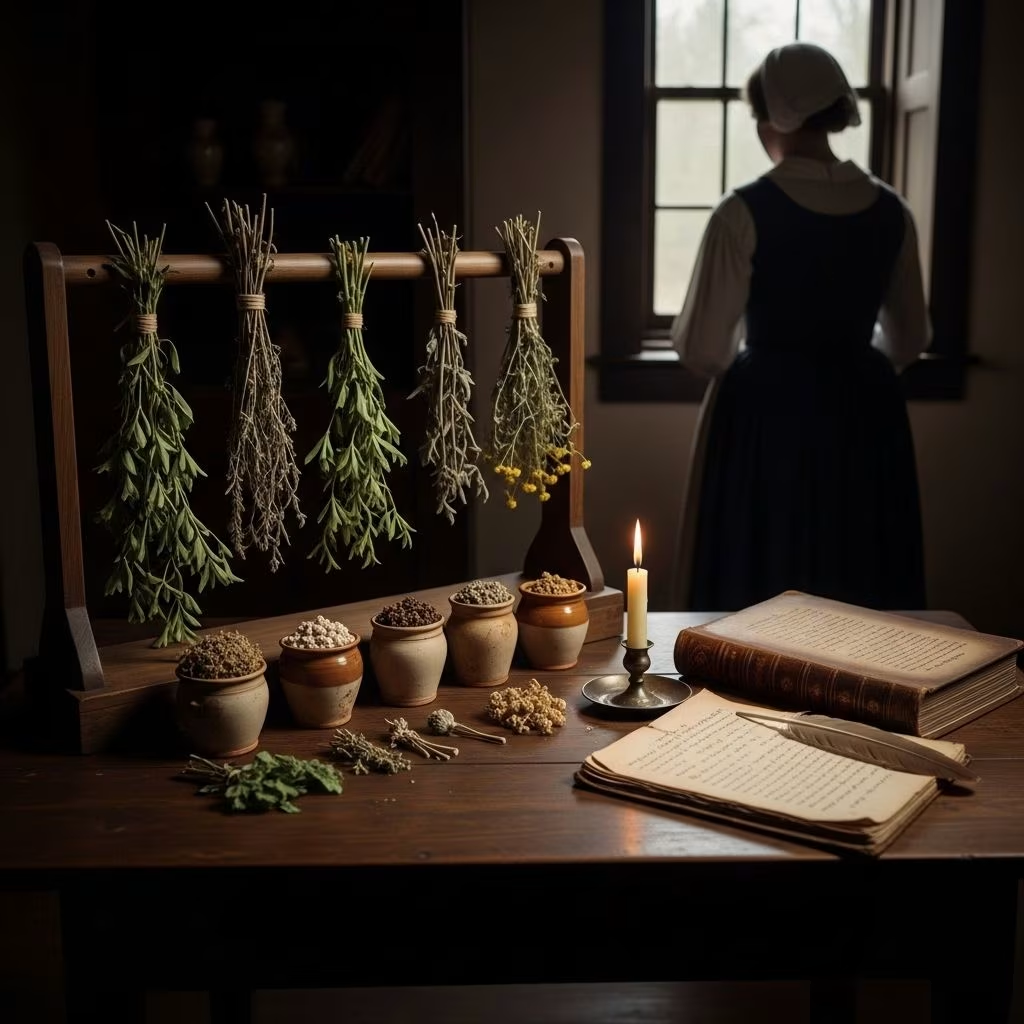
- Herbal abortifacients like tansy, pennyroyal, and savin were common and widely cultivated by New England women, often as part of a collective wisdom exchanged between women.
- Early abortions were primarily considered a morality issue, not a criminal matter, especially before quickening.
- Enforcement of abortion law was rare, with most regulation arising much later in American history.
Why Hide the Pregnancy?
Despite abortion’s social acceptance before quickening, secrecy often surrounded such actions, especially among the prominent families of towns like Pomfret. Women like Sarah and their partners sometimes took great pains to conceal pregnancies and abortions, reflecting the complex interplay of family reputation, social standing, and gender expectations.
Herbal Remedies and Indigenous Knowledge
Abortifacient herbs and plants were central to early American abortion practices. This knowledge often originated with Indigenous communities and was shared — formally or informally — with European settlers.
- Ethnologists and historians argue that Native women were highly skilled in birth control, using plant-based abortifacients for both family planning and birth spacing.
- Prominent herbs included black root, cedar root, tansy, pennyroyal, and savin.
- According to research by UConn historian Nancy Shoemaker, ‘the most common form of limiting births available to Indian women was abortion achieved with the use of plant abortifacients or pressure applied to the woman’s abdomen.’
- Indigenous women’s practices influenced settler women, although the direct, traceable pathways of this knowledge exchange often remain obscured by time.
The use of abortifacients in colonial America underscores women’s agency in managing their reproductive lives. It also highlights the central role of female knowledge — passed between women — in an era before modern medicine or formal family planning.
Herbal Abortifacients: Common Plants and Their Uses
| Plant Name | Use | Common Region |
|---|---|---|
| Tansy | Induced early miscarriage; menstrual regulation | New England |
| Pennyroyal | Encouraged uterine contractions | Widespread |
| Savin | Strong abortifacient; also toxic | Europe and North America |
| Black Root | Used among Native American and Black women | Eastern North America |
| Cedar Root | Induced miscarriage by ingestion or pressure | Eastern Woodlands |
The Cultural and Legal Context of Colonial Abortion
Legal attitudes toward abortion in colonial America were markedly different from those of the 19th and 20th centuries. In most British colonies, abortion was generally not prosecuted if performed before quickening. It was widely seen as a private matter, primarily under the purview of women’s moral choices and bodily autonomy.
- Pre-quickening abortion (before fetal movement) was not considered a criminal offense per English common law and, later, in colonial statutes.
- After quickening, attitudes shifted, viewing the fetus as possessing moral — and sometimes legal — significance. Legal cases rarely resulted in prosecution, especially when abortions occurred early in pregnancy.
- French and Spanish colonies had different approaches: abortions were more often technically illegal, but enforcement varied and many women still managed to obtain them clandestinely.
This legal framework persisted until the early and mid-19th century, when states began to formally criminalize abortion at all stages, culminating in restrictive laws across most of the United States by 1900.
Race, Slavery, and Reproductive Autonomy
The situation was starkly different for enslaved women. Slave owners — especially in the American South — controlled the reproductive choices of enslaved women for economic reasons, forbidding abortion and even punishing suspected attempts at birth control.
- Slave women were subject to owners’ decisions; they were actively encouraged, even coerced, to bear as many children as possible.
- The reproductive autonomy available to free women was completely denied to those living in bondage until the abolition of slavery.
The Rare Court Case: The Aftermath for Sarah Grosvenor
Sarah Grosvenor’s death led to one of the rare court trials related to abortion in colonial America. In November 1745, arrest warrants were issued for physician John Hallowell, Amasa Sessions, and two of Sarah’s female relatives. These charges were based not on the abortion itself (which had been carried out prior to quickening and with little legal precedent for prosecution), but on the tragic result: Sarah and her baby’s deaths following the procedure.
- Prosecution in this case was so unusual that the colonial attorney seemed uncertain of how to proceed.
- Charges against Sarah’s female relatives were eventually dropped, with some historians suggesting the threat of prosecution was leveraged to secure their cooperation as witnesses.
- The grand jury determined there was insufficient evidence to indict Amasa Sessions, who would go on to lead an unremarkable life and was buried near Sarah in Pomfret.
Abortion: Morality, Secrecy, and Everyday Practice
To colonial Americans, regulating one’s menstrual cycle and ending a pregnancy before quickening were pragmatic actions, guided by practicality and community norms rather than fear of the law. The cultural evidence indicates that abortion, especially early on, was an ordinary if emotionally complex choice, far from today’s legal controversies.
- Women shared knowledge and supported each other in both practical and social ways.
- Community reputations, family secrecy, and local attitudes helped shape the reality of pregnancy and abortion in the absence of formal legal prohibition.
- The criminalization and deep moralization of abortion only began in earnest in the mid-19th century, shaped by new legal, social, and medical interests.
Comparative Table: Colonial vs. 19th-Century Abortion Laws
| Period | Legal Status | Common Practices | Enforcement |
|---|---|---|---|
| Colonial America (pre-1800) | Generally legal before quickening | Herbal abortifacients, manual abortion | Rarely prosecuted |
| Early 1800s | Increasingly seen as a moral issue; some colonial and tribal bans | Continued herbal use, some procedural abortions | Selective enforcement, rare prosecution |
| Mid- to Late-1800s | State-by-state criminalization | Underground services | Increasing prosecution, stronger enforcement |
Frequently Asked Questions (FAQs)
Q: Was abortion common in colonial America?
A: Yes, especially before the stage of quickening, abortion through herbal remedies or other means was a practiced, if discreet, part of women’s health. It was regulated more by social norms than by law in most British colonies.
Q: Were there any legal consequences for abortion before the 19th century?
A: Legal prosecution for abortion before quickening was extremely rare in colonial America. Enforcement focused mostly on abortion after quickening, and even then, legal action was inconsistent and uncommon.
Q: How did enslaved women experience reproductive control?
A: Enslaved women were denied bodily autonomy; slave owners forbade abortion or contraception, as enslaved children increased owners’ wealth. This harsh reality lasted until slavery ended.
Q: What role did Indigenous women play in knowledge of abortion?
A: Indigenous women were recognized for their expertise in birth control and the use of plant-based abortifacients. Some of this knowledge was passed to European settlers and became a foundation for colonial women’s practices.
Q: When did abortion become illegal in the United States?
A: Widely enforced criminalization of abortion began in the mid- to late-19th century. Before that, in most states, abortion was not clearly outlawed if performed before quickening; comprehensive bans grew stronger after 1860.
Conclusion: Reassessing the History of Abortion in Colonial America
The history of abortion in colonial America dismantles simplistic narratives of blanket prohibition and criminality. For women of the era, choices about reproduction reflected a mix of indigenous expertise, herbal knowledge, social networks, and shifting — but often permissive — legal attitudes. The tragic story of Sarah Grosvenor, coupled with decades of documented evidence, illuminates a past in which women sought and often secured control over their reproductive destinies — a reality far removed from modern assumptions about the colonial past.
References
- https://today.uconn.edu/2022/08/abortion-in-colonial-america-a-time-of-herbal-remedies-and-accepted-actions/
- https://pubmed.ncbi.nlm.nih.gov/10297561/
- https://www.huntington.org/verso/abortion-american-history
- https://en.wikipedia.org/wiki/History_of_abortion
- https://magazine.publichealth.jhu.edu/2022/brief-history-abortion-us


