The Best Laser Levels for Every Project and Budget in 2025
Laser levels have become essential tools in construction, home improvement, and precise DIY projects. Whether you’re hanging shelves, tiling a floor, or aligning framing on a jobsite, a laser level delivers accuracy and efficiency that traditional spirit levels simply can’t match. With diverse options on the market—from self-leveling cross-line lasers to advanced multi-plane green lasers—choosing the best model for your needs can be confusing. This comprehensive guide breaks down the top laser levels of 2025, key buying considerations, and expert advice for each scenario.
Why a Laser Level Matters
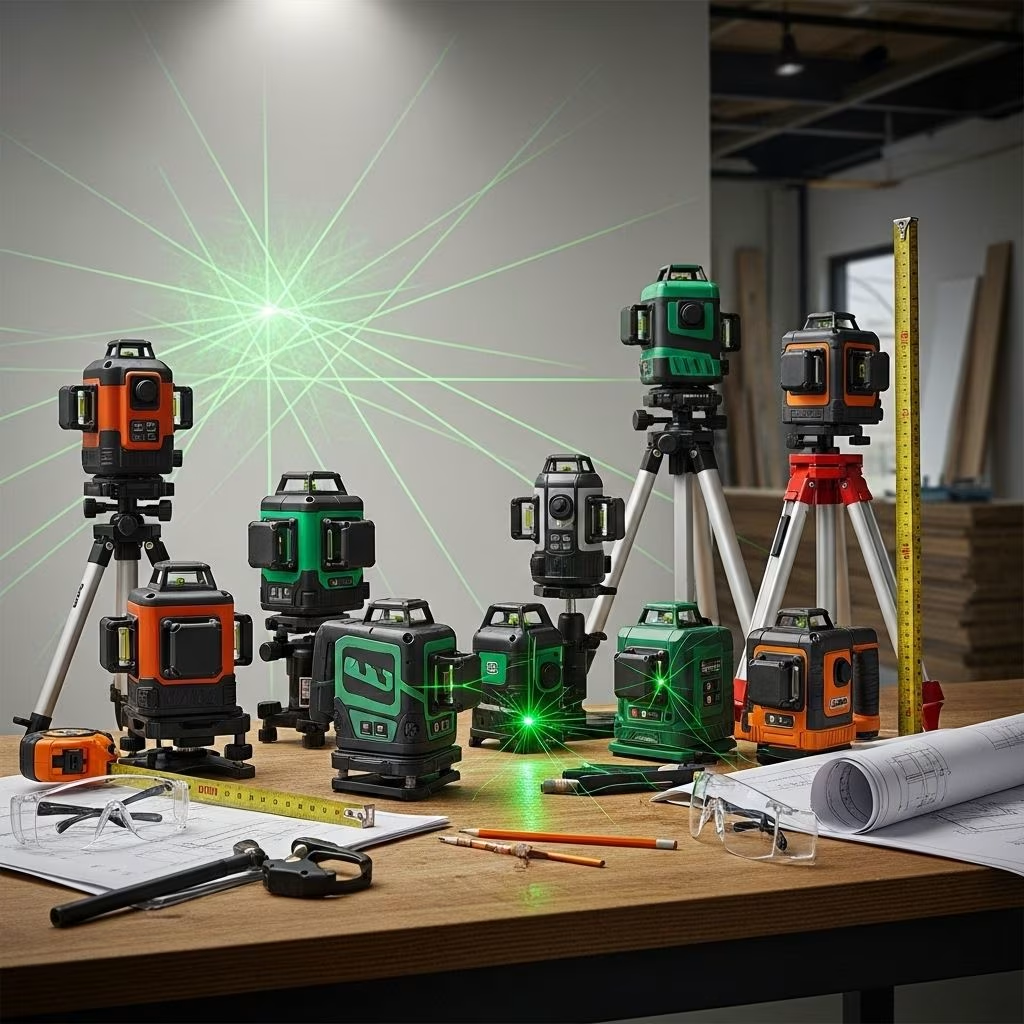
Laser levels project straight, highly visible lines onto flat surfaces, enabling exact alignment over longer distances and multi-surface projects. Modern units offer features including:
- Self-leveling: Ensures accuracy without manual adjustments.
- Multiple laser orientations: Horizontal, vertical, and 360-degree planes.
- Green vs. red lasers: Green lasers are generally more visible, especially under bright lighting.
- Enhanced durability: Designed to withstand the rigors of construction sites.
- Bluetooth connectivity: For remote adjustment and monitoring on high-end models.
Top Laser Level Picks for 2025
Below are the highest-rated laser levels across key categories, including options for every budget and skill level.
Best Overall: DeWalt DW088K 3-Beam Line Laser Level
The DeWalt DW088K is the top performer for a wide range of users, prized for its blend of ease of use, accuracy, and robust construction. Its setup is quick with a self-leveling mechanism, and it projects one horizontal and two vertical red laser beams—ideal for squaring and leveling tasks.
- Accuracy: Within 1/8-inch at 30 feet
- Beam type: Red, 1 horizontal & 2 vertical
- Key features: Magnetic back, micro-adjust knob for fine tuning, heavy-duty build
This model is extremely beginner-friendly, yet solid enough for heavy use. While it doesn’t project a full 360-degree plane, the DW088K excels at most household and professional tasks, from cabinetry to drywall installation.
Best for Pros & Upgrade Pick: Bosch GLL3-330CG 360° Green-Beam Three-Plane Laser
If you require maximum precision and coverage, the Bosch GLL3-330CG stands out for its triple 360-degree green beams.
- Range: Up to 200 ft (330 ft with receiver)
- Accuracy: 3/32-inch at 30 feet
- Key features: Bluetooth connectivity for app adjustments, green lasers for visibility, compatible with both rechargeable Li-ion & AA batteries, robust fall and calibration alerts
This model is ultimately designed for professionals and advanced DIYers working on whole-room layouts, framing, or tile installations where complete spatial reference is required. With CAL Guard diagnostics and multiple power source options, the GLL3-330CG is as future-proof as it gets, albeit at a premium price point.
Best Value: SKIL LL932301 Self-Leveling Cross Line Laser
The SKIL LL932301 provides advanced features for those on a budget. Its simple cross-line projection and self-leveling function suit typical home projects—such as hanging pictures, aligning shelves, or basic renovation work.
- Beam type: Red, horizontal & vertical lines (cross-line)
- Key features: Rechargeable battery, compact design
- Ideal for: DIY projects, renters, and those seeking a reliable entry-level laser
Best 360-Degree Coverage: CIGMAN Self-Leveling 3×360° 3D Laser Level
The CIGMAN Self-Leveling 3×360° 3D model is a standout for complete spatial reference at a midrange price. It features three separate 360-degree laser planes (one horizontal, two vertical), allowing users to easily handle floor-to-ceiling tile layouts or drop ceiling installations with professional accuracy.
- Laser orientation: Three 360-degree planes
- Features: Self-leveling, sturdy casing, extended visibility
- Best for: Remodeling, multi-surface alignment, pro-level renovations
Best Budget Pick: Motovera LL-T2 Laser Level
For those new to laser levels or with basic alignment needs, the Motovera LL-T2 is a solid, affordable choice. It provides accurate cross lines and basic self-leveling for small home improvement tasks.
- Features: Simple operation, compact build, accessible price
- Best for: Occasional use, first-time users, small spaces
Additional Top-Rated Models
- Bosch GLL50-20G: Praised for professional accuracy and durability
- DeWalt DW089K (Upgrade Model): For advanced framing and multi-beam alignment
- Topcon RL-SV2S: Rotary laser suitable for outdoor and large-scale projects
- Johnson 40-6670 Dot Laser: For plumb point marking in specialized applications
- Craftsman 48250 Cross Laser: For wall/floor tiling and locking beams for layouts like wainscoting
How to Choose the Right Laser Level
Picking the right laser level involves evaluating your workspace, accuracy needs, and how often you plan to use it. Consider the following factors for a smart investment:
- Project Type: Are you hanging pictures, remodeling rooms, or building decks? Simpler tools suffice for occasional indoor tasks, but larger or outdoor projects benefit from models with greater range and durability.
- Laser Orientation: Cross-line lasers work for most wall tasks, while multi-plane or rotary lasers are better for layouts spanning floors, walls, and ceilings.
- Laser Color: Green lasers are more visible in bright areas and over longer distances but may cost more than red laser models.
- Self-Leveling or Manual: Self-leveling lasers vastly reduce setup time and error. Manual lasers are less expensive but require careful adjustment by hand.
- Range & Accuracy: For standard interior use, a range of up to 50 feet is usually enough. Pro-grade tools offer 100 feet or more with sub-1/8-inch accuracy.
- Battery Type: Rechargeable batteries are ideal for frequent users, but replaceable AA/AAA models may be more convenient for occasional users.
- Mounting Options: Magnetic bases, tripod mounts, wall mounts, or beam clamps increase flexibility across different jobsites.
- Durability: Construction-grade models feature rubberized, drop-resistant casings and are often rated for dust and water resistance.
- Additional Features: Bluetooth connectivity and calibration sensors offer added convenience for tech-savvy users or those seeking maximum precision.
Laser Level Type Comparison Table
| Type | Best For | Pros | Cons |
|---|---|---|---|
| Cross-Line | Wall and floor tiling, hanging shelves | Simple, versatile, compact | Limited range, no 360-degree coverage |
| Multi-Plane/3D | Full room layouts, renovations | Projects lines in all directions, covers entire spaces | Pricier, larger size |
| Rotary | Large outdoor projects, concrete work | Extends laser lines around the jobsite, works outdoors | Heavier, higher cost, may require detector |
| Dot/Plumb | Door frames, ceiling fixtures | Precise plumb points, compact | Single-purpose, limited for leveling tasks |
Care and Maintenance for Laser Levels
Protecting your investment in a laser level extends its service life and accuracy. Follow these maintenance and usage tips:
- Store your unit in a padded case to prevent lens scratches and internal misalignment.
- Remove batteries if you won’t be using the tool for an extended period.
- Clean the lenses with a soft, lint-free cloth.
- Verify calibration periodically, especially after any drop or impact.
- Keep away from dust and moisture unless your tool is rated for challenging conditions.
Laser Safety Essentials
Laser levels are typically Class II or IIIA lasers, which are safe for most uses, but precautions are necessary:
- Never stare directly into a laser beam or point it at others’ eyes.
- Use safety glasses if using high-powered green lasers for extended periods.
- Store away from children and instruct all users in proper safety protocols.
Frequently Asked Questions (FAQs) About Laser Levels
Q: What are the primary types of laser levels, and which one should I choose?
A: The four main types are cross-line, multi-plane/3D, rotary, and dot/plumb lasers. Choose a cross-line laser for simple interior tasks, a multi-plane model for advanced renovations, a rotary laser for outdoor or large-scale projects, and a dot/plumb laser for doorway or alignment points.
Q: Is a green laser level always better than a red laser level?
A: Green lasers offer increased visibility but cost more. For bright or outdoor environments, green is superior. For standard home use, a red laser is cost-effective and sufficient.
Q: How accurate are laser levels, really?
A: Quality laser levels offer accuracy from 1/8-inch to 3/32-inch at 30 feet. Check each model’s specs, and recalibrate after any fall to maintain precision.
Q: Can laser levels be used outdoors?
A: Many laser levels work outside, but you may need a laser detector for visibility in daylight. Rotary models are best for exterior applications like grading or landscaping.
Q: How long do batteries last in a laser level?
A: Battery life depends on usage and the type of laser (green drains faster than red). Rechargeable models last longer, especially on lower brightness settings. Always keep a spare set for lengthy jobs.
Q: Do I need special accessories with my laser level?
A: Tripods, wall mounts, and laser detectors can expand your tool’s versatility, especially for uneven surfaces or outdoor work. Consider your typical project types before purchasing extra accessories.
Final Buying Tips
Laser levels are a powerful upgrade for anyone serious about precision and efficiency in building, remodeling, or decorating. Whether you’re a weekend warrior or seasoned contractor, selecting a model matched to your project needs is essential. Prioritize accuracy, durability, and ease of setup, and don’t overlook features like green lasers or Bluetooth if your budget allows. Proper care will ensure that your investment delivers flawless results for years to come.
References
- https://www.youtube.com/watch?v=8a3AYlLwXVY
- https://www.youtube.com/watch?v=Xq8cF08jRGE&vl=en
- https://www.bobvila.com/articles/best-laser-level/
- https://www.thisoldhouse.com/tools/21018611/toh-tested-laser-levels
- https://www.finehomebuilding.com/2024/11/11/tool-test-compact-line-lasers
- https://www.homedepot.com/b/Tools-Hand-Tools-Measuring-Tools-Laser-Level/Best-Rated/N-5yc1vZc22oZbwo5q
- https://community.screwfix.com/threads/best-laser-level-expert-recommendations-to-choose.286746/