


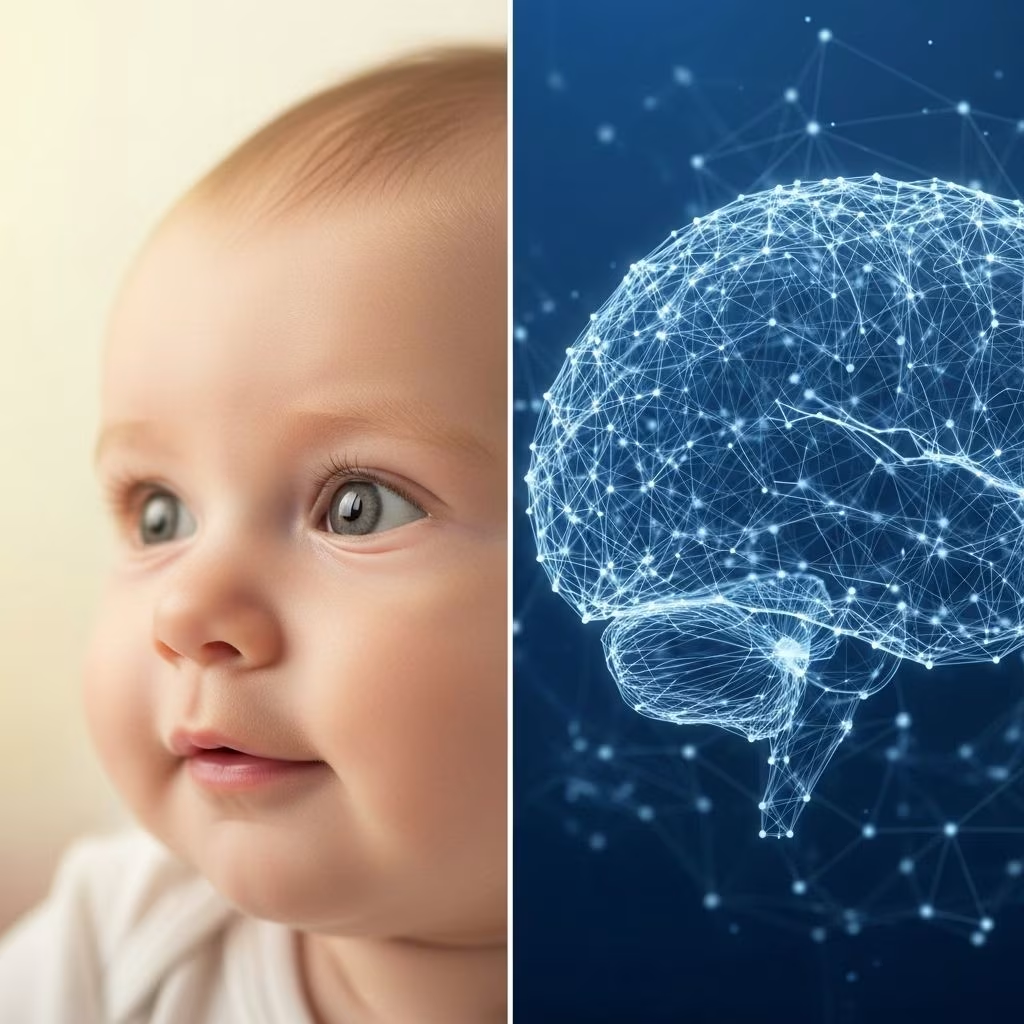
Have you ever wondered why you remember so little — if anything at all — from your baby years? The mysteries of infant memory are deeply entwined with how the human brain develops, challenging assumptions about what babies perceive and retain. Recent research sheds new light on how and when babies begin to form memories and why these early recollections are generally inaccessible to adults. This article explores the science behind infant memory, the phenomenon known as infantile amnesia, and the ongoing discoveries about how young children encode, retain, and lose their earliest experiences.
What Is Memory?
Memory is the brain’s remarkable ability to acquire, encode, store, and retrieve information over time. It enables us to learn, form relationships, develop language, and recognize the world around us. Memory comes in different forms, but two types are especially important to understand infant experiences:
- Episodic Memory: The ability to remember specific events and experiences — such as a birthday party or a particular day spent with family — that can later be consciously recalled.
- Statistical (or Implicit) Memory: The unconscious memory of patterns, routines, or skills, like learning the structure of language or recognizing familiar faces, without necessarily recalling a specific instance.
In adults, these memory systems work in tandem, but in infants, their development follows a distinct trajectory.
Can Babies Form Memories?
For many decades, scientists assumed that babies and toddlers could not form true memories. This belief stemmed from two facts:
- Adults typically can’t remember events from before age three or four.
- The part of the brain central to memory, the hippocampus, is not fully mature at birth and continues developing well into adolescence.
However, emerging research indicates that babies do form memories, even if they are not accessible in the way adult memories are. Recent advances in brain imaging have enabled scientists to observe the memory processes occurring in the infant brain, leading to new insights about how and when babies begin to remember.
How Scientists Study Memory in Babies
Studying memory in infants is uniquely challenging. Babies can’t describe their experiences in words, so researchers must use creative, indirect approaches, such as:
- Looking Behavior: Tracking how long infants look at familiar objects compared to new ones. Babies tend to look longer at things they recognize.
- Brain Imaging: Using technologies like functional magnetic resonance imaging (fMRI) to measure which areas of the brain activate during exposure to new versus familiar stimuli.
- Conditioned Response: Teaching babies to associate one event with another (for example, a sound with a picture), then later testing their reaction to see if the association has been retained.
These methods reveal that even very young infants show signs of memory, particularly for patterns and routines — the building blocks of implicit or statistical learning.
How Babies Encode Memories: The Brain’s Developmental Timeline
The hippocampus, a banana-shaped structure located deep within the brain, plays a crucial role in creating and recalling episodic memories. Traditionally, it was believed that the hippocampus’s immaturity prevented infants from forming lasting memories. However, recent studies are challenging this notion.
Key discoveries:
- Babies as young as three months old display brain activity indicating statistical learning, allowing them to extract patterns from their environment.
- By 12 months and older, evidence suggests that infants begin to form episodic memories — memories of specific events and experiences — with the posterior hippocampus (the section associated with these memories in adults) showing notable activity.
- Brain imaging studies have shown that when infants are exposed to new images or sounds, the level of hippocampal response can predict whether they will later recognize those images or sounds.
- Although the encoding of experiences appears to occur even in the first year of life, the ability to recall those memories later is limited or lost with age.
In essence, the capacity to store memories starts early, but their longevity and accessibility change with development.
Why Can’t Adults Remember Their Early Years?
The inability of adults to recall experiences from infancy is known as infantile amnesia. This phenomenon has puzzled psychologists and neuroscientists for over a century. Here’s what researchers now believe:
- Retrieval, Not Storage, Is the Issue: Recent evidence suggests that babies do encode and store memories — but the systems and cues adults use to retrieve memories differ from those used in infancy.
- Mismatch in Memory Encoding and Recall: The way memories are encoded during babyhood (before the development of language, for example) may not provide sufficient cues or triggers for later retrieval when the brain is matured and organized differently.
- Rapid Brain Changes: The brain undergoes dramatic rewiring in the first few years. As neural networks shift, access to early memories can be disrupted or lost.
- Language Development: Many memories are stored in a non-verbal, sensory-dependent way early on. As children develop language, the brain increasingly relies on verbal cues for memory retrieval, making pre-verbal memories harder to access.
Thus, “forgotten, but not gone” is a theme of current research: early memories may persist in some form, but adults lack the right access codes to unlock them.
Two Types of Memory: Episodic and Statistical Learning
| Feature | Episodic Memory | Statistical (Implicit) Memory |
|---|---|---|
| Definition | Memory for specific events or experiences | Learning of recurring patterns, rules, or categories |
| Developmental Onset | Becomes measurable around 12 months and beyond | Apparent as early as 3 months of age |
| Brain Region Involved | Posterior hippocampus | Anterior hippocampus |
| Example in Babies | Recognizing a toy seen yesterday | Expecting feeding after a certain sound |
| Accessibility Later in Life | Often inaccessible to adult recall | Persists as unconscious knowledge |
Both types of memory are essential for learning, but statistical learning gives babies a foundation for interpreting their world. As the hippocampus matures, episodic memory gradually comes online, enabling recollection of distinct experiences.
When Do Children Begin to Retain Long-Lasting Memories?
Most adults find their earliest memories originate between ages three and four, coinciding with significant advances in language and self-awareness. Nonetheless, some research suggests that certain memories from as early as age two (and, rarely, younger) can endure, often prompted by photos or family stories. Key milestones in memory retention include:
- Under Age 2: Memories are mainly implicit, rooted in patterns and routines.
- Ages 2–3: First fragments of episodic memories may appear, though they tend to be fleeting.
- Age 3–4 and Beyond: Longer-lasting autobiographical memories develop, and children begin to report events in detail.
However, most specific events from infancy and early toddlerhood rarely remain accessible to conscious recall in adulthood.
Why Are Early Memories So Fleeting?
Several factors contribute to the fragility of early childhood memories:
- Brain Growth and Reorganization: Massive neurological changes and synaptic pruning occur in early years, possibly overwriting or disconnecting early memory traces.
- Contextual Differences: Babies experience life before developing a concept of self, before verbal reasoning, and long before developing the narrative approach to memory adults use. This makes it harder to link early experiences to present self-concepts.
- Language Barriers: Without words to describe events, infants’ memories are encoded differently and can be harder to access after developing language.
Can Anything Help Babies Retain Early Memories?
While most early memories fade, the process is not entirely straightforward or beyond influence. Parents and caregivers can support better memory formation and retention in children by:
- Establishing Routines: Consistent practices reinforce implicit learning and offer structure.
- Talking About Past Events: Narrating and discussing experiences helps children attach words and context to their memories, making recall more likely.
- Photo and Video Reminders: Visual cues can prompt recall, anchoring memories as children age.
- Encouraging Storytelling: As language develops, encouraging children to describe their experiences strengthens narrative memory systems.
Frequently Asked Questions (FAQs)
Can babies remember things that happened to them?
Yes, babies can form memories. Scientific evidence now shows that infants as young as several months old encode experiences and patterns. However, these early memories are often not accessible in adulthood.
Why can’t I remember anything from when I was a baby?
This is a phenomenon called infantile amnesia. Most adults cannot access memories from before they were about three years old, likely due to differences in how memories are encoded and retrieved as the brain develops.
At what age do children begin to form lasting memories?
Most researchers agree that lasting autobiographical memories start forming around ages three to four. Isolated fragments may appear earlier, but these are rarely accessible in adulthood without reminders.
Is it possible for adults to “recover” infant memories?
Generally, no. While certain triggers (like photos or family stories) can evoke fragments or feelings, detailed, vivid recollection of infancy remains scientifically unsupported.
Are early experiences still important if we can’t remember them?
Absolutely. Early experiences shape brain development and emotional patterns, even if not consciously recalled later.
Key Takeaways About Infant Memory
- Babies start forming memories much earlier than once assumed, with implicit (statistical) memory seen even at three months and episodic memories appearing around one year.
- Memory formation and retrieval depend on the maturation and reorganization of key brain structures like the hippocampus.
- Infantile amnesia — the inability to recall early life events — is not due to an absence of memory but rather to the brain’s evolving systems of encoding and recall.
- Even though adults can’t remember being babies, these early years are foundational, shaping personality, behavior, and cognitive development.
Conclusion
The unfolding picture of memory in babies is both fascinating and humbling. Science now recognizes that babies are, in fact, laying down the neural groundwork for memory from their first months — even if those traces become inaccessible with time. While adults may forever wonder about their own earliest days, parents and caregivers can take solace in knowing that every cuddle, conversation, and experience contributes to the vibrant web of memories guiding children’s growth.
References
- https://news.yale.edu/2025/03/20/why-dont-we-remember-being-baby-new-study-provides-clues
- https://www.nature.com/articles/d41586-025-00855-0
- https://www.williamhaseltine.com/what-do-babies-remember-how-much-do-we-really-remember-from-the-start/
- https://www.the-scientist.com/babies-form-memories-why-do-adults-forget-them-72826
- https://pmc.ncbi.nlm.nih.gov/articles/PMC5473198/
- https://qbi.uq.edu.au/brain/learning-memory/why-you-cant-remember-being-baby


