Witnessing the Power of Faith in Fátima, Portugal
Set among the undulating fields and quiet villages of central Portugal, the small town of Fátima stands as one of Europe’s most significant Catholic pilgrimage sites. Each year, millions come to this unassuming place — some out of spiritual devotion, others for curiosity, and many seeking an encounter with a story that has echoed across a century: the apparitions of the Virgin Mary to three shepherd children in 1917. Whether one approaches with faith or fascination, Fátima offers an opportunity to witness, firsthand, the enduring power of belief and the communal tribute to an event that has left an indelible mark on Portugal and the Catholic world.
The Origins of Fátima’s Miracle
The story of Fátima began on May 13, 1917. In the midst of the First World War’s devastation, three young shepherds — Lúcia dos Santos and her cousins, Francisco and Jacinta Marto — claimed to experience something otherworldly while tending their sheep near a lone oak tree on the Cova da Iria meadows. According to the children’s accounts, “a lady brighter than the sun” appeared, bearing a message of hope and peace at a time when Europe was ravaged by conflict.
What unfolded captured the imagination of a nation: on the 13th day of each subsequent month from May to October, the woman returned, delivering messages and prophecies. News of the visions spread rapidly; pilgrims and skeptics alike descended on Fátima, while authorities pressed the children for explanations, often with skepticism and even hostility. Despite the pressure, the children maintained the veracity of their experiences, steadfast even under intense scrutiny.
The Climactic ‘Miracle of the Sun’
The crescendo came on October 13, 1917. Tens of thousands — by many counts, around 70,000 people — gathered under a rain-soaked sky. Accounts describe how, at noon, the clouds broke and the sun reportedly “danced,” swirling, flashing, and plunging toward the earth, only to retreat and leave, miraculously, a dried field and stunned witnesses. This event, quickly dubbed the “Miracle of the Sun,” became the fulcrum upon which Fátima’s reputation turned, and echoes of it are preserved in both religious testimony and chroniclers’ reports.
- Date of first apparition: May 13, 1917
- Main figures: Lúcia dos Santos, Francisco Marto, Jacinta Marto
- Number of reported witnesses at Miracle of the Sun: Approx. 70,000
- Key message: Peace and repentance during World War I
Fátima’s Transformation: From Village to Pilgrimage Epicenter
Before the apparitions, Fátima was an unremarkable agrarian village, virtually unknown to the outside world. In the aftermath of 1917, however, it began a transformation. The Vatican conducted careful investigations and, in 1930, officially recognized the visions as “worthy of belief.” The growing credibility attracted even more pilgrims, including those journeying great distances on foot as a sign of devotion.
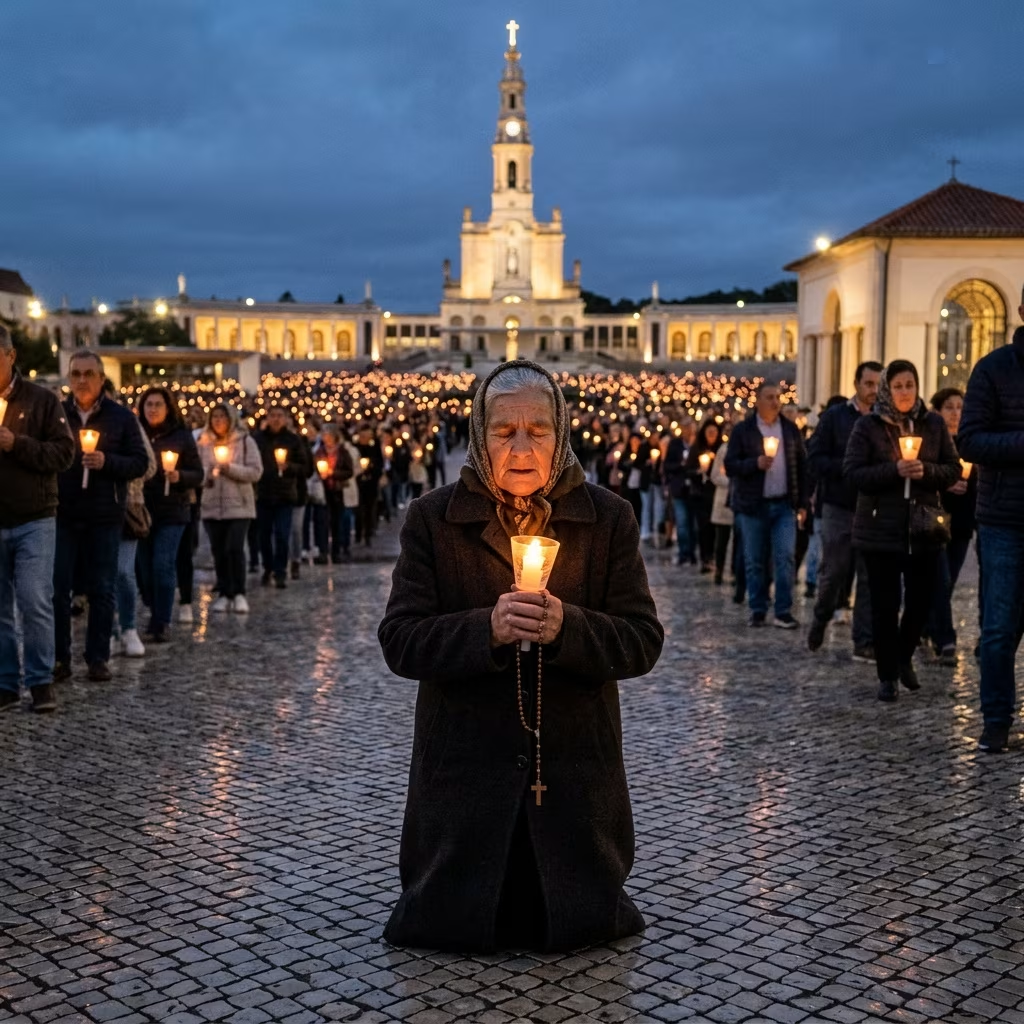
Over the years, what was once a lonely field developed into a vast sanctuary complex. The heart of Fátima is its sprawling esplanade — a space that today rivals the scale of St. Peter’s Square in Rome, designed to accommodate throngs of the faithful. This vast square is bordered by two immense churches, modern facilities for hospitality, and facilities to serve the practical and spiritual needs of visitors.
Key Landmarks and Rituals
- Chapel of the Apparitions: Built directly at the site where the first apparition appeared, the chapel houses the precious statue of the Virgin and is a focal point of prayer and candle lighting.
- The Basilica of Our Lady of the Rosary: A Neoclassical landmark with a 200-foot tower, crowned by a golden crown and visible for miles. The façade features a statue of Mary and mosaics of the Portuguese saints.
- Basilica of the Holy Trinity: A modern structure on the opposite end of the esplanade, designed to host today’s crowds and major liturgical gatherings.
- Stations of the Cross & Oak Tree Site: Marking the path and location where the original visions occurred, offering pilgrims a journey through reflection and prayer.
- Holy Water Fountain: Located at the center of the esplanade, where visitors refill bottles to carry home as religious mementos.
- Pilgrims’ Candle Offerings: A ritual where the devout ignite candles, sometimes bringing enormous wax effigies, as testaments of gratitude or intercession.
- Kneeling Pilgrimage: Many traverse the esplanade’s smooth route approaching the chapel on their knees, a physical sign of devotion and petition.
The Pilgrimage Experience: Fátima Today
Each year, Fátima draws millions from across Portugal and around the world, many timing their arrivals for the 12th and 13th of each month from May to October — solemn anniversaries of the apparitions. During major festivals, the town swells with energy: accommodations fill, impromptu picnics and processions break out, and the commercial center becomes alive with vendors offering religious souvenirs, rosaries, and humble meals. For many, the long walk to Fátima from places as far as Lisbon (80 miles away) is a crucial part of the pilgrimage — a chance for penitence, reflection, and prayer alongside others.
On festival days, Fátima’s atmosphere is electrified by processions of candlelight, the murmured recitation of prayers in dozens of languages, and outdoor masses that sometimes see up to 100,000 participants at once. On the centennial of the apparitions in 2017, half a million pilgrims — including Pope Francis — converged, making it one of the largest peace gatherings in modern Portuguese history.
| Landmark | Description | Significance |
|---|---|---|
| Chapel of the Apparitions | Small sanctuary on apparition site | Focus of prayer and candle offerings |
| Basilica of Our Lady of the Rosary | Neoclassical basilica with 200-foot spire | Main venue for major Catholic liturgies |
| Basilica of the Holy Trinity | Contemporary church at opposite end of esplanade | Hosts large international assemblies and gatherings |
| Holy Water Fountain | Central fountain for pilgrims | Provides holy water for visitors to take home |
| Oak Tree | Site of original Marian apparitions | Key place for meditation and prayer |
Fátima in the Context of Pilgrimage and Faith
Fátima shares a kinship with other great apparition sites such as Lourdes in France and Medjugorje in Bosnia. Yet, for many, it is uniquely accessible and universal. The events in Fátima did not target elite mystics or clergy but ordinary, rural children, making the message resonate deeply with common people. The visionaries’ steadfastness under duress and the mass public experience of the Miracle of the Sun have contributed to the resonance that continues today.
For Catholics, Fátima’s message — a call to peace, prayer, and conversion — remains powerfully relevant. Even for non-believers or those of different religions, the human endeavor to approach the divine and the ability of visions and stories to unite vast groups in shared purpose are remarkable spectacles of human culture. The experience of standing among tens of thousands, united in silence or song, can move even the most skeptical observer to awe.
Pilgrimage Culture in Modern Fátima
- Accessibility: Virtually anyone, regardless of belief, is welcome — creating a tapestry of faith, curiosity, and sometimes skepticism.
- Infrastructure: From budget hostels to religious guesthouses, simple eateries, and souvenir stalls, Fátima is designed to welcome visitors of every kind.
- Modern Peace Movement: The original call for peace still echoes today, with regular prayers for world harmony and reconciliation.
Practical Travel Tips for Experiencing Fátima
- Plan your visit to coincide with the monthly anniversaries (12th–13th) for a powerful festival atmosphere, but expect large crowds and book accommodation well in advance.
- The area around the shrine has extensive parking, but walking pilgrims share the experience of penitence and reflection.
- Outdoor masses and processions occur year-round but are most vibrant during the May–October season.
- Bring a bottle to collect holy water as a souvenir, and consider participating in the candle-lighting ritual, which is open to all visitors.
- Remain respectful: for many, Fátima is a site of deep personal religious significance.
Frequently Asked Questions (FAQs)
Q: What is the significance of Fátima in Catholic tradition?
A: Fátima is revered as the site of a series of Marian apparitions to three shepherd children in 1917. The messages delivered were calls for peace, repentance, and devotion to prayer, and the so-called “Miracle of the Sun” is considered among the most striking public miracles of modern Catholicism.
Q: How many people visit Fátima annually?
A: Each year, millions travel to Fátima; on major festival days, attendances can reach up to 100,000, and on special anniversaries, such as the centenary in 2017, as many as half a million gather at the shrine complex.
Q: Is Fátima only for Catholics?
A: While Fátima is a holy site for Catholics, people of all beliefs—or none—are welcome. Many come for the cultural, historical, or anthropological significance, and the site is renowned for its hospitality and openness.
Q: What are the main rituals observed by pilgrims?
A: Key rituals include candle-lighting, collecting holy water, approaching the chapel on one’s knees, joining processions, and participating in outdoor masses. Visiting the Chapel of the Apparitions and praying at the oak tree are essential acts of devotion.
Q: What is the best time to visit Fátima?
A: May 13 and October 13, marking the first and last apparitions respectively, are particularly significant, as are the 12th and 13th of each month from May to October. These dates see major festivities, processions, and international gatherings.
Conclusion: The Lingering Power of a Century-Old Miracle
More than a century after the first reported apparition, Fátima continues to inspire, uplift, and provoke thought. Two immense basilicas, a sea of compassionate pilgrims, and a town that pulses with stories — all of it was sparked by three children and an event described as bright as the sun. For travelers, Fátima is both a destination and an invitation: to bear witness to faith, to reflect on humanity’s search for meaning, and to appreciate the cultural expressions of spirituality. Whether devout or doubtful, no visitor leaves untouched by the enduring mystery and collective hope that define this singular place in Portugal.
References
- https://www.youtube.com/watch?v=RTzJV-p_22s
- https://blog.ricksteves.com/blog/tag/fatima/
- https://blog.ricksteves.com/blog/fatima/
- https://www.ricksteves.com/watch-read-listen/read/articles/witnessing-the-power-of-faith-in-fatima
- https://www.ricksteves.com/watch-read-listen/video/tv-show/portugal
- https://www.ricksteves.com/watch-read-listen/read/articles/portugal-one-foot-in-the-past-and-one-in-the-future
- https://www.tripadvisor.com.ph/ShowTopic-g189157-i2177-k11589040-Holy_Water-Fatima_Santarem_District_Central_Portugal.html
- https://www.ricksteves.com/watch-read-listen/read/articles