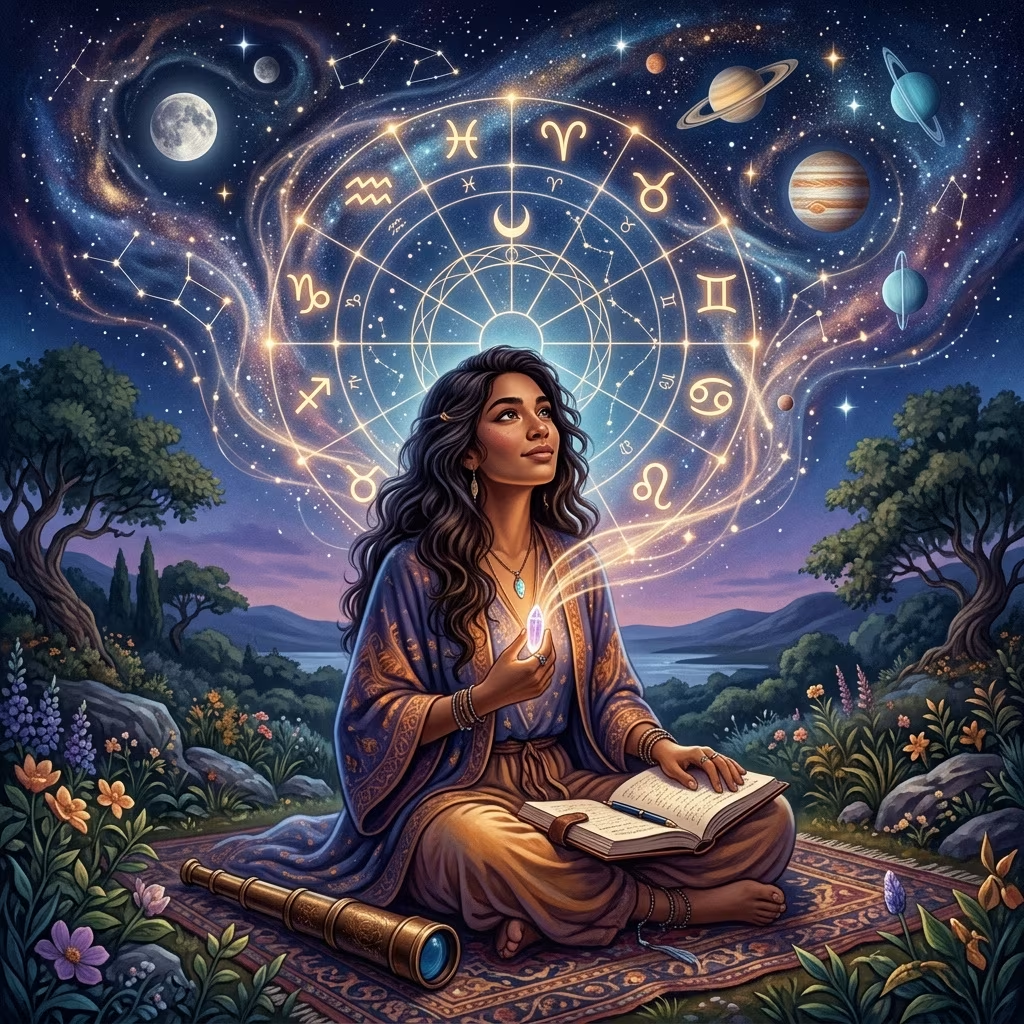
Astrology isn’t just about forecasting your week or decoding celebrity birth charts—it can be a profound tool for self-discovery, particularly when it comes to embracing fluidity in sexuality and gender identity. Guided by the stars, astrology offers a model of the self that is neither rigid nor one-dimensional, but instead as multicolored and dynamic as the night sky itself.
The Stars Reflect Our Complexity
In her bestseller You Were Born for This: Astrology for Radical Self-Acceptance, renowned astrologer Chani Nicholas writes: “You are not just a Virgo or a Gemini or a Libra; you are a moment in time, with every sign, planet and point playing a part in who you are, how you move through the world and what you came here to do.” This profound insight changes the way we see ourselves: not as a single sign, but as a tapestry of traits, contradictions, and shifting possibilities shaped by the cosmos.
For many, including myself, astrology’s vision is deeply liberating. If the planets and signs are continually in motion, so too can our identities, desires, and gender expressions move and change. Fluidity is not just permitted—it’s cosmic.
Getting to Know Your Chart: The “Big Three”
In astrology, people often refer to the “Big Three”:
- Sun Sign: The heart of your personality, your essence.
- Moon Sign: Your emotional core, what you need to feel at peace.
- Rising Sign (Ascendant): Your mask to the world; the first impression you make.
These three major placements combine to form a multi-dimensional portrait that few daily horoscopes capture.
Personally, I’m a Gemini Sun—expressive, restless, endlessly curious. My Rising is Cancer, which lends me a softness and sensitivity that sometimes contrasts with my outspoken Sun. My Moon, in Leo, makes me dramatic and craving for visibility in my emotions. These energies are often at odds with each other, which made me feel contradictory—until I realized that everyone’s birth chart is a beautiful web of moving parts, not a single, static note.
Astrology as a Mirror: Identity and Self-Acceptance
Engaging deeply with astrology can help challenge binary, fixed ideas about identity and encourage us to honor our complexity. As I began tracking the Sun’s path through the houses and the Moon’s intersections with different signs, I noticed my own moods, energy, and sense of self-flow alongside these cosmic movements. My chart reflected back to me that change was natural and even essential.
This recognition proved to be a turning point. I started to shed the shame and confusion attached to not fitting neatly into prescribed boxes (straight or gay, man or woman) and began to celebrate the wild, plural thing I am. In my gender, too, I claimed space for flux: sometimes femme, sometimes not; sometimes wishing to go by they/them, sometimes she/her. It became a process of daily negotiation and exploration.
Fluidity in Gender and Sexuality: Written in the Stars
Astrology understands people as complex, layered, and capable of infinite growth. If my birth chart can contain so many contradictions—fire beside water, mutable beside fixed—then why couldn’t my sexuality and gender be equally fluid?
Specifically, my natal Venus in Gemini—a placement associated with flexibility, flirtation, and adaptability—supported my inclination to experiment with aesthetics, try new relationships, and keep an open mind about whom I desired. I stopped apologizing for being multiple.
Fluidity, in astrological terms, means:
- Honoring change in your feelings, attractions, and self-expression
- Letting go of shame when you don’t conform to social norms
- Celebrating experimentation—in clothes, pronouns, relationships, and self-definition
- Understanding identity as a process, not a product
Reading Your Own Birth Chart: A Quick Guide
Understanding your birth chart can be empowering, especially if you are questioning or exploring your gender or sexuality. Here’s how to begin:
- Calculate your natal chart (numerous free calculators are available online). You’ll need your birth date, time, and place.
- Identify your Sun, Moon, and Rising signs. These offer a snapshot of your core self, emotions, and outward appearance.
- Look for Venus and Mars—the planets of love and desire—to see clues about your attractions and values.
- Notice elements and modalities: How much air, earth, fire, and water is in your chart? Are you mostly cardinal, fixed, or mutable? This can highlight tendencies toward stability or change.
Remember, no single sign or placement is “more” you than the others. All parts are essential to the whole.
The Building Blocks of the Birth Chart
- The Houses: Twelve areas representing life’s different spheres (self, relationships, work, etc.).
- The Signs: The qualities, styles, or colors your energies wear (e.g., Aries—direct; Pisces—dreamy).
- The Planets: The actors, representing different drives and experiences (e.g., Mercury—communication; Mars—desire).
Astrology and Queer Identity
The language of astrology has been particularly resonant in queer circles—not only because its metaphors suit experience outside the mainstream, but because it affirms that contradiction, change, and self-invention are natural.
For LGBTQ+ folks, astrology provides:
- Permission: There is no single, correct way to be.
- Validation: The self is a spectrum, not a single binary or fixed category.
- Empowerment: You can “rewrite” or reinterpret your story at any time, just as planetary energies shift throughout your life.
Many astrologers and queer thinkers have noted how astrological archetypes, transits, and cycles mirror the experience of coming out, gender transition, or reimagining one’s sexuality. If the planets don’t sit still, why should our identities?
Tracking the Moon and Sun: Rituals for Honoring Change
One practical way to nurture self-acceptance is to keep a journal noting how you feel as the Moon changes sign every two-and-a-half days, or as the Sun moves monthly through the zodiac. You may discover patterns of energy, mood, or desire that teach you to trust your changeability rather than fight it. Astrology’s cyclical nature encourages rituals:
- New Moon: Set intentions for self-expression or experiment with a new look or label.
- Full Moon: Celebrate your multiplicity; release old ideas of who you “should” be.
- Solar Return (birthday season): Review growth in your identity over the past year, and affirm your right to evolve.
Famous Fluid Astrological Archetypes
| Sign | Key Trait | Notable Figures |
|---|---|---|
| Gemini | Duality, adaptability | Angelina Jolie, Laverne Cox |
| Pisces | Empathy, boundary-blending | Rihanna, Drew Barrymore |
| Sagittarius | Freedom-loving, open | Nicki Minaj, Miley Cyrus |
| Aquarius | Individualism, innovation | Harry Styles, Ellen DeGeneres |
These signs (especially Gemini and Pisces) are often described as embodying fluid, multifaceted energies—not in a limiting way, but as a cause for celebration.
Practical Tips: Using Astrology for Self-Discovery
- Study your chart with curiosity, not judgment. Every contradiction has something to say.
- Share your chart with friends or queer communities to compare experiences.
- Explore which signs or planets “speak” to your sense of gender and sexuality. (Venus and Mars are a great starting point, but every chart is unique.)
- Think in cycles, not straight lines. Who you are, whom you desire, and how you embody gender may change monthly, yearly, or many times over.
- Embrace the unknown—your chart is a poem, not a prescription.
Common Questions About Astrology and Fluidity
Q: Can my birth chart tell me my sexuality?
A: While no chart “defines” your sexuality, it can point to ways you approach love, desire, and relationships. Astrology affirms diversity, complexity, and evolution as natural parts of selfhood.
Q: What signs are most associated with fluidity?
A: Gemini and Pisces are often highlighted for their duality and changeability, but anyone can be fluid, no matter their chart.
Q: How can I use astrology if I don’t feel like a typical example of my Sun sign?
A: You are not just your Sun sign! All signs, planets, and houses matter. Look at your entire chart for a fuller picture.
Q: Are there specific placements that support exploring gender or sexual identity?
A: Mutable signs (Gemini, Virgo, Sagittarius, Pisces), strong Venus or Neptune aspects, or Uranus connections can suggest openness to change and experimentation—but context always matters.
Embracing the Multitudes: Astrology as Liberation
At its best, astrology is a practice of radical self-acceptance. It reminds us that we “contain multitudes,” in the words of fellow Gemini poet Walt Whitman. By honoring the contradictions, cycles, and shifting desires within our charts, we make space for every version of ourselves—past, present, and future.
As you move through your own journey of gender, sexuality, or simply ongoing self-discovery, remember: the stars themselves teach that there is beauty, strength, and wisdom in change. Like the planets above, your fluidity is a birthright, and your story is as open as the sky.
References
- https://www.cosmopolitan.com/sex-love/a40435854/astrology-fluidity-birth-chart/
- https://masteringthezodiac.com/how-to-read-a-birth-chart
- https://www.cosmopolitan.com/uk/horoscopes/a64298115/air-signs-astrology/
- https://www.youtube.com/shorts/AgoUN7RMMQo
- https://www.elle.com/horoscopes/a65256093/birth-chart-sex-life-sun-venus-mars-sign-explained/
- https://www.tarot.com/astrology/traits-of-rising-signs
- https://www.youtube.com/watch?v=jNWdhNxcAUU
- https://www.elle.com/horoscopes/a44880048/12-houses-of-astrology-meaning/
- https://www.zodiacsign.com/zodiac-signs/cancer/