


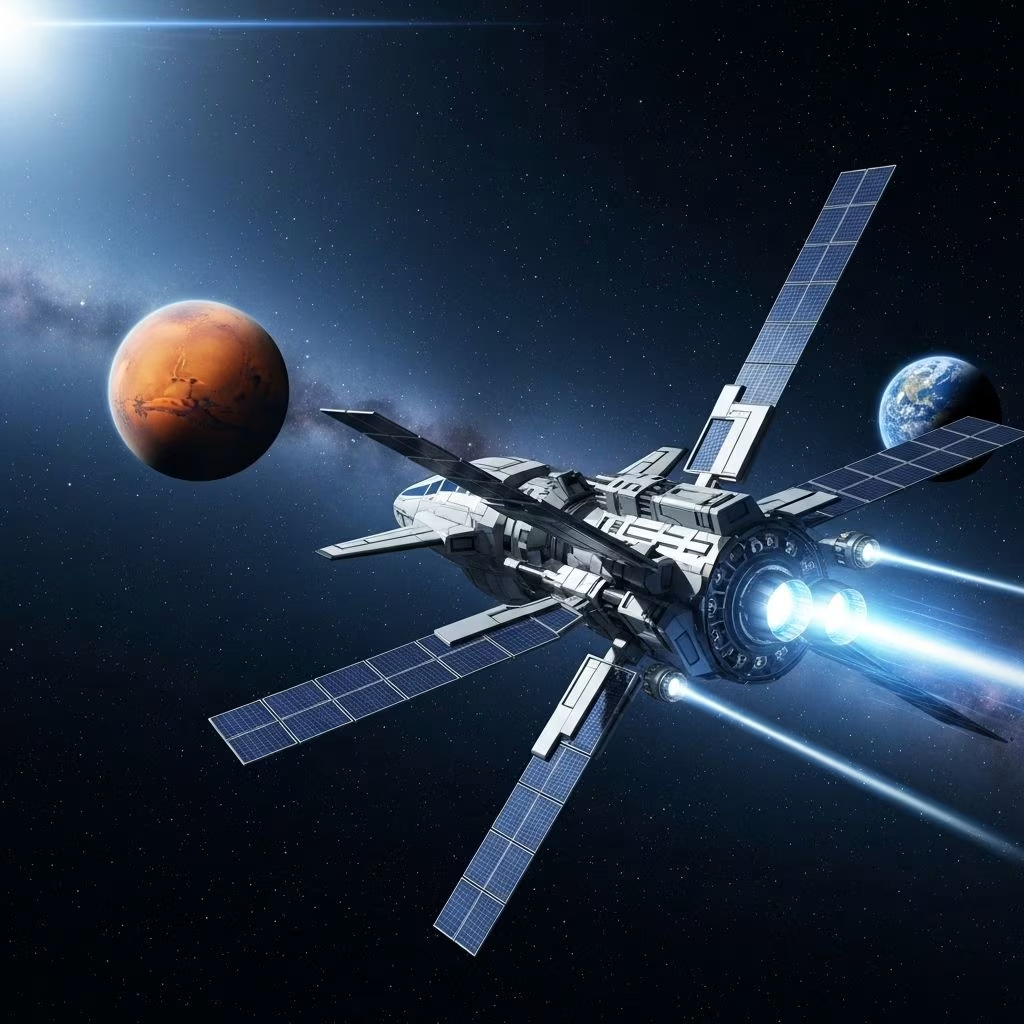
Mars—our closest planetary neighbor and the dream destination for future explorers—poses one of the most challenging commutes in the solar system. This article unpacks the intricacies of travel time to Mars, covering the science behind journey durations, the influence of planetary alignment, current and future propulsion technologies, and the lessons learned from past missions.
Understanding the Distance Between Earth and Mars
The most basic factor in determining Mars travel time is distance. Both Earth and Mars orbit the Sun at different speeds and in different elliptical paths:
- Earth orbits the Sun once every 365 days.
- Mars completes an orbit in about 687 days.
This difference means the separation between the two planets changes constantly. At their closest approach, known as opposition, Earth and Mars can be about 54.6 million kilometers (34 million miles) apart. At their furthest, this distance stretches to over 401 million kilometers (249 million miles) . Most Mars missions aim to launch when the two planets are optimally aligned, minimizing travel distance and required energy.
The Hohmann Transfer: The Most Efficient Path
Most spacecraft heading to Mars use a trajectory called the Hohmann transfer orbit. This is an elliptical path that enables a spacecraft to efficiently move from Earth’s orbit to Mars’ orbit with the least amount of fuel:
- Optimal for missions with chemical rockets
- Launch windows occur every 26 months when Mars and Earth are favorably aligned
- Saves fuel but requires precise timing and a relatively long cruise phase
During these ideal windows, the travel distance averages about 225 million kilometers, though the exact number depends on the unique positions of the planets at the time of launch.
Typical Mars Journey Durations
| Mission/Method | Average Travel Time | Notes |
|---|---|---|
| Hohmann Transfer (Current Technology) | 6–9 months (180-270 days) | NASA/ESA Mars missions; depends on speed & planetary positions |
| Fastest Robotic Mission (Perseverance Rover 2020) | ~7 months | Launched July 2020, landed February 2021 |
| Short-Cut Future Technologies (Theoretical) | 30–90 days | Requires advanced nuclear or electric propulsion (still in development) |
| Parker Solar Probe (If aimed at Mars) | 3–24 days (theoretical) | World’s fastest spacecraft; not built for Mars trajectory |
Current missions with chemical propulsion take about seven to nine months. NASA’s Perseverance rover, for example, made the trip in just over seven months . Private companies like SpaceX aim to reduce this time to three or four months using refined windows and future advanced propulsion .
Key Factors That Influence Travel Time
A variety of variables determine how long it takes to reach Mars:
- Orbital Mechanics: The positions and speeds of Earth and Mars, changing over months and years, dictate the best time for launching a mission.
- Spacecraft Speed: Faster speeds require more energy and fuel; current speeds from Earth to Mars average around 36,000 km/h (22,370 mph) .
- Trajectory Selection: Not all missions use the most direct route. Some may include flybys or gravity assists to save energy or resources.
- Propulsion Technology: Chemical rockets are standard, but research is ongoing into nuclear thermal, electric, and other advanced propulsion systems.
- Landing Approach: Entering the Martian atmosphere requires careful deceleration and trajectory management to ensure a safe descent and landing.
Table of Mars-Earth Distances and Travel Estimates
| Scenario | Distance (million km) | Theoretical Fastest Travel (Parker Solar Probe speed) | Typical Hohmann Time |
|---|---|---|---|
| Closest Approach | 54.6 | ~3.3 days | ~6 months |
| Average Distance | 225 | ~13.6 days | ~7-8 months |
| Farthest Approach | 401 | ~24 days | N/A (not used for launches) |
Current Spacecraft and Record-Holding Speeds
The fastest spacecraft as of 2024 is NASA’s Parker Solar Probe, which reached a record 430,000 miles per hour (692,000 km/h) . Although it was aimed at the Sun—not Mars—it demonstrates the speeds possible with advanced propulsion; if routed to Mars, the journey could theoretically take just days. However, sustaining such speeds and protecting crews and payloads is a major challenge for future missions.
Why Does It Take So Long?
Even with the vastness of interplanetary space, the long journey is not simply “because it’s far away.” Several factors make the Mars journey lengthy:
- Fuel and Energy: Higher speed requires exponentially more fuel, leading to heavier spacecraft and greater energy demands.
- Gravity and Orbits: Escaping Earth’s gravity, entering a transfer orbit, and matching Mars’ speed and position upon arrival are complex processes.
- Crew Safety: Human missions will require much more elaborate life support, shielding, and supply systems than robot missions, further complicating quick travel.
Future Propulsion Technologies: Reducing the Time to Mars
Emerging technologies may change the Mars commute dramatically in coming decades. Among the most promising are:
- Nuclear Thermal Propulsion (NTP): Utilizes nuclear reactions to heat propellant, potentially doubling the speed of chemical rockets.
- Electric/Ion Engines: Produce continuous acceleration over long periods, potentially cutting travel to a few weeks, though payloads may be limited.
- Solar Sails and Advanced Concepts: Solar sails use sunlight for propulsion; theoretical fusion or antimatter drives could push travel times even lower if developed.
These technologies are under research, and any human Mars mission remains at least a decade away as safety and reliability standards, as well as cost-efficiency, are addressed.
Lessons from Past Robotic Mars Missions
NASA, ESA, and other agencies have conducted dozens of Mars missions over the last five decades, gradually improving our understanding of interplanetary travel. Key takeaways include:
- Robotic Missions Chart the Course: Missions like Viking, Spirit, Opportunity, Curiosity, and Perseverance demonstrate varying journey times and landing techniques.
- Entry, Descent, and Landing (EDL): Slowing from interplanetary speeds to land safely on Mars is particularly complex due to the thin Martian atmosphere.
- Communication Delays: Distance also means signals take 3–22 minutes to travel between planets, affecting real-time maneuvering.
Each mission increases the pool of data, helping refine launch windows, fuel estimates, and safe landing strategies for eventual human explorers.
Frequently Asked Questions (FAQs)
Q: Why can’t we simply launch to Mars at any time?
A: Orbits of Earth and Mars mean that the distance and relative speed between them are constantly changing. Launching during a Hohmann transfer window every 26 months offers the shortest, most fuel-efficient trip.
Q: Is travel time the same for robots and humans?
A: Robotic missions can take riskier trajectories, but human missions must optimize for crew safety, radiation exposure, and supplies, which may limit speed and flexibility. Both are limited by current propulsion technology.
Q: Could future spacecraft reach Mars in weeks?
A: Advanced nuclear or electric propulsion systems could, in theory, reduce travel to 30–45 days, but these technologies require significant testing before being safe for crewed use.
Q: How do cosmic rays and solar storms affect the journey?
A: Space is filled with radiation hazards. Longer journeys increase radiation exposure for astronauts; shielding and speed are major concerns. Robots are hardened for radiation, but human missions must mitigate these risks.
Q: How quickly did the fastest spacecraft reach Mars?
A: Theoretically, NASA’s Parker Solar Probe, moving at 692,000 km/h, could reach Mars from Earth in as little as 3–4 days if directed on the optimal path, but it was not designed for Mars transfer.
Key Takeaways for Would-be Mars Travelers
- Mars is, on average, 225 million km away from Earth, but this figure can vary enormously.
- Travel time depends on orbital alignment, speed, propulsion, and mission requirements.
- Present chemical rockets make the trip in 6–9 months using the Hohmann transfer.
- Advanced propulsion may cut the time to weeks, boosting prospects for crewed missions.
- Robotic missions continually refine our understanding and technical capability for interplanetary travel.
Conclusion
The dream of human exploration of Mars is closer than ever, but the journey remains one of the greatest technical and logistical challenges humanity has ever faced. Understanding the complex dance of orbital mechanics, propulsion technology, safety, and mission planning is key to transforming the vision of setting foot on the Red Planet into a reality.
References
- https://www.skyatnightmagazine.com/space-science/how-long-does-take-get-mars
- https://forums.space.com/threads/how-long-does-it-take-to-get-to-mars.29557/
- https://www.youtube.com/watch?v=bShVdWmHeJ8
- https://www.jagranjosh.com/general-knowledge/how-long-does-it-take-to-get-to-mars-1820000455-1
- https://spacevoyageventures.com/mars-travel-time/
- https://en.wikipedia.org/wiki/Human_mission_to_Mars
- https://www.iuemag.com/s24/sf/how-long-is-the-journey-to-mars-and-what-we-know-so-far
- https://www.youtube.com/watch?v=_m8XsagvGJs
- https://www.nasa.gov/humans-in-space/humans-to-mars/
- https://www.nasa.gov/directorates/smd/how-long-does-it-take-to-get-to-the-moon-mars-jupiter-we-asked-a-nasa-expert-episode-51/
- https://www.spaceheavens.com/how-long-to-travel-to-mars-spacex/
- https://www.loveyoutomarsandback.com/spaceblog/how-long-does-it-take-to-travel-to-mars
- https://www.oceanhaven.com/post/the-ultimate-guide-on-how-long-to-travel-to-mars
- https://myspacemuseum.com/how-long-does-it-take-to-get-to-mars
- https://www.oceanhaven.com/post/explore-how-long-would-it-take-to-go-to-mars


