How Old Is the Universe?
The quest to determine the age of the universe has persisted for centuries. Modern astronomy estimates the universe is about 13.8 billion years old, with high precision thanks to sophisticated instruments and theoretical advances. However, recent findings and alternative models have reignited debates about whether the cosmos may be even older.
What Is the Universe?
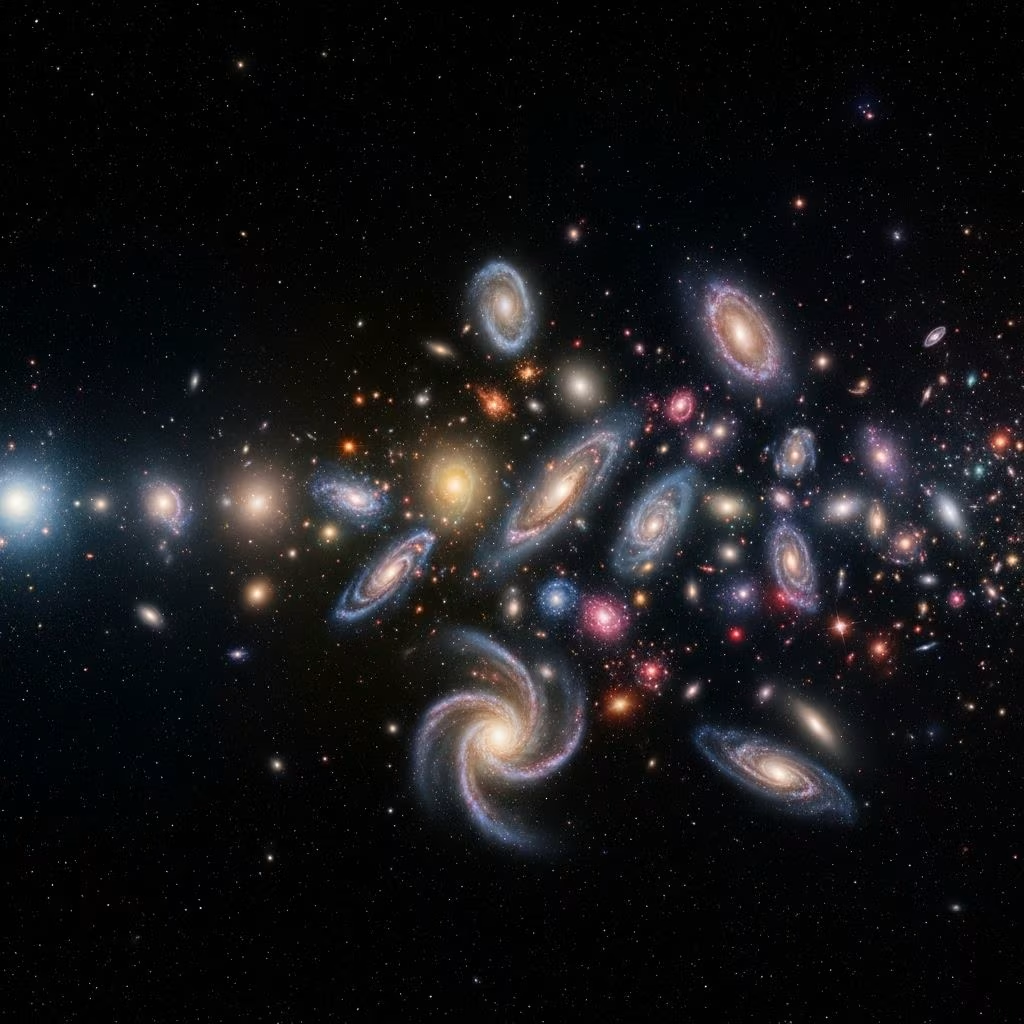
The universe encompasses all of space, time, matter, energy, and the laws that govern them. It is everything in existence, spanning billions of galaxies, each with hundreds of billions of stars, gas, dust, and dark matter. Our observable universe stretches roughly 93 billion light-years in diameter, a scope only made possible because of the universe’s expansion over billions of years.
Measuring the Universe’s Age: Core Concepts
- Big Bang Theory: Most astronomers agree the universe began with the Big Bang, a singularity event roughly 13.8 billion years ago.
- Cosmic Microwave Background (CMB): The CMB is the afterglow of the Big Bang, visible as faint microwave radiation left over from when the universe became transparent, about 380,000 years after the initial expansion.
- Expansion of the Universe: By studying how quickly galaxies are moving away from each other, scientists can infer the rate of expansion—and thus, the universe’s age.
The Main Methods for Determining the Universe’s Age
- Analyzing the CMB using satellites and ground-based telescopes.
- Observing the oldest stars and stellar populations (e.g., globular clusters).
- Studying galactic redshift and distances to remote galaxies.
- Modeling cosmic geometry and accounting for dark energy and matter.
Breakthrough Discoveries and Instruments
Two landmark projects stand out in the determination of cosmic age:
- Planck Space Observatory: Operated by the European Space Agency, Planck mapped the CMB with unprecedented resolution. Its results placed the universe’s age at approximately 13.8 billion years.
- Atacama Cosmology Telescope (ACT): Located in Chile, ACT has produced measurements that closely match Planck’s findings—roughly 13.77 billion years, with a margin of error of ±40 million years. This consensus marks a major success in cosmological precision.
Recent Debates: Is the Universe Even Older?
While the consensus sits at about 13.8 billion years, some astronomers have identified inconsistencies:
- Methuselah Star Paradox: Stars like the so-called Methuselah appear older than the established age of the universe, raising questions about cosmic chronology.
- Impossible Early Galaxies: Observations by the James Webb Space Telescope have revealed mature galaxies less than 300 million years after the Big Bang, suggesting a faster-than-expected evolution.
- New Models Propose a 26.7 Billion-Year-Old Universe: Rajendra Gupta’s model, incorporating revised interpretations of early galaxy data and redshift observations, posits that the universe could be more than twice as old as traditionally calculated.
Table: Established vs Alternative Age Estimates
| Method/Model | Estimated Age | Notes |
|---|---|---|
| Planck Mission (2015–2020) | 13.8 billion years | Consensus, most widely accepted |
| ACT (Atacama Cosmology Telescope) | 13.77 ± 0.04 billion years | Matches Planck’s findings |
| James Webb Space Telescope Observations | Challenges early galaxy formation models | Galaxies mature faster than expected |
| Gupta’s Model (2023) | 26.7 billion years | Alternative model, not consensus |
How Do We Know the Universe’s Age?
Cosmologists rely on multiple methods to triangulate the universe’s age:
- Studying the Oldest Light: The CMB provides a snapshot of the universe just 380,000 years after the Big Bang. By decoding tiny temperature variations, researchers extrapolate both the starting point and subsequent expansion rate.
- Hubble’s Law & Redshift: By measuring how fast other galaxies recede from ours (their redshift), scientists calculate the Hubble constant. This constant enables an estimate of the time since cosmic expansion began.
- Globular Clusters & Stellar Evolution: The oldest star clusters are 11–13 billion years old, acting as benchmarks for the minimum age of the universe.
Key Challenges and Ongoing Mysteries
Despite remarkable progress, several key puzzles persist:
- Discrepant Expansion Rates: Different measurement techniques sometimes yield slightly divergent values for the Hubble constant, causing discrepancies in calculated ages[10].
- Mature Early Galaxies: The presence of highly evolved galaxies soon after the Big Bang challenges standard cosmological timelines.
- Stars Older Than the Universe?: Some measurements of certain stars’ ages approach or even exceed the universe’s calculated age, sparking debate about stellar evolution models and data interpretation.
- Dark Matter & Dark Energy: These mysterious components make up most of the universe’s mass-energy, affecting its expansion history in ways not yet fully understood.
FAQ: Frequently Asked Questions on the Age of the Universe
Q: Why is the universe’s age estimated at about 13.8 billion years?
A: The 13.8 billion years figure is derived from precise measurements of the cosmic microwave background and the expansion rate of the universe, confirmed by both the Planck satellite and the ACT ground-based telescope.
Q: Why do some scientists argue the universe could be older?
A: Alternative models such as those proposed by Rajendra Gupta suggest an older universe (up to 26.7 billion years) based on revised interpretations of galaxy formation timelines and light redshift data. However, these models have not reached consensus.
Q: How does the James Webb Space Telescope challenge existing models?
A: Webb’s discovery of mature galaxies only 300 million years after the Big Bang implies galaxy formation may occur much faster, raising questions about standard age estimates and cosmic evolution.
Q: What tools do astronomers use to study the age of the universe?
- Planck Space Observatory – Mapped the cosmic microwave background.
- Atacama Cosmology Telescope (ACT) – Provided ground-based confirmation of Planck’s results.
- Hubble Space Telescope – Helped refine distance and expansion rate measurements.
- James Webb Space Telescope – Offers deeper observations of distant, early galaxies.
Q: Does science have a final answer on the universe’s age?
A: While the consensus centers around 13.8 billion years, astronomy is an evolving field. New data and models can disrupt established views, and ongoing research is continually improving our understanding of the universe’s true age.
Timeline: Key Discoveries in Measuring the Universe’s Age
- 1920s: Edwin Hubble’s observations confirm the universe is expanding.
- 1965: Discovery of the cosmic microwave background, supporting the Big Bang theory.
- 1990s: Increasingly precise measurements of the expansion rate with new instruments.
- 2000s–2010s: Planck Space Observatory and WMAP make precise CMB measurements.
- 2020s: ACT independently confirms universe’s age; James Webb discoveries challenge evolutionary timelines.
- 2023: Publication of models proposing an older universe, up to 26.7 billion years.
Why the Universe’s Age Matters
Knowing the age of the universe is crucial for understanding:
- The timeline of cosmic evolution: from the Big Bang, to star and galaxy formation, to our own solar system.
- The fate of the universe: quicker expansion due to dark energy could shape future cosmic events.
- Refining models of physics: Constraints on particle physics, stellar lifecycles, and cosmological constants.
- Our place in cosmic history: A precise timeline helps humanity understand its origins and the context of life on Earth.
Cosmic Measurement Techniques Explained
Cosmic Microwave Background (CMB)
The CMB is the relic heat from the Big Bang—a nearly uniform glow seen in all directions, corresponding to a temperature of 2.73 K. Tiny fluctuations in the CMB, mapped in detail by Planck and ACT, encode information about the universe’s initial conditions and subsequent expansion.
Galactic Redshift
When light travels from distant galaxies, its wavelength stretches due to the expansion of space—this is ‘redshift.’ By measuring redshifts and calibrating distances, astronomers determine how quickly space itself is expanding.
Globular Cluster Dating
Globular clusters, dense groups of ancient stars, are among the oldest objects in the universe. Their ages—measured by analyzing star brightness, composition, and models of stellar evolution—provide a lower bound for the universe’s true age.
Summary Table: Major Age Estimates and Implications
| Estimate | Source/Instrument | Implication |
|---|---|---|
| ~13.8 billion years | Planck, ACT, WMAP | Current scientific consensus |
| ~11–13 billion years | Globular clusters | Supports CMB-based estimates |
| ~26.7 billion years | New theoretical models (Gupta, 2023) | Challenges standard cosmology; not widely accepted |
Outlook: The Future of Universe Age Measurement
As technology evolves—enabling deeper looks into the universe’s earliest moments—cosmologists refine their methods and confront new anomalies. The next decade is likely to bring:
- Better calibration of the Hubble constant via new instruments and observations.
- More precise mapping of early galaxy formation and evolution.
- Philosophical implications if the universe proves to be much older than currently believed.
Frequently Asked Questions (FAQs)
Q: What is the cosmic microwave background?
A: The CMB is the leftover heat from the Big Bang, now observed as faint microwave radiation. It provides crucial data for determining the age and of the universe.
Q: Why do some stars appear older than the universe?
A: Measurement uncertainties and stellar evolution models can result in calculated ages for certain stars that slightly exceed the universe’s consensus age. These anomalies push scientists to improve data accuracy and theoretical models.
Q: Is there a single accepted age for the universe?
A: The most widely accepted age is about 13.8 billion years, but alternative models suggesting an older universe exist and are under investigation.
Q: How does the universe’s age affect astronomy?
A: The universe’s age sets the timeline for cosmic evolution, informs models of galaxy and star formation, and provides constraints for physics and cosmology.
Conclusion
Determining the age of the universe blends observation, theory, and intellectual curiosity. While most astronomers agree it is about 13.8 billion years old, ongoing discoveries and alternative hypotheses keep the scientific conversation vibrant. The true age of the cosmos not only illuminates our origins but inspires continuous exploration of the greatest mysteries.
References
- https://www.space.com/universe-age-14-billion-years-old
- https://www.space.com/7989-galactic-lenses-confirm-universes-age-size.html
- https://en.wikipedia.org/wiki/Age_of_the_universe
- https://www.popularmechanics.com/space/deep-space/a44547887/universe-age-twice-as-old-as-expected/
- https://wmap.gsfc.nasa.gov/universe/uni_age.html
- https://phys.org/news/2023-07-age-universe-billion-years-previously.html
- https://www.spacedaily.com/reports/Researchers_confirm_age_of_universe_at_138_billion_years_999.html
- https://cosmosmagazine.com/space/astrophysics/universe-27-billion-years-old/
- https://www.skyatnightmagazine.com/space-science/how-old-is-the-universe
- https://imagine.gsfc.nasa.gov/science/featured_science/tenyear/age.html
- https://www.jameswebbdiscovery.com/universe/universe-is-how-old-discovering-the-age-of-the-cosmos
- https://www.sci.news/astronomy/universe-age-12085.html
- https://science.slashdot.org/story/03/01/06/1217226/new-estimates-for-universes-age
- https://www.openaccessgovernment.org/age-of-universe-research-james-webb/163845/
- https://study.com/academy/lesson/how-to-calculate-the-age-of-the-universe.html
- https://scitechdaily.com/cosmic-paradigm-shift-new-research-doubles-universes-age-to-26-7-billion-years/
- https://bigthink.com/starts-with-a-bang/universe-13-8-or-26-7-billion-years/