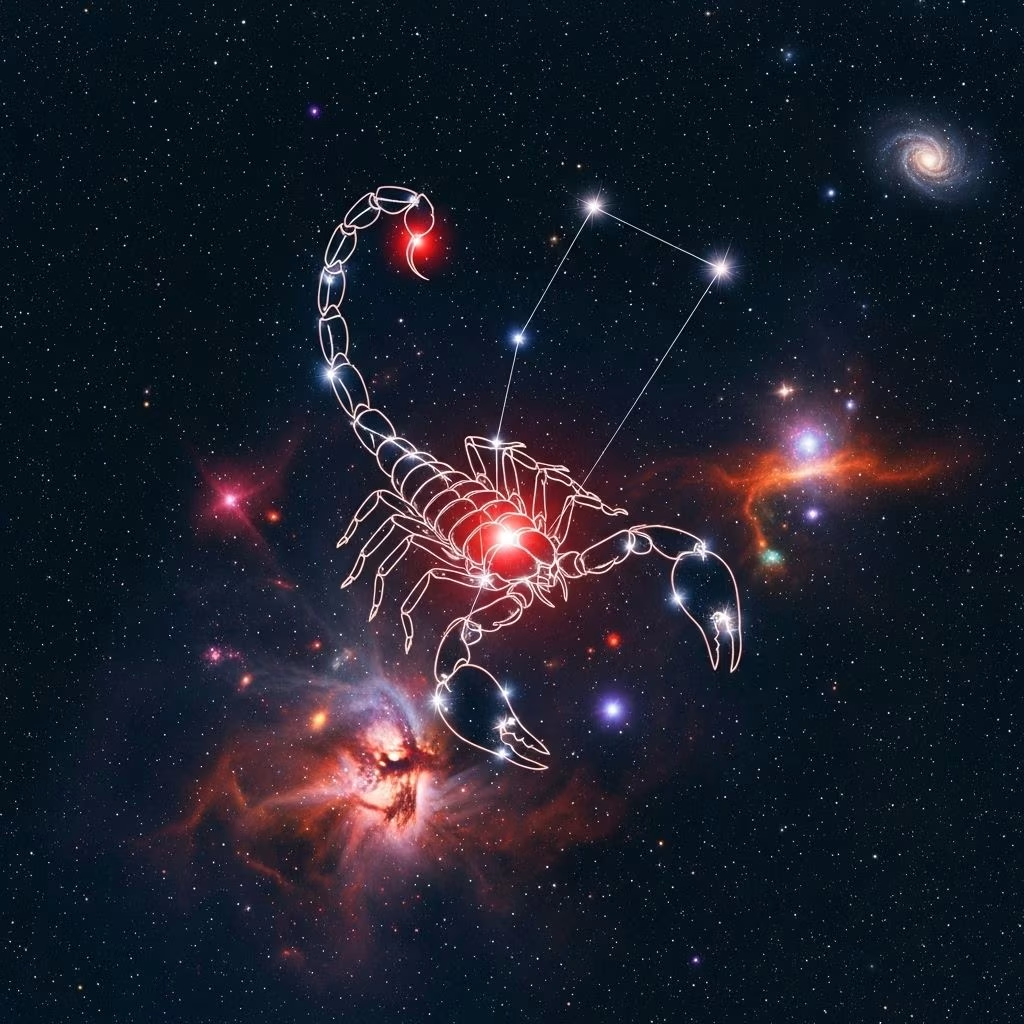
Among the night sky’s dazzling luminaries, few constellations rival the dramatic presence and astronomical richness of Scorpius. Known as the Scorpion, this ancient zodiac constellation is renowned for both its striking stellar pattern—evocative of a scorpion’s curved form—and the vibrant legends surrounding its stars. Nestled amid the dense heart of the Milky Way, Scorpius stands as a beacon for skywatchers, brimming with bright stars, clusters, nebulae, and a tapestry of mythos stretching back millennia.
Overview of Scorpius
Scorpius (♏) is a southern zodiac constellation whose roots pre-date Classical Greece, appearing in the sky maps of the Sumerians over 5,000 years ago. Traditionally depicting a scorpion, its most prominent feature is a J- or fishhook-shaped arc punctuated by the fiery red brilliance of Antares—the ‘heart’ of the scorpion.
- Latin Name: Scorpius (the Scorpion)
- Abbreviation: Sco
- Genitive (star names): Scorpii
- Quadrant: SQ3 (third quadrant of southern hemisphere)
- Family: Zodiac
- Area: ~497 square degrees (33rd largest)
- Best Visibility: July (southern hemisphere summer, northern hemisphere summer evenings)
- Latitude Range: +40° to -90° (highly visible in tropics and southern latitudes)
Scorpius in Mythology
Scorpius’ mythological tapestry is especially rich in Greek lore. According to legend, the scorpion was sent by the goddess Artemis (or Gaia, in some versions) to slay Orion, the great hunter, as penance for his boastfulness or threats against Earth’s creatures. As a result, Orion and Scorpius were set in the sky on opposite sides—when Scorpius rises, Orion sets, symbolizing the scorpion’s eternal pursuit of the hunter.
The Greeks, Babylonians, and earlier Sumerian star-watchers all associated this group of stars with a scorpion, marking its curved tail and poised stinger among the sky’s brightest stars.
- Ancient Sumerians referred to it as GIR-TAB, meaning “the scorpion.”
- Appears as part of the zodiacal band, playing a role in astrological traditions worldwide.
- Featured in stories across Asia and South America, frequently embodying danger, transformation, or protection.
Location and Visibility
Scorpius lies along the Milky Way’s luminous core, making it a key gateway to some of the richest star fields and deep-sky objects. Its “tail” stretches toward the constellation Sagittarius, while its “claws” reach toward Libra and Ophiuchus.
- Neighboring Constellations: Ara, Corona Australis, Libra, Lupus, Norma, Ophiuchus, Sagittarius
- Coordinates (approximate): Right Ascension 16h 52m, Declination −33°
- Best Viewing: High in the southern sky during June–August for northern observers; overhead in the southern hemisphere during winter.
Tip: Look for a hook-shaped “line” of stars close to the southern horizon in summer. Bright Antares makes the pattern easy to find even in light-polluted areas.
Notable Stars in Scorpius
Scorpius is distinguished by numerous bright stars, many with unique characteristics and histories. The constellation contains 18 officially named stars as recognized by the International Astronomical Union (IAU).
| Star Name | Bayer/Flamsteed | Type | Magnitude | Description |
|---|---|---|---|---|
| Antares | Alpha Scorpii | Red supergiant | 0.96 | Fiery ‘heart’ of the scorpion, one of the sky’s brightest stars |
| Shaula | Lambda Sco | B-type subgiant | 1.62 | Forms the scorpion’s stinger at the tail’s tip |
| Lesath | Upsilon Sco | B-type subgiant | 2.70 | Close pair with Shaula, marking the stinger |
| Dschubba | Delta Sco | B-type giant | 2.32 | Marks the forehead or the “bend” of the scorpion |
| Sargas | Theta Sco | F-type giant | 1.87 | On the tail, south of Antares |
In addition to these, Scorpius boasts several notable stars with exoplanets, including Pi Sco, which, like Antares, is among the sky’s most radiant objects.
Other Named Stars in Scorpius
- Acrab (Beta Sco)
- Alniyat (Sigma Sco and Tau Sco)
- Larawag (Epsilon Sco)
- Iklil (Rho Sco)
- Jabbah (Nu Sco)
- Xamidimura (Mu¹ Sco)
- Paikauhale (Pi Sco)
- Dìwö, Fuyue, Fang, Pipirima, Rapeto, Sharjah
Deep-Sky Objects within Scorpius
Located near the galactic center, Scorpius is a treasure trove for observers craving star clusters and nebulae. The constellation contains four Messier objects and multiple remarkable nebulae.
- Messier 4 (M4): A globular cluster just west of Antares, visible even with binoculars.
- Messier 6 (M6, Butterfly Cluster): An open cluster resembling a butterfly, rich with blue and orange stars.
- Messier 7 (M7, Ptolemy Cluster): A bright open cluster easily spotted with the naked eye; significant in ancient astronomy.
- Messier 80 (M80): A distant, compact globular cluster packed with aging stars.
Nebulae of Note:
- Cat’s Paw Nebula (NGC 6334): A star-forming region shaped like the print of a cat.
- Butterfly Nebula (NGC 6302): A planetary nebula with vivid colors and a distinctive wing-like structure.
- Cotton Candy Nebula
- Blue Horsehead Nebula (IC 4592): A faint reflection nebula with a blue hue.
- Fried Egg Nebula (Hen 3-1397): Named for its yellow core and pale surrounding ring.
- War and Peace Nebula (NGC 6357): A complex emission nebula filled with young, hot stars.
Key Facts and Figures
- Size: 33rd largest constellation, occupying 497 sq. degrees.
- Brightest Star: Antares (Alpha Scorpii), magnitude 0.96.
- Total Named Stars: 18 (recognized by IAU)
- Stars with Known Planets: 13–17 stars, depending on sources.
- Messier Objects: 4 (M4, M6, M7, M80).
- Meteor Showers: Alpha Scorpiids (peak April–May) and Omega Scorpiids (peak May–June).
- Right Ascension/Declination: RA 16h 52m, Dec –33°.
How to Locate Scorpius in the Night Sky
For many observers, Scorpius is among the easiest constellations to recognize thanks to its distinct pattern and bright red Antares.
- Find the constellation Libra to its west (left if facing south) and Sagittarius to its east (right).
- Look for the “J” shape (or fish hook) curling down toward the southern horizon in summer skies.
- Antares is easily spotted due to its reddish hue, outperforming most nearby stars in brightness.
- In dark sky locations, the Milky Way’s core—rising near Scorpius—provides a stunning backdrop brimming with star fields.
In the northern hemisphere, the scorpion does not rise high in the sky; in latitudes south of the equator, it sits dramatically overhead in winter months, offering superb viewing.
Scientific Importance and Cultural Significance
As a zodiac constellation, Scorpius has held symbolic and practical roles across civilizations:
- One of the 12 zodiac signs traversed by the Sun in its annual journey across the sky.
- Featured in numerous ancient texts and sky maps due to its proximity to the Milky Way’s center.
- Continuously observed by astronomers for its exoplanet-hosting stars and dynamic variable stars, including the red hypergiant AH Scorpii—among the largest stars discovered.
- Its shape and legend inspire art, literature, and even astrological forecasts to this day.
Frequently Asked Questions (FAQs)
Q: When is the best time to view Scorpius?
A: Scorpius is best observed during July through August, high in the southern sky after sunset. In the northern hemisphere, look towards the southern horizon on midsummer evenings; in the southern hemisphere, Scorpius is virtually overhead during winter nights.
Q: What is the brightest star in Scorpius?
A: Antares (Alpha Scorpii) is the constellation’s brightest star, a prominent red supergiant often compared in brightness and hue to Mars.
Q: How do I find Scorpius from a city?
A: Despite light pollution, Antares and the J-shaped curve are often visible from urban locations. Look to the south around 10 p.m. local time in July. If you see a bright reddish star low in the southern sky, you’re likely spotting Antares.
Q: What deep-sky objects can I see in Scorpius?
A: With binoculars, search for the Butterfly Cluster (M6) and Ptolemy Cluster (M7) as bright, hazy patches. Telescopes reveal globular clusters (M4, M80) and prominent nebulae like the Cat’s Paw and Butterfly Nebulae.
Q: Why is Scorpius linked with Orion in mythology?
A: Greek myth states that Orion, the great hunter, was slain by a scorpion. As a result, the two constellations lie on opposite sides of the sky—so they are never seen together, symbolizing the hunter forever fleeing his nemesis.
Quick Facts: Scorpius at a Glance
- Scorpius is one of the zodiac’s most easily recognized constellations, visible on clear summer nights.
- Home to Antares, several brilliant clusters, nebulae, and a rich array of double stars.
- The constellation is steeped in myth and is prominent in many world star lore traditions.
- Ideal for both binocular and telescope observation from southern and tropical latitudes.
See Also
- Other Zodiac Constellations: Aries, Taurus, Gemini, Cancer, Leo, Virgo, Libra, Sagittarius, Capricornus, Aquarius, Pisces
- Featured Deep-Sky Objects: Messier 4, Messier 6, Messier 7
- Milky Way Features: Central bulge, star-forming regions
References
- https://www.constellation-guide.com/constellation-list/scorpius-constellation/
- https://theplanets.org/constellations/scorpius-constellation/
- https://en.wikipedia.org/wiki/Scorpius
- https://theskylive.com/sky/constellations/scorpius-constellation
- https://www.go-astronomy.com/constellations.php?Name=Scorpius
- https://www.britannica.com/place/Scorpius
- https://www.space.com/21738-scorpius-constellation-explained.html
- https://star-name-registry.com/constellations/scorpius
- https://www.centreofexcellence.com/scorpio-constellation/
- https://starregister.org/scorpius.php
- https://astrobackyard.com/scorpius-constellation/
- https://www.space.com/26372-scorpius-constellation-night-sky-skywatching.html
- https://www.constellation-guide.com/constellation-list/Scorpius-constellation/
- https://www.solarsystemquick.com/universe/scorpius-constellation
- https://www.underthenightsky.com/constellations/scorpius/
- https://nineplanets.org/scorpius-constellation/
- https://www.planetguide.net/scorpio-constellation/
- https://www.jameswebbdiscovery.com/universe/100-interesting-facts-about-the-scorpius-constellation