Saturn: The Solar System’s Majestic Ring Bearer
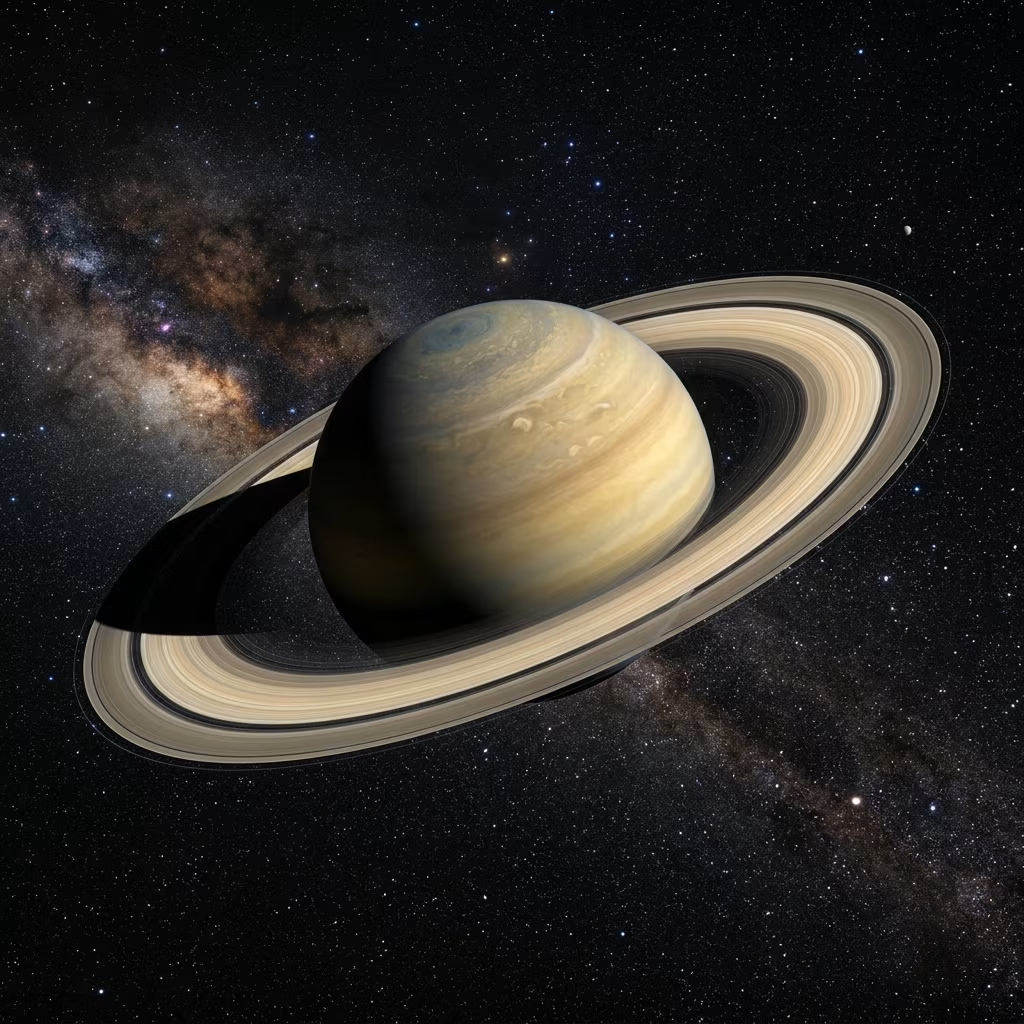
Saturn stands as one of the most breathtaking and enigmatic worlds in our solar system. A gas giant famed for its spectacular ring system, Saturn has inspired astronomers and captivated the public imagination for centuries. This article explores the planet’s dynamic features, the structure and mystery of its rings, its swirling atmosphere, fascinating moons, and the discoveries that continue to deepen our understanding of this celestial marvel.
Quick Facts About Saturn
- Type: Gas giant (second largest after Jupiter)
- Distance from Sun: ~1.43 billion km (890 million miles)
- Orbital Period: ~29.5 Earth years
- Known Moons: Over 80 confirmed (including Titan, Enceladus, and Rhea)
- Diameter: ~116,460 km (72,366 miles)
- Day Length: 10 hours, 33 minutes (rotation period)
- Atmosphere: Hydrogen, helium, traces of other gases
- Distinguishing Feature: Most extensive ring system in the solar system
Saturn in History
Known since ancient times as one of the five planetary ‘wanderers’ observed with the naked eye, Saturn’s distinctive yellowish appearance led cultures worldwide to weave myths around it. The planet is named after the Roman god of agriculture, paralleling the Greek god Cronus. However, the most astonishing aspect of Saturn—its rings—remained invisible until the advent of telescopic astronomy.
Early Observations
- 1610 – Galileo Galilei: First to observe Saturn’s unusual ‘ears’ through a telescope, but could not explain their nature.
- 1655 – Christiaan Huygens: Correctly identified a ‘thin, flat ring, nowhere touching the body, and inclined to the ecliptic.’
- 1675 – Giovanni Cassini: Discovered the major gap in the ring system now called the Cassini Division.
Modern Discoveries
The exploration of Saturn accelerated with robotic missions in the 20th and 21st centuries. NASA’s Pioneer 11, Voyager 1 and 2, and the crowning achievement, the Cassini-Huygens mission, offered up-close studies of the planet, rings, and moons.
- Pioneer 11: First flyby (1979), confirming the existence of thin outer rings and the magnetic field.
- Voyager 1 & 2: Provided detailed images and discovered new moons and ring features (1980–1981).
- Cassini-Huygens: Entered Saturn orbit in 2004, and for over 13 years, delivered unprecedented detail about the planet, rings, and satellites.
Saturn’s Rings: Structure and Composition
Saturn boasts the most extensive and visually stunning ring system of any planet in the solar system. They define the planet’s appearance and have long been a subject of wonder and scientific intrigue.
Major Ring Types and Features
The rings are labeled in order of discovery rather than distance from Saturn:
- D Ring: Faint, closest to Saturn.
- C Ring: Faint but wider and inside the B ring.
- B Ring: Brightest and most massive ring.
- Cassini Division: Dark gap dividing the B and A rings (discovered by Cassini).
- A Ring: Bright, located outside the Cassini Division.
- F Ring: Thin, braided, just outside the A ring, “shepherded” by two small moons (Prometheus and Pandora).
- G and E Rings: Fainter, farther from the planet; E ring is diffuse and enormous, extending from Mimas to Titan.
| Ring | Distance from Center (km) | Width (km) | Notes |
|---|---|---|---|
| D | 66,900–74,510 | 7,500 | Very faint, closest to planet |
| C | 74,658–92,000 | 17,500 | Translucent, inside B ring |
| B | 92,000–117,580 | 25,500 | Brightest, massive |
| Cassini Div. | 117,580–122,170 | 4,700 | Major gap |
| A | 122,170–136,775 | 14,600 | Outside Cassini Division |
| F | 140,210 | Less than 100 | Thin and braided |
| G | 166,000 | 8,000 | Faint |
| E | 180,000–480,000 | 300,000 | Very diffuse, largest ring |
Physical Properties
- Composition: About 99% water ice with minor rocky components.
- Particle Size: Micrometers up to several meters.
- Thickness: Main rings are generally less than 100 meters (300 feet) thick—even thinner compared to their immense radial span.
- Total mass: Estimated at only about half the mass of Saturn’s moon Mimas.
Ring Origins and Lifespan
The formation of Saturn’s rings remains debated. Early models suggested they are primordial, but Cassini data suggests a much younger age—perhaps only a few hundred million years old. The likely origin involves the destruction of an ancient moon or comet, shattered by Saturn’s gravity and then distributed into the spectacular rings visible today.
Ring Structure and Gaps
- Major gaps such as the Encke and Cassini Divisions are shaped by small embedded moons.
- Many smaller “ringlets” and density waves are produced by gravitational resonances with satellites.
- Shepherd moons maintain sharp boundaries, especially in narrow rings like the F ring.
Dynamic Atmosphere of Saturn
Saturn’s atmosphere is primarily hydrogen and helium, with trace amounts of ammonia, methane, water vapor, and hydrocarbons. The atmospheric features, though less dramatic than Jupiter’s Great Red Spot, display extraordinary weather patterns and seasonal changes.
Major Features
- Belts and Zones: Alternating bands caused by fast winds, reaching up to 1,800 km/h (1,100 mph) at the equator.
- Storms: Periodic “Great White Spots” (planet-wide storms) can erupt roughly once every Saturn year.
- Hexagonal Jet Stream: A unique, persistent hexagon-shaped wave pattern at the planet’s north pole, with an eye-like central vortex.
- Seasonal Changes: Saturn’s 27-degree axial tilt produces long, slow-moving seasons lasting over seven Earth years each.
Magnetosphere and Internal Structure
- Magnetosphere: Saturn’s rapid rotation generates a substantial magnetic field, though weaker than Jupiter’s. This field traps charged particles and interacts with the solar wind, creating auroras near the poles.
- Interior: Likely composed of a rocky core, an extensive layer of metallic and molecular hydrogen, and a small fraction of helium, with gradual transitions between each layer.
- Wind Speeds: Winds on Saturn can exceed 1,800 km/h (1,100 mph) at the equator, making them some of the fastest in the solar system.
Saturn’s Moons: A Diverse Collection of Worlds
Saturn’s satellite system is vast and incredibly varied, with more than 80 confirmed moons. These range from large, diverse worlds like Titan to tiny, irregularly shaped ‘moonlets’ embedded in and near the rings.
Major Moons
| Moon | Diameter (km) | Notable Features |
|---|---|---|
| Titan | 5,151 | Thick nitrogen atmosphere, hydrocarbon lakes, potential for life |
| Rhea | 1,527 | Craters, wispy icy surface |
| Enceladus | 504 | Active geysers, subsurface ocean |
| Mimas | 396 | Large crater (Herschel), ice surface |
| Dione | 1,123 | Icy canyons, bright wisps |
| Hyperion | 270 | Irregular shape, sponge-like appearance |
| Iapetus | 1,471 | Two-toned coloration, equatorial ridge |
- Titan: Saturn’s largest moon and the second-largest in the solar system. Features a thick, nitrogen-rich atmosphere, methane lakes, and a landscape eerily reminiscent of early Earth.
- Enceladus: Known for its icy surface and plumes of water vapor and organic molecules, indicating a subsurface ocean and raising the prospect of habitability.
- Mimas: Nicknamed the “Death Star moon” due to its large Herschel crater.
Ring Moons and Shepherd Moons
- Small satellites such as Prometheus and Pandora shepherd the F ring, preventing it from dispersing.
- Other “moonlets” like Pan and Daphnis clear distinct gaps in the rings (Encke and Keeler gaps).
Saturn’s Rings and Solar System Formation
The study of Saturn’s rings sheds light not just on the planet but on planetary system formation itself. The composition, structure, and age of the rings provide clues about the processes that shaped not only Saturn but also the other planets and moons in the early solar system. The finely detailed structure visible today results from billions of years of gravitational interactions, collisions, and evolutionary change.
How to Observe Saturn from Earth
- Saturn is easily spotted with the naked eye as a bright, yellowish “star” depending on its position along the ecliptic.
- Even a small telescope reveals the planet’s ring system.
- Best viewing is when Saturn is in opposition—directly opposite the Sun in the sky—when it is closest and brightest.
- Rings tilt toward or away from Earth in a ~29.5-year cycle, dramatically affecting their visibility from our vantage point.
Frequently Asked Questions (FAQs)
Q: Can Saturn’s rings be seen without a telescope?
A: No, Saturn’s rings are not visible to the naked eye. However, Saturn itself can be seen, and the rings are clearly visible with a small backyard telescope.
Q: How many rings does Saturn have?
A: Saturn has seven major ring groups (D, C, B, A, F, G, and E), with countless thin ringlets and gaps within those regions.
Q: Are Saturn’s rings permanent?
A: The rings are likely temporary on cosmic timescales—possibly a few hundred million years old, and current research suggests they may eventually dissipate due to gravitational and meteorite influences.
Q: What are Saturn’s rings made of?
A: Primarily water ice, mixed with small amounts of dust and rocky material. Most particles are about the size of snowballs or smaller.
Q: What makes Saturn different from Jupiter?
A: While both are gas giants, Saturn is known for its extensive, bright ring system and slightly lower density—Saturn could theoretically float in water.
Q: What is the Cassini Division?
A: The Cassini Division is a prominent gap about 4,700 km (2,920 miles) wide between Saturn’s A and B rings, caused by resonances with the moon Mimas.
Conclusion: The Legacy of Saturn
Saturn remains a world of wonders—a dynamic planet, a system of dazzling rings, and a menagerie of moons, each holding its share of surprises. As robotic explorers continue to send back data and as Earth-based observatories improve, our picture of Saturn grows sharper. This great planet not only teaches us about the diversity and beauty of our solar system but also offers clues about planet and satellite formation on a cosmic scale. No matter how much we learn, Saturn will always stand as the solar system’s grand ring bearer, a captivating symbol of scientific discovery and awe.
References
- https://science.nasa.gov/resource/saturns-rings-2/
- https://en.wikipedia.org/wiki/Rings_of_Saturn
- https://science.nasa.gov/saturn/facts/
- https://www.amnh.org/explore/news-blogs/saturns-rings-solar-system-formation
- https://www.space.com/23235-rings-of-saturn.html
- https://www.skyatnightmagazine.com/space-science/a-guide-to-the-rings-of-saturn
- https://en.wikipedia.org/wiki/Saturn’s_rings
- https://www.ebsco.com/research-starters/science/saturns-ring-system
- https://www.youtube.com/watch?v=S9fBi0gxr-Q
- https://www.britannica.com/place/Saturn-planet/The-ring-system
- https://www.universityofcalifornia.edu/news/how-saturn-got-its-rings
- https://www.livescience.com/space/saturn/saturn-facts-about-the-ringed-planet
- https://www.planetary.org/articles/rings-of-the-solar-system
- https://www.youtube.com/watch?v=6Bv8g5xBJSo
- https://wonderdome.co.uk/rings-of-saturn-facts/
- https://study.com/learn/lesson/saturn-facts-rings-temperature-size.html
- https://www.britannica.com/place/Saturn-planet
- https://science.howstuffworks.com/rings-of-saturn.htm