What Are Redshift and Blueshift?
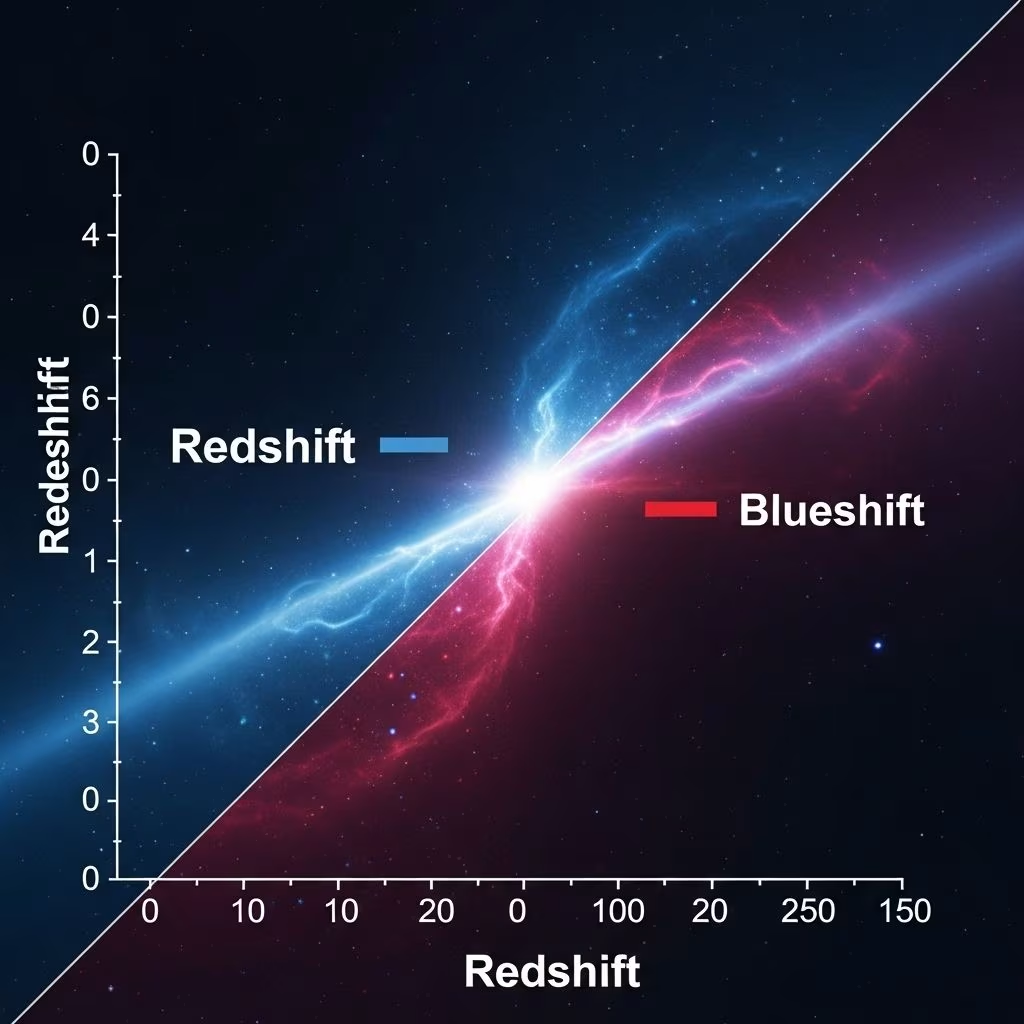
Redshift and blueshift are fundamental concepts in astronomy, describing how the light from celestial objects changes as they move relative to an observer. These phenomena are crucial for unraveling the motion of stars, galaxies, and even the evolution of the universe itself. By observing shifts in the wavelengths of light, astronomers can decode movements across vast cosmic distances.
Overview of Spectral Shifts
- Redshift: Occurs when light or other electromagnetic radiation from an object increases in wavelength, shifting toward the red part of the spectrum. This is typically observed when an object is moving away from the observer.
- Blueshift: Happens when the wavelength decreases, shifting light toward the blue spectrum. This indicates an object is moving closer to the observer.
The terms stem from the visible light spectrum’s color extremes—red (longer wavelengths) and blue (shorter wavelengths).
Understanding the Doppler Effect
The Doppler Effect is central to spectral shifts. It describes how light or sound waves are compressed or stretched by the motion of the source relative to the observer:
- If a light source moves away, its waves are stretched, resulting in redshift.
- When a source approaches, waves are compressed, leading to blueshift.
This effect is analogous to how an ambulance siren sounds higher-pitched as it approaches and lower as it recedes[12].
The Scientific Definition of Redshift and Blueshift
Scientifically, redshift (z) is quantified using the difference between emitted and observed wavelengths:
| Definition | Equation |
|---|---|
| Redshift by wavelength | z = (λ_observed – λ_emitted) / λ_emitted |
| Redshift by frequency | z = (f_emitted – f_observed) / f_observed |
| Wavelength ratio | 1 + z = λ_observed / λ_emitted |
| Frequency ratio | 1 + z = f_emitted / f_observed |
Doppler effect redshift applies if the source is receding (z > 0), while Doppler blueshift is for a source approaching (z < 0).
Types of Redshift: Beyond Movement
Redshift doesn’t arise only from relative motion. Astronomy recognizes three main forms:
- Doppler Redshift: Caused by relative motion—galaxies moving away produce this shift.
- Gravitational Redshift: Arises when light escapes a strong gravitational field. The energy loss stretches its wavelength.
- Cosmological Redshift: Results from the universe’s expansion, stretching light as space itself grows. This is fundamental to understanding the observable universe and its origins.
Other processes like scattering can shift a light’s frequency, but these are distinguished from true astronomical redshift.
Measuring Redshift and Blueshift in Practice
Astronomers use telescopes and spectrometers to analyze light from stars and galaxies. By comparing the observed spectra to laboratory standards, they identify shifts in spectral lines—such as those of hydrogen—in star and galaxy light.
- Absorption lines: Dark lines at specific wavelengths caused by elements absorbing certain light frequencies.
- Emission lines: Bright lines indicating the frequencies at which atoms emit energy.
Shifts in these lines reveal redshift or blueshift, indicating an object’s motion relative to Earth.
Redshift in Cosmology: Mapping the Universe
Redshift is foundational to understanding the large-scale structure and history of the cosmos:
- Distant galaxies exhibit cosmological redshift, providing evidence that the universe is expanding.
- The Big Bang is supported by the observation that primordial heat has redshifted into the cosmic microwave background—now detectable only in the microwave part of the spectrum.
- Redshifts enable automated surveys that map galaxy positions and movements, helping astronomers model cosmic evolution.
Interpreting Blueshift: When Objects Approach
In contrast, blueshift is less commonly seen in cosmic terms, but it reveals objects moving toward us. Some nearby galaxies, such as the Andromeda Galaxy, display a blueshift because they approach the Milky Way. This phenomenon helps astronomers predict future interactions and collisions between galaxies[12].
Redshift and Blueshift in Everyday Technology
- Doppler Radar: Used for weather prediction, radar guns, and navigation, all based on tracking frequency shifts.
- Medical Imaging: Technologies apply similar principles to study blood flow and motion inside the body.
Even gravitational waves, detected from cataclysmic cosmic events, experience redshift and blueshift as they traverse the universe.
Historical Significance: The Story of Cosmic Expansion
The concept of redshift revolutionized astronomy. In the early 20th century, Edwin Hubble’s observations revealed that most galaxies showed a significant redshift, proving they were moving away from us. This led to the momentous discovery of the expanding universe, the backbone of modern cosmology.
- Hubble’s Law: The farther away a galaxy, the greater its redshift, and thus its speed of recession.
- Cosmological Principle: Redshift surveys have helped confirm that the universe is homogeneous and isotropic at large scales.
Calculation Examples: Applying the Equations
| Scenario | Observed Wavelength (λobsv) | Emitted Wavelength (λemit) | Redshift (z) |
|---|---|---|---|
| Neutral hydrogen line in galaxy | 660 nm | 656 nm | z = 0.0061 |
| Medium-redshift galaxy | 750 nm | 500 nm | z = 0.5 |
| High redshift quasar | 1450 nm | 500 nm | z = 1.9 |
These calculations demonstrate how astronomers determine how fast, and how far, cosmic objects are moving.
Why Redshift and Blueshift Matter
- Mapping Cosmic Motion: Chart movement of galaxies and the structure of the universe.
- Measuring Expansion Rate: Underpins calculations of the Hubble constant and universe’s age.
- Testing Physics: Confirms predictions from general relativity about gravity’s effects on light.
- Detecting Cosmic Events: Used to study explosive origins like quasars or the afterglow of gravitational waves.
Common Misconceptions
- Redshift is not simply a product of local movement—it can arise from gravitational effects and from the stretching of space itself.
- Blueshift is less frequent cosmologically but is crucial for understanding local dynamics, like galactic mergers.
- Other optical phenomena may alter light frequency, but only Doppler, gravitational, and cosmological shifts are termed redshift or blueshift in astronomy.
Frequently Asked Questions (FAQs)
Q: Does redshift always mean an object is moving away?
A: Not always. Redshift can result from the object’s motion, but also from strong gravitational fields or expansion of space itself.
Q: How do astronomers measure redshift?
A: By comparing the observed spectral lines of astronomical objects to known laboratory frequencies, astronomers deduce the shift and calculate the redshift value.
Q: What is cosmological redshift?
A: This form of redshift is caused by the stretching of space between objects as the universe expands. It is seen in the light from very distant galaxies and is key evidence for the Big Bang theory.
Q: Can we observe blueshift from stars or galaxies?
A: Yes, blueshift is observed when celestial objects move toward Earth—such as Andromeda Galaxy. It provides insight into future galactic collisions and local dynamics.
Q: How do redshift and blueshift influence technology?
A: The principles underpin technologies like Doppler radar and medical imaging—tools that employ frequency shifts to measure movement and flow in various settings.
Conclusion: The Power of Spectral Shifts
Redshift and blueshift are the keys to understanding cosmic motion, revealing the dynamics of stars, galaxies, and the evolution of space itself. Through meticulous measurement and analysis of spectral changes, astronomers continue to unlock the secrets of our universe’s past, present, and future.
References
- https://www.space.com/25732-redshift-blueshift.html
- https://en.wikipedia.org/wiki/Redshift
- https://lco.global/spacebook/light/redshift/
- https://www.youtube.com/watch?v=QL3JeOldO7U
- https://www.iflscience.com/what-are-redshift-and-blueshift-and-why-do-they-matter-71119
- https://itu.physics.uiowa.edu/labs/advanced/astronomical-redshift
- https://ui.adsabs.harvard.edu/abs/2021APS..NEFC01009S/abstract
- https://ned.ipac.caltech.edu/help/zdef.html
- https://www.youtube.com/watch?v=uqfMtb93L3w
- https://en.wikipedia.org/wiki/Blueshift
- https://www.vaia.com/en-us/textbooks/physics/university-physics-3-edition/chapter-5/problem-10-explain-the-meaning-of-the-terms-red-shift-and-bl/
- https://www.tutorchase.com/answers/ib/physics/how-do-you-differentiate-between-redshift-and-blueshift-in-the-doppler-effect
- https://ui.adsabs.harvard.edu/abs/2017APS..APR.L1023S/abstract
- https://www.inverse.com/science/redshift-blueshift-definition
- https://www.intelligentdesigneronline.com/drhoades/advanced/labs/emission_lab/emissionLab3.php?debug=1
- https://science.nasa.gov/mission/hubble/science/science-behind-the-discoveries/hubble-cosmological-redshift/
- https://www.howitworksdaily.com/the-difference-between-redshift-and-blueshift/