The Star of Bethlehem: Science Meets Scripture
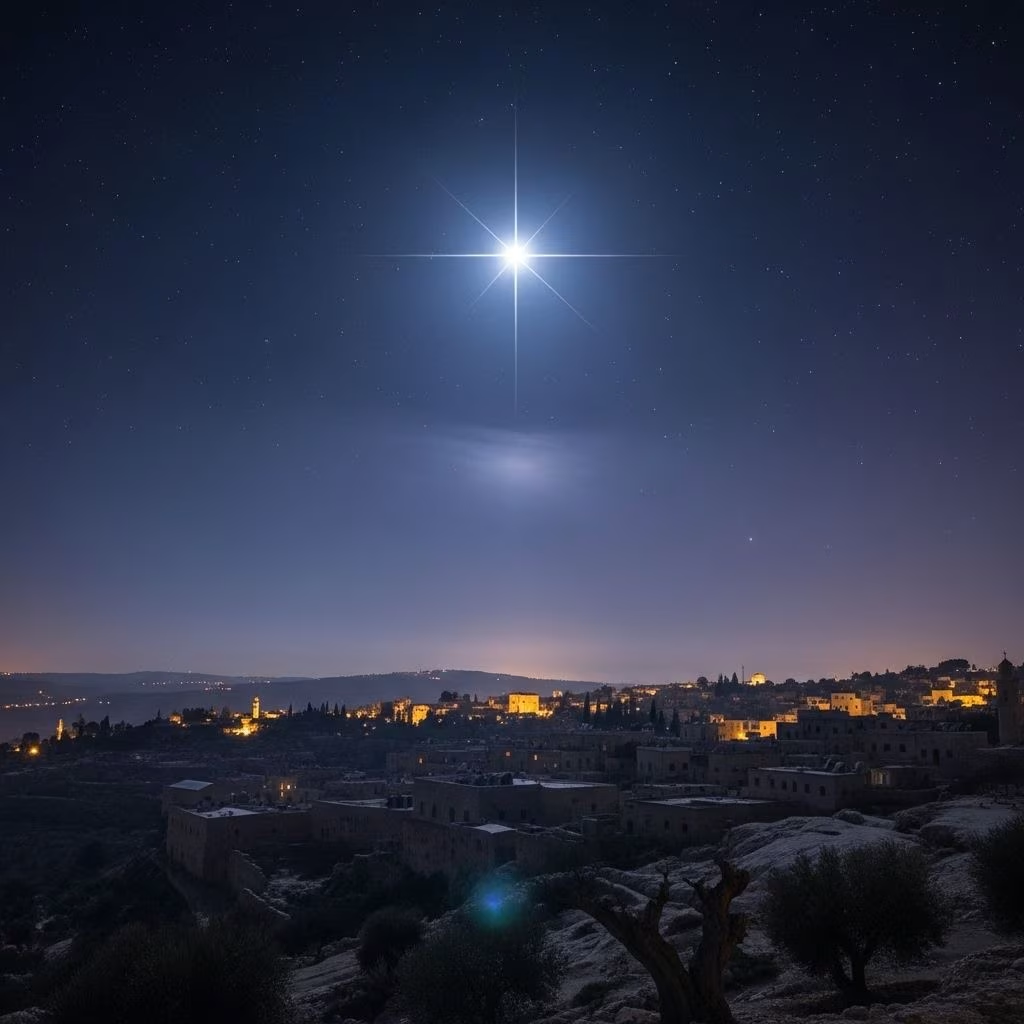
The Star of Bethlehem, also called the Christmas Star, remains one of the most compelling intersections of faith, history, and astronomy. Described in the Gospel of Matthew, the star is said to have guided wise men (Magi) from the East to Jerusalem, marking the birth of Jesus and leading them to Bethlehem. The phenomenon’s true nature has inspired centuries of debate, scientific inquiry, and theological reflection.
Contents
- The Ancient Account: The Magi and the Christmas Star
- Scientific Theories: What Could the Star Have Been?
- The Planetary Conjunction Hypothesis
- Supernova or Comet Hypotheses
- The Star’s Historical and Cultural Significance
- Interpretations and Scholarly Debates
- Frequently Asked Questions
The Ancient Account: The Magi and the Christmas Star
The story of the Star of Bethlehem is found in the Gospel of Matthew, chapter 2. According to the narrative:
- Magi, regarded as wise men or astrologers from the East, observed a star that signified the birth of the “king of the Jews.”
- They journeyed to Jerusalem and inquired about the newborn king, leading to an encounter with King Herod.
- Herod, fearing for his rule, consulted religious scholars who pointed to Bethlehem as the prophesied birthplace.
- The star is said to have reappeared, guiding the Magi to Bethlehem, where they offered gifts to the infant Jesus.
- The wise men received a divine warning to avoid Herod on their return journey.
The star story is woven into Christian tradition and is celebrated at Epiphany (January 6) in Western Christianity.
Key Features of the Biblical Star
- Signified birth and kingship
- Connected to the Jewish nation
- Rose in the East and was not initially recognized by King Herod
- Endured over time and guided the Magi
- Stopped over Bethlehem, identifying the exact location
Scientific Theories: What Could the Star Have Been?
For centuries, scholars and scientists have tried to root the mysterious star in tangible astronomical phenomena. The main contenders include:
- Planetary conjunctions
- Supernovae
- Comets
- Meteor showers
Experts generally rule out a meteor, since such an object burns up in the atmosphere within seconds and cannot be observed or followed over weeks as described in the biblical story.
The evidence for a supernova is also weak. No known supernova remnants coincide with the era of Jesus’ birth, and ancient records would likely have mentioned such a remarkable celestial event.
The Planetary Conjunction Hypothesis
Many astronomers point to a planetary conjunction—a seeming close approach of planets as seen from Earth—as the likeliest scientific explanation for the Star of Bethlehem. Such conjunctions can create a strikingly bright object, visible for extended periods and possibly interpreted as a portent.
- Jupiter and Saturn: Around 7–6 BCE, there was a rare triple conjunction between Jupiter and Saturn. This means the two planets appeared close together three times in a short period.
- Jupiter, Regulus, and Venus: In 3–2 BCE, Jupiter (the ‘king planet’) passed close to Regulus (the ‘king star’) and later formed a close conjunction with Venus. This occurred near the time hypothesized for Jesus’ birth. In the June 2 BCE conjunction, Jupiter and Venus would have appeared nearly as a single, intensely bright beacon.
- In ancient astrology and symbolism, Jupiter was connected to kingship and righteousness, while Venus represented fertility and love.
- Some researchers, using astronomy simulation software, argue that these conjunctions—their timing, brightness, and celestial configuration—could meet many of the biblical description’s criteria.
| Event | Year (BCE) | Likely Visibility | Relevance |
|---|---|---|---|
| Jupiter–Saturn Triple Conjunction | 7–6 BCE | High (unusual alignment) | Royal symbolism, dramatic sky configuration |
| Jupiter–Regulus–Venus Alignment | 3–2 BCE | Very bright, closely merged | “King planet” meets “King star” and “fertility” planet |
Notably, there has not been as close a Venus-Jupiter conjunction since 2 BCE. Astronomers suggest that such an event would have drawn the attention of ancient sky watchers, especially those trained in astrology such as the Magi.
Supernova or Comet Hypotheses
The supernova hypothesis presumes that an exploding star might have created a new, bright object in the night sky. While supernovae are dramatic and can remain visible for months, there is little supporting evidence for one occurring around 5–3 BCE. Remnants of known supernovas do not match with required dates, and historical records are silent.
The comet theory suggests that a comet could have been interpreted as a sign. Comets, with their glowing heads and tails, were often seen as celestial omens in antiquity. However:
- No component comet was documented by Chinese or Babylonian astronomers during the relevant time frame.
- Comets were generally considered harbingers of doom, not blessings or new births, in ancient cultures.
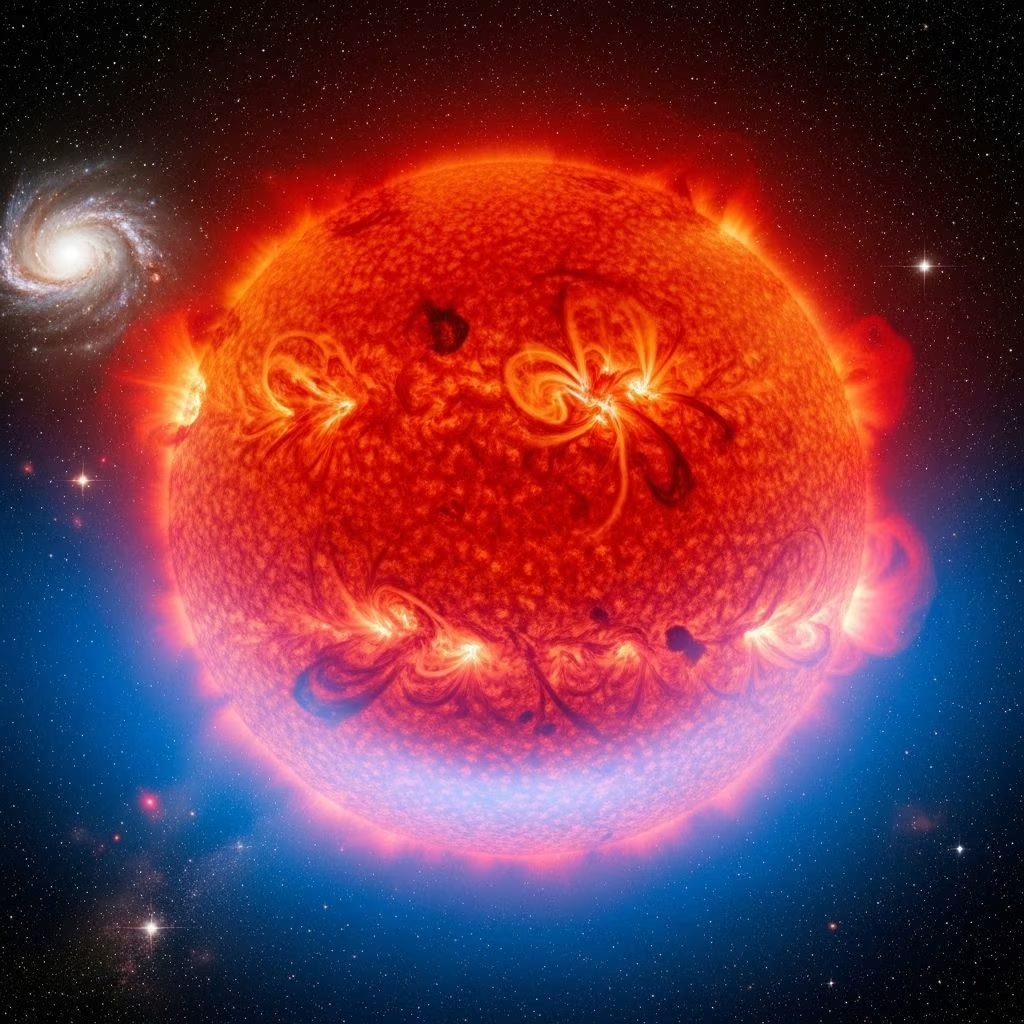
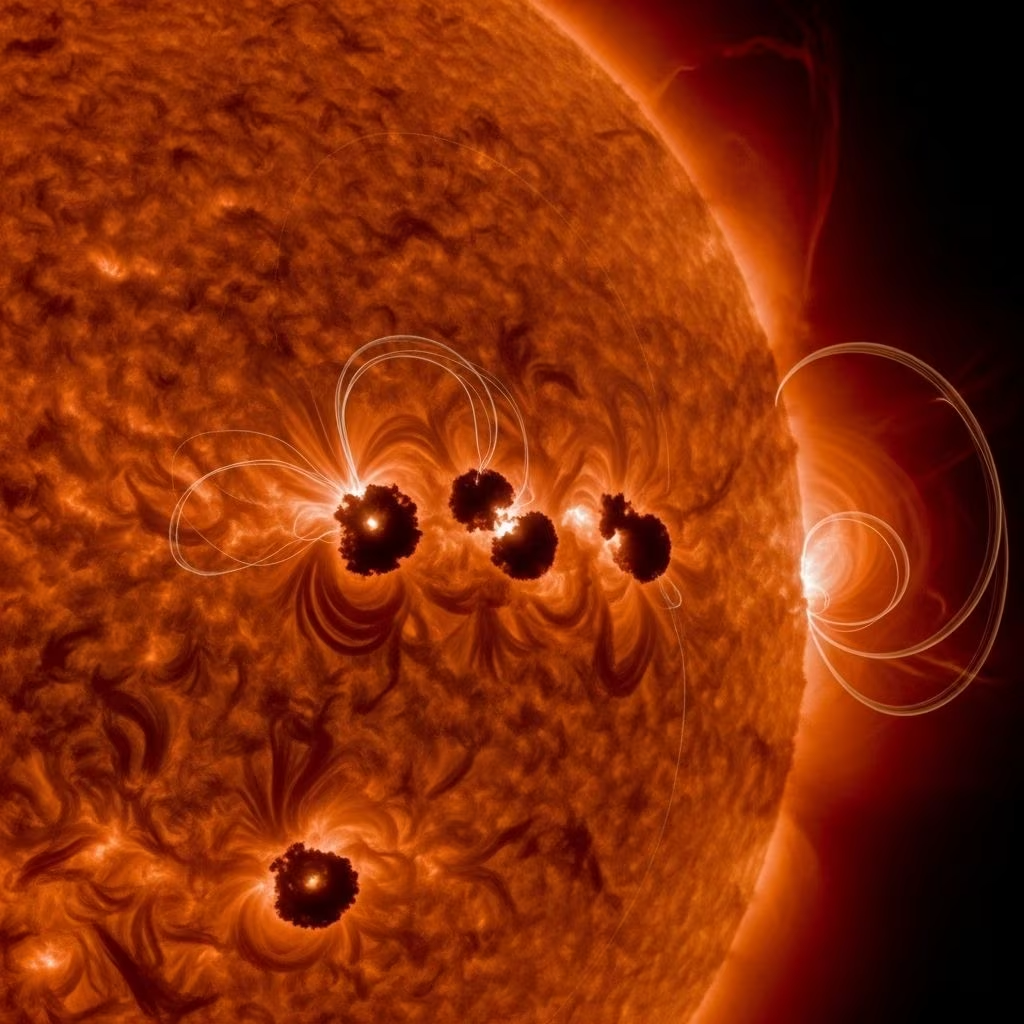
Other theories, such as a nova (brief stellar flare-up), solar flares, or a mysterious new object, are generally unsubstantiated due to lack of evidence.
The Star’s Historical and Cultural Significance
The Star of Bethlehem’s place in Christian tradition is profound. It appears at the intersection of prophecy and divine intervention, associated with the birth of Jesus and the fulfillment of ancient predictions.
- For many believers, the star is a miraculous sign demonstrating God’s power.
- In religious art, music, and storytelling, the star signifies hope, guidance, and the fulfillment of messianic prophecy.
- The event is commemorated during Epiphany celebrations in Christianity.
- The story has inspired countless planetarium shows, scholarly investigations, and artistic depictions.
Meanwhile, most ancient sources—and Church tradition—imply the Magi arrived in Bethlehem some time after the actual birth. This is inferred from language in the Gospel account and Herod’s order to kill male infants up to two years old.
Interpretations and Scholarly Debates
The Star of Bethlehem continues to be a subject of vigorous debate. Opinions broadly fall into three camps:
- Miraculous Event: Some theologians and believers argue the star was wholly supernatural, outside natural law, intended solely as a sign.
- Symbolic Account: Certain scholars see the story as a later addition—a pious fiction or symbolic legend stitched into the Gospel narrative for theological or literary reasons.
- Natural Phenomenon: Astronomers and researchers pursue historical records and mathematical modeling to pinpoint natural celestial events that might match the description and timing.
Despite centuries of searching, no single explanation is universally accepted. The lack of conclusive scientific evidence leaves room for faith, tradition, and speculation—each adding to the story’s enduring fascination.
Frequently Asked Questions (FAQs)
Q: Was the Star of Bethlehem a real astronomical event?
A: Science cannot definitively prove the existence of the Star of Bethlehem or its nature. Multiple plausible theories exist, but definitive evidence is lacking.
Q: Did any cultures record a striking celestial event at the time?
A: If a supernova or comet had occurred, it likely would have been recorded by astrologers or astronomers in China, Babylon, or Rome. No reliable records exist for the period in question.
Q: Why is the planetary conjunction theory favored?
A: Several notable conjunctions between Jupiter, Saturn, Venus, and Regulus occurred near the supposed birth year of Jesus. Ancient cultures often attributed significant meaning to such formations.
Q: Do any sources claim the story is symbolic rather than historic?
A: Some modern scholars consider the Star of Bethlehem to be a symbolic narrative rather than a historical event added for theological emphasis.
Q: What is the lasting legacy of the Star?
A: The Star of Bethlehem endures as a symbol of divine guidance, hope, and the fusion of faith and celestial wonder. Its story remains central to Christian celebrations and inspires scientific exploration to this day.
Final Thoughts: Why the Star of Bethlehem Still Matters
The enduring allure of the Star of Bethlehem lies in its invitation to imagine the night sky of history, to probe the boundaries between science and story, and to reflect on the vastness of human curiosity. Whether viewed as miraculous sign, celestial marvel, or storied legend, the Christmas Star continues to shine across centuries as a beacon of faith, wonder, and the tantalizing mystery of the cosmos.
References
- https://www.astronomy.com/science/the-star-of-bethlehem-can-science-explain-what-it-was/
- https://en.wikipedia.org/wiki/Star_of_Bethlehem
- https://www.rmg.co.uk/stories/space-astronomy/what-was-christmas-star
- https://www.biblicalarchaeology.org/daily/what-was-the-star-of-bethlehem/
- https://answersingenesis.org/astronomy/stars/what-was-the-star-of-bethlehem/
- https://www.cam.ac.uk/stories/what-was-the-star-of-bethlehem
- https://www.asa3.org/ASA/topics/Astronomy-Cosmology/S&CB%2010-93Humphreys.html
- https://www.utrgv.edu/newsroom/2019/12/18-star-of-bethlehem-leads-to-astronomical-questions.htm
- https://www.youtube.com/watch?v=ozxqp0B1npU
- https://answersingenesis.org/astronomy/stars/what-was-the-star-of-bethlehem/?srsltid=AfmBOorA6qJXN-lZkXe8maFKVusVcyANMuDLocCB7i7-pDpiJHrqZv3B
- https://www.ebsco.com/research-starters/astronomy-and-astrophysics/star-bethlehem-christmas-star
- https://milwaukeeastro.org/archive/star_bethlehem.asp
- https://www.youtube.com/watch?v=jMfXbpoEH20
- https://cmda.org/the-star-of-bethlehem-a-mystery-of-the-ages/
- https://wisconsinlife.org/story/the-astronomy-behind-the-fabled-star-of-bethlehem/
- https://news.nd.edu/news/bethlehem-star-may-not-be-a-star-after-all/