


The Science Behind ‘Interstellar’: A Deep Exploration
Christopher Nolan’s ‘Interstellar’ captivated audiences with a mix of grand storytelling and jaw-dropping space visuals. But what makes this film uniquely compelling is its commitment to scientific authenticity, thanks to the involvement of physicist Kip Thorne. Below, we unpack the core scientific ideas underpinning the movie—from the mysteries of black holes to the mechanics of the spaceship Endurance—explaining what’s fact, what’s fiction, and what sits at the frontier between them.
Introduction: Science Meets Cinema
From its early conception, ‘Interstellar’ was designed to root its story in known physics. To this end, director Christopher Nolan recruited Nobel laureate Kip Thorne—a worldwide expert on black holes and gravitational physics. Thorne was fundamental in both constructing the film’s scientific framework and ensuring its visualizations remained as grounded in current astrophysics as possible.
The movie’s most iconic moments—such as visiting alien worlds orbiting a giant black hole—are not mere science fiction fantasies, but extrapolations from real scientific theories and equations. While narrative liberties are inevitable, much of ‘Interstellar’s’ science explores core ideas like general relativity, wormhole traversal, and the dangers and wonders of cosmic phenomena.
Gargantua: The Supermassive Black Hole
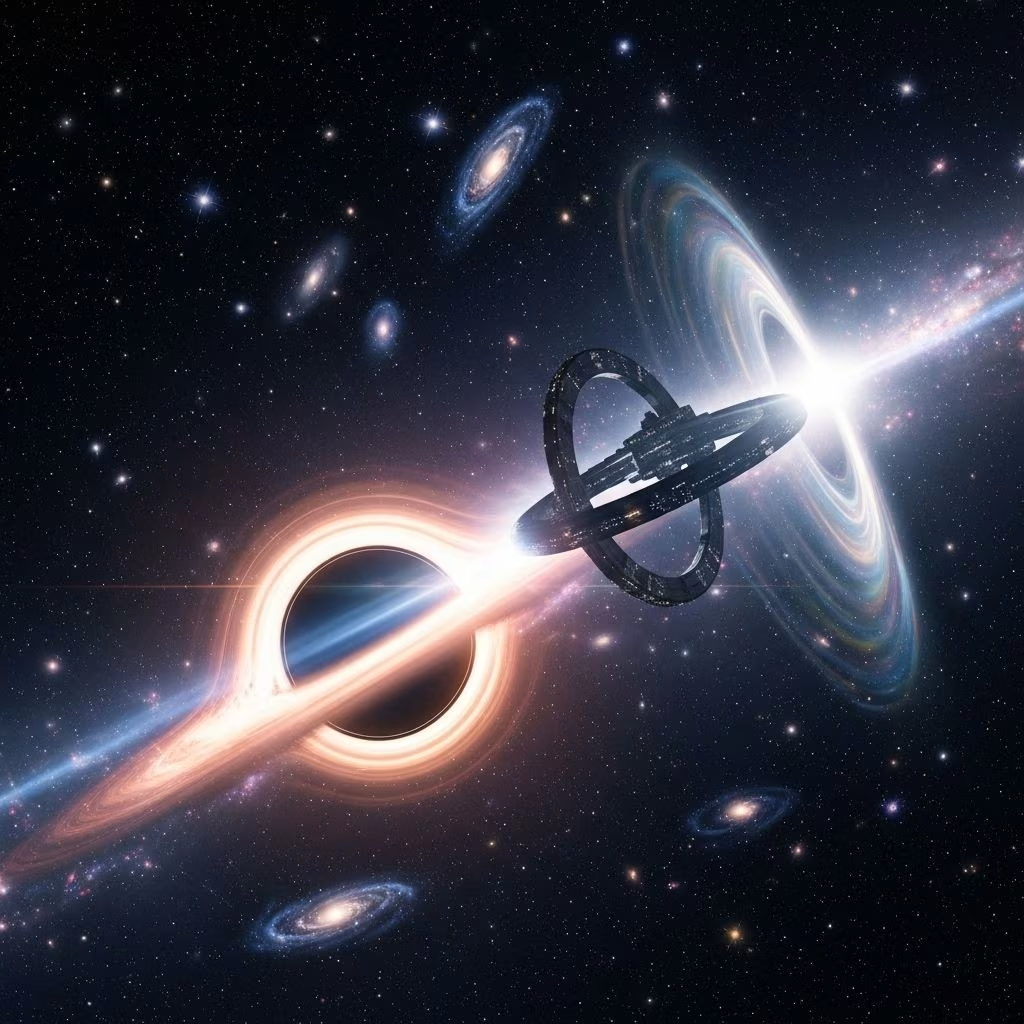
At the center of ‘Interstellar’ is the fictional black hole called Gargantua. This cosmic giant sets the backdrop for much of the film’s drama, offering both a believable and awe-inspiring setting for interstellar travel. Here’s what sets Gargantua apart:
- Mass: Gargantua is imagined as a supermassive black hole possessing 100 million times the mass of the Sun—a scale seen in some real galaxies.
- Distance: Located 10 billion light-years from Earth, Gargantua resides far beyond the local group of galaxies, deep in cosmic history.
- Rotation: Remarkably, Gargantua spins at 99.8% the speed of light. This incredible rotation rate has profound effects on the surrounding space-time and impacts how energy and matter behave near the event horizon.
The depiction of Gargantua’s environment—most notably its glowing accretion disk and warped appearance—is directly inspired by the science of the universe’s most extreme objects. The black hole’s role as both a barrier and potential gateway is rooted in current astrophysics debates and computational models, lending an air of authenticity to the story’s stakes.
Wormholes: Cosmic Gateways
Travel across the vast chasms of interstellar space remains well beyond today’s technology. In ‘Interstellar’, astronauts utilize a wormhole—an artificial shortcut through space-time—enabling them to reach the planetary system orbiting Gargantua in a single leap.
- What is a wormhole? A theoretical tunnel connecting distant points in the universe, often predicted by Einstein’s general theory of relativity, but not yet observed in nature.
- Function in the story: The appearance of a wormhole in Earth’s solar system is a narrative device, but the equations governing how matter might travel through such a gateway are rooted in real physics. Kip Thorne provided mathematical consultation to render the wormhole as plausibly as possible for the big screen.
While ‘Interstellar’ takes some narrative license in making wormhole travel a tangible possibility, its basic concept is firmly grounded in current scientific thinking, continually inspiring both astrophysicists and science fiction creators.
Relativity and Time Dilation: Living With Gravity
One of the film’s most memorable and mind-bending scientific conceits involves gravitational time dilation. This effect—directly predicted by Einstein’s equations of general relativity—plays a dramatic role in the fate and perception of the Endurance’s crew.
- Gravitational time dilation: Time passes slower in stronger gravitational fields. For an observer near a massive object, like a black hole, clocks run more slowly compared to those farther away.
- Movie Example: On the surface of a planet in close orbit to Gargantua, years can pass in a matter of minutes for orbiting crew, leading to a profound disconnect between space travelers and those left behind on Earth.
- Real Science: Although such extreme time dilation would require precise conditions (notably strong gravity close to the event horizon but not so close as to be destroyed by tidal forces), this effect has been experimentally verified in milder forms—such as the time difference between GPS satellites and Earth’s surface.
This theme transforms abstract equations into emotional stakes, making the relativity of time a central tension in the narrative of exploration and sacrifice.
The Endurance: Engineering Interstellar Voyages
The heart of human exploration in ‘Interstellar’ is the spaceship Endurance. Designed for plausibility, it showcases several real engineering and scientific concepts, merging futuristic ambition with grounded design.
- Structure: Endurance features a ring-shaped configuration of 12 modules (docking ports at the hub), resembling NASA mission concepts dating back to the 1960s and the International Space Station’s modularity.
- Artificial Gravity: The ship rotates at 5.6 revolutions per minute, generating Earth-style artificial gravity through centrifugal force, allowing astronauts to function as if they are “on the ground” during prolonged missions.
- Multipurpose Design: Endurance’s modules can detach and be reassembled into a planetary base, echoing real-world concepts for modular bases on the Moon or Mars.
- Launch System: The crew reaches Endurance in orbit via a rocket inspired by NASA’s Space Launch System (SLS), minus its solid rocket side boosters—emphasizing realistic contemporary launch vehicles.
- Auxiliary Craft: The ship carries
- Ranger: Fast, agile, single-stage craft for reconnaissance and planet landings.
- Lander: Heavy-lift vehicles for ferrying cargo and equipment to and from planetary surfaces.
‘Interstellar’ also pays homage to classic spaceship design with physical models (“miniatures”), simulating the nuanced way light and shadow move on real hardware—an approach distinct from the modern trend of pure CGI.
Accretion Discs: Light and Heat Around Black Holes
Gargantua is encircled by a stunning accretion disc—a swirling belt of gas and dust heated to millions of degrees as it spirals toward the event horizon. This structure does more than dazzle visually; it is central to the conditions enabling life on the planets in Gargantua’s system.
- Composition: The accretion disc is made up of superheated gas and dust, with temperatures comparable to the surface of the Sun—hot enough to radiate intensely in visible and X-ray wavelengths.
- Function in the movie: The disc provides essential light and heat that warm the orbits of the planets near Gargantua, standing in for the role a sun would normally play in a planetary system.
- Gravitational Lensing: In the artwork of ‘Interstellar’, the image of the accretion disc is dramatically warped by the black hole’s intense gravitational field. This lensing bends light paths, creating two arcs—one looping above and one below Gargantua—producing its distinctive look.
Visualizing the Unimaginable: Bringing Science to the Screen
One of ‘Interstellar’s’ greatest achievements may be translating the extreme and invisible scales of astrophysics into cinematic spectacle that remains scientifically credible. Under Kip Thorne’s guidance, the film’s visual effects team rendered:
- The double image of the accretion disc, warped by gravitational lensing—offering the first cinematic approximation based on real gravitational equations.
- Relativistic visuals, such as stars smearing into glowing bands near the speed of light—evoking the drastic distortions forecast by Einstein’s relativity.
- The interior of a wormhole, with plausible (though theoretical) portrayals of space bending into a tunnel through which Endurance travels.
- Physical models (miniatures), capturing lifelike movement and lighting in spacecraft shots, resisting today’s trend toward full computer-graphics animation for realism and texture.
By fusing artistic imagination with strict adherence to known mathematical descriptions, ‘Interstellar’ created not only believable visuals but also a kind of science communication, sparking public curiosity about both real and hypothetical space phenomena.
Key Scientific Features at a Glance
| Feature | Movie Portrayal | Scientific Basis |
|---|---|---|
| Black Hole (Gargantua) | Mass: 100 million suns, spins at 99.8% light speed | Real supermassive black holes exist in nature; extreme spin plausible |
| Wormhole | Shortcut across space near Saturn | Theoretical in general relativity; never observed |
| Time Dilation | Minutes on planet = years on spaceship | Predicted by Einstein’s relativity; confirmed in weak gravity, extreme effect plausible in special cases |
| Spaceship Endurance | Rotating ring creates artificial gravity | Matches real NASA design studies for long-duration missions |
| Accretion Disc | Provides heat and light to planets; visually double-lobed | Real for black holes; warped appearance matches relativity predictions |
Frequently Asked Questions (FAQs)
Q: How accurate is the science in ‘Interstellar’?
A: The film strives for authenticity, especially regarding black holes, time dilation, and wormholes. Kip Thorne ensured scientific rigor, though some creative liberties exist for storytelling. Certain scenarios, like life-sustaining planets close to a black hole, incorporate plausible but speculative physics.
Q: Are wormholes considered possible in real physics?
A: Wormholes are mathematical solutions to Einstein’s field equations, but no observational evidence confirms their existence. Traversable wormholes would require exotic forms of negative mass energy, which remain hypothetical.
Q: What would it look like to see a real black hole?
A: The depiction of Gargantua’s warped, glowing accretion disc is based on scientific calculations—light is bent around the massive object, likely creating the distinctive arcs seen in the film. While the Event Horizon Telescope has imaged a black hole’s shadow, the dynamic visuals around Gargantua remain largely theoretical.
Q: Was the Endurance’s artificial gravity realistic?
A: Yes—spinning a ringed spacecraft to simulate gravity via centripetal force has long been a proposed solution for long-term human habitation in space. The rotation rate (5.6 revolutions per minute) is within the range considered plausible by actual NASA mission studies.
Q: Why do space travellers experience time differently near Gargantua?
A: The massive gravity of Gargantua warps space-time so severely that time slows dramatically for anyone nearby, relative to distant observers. This is not just theory: it has been confirmed near Earth with atomic clocks and predicted to be extreme near supermassive black holes.
Further Exploration
- How Interstellar Space Travel Works
- Latest Discoveries about Black Holes
- Gallery: Visions of Starship Travel Beyond the Stars
Sources: Scientific details and explanations are drawn from public infographics and expert commentary provided by Space.com, as well as foundational astrophysics findings.
References
- https://www.space.com/27692-science-of-interstellar-infographic.html
- https://www.space.com/27694-interstellar-movie-spaceships-infographic.html
- https://www.scribd.com/document/349130967/STEMJOBS-LessonPlan-Interstellar
- https://en.wikipedia.org/wiki/Outer_space
- https://infographicsite.com/infographic/life-in-space-timeline-and-statistics/
- https://en.wikipedia.org/wiki/Interstellar_medium
- https://spaceplace.nasa.gov/interstellar/en/
- https://www.sparrowhawkdata.com/gallery/space-probe-lollipop-infographic/
- https://science.nasa.gov/solar-system/10-things-going-interstellar/
- https://www.youtube.com/watch?v=PLBZOleebsE
- https://irg.space/interstellar-updates/
- https://nofilmschool.com/explaining-interstellar-infographic
- https://www.universetoday.com/articles/interstellar-space
- https://www.youtube.com/watch?v=_dHzHSt5Qwc
- https://www.thequantumcat.space/p/what-lies-beyond-exploring-interstellar


