Buran: The Soviet Space Shuttle
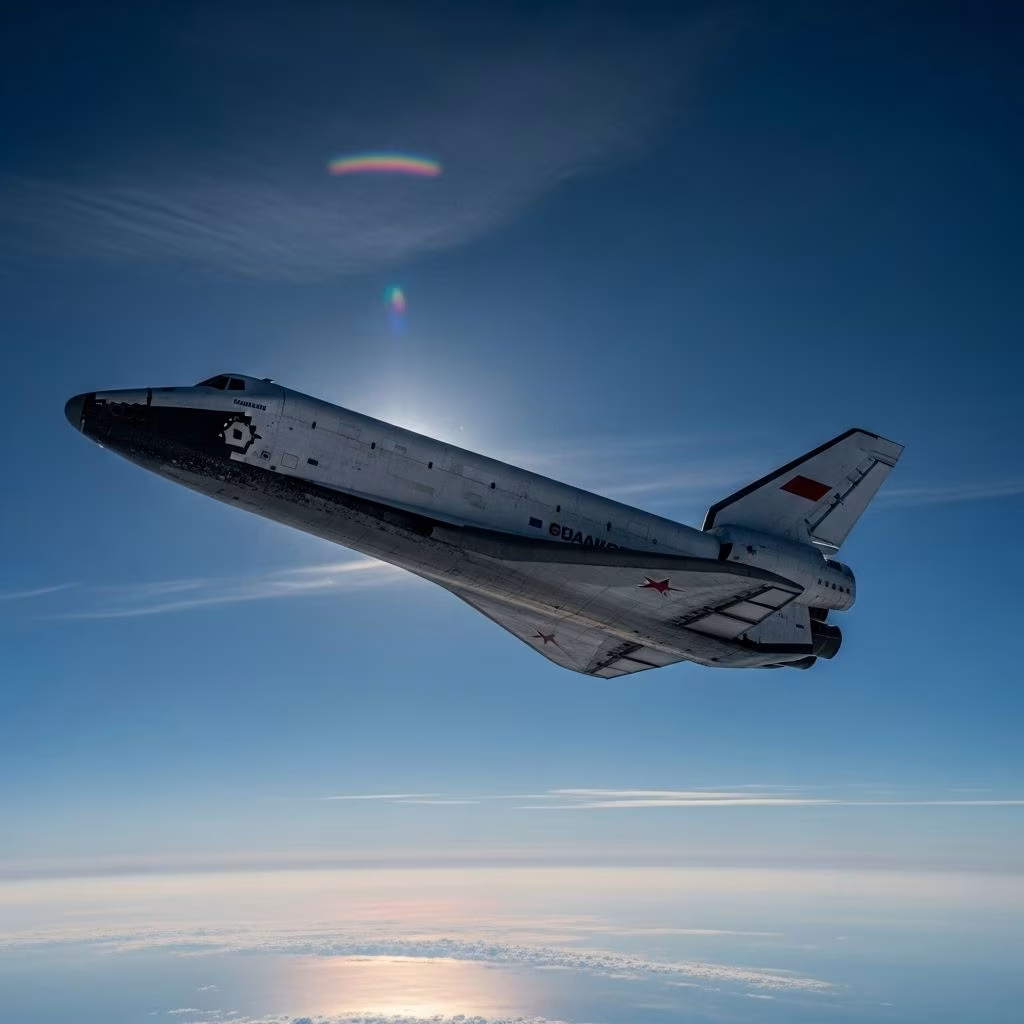
The Buran programme represented the Soviet Union’s most ambitious foray into building a reusable spacecraft, paralleling NASA’s celebrated Space Shuttle system. Although only one Buran orbiter ever flew to space, the project remains a testament to Cold War engineering and innovation, offering lessons and inspiration decades after its closure.
Origins and Motivations
In the shadow of the American Space Shuttle’s spectacular debut, the Soviet Union commenced the Buran programme in 1974 in response to perceived strategic and technological challenges. Soviet leaders believed a domestic reusable spacecraft was essential for both scientific exploration and national security, with the added ambition of matching or surpassing U.S. capabilities.
- Started: 1974 at the Central Aerohydrodynamic Institute, Moscow.
- Main city of development: Moscow, with hundreds of contributing enterprises across the USSR.
- Primary objective: To build a reusable spaceplane with broad scientific, military, and orbital construction potential.
The Buran Programme: Overview
Buran (‘Blizzard’ or ‘Snowstorm’ in Russian) was not just a spacecraft but a far-reaching effort involving the Soviet super-heavy launcher Energia and an array of shuttle prototypes. Its development consumed vast resources, becoming the USSR’s most expensive space endeavor.
- Main components: The Buran orbiter and the Energia launch vehicle.
- Programme cost: Estimated to be the largest in Soviet space history.
- Status: Officially suspended in 1993 after the dissolution of the USSR, having produced several test articles but only one operational flight.
Design and Engineering Innovations
Buran’s external similarity to NASA’s Space Shuttle masked substantial functional differences. While both systems were designed as reusable orbiters, Buran featured novel approaches that reflected Soviet priorities and technical philosophies.
| Feature | Buran | NASA Space Shuttle |
|---|---|---|
| Main Engines | Located on Energia rocket (not on orbiter); only orbital engines on shuttle | Three main engines on the orbiter; used during launch |
| Launch Vehicle | Energia (expendable, super heavy-lift) | Solid Rocket Boosters + External Tank (reusable elements) |
| Automation | Fully automated/uncrewed flight capability | Crewed flights; limited uncrewed capability added later |
| Payload Capacity | 30 metric tons to orbit; 20 tons return | 27.8 metric tons to orbit; 15 tons return |
| Landing System | Drag chute used; gear set farther back | Drag chute added in later upgrades |
| Transport to Pad | Horizontal rail transporter | Vertical crawler transporter |
| Crew Capacity | Up to 10 | Typical 5–7; up to 8, maximum 11 (emergency) |
| Thermal Protection | Tile gap layout parallel/perpendicular to airflow | Mosaic layout; different gap orientations |
| Lift-to-Drag Ratio | 5.6 | 4.5 (subsonic) |
- Buran’s orbital maneuvering system used GOX/LOX/Kerosene for improved thrust and lower toxicity.
- Its autonomy allowed uncrewed missions with complete automated launch, orbit, and landing cycles—a capability NASA’s Shuttle only acquired in part much later.
- The shuttle’s drag chute and advanced aerodynamic shape supported optimized re-entry and landing.
Construction and Production
Development encompassed a vast industrial network throughout the Soviet Union, challenging engineering teams and mobilizing over a thousand companies and academic institutions. The construction timeline included prototype fabrication, systems testing, and rigorous flight rehearsals.
| Year | Milestone |
|---|---|
| 1980 | Assembly started |
| August 1983 | Fuselage delivered to NPO Energia |
| March 1984 | Electrical system testing |
| December 1984 | Delivery to Baikonur Cosmodrome |
| Apr 1986 | Final assembly started |
| Nov 1987 | Final assembly completed |
| May–Jun 1988 | Test rollout |
| Nov 1988 | First and only orbital flight |
- Multiple flight and engineering models were constructed, but only Buran (serial 1.01) was launched into space.
- The programme’s cancellation after the Soviet collapse halted all further production work.
Buran Specifications
| Specification | Measurement |
|---|---|
| Dry mass | 62,000 kg |
| Maximum Payload | 30,000 kg |
| Max Liftoff Weight | 105,000 kg |
| Length | 36.37 m |
| Wingspan | 23.92 m |
| Height (on gear) | 16.35 m |
| Payload bay length | 18.55 m |
| Payload bay diameter | 4.65 m |
| Wing sweep (maximum) | 45 degrees |
| Orbital engine thrust (total) | 17,600 kgf |
- The energetic and aerodynamic design enabled high orbital transport capacity and reliable re-entry maneuvers.
- Advanced heat shielding using unique tile patterning improved protection during atmospheric return.
The Historic 1988 Buran Flight
Buran’s singular orbital mission stands as a technical triumph. On November 15, 1988, Buran lifted off from Baikonur on a fully automated flight, orbiting Earth twice before flawlessly landing at the cosmodrome—all without a crew.
- Launch date: November 15, 1988.
- Flight details: Two orbits around Earth; automated landing.
- Significance: Demonstrated total flight automation, precise control, and mission reliability.
This achievement marked Buran as the first spaceplane to perform an uncrewed, fully automated flight—a feat that would not be matched by NASA’s Shuttle for nearly two decades.
The Programme’s Curtain: Suspension and Legacy
Buran’s promising beginning was cut short. Political upheavals, economic constraints, and shifting technological priorities led to the programme’s suspension in 1993. The only space-flown orbiter was ultimately destroyed in 2002 when a hangar roof collapsed at Baikonur, ending hopes for a museum or further study.
- All subsequent Buran-class orbiters remained unfinished or unflown.
- The Energia rocket continued for a brief period, launching other heavy payloads before being retired.
Yet Buran’s influence endures among engineers, historians, and space aficionados worldwide.
Buran’s Unique Innovations and Comparison
- First shuttle capable of fully automated, crewless flight and landing.
- Higher orbital payload return than American Shuttle.
- Distinguished by launch architecture—did not carry main engines into orbit, allowing cleaner separation from propulsion hardware.
- Featured advanced heat-resistant tiles with airflow-optimized alignments.
- Pioneered horizontal transport and pad erection procedures for large spacecraft.
Buran’s Place in Space History
Buran stands out as a symbol of Soviet determination to compete on the technological world stage, offering bold solutions to complex aerospace challenges. Though the programme did not realize its full potential, its technical achievements paved the way for advancements in reusable spaceflight and demonstrated the capacity for fully autonomous operations in orbital vehicles.
As an artifact of Cold War science, Buran also serves as a poignant reminder of the costs and uncertainties of ambitious state-driven research, both in terms of human ingenuity and national priorities.
Frequently Asked Questions (FAQs)
Q: How did Buran differ from NASA’s Space Shuttle?
A: Buran’s main engines were on its launch rocket (Energia), saving weight on the orbiter itself, and it performed its only flight completely unmanned and automated—something NASA’s Shuttle could not do until much later. Buran also carried a larger payload and employed different heat shield tile layouts.
Q: Why was Buran’s programme cancelled?
A: The end of the Cold War, severe economic difficulties in the newly independent Russian state, along with a lack of clear post-mission objectives led to funding cuts, making further Buran missions unfeasible.
Q: What happened to the flown Buran orbiter?
A: After its solitary spaceflight, the first Buran orbiter was stored in Baikonur until a hangar collapse in 2002 destroyed the vehicle and killed several workers.
Q: Is any Buran hardware preserved today?
A: Several test vehicles and prototypes survive at various Russian sites and museums, but none have ever flown to space; some are exhibited as engineering artifacts or tourist attractions.
Q: Did Buran influence modern space vehicles?
A: Buran’s achievements in flight automation and reusable system design influence present discussions of orbital spacecraft and unmanned reusable vehicles. Its engineering approaches provided valuable lessons for both Russian and international spaceflight development.
Buran: Lessons for Today’s Aerospace Innovators
Buran’s story invites reflection among modern engineers and policymakers:
- *Fully automated* mission design remains attractive for reducing risks and extending operational scope.
- Reusable launch architectures are central to contemporary commercial and national spaceships.
- International collaboration or competition shapes engineering priorities, as demonstrated by the Shuttle “race.”
Despite political and economic setbacks, the legacy of Buran continues in research, documentary study, and as inspiration for future reusable spacecraft.
Buran vs Space Shuttle: At a Glance
| Aspect | Buran | NASA Space Shuttle |
|---|---|---|
| First Launch | 1988 | 1981 |
| Flights | 1 (uncrewed) | 135 (mostly crewed) |
| Max Payload to Orbit | 30 tons | 27.8 tons |
| Automation | Complete automated capability | Limited (added later) |
| Programme Cost | Largest in USSR space history | Over $200 billion (lifetime) |
Buran’s Enduring Inspiration
Buran’s brief but brilliant flight remains a powerful story for anyone intrigued by space technology. From the vision born in the Cold War to the reality of advanced engineering, the Buran orbiter’s legacy will echo through generations of spacecraft designers, historians, and space enthusiasts.
References
- https://en.wikipedia.org/wiki/Buran_programme
- https://airandspace.si.edu/stories/editorial/soviet-buran-shuttle-one-flight-long-history
- https://en.wikipedia.org/wiki/Buran_(spacecraft)
- https://www.space.com/29159-buran-soviet-shuttle.html
- http://www.astronautix.com/b/buran.html
- https://www.buran-energia.com/bourane-buran/bourane-desc.php
- https://www.britannica.com/topic/Buran-Russian-spacecraft
- https://www.spaceflighthistories.com/post/soviet-buran-shuttle
- https://www.youtube.com/watch?v=ieqDMFfyifo
- https://nss.org/a-brief-history-of-soviet-space-shuttle-buran-part-two-guest-post-by-jay-chladek/
- https://www.russianspaceweb.com/buran.html
- https://www.buran.su/buranvssts-comparison.php
- https://study.com/academy/lesson/buran-history-construction-facts-russian-space-shuttle.html
- https://nss.org/a-brief-history-of-the-soviet-space-shuttle-buran-part-one-guest-post-by-jay-chladek/
- http://www.buran.su
- https://www.buran-energia.com/bourane-buran/bourane-but.php
- https://www.acielouvert.ipsa.fr/post/the-buran-space-shuttle-an-enhanced-version-of-the-american-shuttle
- https://www.aerospaceguide.net/buran/index.html
- https://www.advantour.com/kazakhstan/baikonur-cosmodrome/buran.htm