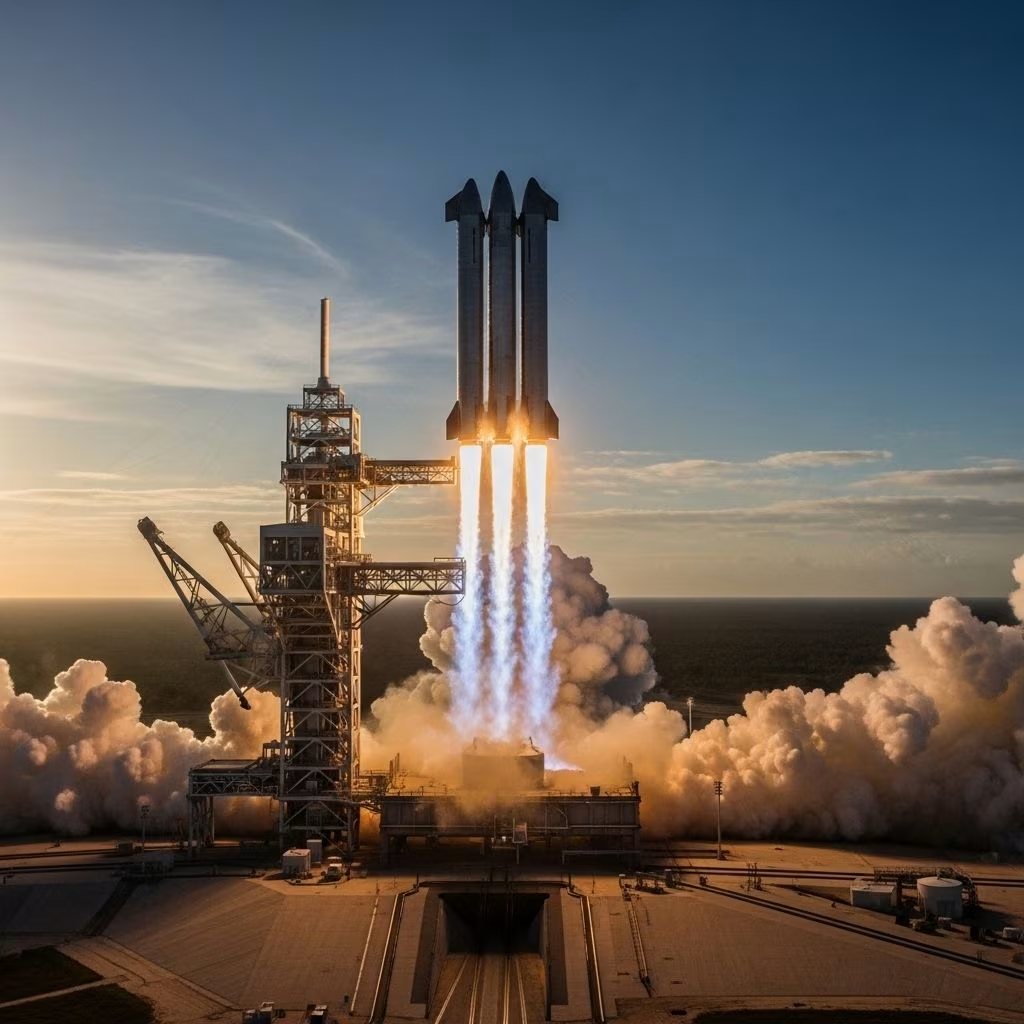
What’s Next for SpaceX’s Starship After Flight 10 Success?
Flight 10 marked a major milestone for SpaceX’s Starship program, showcasing significant progress and revealing new technical challenges to address before humanity can set its sights on Mars. As the world’s most powerful and largest launch vehicle continues its development, Flight 10’s partial success redefines the trajectory, timeline, and ambitions of SpaceX’s plans for interplanetary travel.
The Significance of Starship Flight 10
Starship Flight 10 launched successfully on May 27, 2025, reaching space and successfully completing several mission objectives, even though control was lost after an anomaly and the vehicle was destroyed during reentry over the Indian Ocean. This flight surpassed prior test flights by demonstrating improved stage separation, orbital performance, and preliminary reusability milestones. Despite the loss of the vehicle, the data collected is instrumental in informing future upgrades and operational procedures for upcoming flights.
- Super Heavy Booster: Enabled a more stable ascent and cleaner stage separation.
- Starship Upper Stage: Achieved orbital velocity, marking a technological advancement over earlier, shorter flights.
- Anomaly Data: Revealed propellant leak and reentry control issues that will guide hardware modifications.
Learning from Flight 7, 8, and 10 – Technical Challenges and Solutions
Earlier this year, Flights 7 and 8 suffered catastrophic explosions less than 10 minutes into flight, underscoring the risks and complexities of developing fully reusable launch systems. These failures highlighted the need for improvements in engine reliability, propellant management, and autonomous reentry control. Flight 10’s longer mission duration allowed SpaceX to test major upgrades and highlighted new issues, such as a propellant leak, which will be addressed in future hardware iterations.
- Flight 7 & 8: Exploded in early ascent due to Raptor engine issues and plume dynamics.
- Flight 9: Achieved stage separation but failed to maintain control during reentry, leading to destruction.
- Flight 10: Lost control after a longer flight, but achieved meaningful progress in orbital operations and reentry data.
SpaceX’s Roadmap: Accelerating Starship Testing and Mars Preparations
With Flight 10’s data in hand, SpaceX, led by Elon Musk, aims to dramatically accelerate testing and vehicle iteration rates. Recent regulatory approval from the Federal Aviation Administration (FAA) enables up to 25 Starship flights annually, vastly increasing the speed at which SpaceX learns from each launch and refines the vehicle’s design.
- Starship Block Upgrades: Engineers are integrating fixes for propellant leaks, avionics software refinements, and reentry heat shield enhancements.
- Rapid Iteration: Each flight is expected to feature incremental or even major design changes, emphasizing SpaceX’s “test, fail, fix, repeat” philosophy.
- Regulatory Pathways: FAA stakeholders are coordinating with SpaceX to ensure safe flight operations and minimize public risk.
This rapid cadence is unprecedented in the space launch industry and is key to Musk’s vision of sending potentially thousands of Starship vehicles to Mars in the coming decades.
Starship Vehicle Design: Fully Reusable, Rapid Turnaround
| Component | Description | Advancements |
|---|---|---|
| Super Heavy Booster | First stage, provides the main lift for Starship | Designed for rapid reuse; improved engine reliability in recent flights |
| Starship Upper Stage | Second stage; carries crew/cargo and performs orbital maneuvers | Advanced heat shields; new guidance systems for reentry |
| Rapid Refueling | In-orbit fuel transfer for deep space missions | Critical for Mars missions; still in development phase |
Both stages are designed to be fully and quickly reusable. Rapid reuse is essential to minimize costs and logistics for large-scale missions, as Musk’s vision demands launching thousands of ships within short launch windows.
Next Destinations: Mars Mission Timeline and Landing Sites
Although Musk’s initial optimism targeted Mars missions as soon as 2025–2026, recent technical setbacks have led SpaceX to revise its timelines. There is now only a slight chance for a Starship mission to the Red Planet by the end of 2026[13]. The earliest uncrewed missions, if successful, would deliver essential cargo and infrastructure to Arcadia Planitia, a volcanic plain in Mars’ northern hemisphere, with ideal landing and access to water ice resources.
- Arcadia Planitia: Flat terrain for safe landings, distant from polar ice hazards, optimal for resource extraction.
- Mission Architecture: Initial landers will deliver supplies; later missions will transport crews to begin settlement.
- In-orbit Refueling: Mission schedule depends on successful demonstration of orbital fueling, which remains an unresolved technical hurdle.
Technical Hurdles: In-Space Refueling, Engine Reliability, and More
The path to Mars is littered with engineering and logistical challenges, notably:
- Engine Reliability: Persistent failures and performance variations in Raptor engines require redesigns and rigorous testing.
- Propellant Management: Anomalies in propellant transfer and storage must be resolved to enable deep space missions.
- Thermal Protection Systems: Advanced heat shields are needed for safe atmospheric reentry on Earth and Mars.
- Orbital Refueling: Demonstrating tanker rendezvous and fuel transfer in orbit remains a crucial, unmastered objective.
- Rapid Turnaround: SpaceX aims for aircraft-like reusability, but maintenance and inspections after each flight still require streamlining.
Solutions to these hurdles will determine whether SpaceX’s schedule for Mars missions can stay on track or demands further adjustments.
Regulatory, Safety, and Environmental Considerations
Starship’s rapid development and launch cadence depend on regulatory approvals, environmental impact assessments, and robust safety protocols. The FAA recently increased SpaceX’s permitted annual flight rate after thorough reviews. However, future crewed missions will require additional oversight and international agreements, especially for interplanetary flights that would impact global space policy.
- FAA approval for high-cadence test flights.
- Ongoing environmental reviews for Boca Chica, Texas launch site.
- SpaceX collaborations with NASA and international agencies for mission safety.
SpaceX’s Vision: Building a Multi-Planetary Civilization
Elon Musk’s primary metric for Starship’s progress is the timeline to establishing a self-sustaining civilization on Mars. He envisions launching between 1,000 and 10,000 ships every two years, each carrying people and critical supplies for settlement. While this vision is more aspirational than concrete, each Starship flight advances the engineering and operational knowledge necessary to tackle these challenges.
- Settlement Plans: Early missions focus on infrastructure (habitats, resource extraction, water, and power).
- Thousands of Ships: Long-term vision involves flotillas of Starships shuttling colonists and materials to Mars when Earth-Mars transfer windows open.
- Incremental Learning: Each test improves both hardware and mission planning, narrowing knowledge gaps for planetary settlement.
International Context and Comparisons
SpaceX’s pursuit of Mars dwarfs current efforts by governmental agencies like NASA, Roscosmos, and CNSA, all of whom are years away from launching crewed missions to Mars. While NASA plans Artemis Moon missions, its timeline for Mars extends at least another decade. SpaceX’s aggressive schedules create pressure and opportunity for greater collaboration and competition, potentially accelerating interplanetary exploration for all stakeholders.
- NASA’s Mars ambitions largely hinge on technology demonstrations expected in the 2030s.
- SpaceX outpaces most private competitors with reusable super-heavy launch architecture.
- Global interest in Mars is rising, but few entities can match Starship’s capacity for bulk cargo and crew delivery.
Looking Ahead: Starship Flight Expectations and Milestones
The next year will see an unprecedented series of launches, with SpaceX aiming for test flights every few weeks. Not every flight will be a full mission; some will focus on incremental improvements, subsystem testing, and failed missions that yield valuable data. Once SpaceX nails down in-space refueling and orbital rendezvous, the pathway toward actual Mars missions becomes more tangible.
- 2025–2026: Critical demos for refueling, reentry survivability, extended life support.
- Late 2020s: Possible cargo-only Mars missions, building infrastructure for human arrival.
- Early 2030s: First crewed missions, pending technical and regulatory outcomes.
Frequently Asked Questions (FAQs)
Q: Will SpaceX’s Starship reach Mars by 2026?
A: Current projections suggest only a slight chance for a mission by late 2026 due to technical setbacks with refueling and engine reliability[13]. Uncrewed supply landers are more likely as initial steps.
Q: What is Starship’s greatest engineering challenge?
A: The hardest problems involve in-space refueling, complex engine reliability, autonomous reentry control, and rapid vehicle turnaround between flights.
Q: Why is Arcadia Planitia the preferred Mars landing site?
A: It offers flat terrain, relative proximity to water ice, and safe landing/takeoff conditions vital for sustained settlement operations.
Q: How many people could Starship transport to Mars?
A: In theory, each launch window could accommodate thousands of passengers and tons of cargo if rapid reuse and mass production goals are met.
Q: How did Flight 10 differ from previous launches?
A: Flight 10 achieved higher orbital performance and longer mission duration, yielding crucial data for the next generation of hardware.
Key Takeaways for the Future of Starship
- Flight 10’s data fuels rapid iteration on Starship—improving reliability, safety, and mission scope.
- Mars missions remain aspirational but technically feasible as SpaceX resolves major engineering challenges.
- Starship stands alone as the vehicle most capable of revolutionizing space travel, large-scale cargo delivery, and interplanetary colonization within the next decade.
References
- https://www.spacex.com/updates
- https://www.spacex.com/humanspaceflight/mars/
- https://en.wikipedia.org/wiki/SpaceX_Starship
- https://www.usatoday.com/story/news/nation/2025/06/02/elon-musk-mars-exploration-spacex/83991835007/
- https://www.humanmars.net/2025/05/spacex-starship-mars-mission-update-2025.html
- https://www.nasaspaceflight.com/2025/05/future-starship-block-3-mars/
- https://www.space.com/space-exploration/launches-spacecraft/whats-next-for-spacexs-starship-mars-rocket-after-flight-10-success
- https://www.space.com/space-exploration/private-spaceflight/elon-musk-says-spacex-will-launch-its-biggest-starship-yet-this-year-but-mars-in-2026-is-50-50
- https://www.youtube.com/watch?v=y9Rv-Q20zRE
- https://www.youtube.com/watch?v=0nMfW7T3rx4
- https://phys.org/news/2025-06-missions-mars-starship-months.html
- https://en.wikipedia.org/wiki/List_of_Starship_launches
- https://timesofindia.indiatimes.com/science/elon-musk-has-made-an-announcement-starship-flight-to-mars-crewed-by-optimus-in-nov/dec-next-year/articleshow/123164458.cms
- https://ts2.tech/en/spacex-starship-the-giant-rocket-poised-to-change-space-travel-forever-2025-update/
- https://www.usatoday.com/story/news/nation/2025/08/21/starship-launch-mars-elon-musk/85726892007/
- https://ts2.tech/en/spacex-mid-2025-comprehensive-report-june-27th-2025/
- https://www.nextbigfuture.com/2025/05/spacex-has-updated-mars-and-starship-plans.html
- https://abcnews.go.com/US/spacexs-starship-faces-10th-test-after-previous-flights/story?id=124822338