


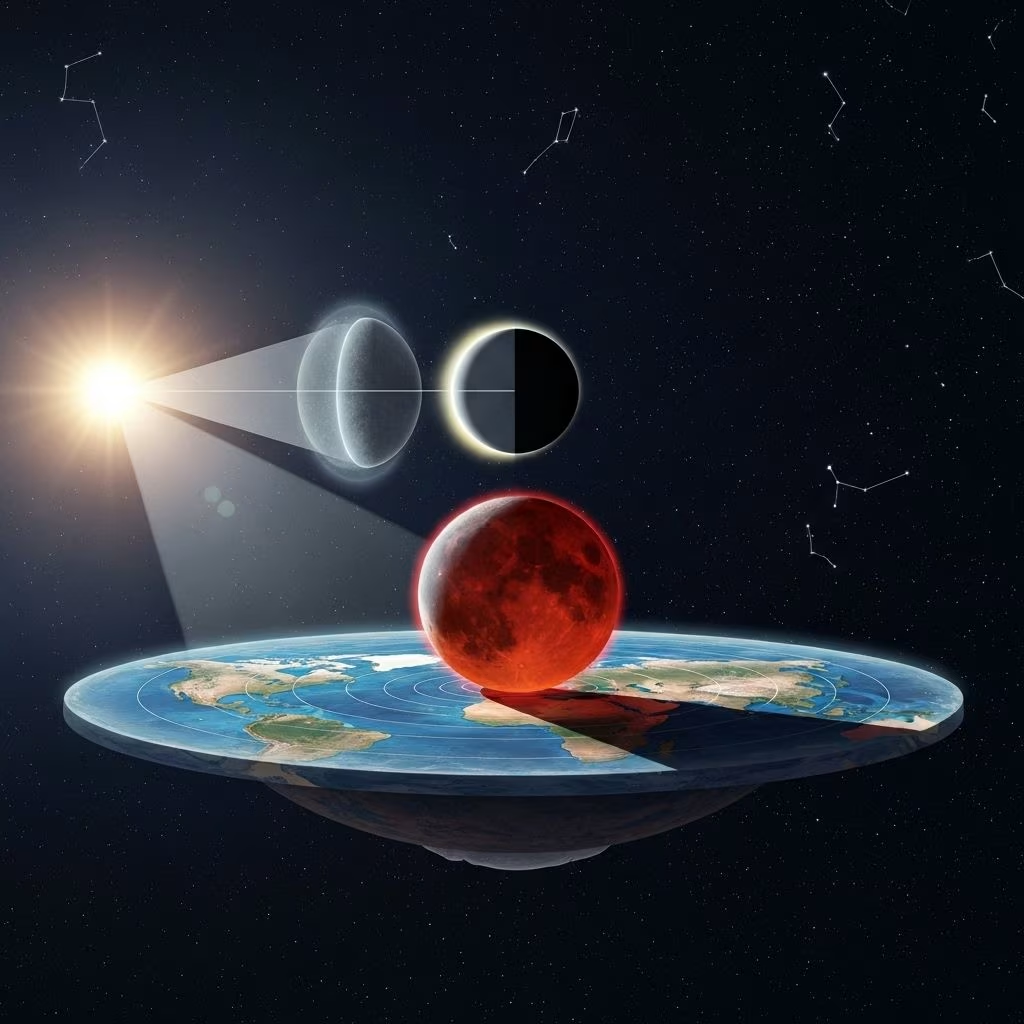
How Flat-Earthers Explain Total Lunar Eclipses
The flat-Earth movement has long challenged widely-accepted scientific explanations for astronomical phenomena, offering alternative models for everything from gravity to planetary motion. One of the clearest examples of these alternative perspectives surfaces during total lunar eclipses. While the scientific community explains these striking events through well-defined orbital mechanics, flat-Earth proponents have crafted their own distinctive narrative, one that centers around a mysterious ‘shadow object’ and a fundamentally different idea of how the cosmos works.
Understanding the Mainstream Explanation: Lunar Eclipses 101
- Total lunar eclipses occur when the Earth passes directly between the Sun and the Moon, casting a shadow (the umbra) that covers the lunar surface.
- The moon turns a blood-red color during this event due to Rayleigh scattering, which is the same reason sunsets and sunrises appear reddish. Sunlight filtering through Earth’s atmosphere scatters shorter blue wavelengths, allowing redder wavelengths to illuminate the Moon.
- This phenomenon can be observed by anyone standing on the night side of the planet when the alignment occurs.
This explanation is supported by centuries of observations and rigorous modeling, but is fundamentally at odds with flat-Earth cosmology.
Flat-Earth Cosmology: The Basics
Flat-Earthers propose that Earth is not a globe, but rather a flat, disk-shaped structure, sometimes described as a “pizza-shaped Earth.” However, not all aspects of the cosmos are treated as flat:
- The Sun and Moon are typically regarded as spherical objects, despite Earth’s flatness.
- The Sun and Moon orbit above the Earth, circling the North Pole, perpetually above the surface and never dipping below or around the opposite side of the disk.
- Day and night, phases of the Moon, and other celestial events are explained via this overhead system, with the sky often depicted as a kind of dome (the ‘firmament’).
This model offers alternative explanations for many phenomena, but lunar eclipses present a unique challenge to the flat-Earth worldview.
The Challenge: Eclipses on a Flat Earth
In the mainstream model, a lunar eclipse requires the Sun, Earth, and Moon to align in a straight line, with the Earth between the Sun and the Moon, casting a shadow on the lunar surface. This is only possible if both the Earth and Moon are spherical and engaged in orbital motion around the Sun. In the flat-Earth model:
- The Sun and Moon never get on opposite sides of a disk-shaped Earth since they always orbit above it.
- This makes it impossible for the Earth’s shadow to fall on the Moon, according to the flat-Earth geometry.
- Despite this, lunar eclipses do occur and are observable, creating a paradox that needs resolving from a flat-Earth perspective.
Theories Developed by Flat-Earthers
Faced with undeniable lunar eclipses, flat-Earthers have turned to creative explanations. The most prominent among these is the idea of a mysterious object, often called the ‘shadow object’.
- The Shadow Object Theory: During a lunar eclipse, a previously unseen dark celestial body passes in front of the Moon, casting the observed shadow.
- This shadow object is claimed to be invisible or undetectable outside of eclipse events.
- Flat-Earthers argue that traditional astronomy covers up the existence of this object, crediting Earth’s shadow instead.
- The shadow object is said to orbit the Sun, much like the Sun and Moon, but its path is less well defined and not directly observable.
Details of the Shadow Object Theory
The concept of the shadow object raises many challenges even within flat-Earth communities, including:
- Lack of evidence for the shadow object outside eclipses.
- No clear predictions or calculations regarding its orbit, size, or composition.
- The suggestion that the shadow object is a rare or even unique phenomenon that only reveals itself during eclipses.
Despite these issues, the shadow object idea remains one of the mainstays of flat-Earth eclipse explanation, largely because it sidesteps the problem of Earth’s geometry.
Flat-Earth vs. Mainstream: A Comparison Table
| Aspect | Mainstream Science | Flat-Earth Theory |
|---|---|---|
| Shape of Earth | Oblate spheroid (near-spherical) | Flat disk (pizza-shaped) |
| Sun & Moon Orbits | Both orbit Earth (geocentric) or Sun (heliocentric) in ellipses or circles | Both orbit above the Earth, circling the North Pole |
| Cause of Lunar Eclipse | Earth’s shadow blocks sunlight to the moon | Unknown “shadow object” passes between observer and moon |
| Lunar Eclipse Predictions | Can be calculated with high precision centuries in advance | No established method; predictions rely on outside astronomy data |
| Appearance of Shadow | Matches shape of Earth’s curvature, always round | Attributed to the unknown object, typically circular by coincidence |
Flat-Earth Criticisms of Conventional Eclipse Explanations
Instead of building detailed models for their own explanations, many flat-Earth proponents focus on questioning or criticizing the established scientific model. Major points of contention include:
- Claiming that the direction of shadow movement during an eclipse appears inconsistent or opposite to expectations based on globe-Earth models.
- Asserting that shadow movement changes direction during eclipses, which they believe would be impossible if the event was caused solely by Earth’s movement.
- Arguing about observational differences depending on hemisphere and latitude, sometimes misunderstanding the perspective-based reversal of directions for observers in the Northern vs. Southern Hemispheres.
- Questioning why the atmosphere would scatter red light in the specific way required for the blood-red appearance instead of just causing darkness.
Scientific Responses to These Critiques
- Apparent shadow direction and movement is explained through geometry of the Earth-Moon-Sun system and the perspective from which observers view the eclipse. The shadow always moves in a predictable, model-consistent manner.
- Changes in shadow movement during the eclipse are optical illusions driven by the relative motion of the Moon, Earth’s rotation, and observer viewpoint—not inconsistencies in the model.
- Red coloration is a result of Rayleigh scattering, which is well-modeled and consistently produces a red hue during total lunar eclipses.
What Do Flat-Earthers Believe About the Sun and Moon?
Though flat-Earth theories vary, the consensus described in many flat-Earth communities is:
- The sun and moon are spherical and relatively small compared to mainstream science, typically described as being about 32 miles (51 kilometers) in diameter.
- They orbit the North Pole, at relatively low altitudes (several thousand miles up), never “setting” but rather moving in a circle that brings them close and far from a given location—explaining day and night.
- Lunar phases, seasons, and eclipses are explained with the movement patterns of these bodies, though these explanations often lack quantitative rigor or predictive power.
- Lack of detail on how these movements could cause observed cycles as seen from all over the Earth.
The “Shadow Object” in Detail
Originating in the 19th century within early flat-Earth literature, the shadow object—sometimes dubbed the “anti-lunar object” or other fanciful names—remains central to flat-Earth eclipse explanations.
- No photos or telescope observations exist of the shadow object outside of lunar eclipses.
- No known physical properties, such as reflectivity or gravitational influence, have been articulated.
- Proponents do not agree on whether it orbits the sun, the moon, or the dome above the flat Earth.
- Its apparent existence is asserted solely to account for the observed shadow during eclipses.
Despite the lack of direct evidence, flat-Earth advocates invoke this entity to reconcile eclipse observations with their cosmological model.
Can the Flat-Earth Model Predict Eclipses?
One major difference between the mainstream and flat-Earth models is predictive power:
- Conventional science can predict eclipses centuries in advance using orbital mechanics and physics.
- Flat-Earth models have yet to produce any system for reliably forecasting when lunar eclipses will occur, often relying on predictions generated by mainstream astronomy.
- This lack of predictive rigor is often cited by critics as a fundamental weakness of alternative eclipse theories.
The Broader Significance: Why the Debate Matters
The flat-Earth approach to lunar eclipses highlights the tension between established science and conspiracy-driven worldviews. On one hand, conventional science relies on repeatable observations and mathematical consistency. On the other, flat-Earth explanations focus more on rhetorical critique and ad hoc solutions lacking direct evidence.
- The stark contrast between the approaches becomes clear when considering events like the Super Blood Wolf Moon—which, for flat-Earth theorists, is not only an astronomical event, but also an opportunity to promote their ideas and challenge scientific norms.
Frequently Asked Questions (FAQs)
Q: What causes the red color of the moon during a total lunar eclipse?
A: According to mainstream science, Earth’s atmosphere scatters sunlight, filtering out blue light and allowing red light to reach the moon, causing its reddish hue during totality.
Q: What do flat-Earthers claim causes the shadow on the moon?
A: Flat-Earthers contend that a mysterious, invisible ‘shadow object’ passes in front of the moon, rather than Earth’s shadow, to account for the observed darkness and shape.
Q: How do flat-Earthers explain the predictability of eclipses?
A: Most flat-Earth models lack mechanisms for predicting lunar eclipses and instead use calculations developed by mainstream astronomers, which critics cite as a major flaw.
Q: Are the sun and moon flat in flat-Earth theories?
A: Surprisingly, many flat-Earth proponents claim the sun and moon are spherical but small, moving in circles above the flat Earth.
Q: Is there any evidence for the shadow object?
A: No direct observational evidence supports the existence of the shadow object; it is proposed solely to explain lunar eclipses within flat-Earth cosmology.
Sources and Further Reading
- Space.com – How Flat-Earthers Explain Total Lunar Eclipses
- Live Science – How Flat-Earthers Explain Total Lunar Eclipses
- Answers in Genesis – Disproving Two Flat-Earther Claims About Lunar Eclipses
References
- https://www.space.com/43086-flat-earthers-explain-lunar-eclipses.html
- https://answersingenesis.org/blogs/danny-faulkner/disproving-flat-earther-claims-lunar-eclipses/
- https://www.livescience.com/64565-flat-earthers-explain-lunar-eclipses.html
- https://www.youtube.com/watch?v=T56XOxaJj_4
- https://www.youtube.com/watch?v=PnA-xoolELw
- https://www.space.com/lunar-eclipse-what-can-scientists-learn
- https://www.theflatearthsociety.org/forum/index.php?topic=71908.0
- https://www.skyatnightmagazine.com/space-science/lunar-eclipse-interesting-facts
- https://wiki.tfes.org/The_Lunar_Eclipse
- https://www.iflscience.com/this-is-what-flatearthers-think-happens-during-a-lunar-eclipse-51280
- https://www.scienceabc.com/nature/universe/what-is-a-flat-earth-eclipse.html
- https://starwalk.space/en/news/7-ways-to-prove-the-earth-is-round
- https://en.wikipedia.org/wiki/Empirical_evidence_for_the_spherical_shape_of_Earth
- https://answersingenesis.org/astronomy/moon/january-total-lunar-eclipse-and-flat-earth/
- https://www.phillyvoice.com/ask-hickey-what-are-flat-earthers-saying-about-mondays-eclipse/
- https://ithy.com/article/earth-shape-proven-scientifically-225knbbk
- https://truthorfake.com/blog/the-earth-is-flat-tfz3xb


