


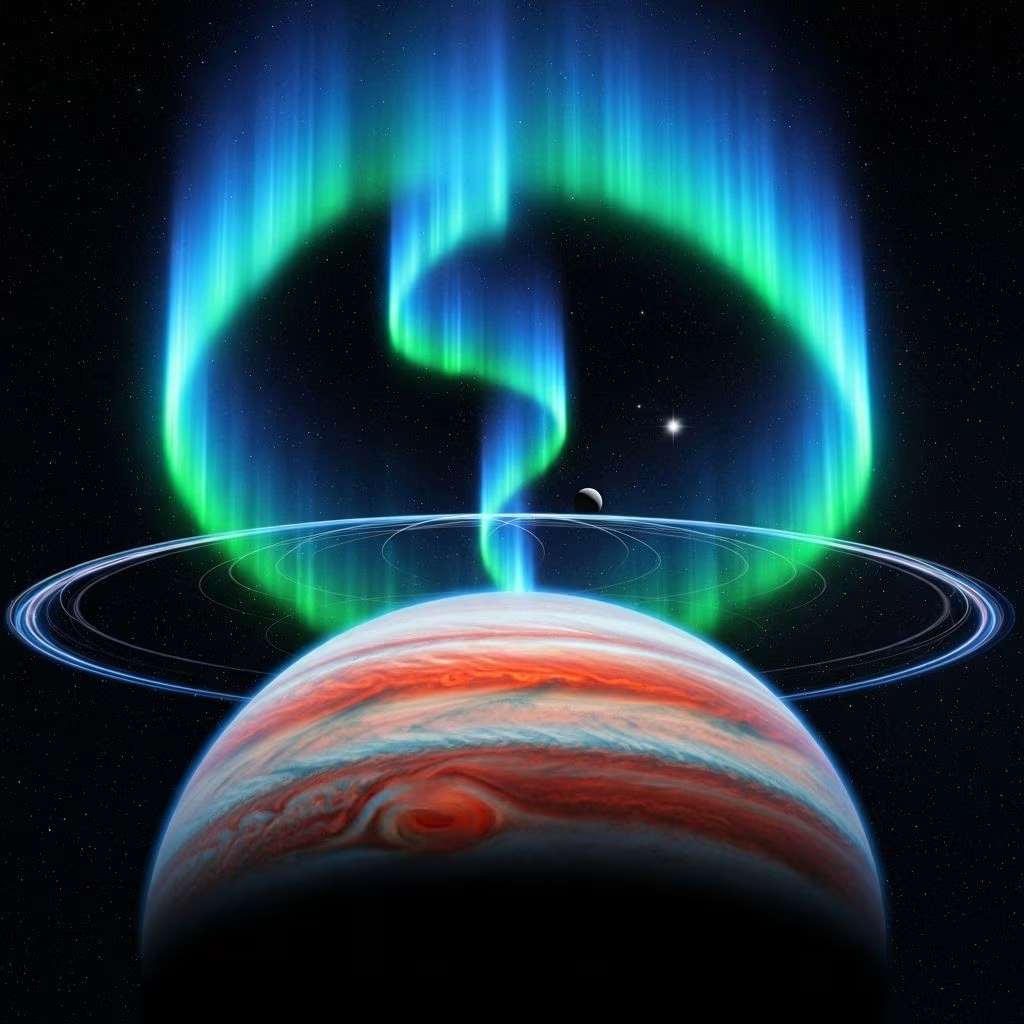
Alien Auroras on Jupiter: Unveiling a New Kind of Plasma Wave
Jupiter’s majestic auroras, dazzling in ultraviolet and invisible to the unaided eye, are far more powerful and exotic than anything found on Earth. Thanks to NASA’s Juno spacecraft and pioneering research by scientists at the University of Minnesota Twin Cities, a brand-new plasma wave phenomenon has now emerged from Jupiter’s turbulent polar regions, opening new frontiers for planetary science and space weather research .
About Alien Auroras on Jupiter
Auroras—the shimmering lights that illuminate polar skies on Earth—result when charged particles stream along magnetic field lines and collide with atmospheric gases, generating luminous displays. These atmospheric spectacles, called the northern and southern lights (aurora borealis and aurora australis), glow in familiar greens and blues, thanks to the energy released by oxygen and nitrogen atoms .
On Jupiter, however, auroras are even mightier—so intense that their power outstrips Earth’s entire energy grid. Yet these alien auroras are mostly invisible to us, their emissions peaking in ultraviolet and infrared wavelengths. Jupiter’s signature auroras swirl ceaselessly in both hemispheres, forged by the planet’s extraordinary magnetic environment and its rapid rotation .
- Location: Form near Jupiter’s poles, constantly flickering in the planet’s upper atmosphere.
- Power: Among the most energetic in the solar system, far exceeding their terrestrial counterparts.
- Visibility: Require ultraviolet and infrared instruments for observation; not visible to the naked eye.
The study of these auroras provides not just an insight into Jupiter, but into the workings of planetary magnetospheres throughout the cosmos .
How Juno Made the Discovery
The discovery of Jupiter’s new plasma wave type would not have been possible without NASA’s Juno spacecraft, which orbits Jupiter on a highly elliptical path that frequently takes it over the planet’s poles. Since 2016, Juno has been conducting a close survey of Jupiter’s magnetic and atmospheric environments, avoiding prolonged exposures to the dangerous radiation belts near the equator .
- Polar Orbit: Juno is the first spacecraft to directly sample Jupiter’s polar regions from close orbit, providing new perspectives on the auroras and the planet’s magnetism .
- Waves Instrument: Juno’s specialized Waves instrument “listens” to electromagnetic oscillations generated by charged particles (plasma), capturing signatures from deep within Jupiter’s magnetosphere .
- Historic Passes: The mission’s unique polar orientation enabled scientists to analyze plasma waves and auroral processes inaccessible to prior missions .
Professor Ali Sulaiman of the University of Minnesota notes, “The James Webb Space Telescope has given us some infrared images of the aurora, but Juno is the first spacecraft in a polar orbit around Jupiter.” This allowed the team to collect direct, in situ measurements of electromagnetic phenomena in these enigmatic zones .
What are Plasma Waves?
Plasma—sometimes called the fourth state of matter—is an electrically conductive soup of free electrons and ions. In many parts of the universe, it is more common than solids, liquids, or gases. It fills the space near planets with magnetic fields and gives rise to a fascinating array of electromagnetic phenomena, including plasma waves .
- Definition: Plasma waves are oscillations caused by the movement and interactions of charged particles, often guided or energized by magnetic fields.
- Role in Auroras: When plasma waves accelerate electrons into a planet’s upper atmosphere, the resulting collisions excite atmospheric gases, producing auroral light displays.
On Earth, plasma waves help drive the auroras seen at high latitudes. The most familiar of these are Alfvén waves, a type of magnetohydrodynamic (MHD) wave theorized in 1942 and central to both terrestrial and planetary auroral physics .
Yet, as Juno revealed, not all plasma waves are created equal. The physicists found that the waves associated with Jupiter’s auroras were not simply exotic versions of those found on Earth, but belonged to a fundamentally new category .
Jupiter’s Magnetic Field: Driver of Extreme Auroras
Jupiter boasts the largest and most powerful magnetic field of any planet in the solar system. Generated by internal convective currents and rapid rotation, this magnetic field is a colossal force, shaping the planet’s near-space environment and acting as a giant accelerator for charged particles .
- Field Strength: Roughly 20,000 times stronger than Earth’s average field at the cloud tops.
- Magnetosphere Size: Extends millions of kilometers into space, engulfing some of Jupiter’s moons within its influence.
- Unique Topology: Whereas Earth’s auroras form in a ring encircling each pole, Jupiter’s auroras are distorted by plasma flows from its volcanic moon Io and other sources, producing a more complex and dynamic pattern .
In this harsh environment, the interplay of radiation, magnetic fields, and plasma results in extreme auroral events. The low plasma density over the poles—much lower than what we experience on Earth—means the properties of waves and energetic particles are distinctly more extreme .
Unprecedented Findings: The New Plasma Wave
By carefully analyzing data collected during Juno’s polar passes, the research team identified a previously unknown type of plasma wave associated with Jupiter’s auroras. This finding marks a leap forward in understanding the electromagnetic environments of giant planets .
- New Plasma Wave Type: Displays very low frequency oscillations, an order of magnitude below what is observed in Earth’s magnetosphere.
- Cause: The exceptionally low density of plasma in Jupiter’s polar regions, combined with the planet’s powerful magnetic field, gives rise to these rare waves that had never before been detected around Earth .
- Scientific Process: The team, led by physicist Robert Lysak, used Juno’s Waves instrument to “listen” for and characterize these low-frequency signals .
These waves differ fundamentally from Alfvén waves and other known magnetospheric oscillations, suggesting that Jupiter’s auroral engine runs on principles unfamiliar to terrestrial physics .
Comparison Table: Jupiter vs. Earth’s Auroras and Plasma Waves
| Feature | Jupiter | Earth |
|---|---|---|
| Typical Aurora Power | Enormous, invisible to human eyes | Lower, visible as colored lights |
| Plasma Wave Frequency | Very low, newly discovered type | Higher, typically Alfvén waves |
| Magnetic Field Strength | 20,000x Earth’s (at cloud tops) | Much weaker |
| Observation Requirements | UV and IR instruments | Visible spectrum, sometimes camera |
| Impact of Plasma Density | Extremely low at poles, unique phenomena | Higher, more familiar dynamics |
Implications for Planetary Science
The discovery of a new plasma wave in Jupiter’s auroral region has far-reaching consequences for planetary physics, magnetospheric science, and our overall understanding of space weather processes .
- Alien Auroras: The findings suggest auroras on distant exoplanets may reveal their own unique plasma wave phenomena, depending on their magnetic and atmospheric properties.
- Magnetic Shielding: Studying these waves offers insight into how magnetic fields shield planets from stellar radiation—a key consideration for the habitability of worlds beyond our solar system.
- Universal Plasma Behaviors: These results force scientists to reconsider the “Earth-centered” model of planetary auroras and plasma waves, highlighting the enormous diversity of cosmic plasma environments.
- Juno’s Legacy: The Juno mission’s polar data continues to rewrite planetary science and will inspire the next generation of missions to Jupiter and other giant planets.
Frequently Asked Questions (FAQs)
Q: What exactly is a plasma wave?
A: Plasma waves are rhythmic oscillations of charged particles in plasma, influenced by electric and magnetic fields. On Jupiter, these waves help energize particles that cause auroras .
Q: Why are Jupiter’s auroras invisible to naked-eye observation?
A: Jupiter’s auroras primarily emit in ultraviolet and infrared light, which human eyes cannot detect. Specialized instruments are required for observations .
Q: What makes Jupiter’s magnetic field special?
A: Jupiter has the most powerful planetary magnetic field in the solar system, vastly stronger and more complex than Earth’s, powering tremendously energetic auroras and plasma waves .
Q: How did the Juno craft avoid damage from Jupiter’s harsh radiation?
A: Juno was designed to follow a looping, highly elliptical orbit that limits its time inside Jupiter’s intense radiation belts, allowing repeated polar flybys with minimal exposure .
Q: What are the broader scientific implications of these findings?
A: Discovering a new plasma wave broadens our framework for magnetospheric physics, boosts our knowledge of planetary shielding, and hints at even more exotic aurora phenomena on other worlds .
Further Reading
- For more on NASA’s Juno mission: visit official NASA portals and recent scientific publications.
- To understand planetary magnetospheres: explore studies in plasma physics and space weather research.
- Stay updated on aurora research: NASA, Phys.org, Universe Today, and academic journals in astronomy and geophysics.
References
- https://dailygalaxy.com/2025/08/unprecedented-discovery-jupiters-auroras/
- https://phys.org/news/2025-08-alien-aurora-plasma-jupiter.html
- https://www.space.com/astronomy/jupiter/alien-auroras-on-jupiter-reveal-a-new-kind-of-plasma-wave-scientists-say
- https://www.universetoday.com/articles/scientists-discover-unusual-plasma-waves-in-jupiters-aurora
- https://cse.umn.edu/college/news/alien-aurora-researchers-discover-new-plasma-wave-jupiters-aurora
- https://www.youtube.com/watch?v=7IiTF4stSrs


