What Is Astronomy?
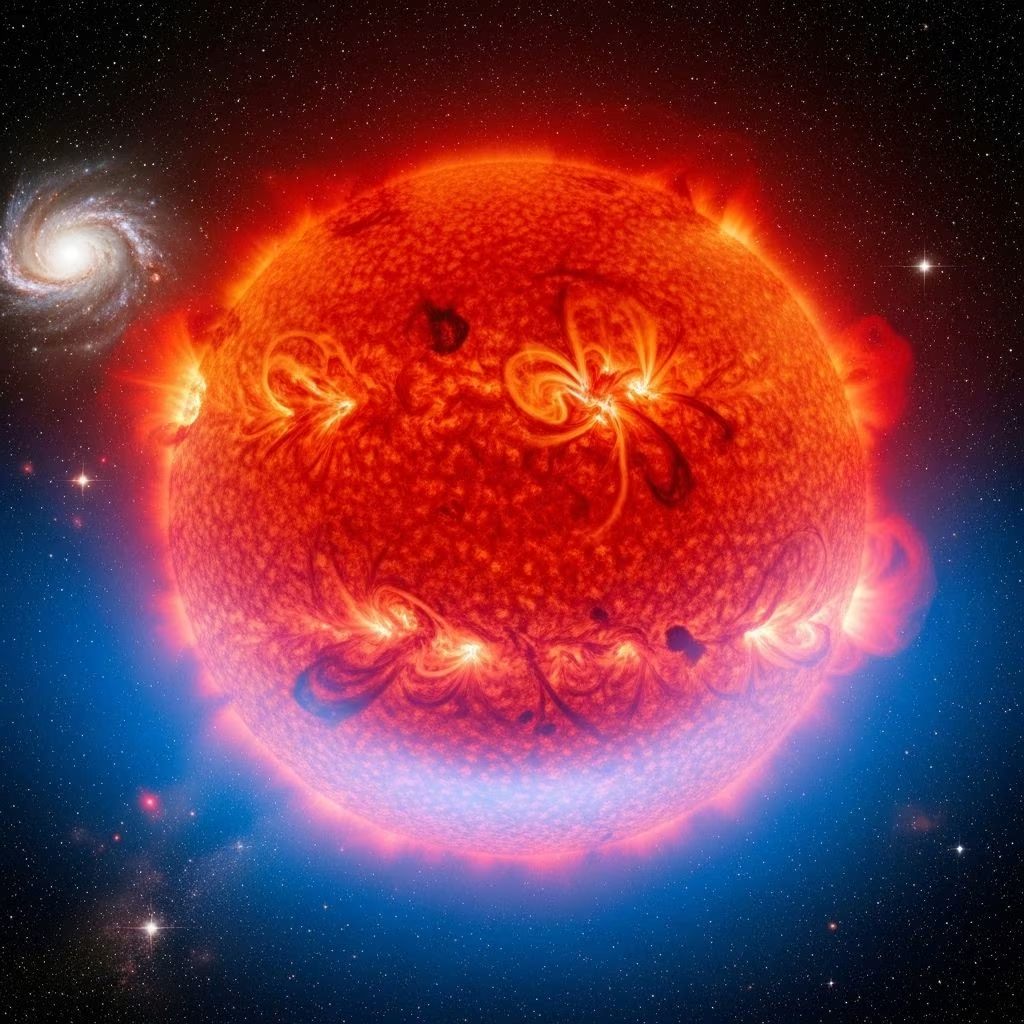
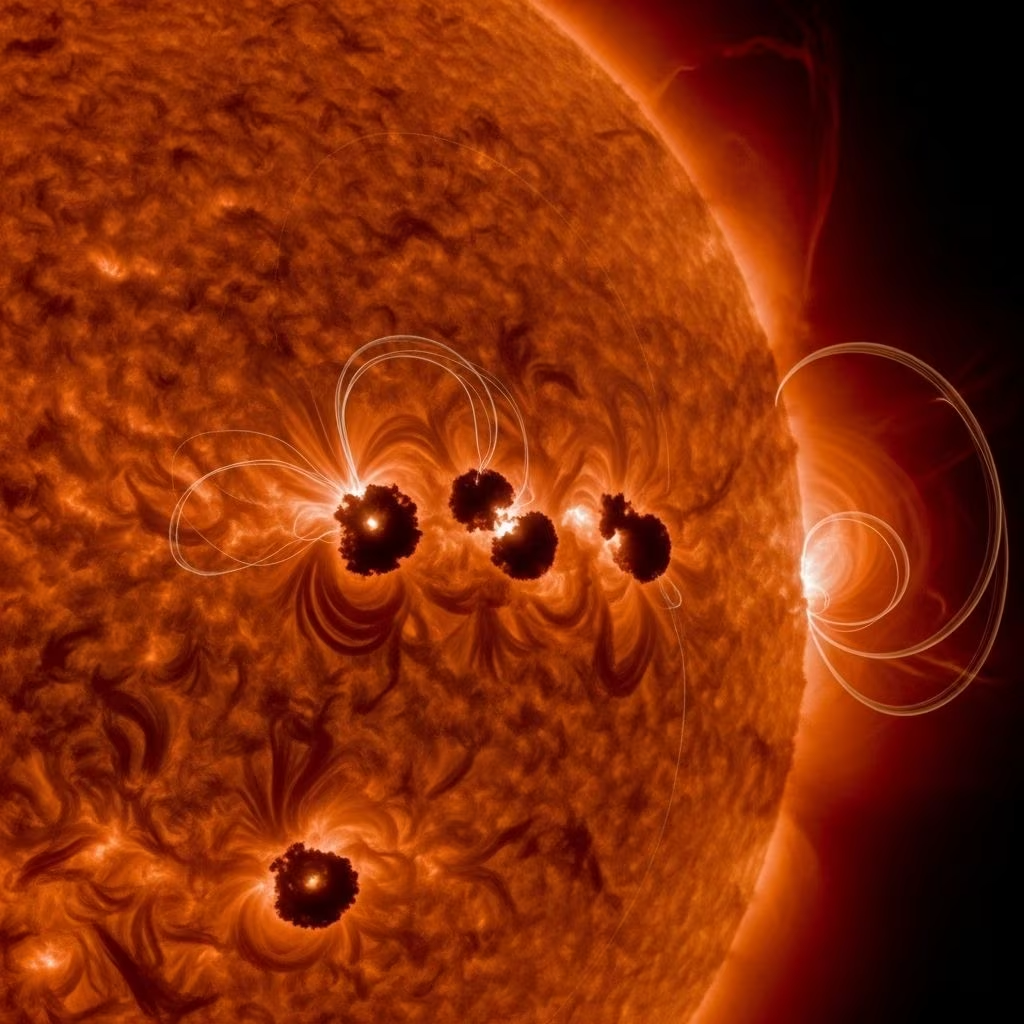
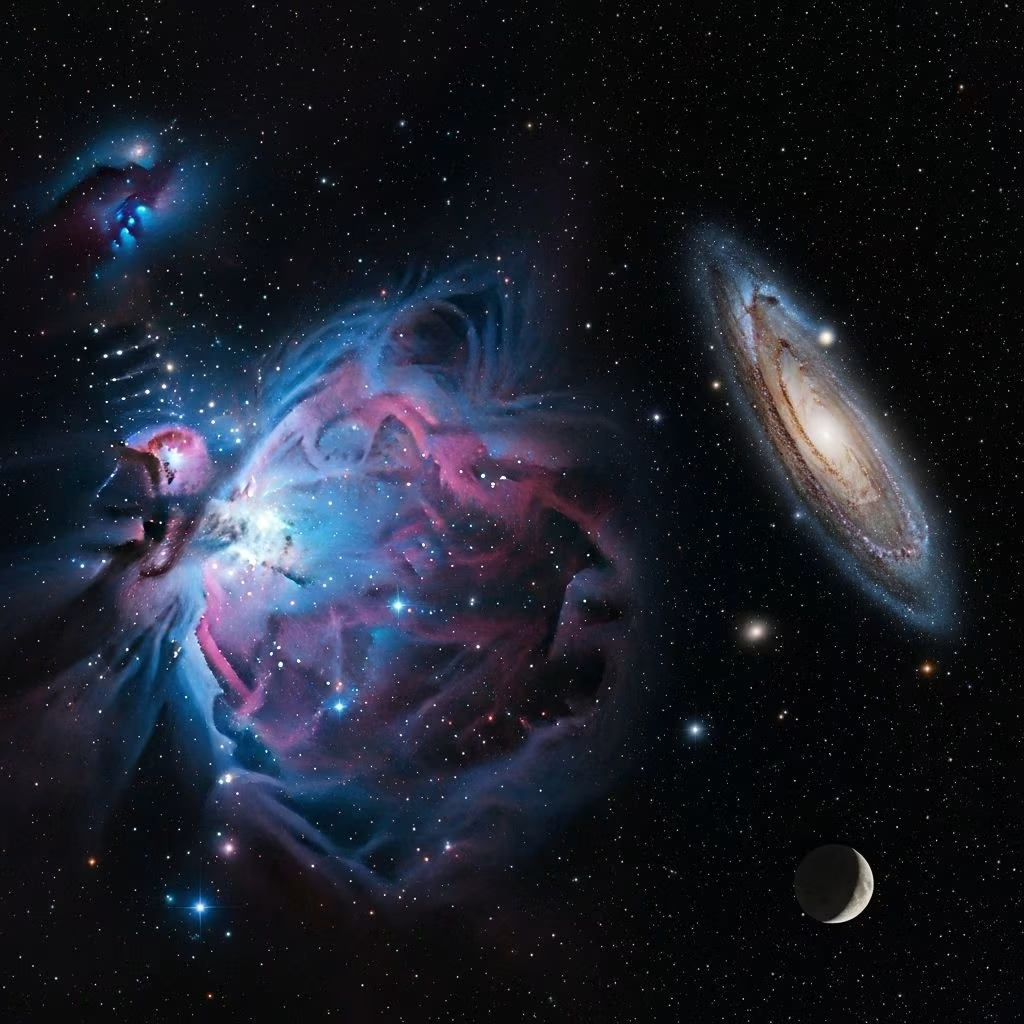
Astronomy is the scientific study of the universe and everything in it beyond Earth’s atmosphere. This discipline explores celestial objects such as planets, stars, galaxies, and the cosmic phenomena that govern their behavior. Through observation, measurement, and theory, astronomers have gradually revealed the mechanisms underlying the vast and complex cosmos.
The Roots of Stargazing: A Brief History of Astronomy
The origins of astronomy can be traced back to humanity’s earliest days, when ancient civilizations looked to the skies for patterns and meaning. From charting the movement of stars and planets to constructing myths and calendars, the sky has always played a pivotal role in shaping human understanding.
- Ancient Astronomy: Cultures including the Babylonians, Egyptians, Chinese, and Maya meticulously tracked the motions of celestial bodies. Their sophisticated calendar systems and monuments—such as Stonehenge and the Egyptian pyramids—were often aligned with significant celestial events.
- Greek and Roman Developments: Philosophers like Aristotle and Claudius Ptolemy attempted to model the cosmos using geometry, arguing for an Earth-centered universe. Ptolemy’s geocentric system, although later disproven, became the standard for centuries.
- The Islamic Golden Age: Scholars in the Middle East translated and preserved ancient texts and made cutting-edge contributions of their own, advancing observational methods and star catalogs.
- The Copernican Revolution: In the 16th century, Nicolaus Copernicus proposed a sun-centered (heliocentric) model, radically challenging established ideas and inspiring a wave of investigation.
Modern Astronomy’s Milestones
- Johannes Kepler defined planetary motion using ellipses, revolutionizing celestial mechanics with his three laws.
- Galileo Galilei was among the first to use a telescope, uncovering Jupiter’s moons and phases of Venus, which lent support to heliocentrism.
- Isaac Newton unified terrestrial and celestial physics through his law of universal gravitation.
- William Herschel expanded our knowledge of the Milky Way’s structure and discovered the planet Uranus.
- Edwin Hubble revealed that the Milky Way is just one galaxy among billions, and demonstrated that distant galaxies are receding from us—evidence of an expanding universe.
How Do Astronomers Study the Universe?
Advances in astronomy have always gone hand in hand with the development of new tools and methods of observation. Today, astronomers use a combination of ground-based and space-based instruments, sophisticated simulations, and mathematical models to analyze the cosmos.
The Power of Telescopes
- Refracting Telescopes: Use lenses to bend and focus light. Galileo’s simple refractor transformed astronomy with its magnified view of the heavens.
- Reflecting Telescopes: First designed by Isaac Newton, these use mirrors to collect and focus light. Modern observatories employ large reflectors to study faint and distant objects.
- Radio and Space Telescopes: Beyond visible light, radio telescopes, X-ray detectors, and other specialized instruments detect a range of electromagnetic signals, revealing phenomena such as pulsars, black holes, and the cosmic microwave background.
The Electromagnetic Spectrum and Observing the Cosmos
| Type | Wavelength Range | Celestial Objects Studied |
|---|---|---|
| Radio | > 1 mm | Pulsars, cold gas clouds, cosmic microwave background |
| Infrared | 700 nm – 1 mm | Star-forming regions, cool stars, dust-shrouded galaxies |
| Visible | 400–700 nm | Stars, planets, galaxies |
| Ultraviolet | 10–400 nm | Hot stars, young galaxies, ionized gas clouds |
| X-ray | 0.01–10 nm | Black holes, neutron stars, supernova remnants |
| Gamma-ray | < 0.01 nm | Gamma-ray bursts, active galactic nuclei |
Major Discoveries and Key Concepts
The Structure of the Universe
- The Solar System: Earth orbits the Sun along with seven other major planets, their moons, dwarf planets, asteroids, and comets.
- Stars and the Milky Way: Hundreds of billions of stars make up our galaxy, just one among countless others.
- Galaxies and Clusters: Galaxies gather into clusters and superclusters, creating a vast and intricate cosmic web.
Expanding Cosmos: The Big Bang Theory
The prevailing model of the universe’s origin is the Big Bang, which posits that all space, time, matter, and energy burst forth from an extremely hot, dense state nearly 13.8 billion years ago. Supporting evidence includes:
- Cosmic Microwave Background: Remnant radiation observed from all directions, a faint afterglow of the primordial fireball.
- Galactic Redshift: Distant galaxies are receding, and their light is stretched to longer wavelengths (redshift), a direct consequence of the expanding universe.
- Abundance of Light Elements: The measured proportions of hydrogen, helium, and lithium support models of nuclear fusion in the early universe.
Stellar Evolution and Exotic Objects
Stars are born from vast clouds of gas and dust, shining for millions or billions of years before exhausting their fuel. Their ultimate fate depends on their mass:
- White Dwarfs: The remnants of Sun-like stars.
- Neutron Stars: Compact, rapidly spinning remnants of massive stars, sometimes observable as pulsars.
- Black Holes: Regions where gravity is so intense that not even light can escape, often formed from the cores of the most massive stars.
The Modern Era: Unveiling the Cosmic Frontier
Space Telescopes: Eyes Above Our Atmosphere
Earth’s atmosphere blocks many wavelengths of light, limiting observations. Space telescopes—operating above this atmospheric interference—have revolutionized our understanding. Among the most influential instruments:
- Hubble Space Telescope: Since 1990, Hubble’s detailed images have revealed distant galaxies, stellar nurseries, and the accelerating expansion of the universe.
- James Webb Space Telescope (JWST): Launched in 2021, JWST peers deeper into space and further back in time, studying infant galaxies and the formation of stars.
Recent Breakthroughs: Exploring the Oldest Galaxies
In 2024, the JWST shattered previous records by detecting galaxy MoM z14, which existed just 280 million years after the Big Bang—making it the most distant known object in the universe at the time. This galaxy’s detection pushes the boundaries of what astronomers believed possible, revealing elements like carbon and nitrogen, and suggesting the existence of even earlier, primordial galaxies.
Branches of Astronomy
- Observational Astronomy: Focuses on collecting data through telescopes and detectors, measuring the properties of celestial objects.
- Theoretical Astronomy: Uses mathematical models and simulations to interpret data and develop explanations for observed phenomena.
- Astrophysics: Applies the laws of physics to understand celestial processes such as star formation, supernovae, and galaxy evolution.
- Cosmology: Explores the universe’s origin, evolution, structure, and ultimate fate.
- Planetary Science: Studies the solar system’s planets, moons, and smaller objects.
Why Does Astronomy Matter?
Astronomy provides profound insights into our origins and our place in the cosmos. Its discoveries have reshaped philosophy, science, and society by:
- Placing Earth in Context: Revealing that we are part of an immense, evolving universe.
- Driving Technological Innovation: Promoting the development of new technologies, from imaging sensors to computer algorithms.
- Inspiring Wonder: Encouraging curiosity, creativity, and a sense of stewardship for our planet.
Frequently Asked Questions (FAQs)
Q: What is the difference between astronomy and astrology?
A: Astronomy is a scientific discipline that studies the universe through evidence and observation, while astrology is a belief system that asserts celestial bodies influence human events.
Q: How do astronomers measure the distance to stars and galaxies?
A: Astronomers use techniques such as parallax (for nearby stars), Cepheid variable stars, and redshift measurements for distant galaxies to calculate cosmic distances.
Q: Who was the first person to observe the universe with a telescope?
A: Galileo Galilei was among the first to use a telescope for astronomical observations, discovering lunar craters, Jupiter’s moons, and more in the early 17th century.
Q: What caused the ‘Great Debate’ in astronomy?
A: The ‘Great Debate’ of the early 20th century was a scientific argument over whether the Milky Way contained the entire universe or whether other galaxies existed beyond it. Edwin Hubble’s work later confirmed the existence of other galaxies.
Q: Why are space telescopes important?
A: Space telescopes can observe wavelengths blocked by Earth’s atmosphere and avoid atmospheric distortion, leading to clearer, deeper views of the universe.
Conclusion
Astronomy continues to unlock the secrets of space and time, revealing a universe far grander and more complex than our ancestors imagined. As technology advances, new frontiers await discovery—reminding us that the quest to understand the cosmos is one of humanity’s oldest and most inspiring endeavors.
References
- https://www.space.com/astronomy/cosmic-miracle-james-webb-space-telescope-discovers-the-earliest-galaxy-ever-seen
- https://en.wikipedia.org/wiki/History_of_astronomy
- https://www.universetoday.com
- https://www.space.com/16014-astronomy.html
- https://www.space.com
- https://science.nasa.gov/mission/hubble/
- https://www.space.com/24870-what-is-space.html
- https://www.sciencenews.org/topic/astronomy
- https://hub.edubirdie.com/examples/astronomy-as-the-future-of-mankind/
- https://www.vaticanobservatory.org/category/sacred-space-astronomy/