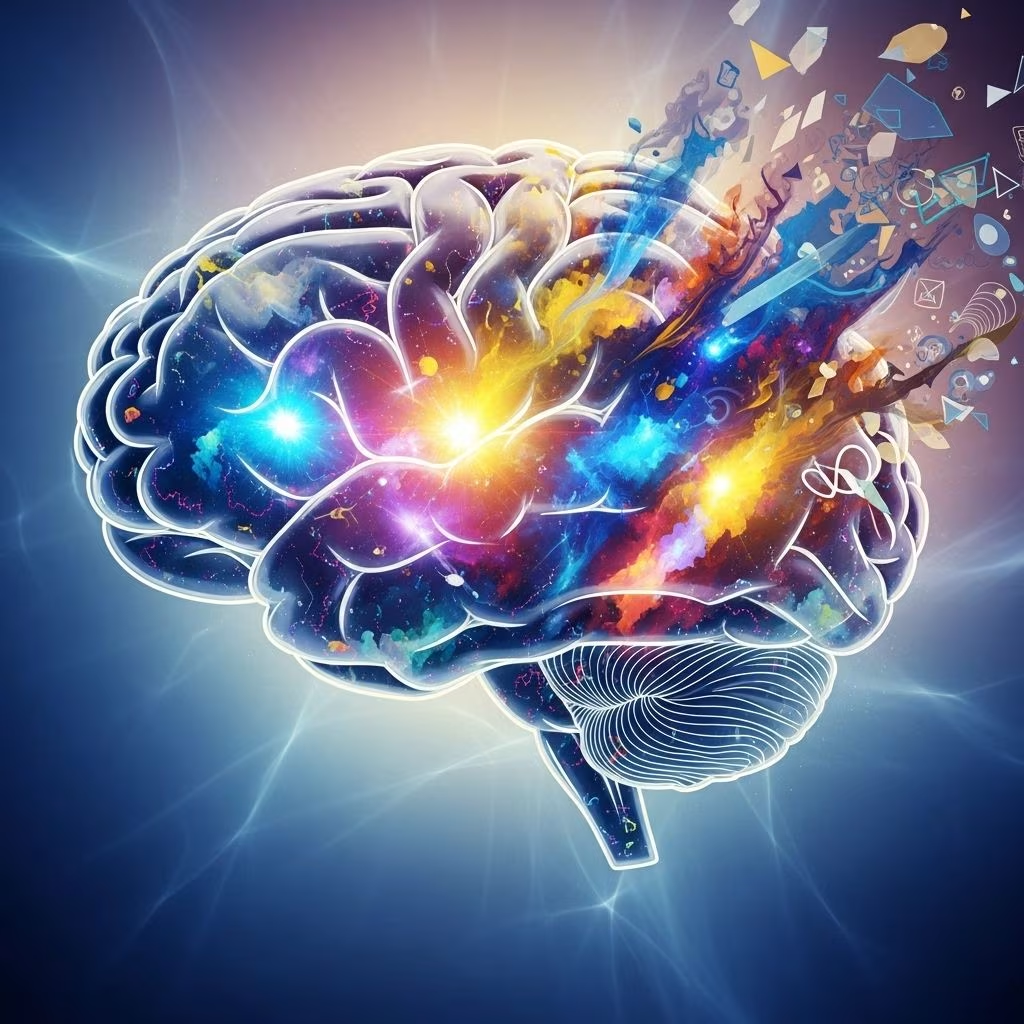
How Creativity Shapes the Brain—and How the Brain Shapes Creativity
The ability to generate new ideas, view familiar things in fresh ways, and solve problems with imagination is often celebrated as a hallmark of humanity. But what exactly happens in the brain when we engage in creative thinking? Recent advances in neuroscience have begun to unravel the intricate relationship between creativity and the brain, revealing a complex, dynamic network that links imagination, memory, and innovative thinking. In this article, we explore the latest scientific findings on how creativity originates in the mind, the neural systems involved, and actionable ways to nurture the creative spark within each of us.
Why Creativity Is Essential for Brain Health and Everyday Life
Creativity is more than a trait reserved for artists and inventors—it’s an essential survival skill. Throughout evolution, the capacity to imagine, innovate, and adapt has helped humans overcome challenges, build communities, and develop culture. In modern life, creative thinking aids in:
- Generating unique solutions for complex problems
- Improving emotional resilience and mental flexibility
- Enhancing learning and memory through novel associations
- Providing outlets for self-expression and well-being
From scientific breakthroughs and works of art to everyday tasks like meal planning or handling unexpected setbacks, the ability to approach situations with originality is intimately tied to both cognitive health and happiness.
Understanding Creativity: Defining the Elusive Concept
Despite its universal appeal, creativity is notoriously hard to define. Researchers commonly agree on two key elements: originality—the production of something new or unique—and usefulness—the idea’s applicability or value in a given context. Creativity often emerges through two kinds of thinking:
- Divergent Thinking: The ability to generate a wide range of novel ideas, often measured through brainstorming tasks (e.g., “How many uses can you imagine for a paperclip?”)
- Convergent Thinking: The process of evaluating, refining, and selecting the most effective solution or idea among many possibilities
Creativity isn’t just about having wild ideas; it’s about flexibly moving between imagination and judgment, surprise and strategy.
The Creative Brain: Networks That Power Imagination
For decades, scientists searched for a single “creativity center” in the brain. Modern imaging techniques such as functional MRI (fMRI) and electroencephalography (EEG) have instead revealed that creativity is a whole-brain phenomenon. Three major brain networks play crucial roles in creative thinking:
- Default Mode Network (DMN): This network activates when the mind is relaxed, daydreaming, or running on “autopilot.” It’s associated with spontaneous thought, imagination, and memory retrieval.
- Executive Control Network (ECN): Responsible for focused attention, self-monitoring, and goal-directed behavior. It evaluates and refines raw ideas generated by the DMN.
- Salience Network: Acts as a switchboard, helping the brain transition between the default and executive networks depending on whether spontaneous thought or focused attention is needed.
Creativity arises when these networks—usually working independently—cooperate in a dynamic dance. For example, you might daydream a quirky idea (DMN), then assess its feasibility (ECN). Highly creative people show strong functional connections between these systems, allowing them to both generate and evaluate unorthodox ideas.
The Hippocampus: The Memory-Imagination Link
Recent research highlights the hippocampus—a brain region central to memory—as a vital player in creativity. Studies show that not only does recalling past personal events activate the hippocampus, but so does imagining future scenarios and inventing creative ideas.
This overlap may explain why drawing on memories or imagining detailed scenes can boost creative performance—our brains “recycle” fragments of past experiences to build new concepts.
How Scientists Measure Creativity in the Brain
To decode the neuroscience of creativity, researchers employ a blend of clever tasks and high-tech imaging:
- Divergent Uses Task: Participants brainstorm as many unusual uses as possible for common objects (e.g., “a shoe: a flowerpot, a paperweight, a doorstop”). Brain activity is recorded and later linked to the originality of ideas.
- Imagination/Memory Tasks: Asking people to imagine future events, recall personal memories, or invent stories, while monitoring which brain regions light up.
- Functional Connectivity Analysis: Machine learning models predict individual creativity based on the strength and patterns of brain network connections during these tasks.
Brain imaging reveals that creative thinking is not confined to one area. Instead, it is the integration and fluid communication among networks—especially between the DMN, ECN, and salience network—that predicts creative output.
The Two-Step Process of Creative Thought
Groundbreaking studies suggest that creative thinking unfolds in two stages:
- Idea Generation: The DMN first becomes active, producing a flow of spontaneous thoughts and images, fueled by memory and imagination.
- Idea Evaluation: The ECN collaborates with the DMN, sifting the brainstormed ideas for those that are original yet practical or meaningful.
Brain stimulation studies reveal that when parts of the DMN are temporarily dampened, people generate fewer and less creative ideas—even though their ability to mind-wander is unaffected. This underscores the DMN’s vital, causal role in creative cognition.
Can Creativity Be Enhanced? Insights from Neuroscience
If creativity depends on cooperation among key brain networks, can we train ourselves to be more creative? Research indicates several promising avenues:
- Mind-Wandering and Incubation: Stepping away from a problem or engaging in relaxed activities (such as walking or showering) allows the DMN to roam, often leading to unexpected insights.
- Memory and Detail: Exercises that engage memory—such as recalling detailed past experiences—can prime the brain for creative thinking by activating the hippocampus and default network.
- Novelty and Play: Changing routines, traveling, or pursuing hobbies that expose you to new sights and sounds stimulate fresh connections in the brain.
- Embracing Constraints: Paradoxically, giving the brain clear limits (like writing a poem with only six words) can spark more creative problem-solving by forcing new approaches.
Even brief interventions—such as a session of detailed memory recall before a brainstorming task—have been shown to measurably increase the originality and number of creative ideas generated.
Creativity, Mood, and Mental Health
The relationship between creativity and mental health is complex. Historically, myths of the “tortured genius” abound, but neuroscience paints a more nuanced picture:
- Positive Mood States: Laughter, joy, and playful mindsets open the brain to associative, creative connections.
- Mental Illness: Mood disorders such as depression can alter DMN activity—causing people to ruminate on negative thoughts—potentially reducing creative capacity.
- Therapeutic Value: Creative pursuits like art, music, and journaling are powerful supports for mental well-being. They help process emotions, build resilience, and provide a sense of purpose or flow.
Understanding how healthy brains shift between different modes of thought could inform treatments for conditions where this flexibility is impaired—from anxiety and depression to attention deficit disorders.
Creativity Beyond the Arts: Everyday Applications
While often associated with the arts, creativity is fundamental to all aspects of life:
- Science and Technology: Inventing new solutions, devising experiments, or rethinking old theories
- Business and Leadership: Adapting to rapid change, inspiring teams, or launching novel products
- Social and Emotional Life: Finding compromise in conflict, nurturing empathy, or imagining shared goals
Encouraging innovation in the workplace, classroom, or community creates environments where creative strengths flourish and multiply.
Habits to Cultivate Your Brain’s Creative Potential
While genetics and personality play roles in creativity, the habits you nurture matter profoundly. Strategies for cultivating creativity include:
- Pursue divergent thinking: Regularly challenge yourself with open-ended questions and “what if” scenarios.
- Seek novelty: Expose yourself to unfamiliar cultures, art forms, or disciplines.
- Protect downtime: Give your brain space for mind-wandering every day—disconnect from screens, walk outdoors, or meditate.
- Embrace imperfection: Permit yourself to brainstorm “bad” ideas without judgment—often, these lead to breakthroughs.
- Reflect on your experiences: Keeping a journal, making art, or discussing ideas with friends strengthens memory-imagination networks.
Small changes in daily routine can spark bigger shifts in perspective and innovation.
The Future of Creativity Research: What Science Hopes to Discover
As imaging techniques become more precise, researchers hope to:
- Pinpoint exactly how brain regions coordinate at split-second intervals during “aha” moments
- Develop interventions for boosting creativity in aging brains or in recovery from illness or injury
- Discover how digital technologies and remote interactions shape creative capacity—both positively and negatively
- Better understand why some brains are exceptionally creative, and how this correlates with personality, motivation, or life experience
Unlocking the brain’s creative mechanisms may ultimately help cultivate originality on both individual and societal scales.
Frequently Asked Questions (FAQs) About Creativity and the Brain
Q: What is the most important brain network for creativity?
A: The default mode network (DMN) is critical for generating spontaneous, imaginative ideas. However, the highest creativity emerges when the DMN cooperates dynamically with the executive control and salience networks.
Q: Can creativity really be improved, or is it just an inborn talent?
A: While genetics and personality play roles, research shows creative thinking is like a muscle—it can be strengthened with practice, memory training, and exposure to new experiences.
Q: How do mood and mental health affect creativity?
A: Positive mood states boost flexible, creative thinking. Mood disorders that disrupt healthy brain network balance can hinder creativity, but creative activities are proven tools for mental wellness.
Q: Are there specific habits that help people be more creative?
A: Yes. Trying new things, making time for daydreaming, journaling or reflecting on experiences, and practicing divergent thinking tasks can all enhance creativity over time.
Key Takeaways: Cultivating Creativity for a Healthier Brain
- Creativity depends on seamless cooperation between major brain networks, especially those involved in imagination, focus, and evaluation.
- Original ideas emerge when we oscillate between letting thoughts roam and evaluating possibilities with intention.
- Everyone has creative potential—practices that foster new associations, recall detailed memories, and invite playful thinking will strengthen the brain’s creative architecture.
- Prioritizing creativity in daily life supports mental health, adaptability, and joy—qualities vital for individuals and communities alike as the pace of change accelerates.
References
- https://healthcare.utah.edu/newsroom/news/2024/07/study-pinpoints-origins-of-creativity-brain
- https://pmc.ncbi.nlm.nih.gov/articles/PMC7075500/
- https://pmc.ncbi.nlm.nih.gov/articles/PMC6428025/
- https://www.psu.edu/news/research/story/making-connections-psychologist-explores-neuroscience-creativity
- https://www.apa.org/monitor/2022/04/cover-science-creativity
- https://lpsonline.sas.upenn.edu/features/science-creativity-how-train-your-brain-innovative-thinking
- https://www.nsf.gov/news/where-brain-does-creativity-come-evidence-jazz
- https://www.tsfnc.org
- https://dornsife.usc.edu/bci/
- https://online.jwu.edu/blog/unlocking-power-mind-brain-region-behind-creativity-and-imagination/