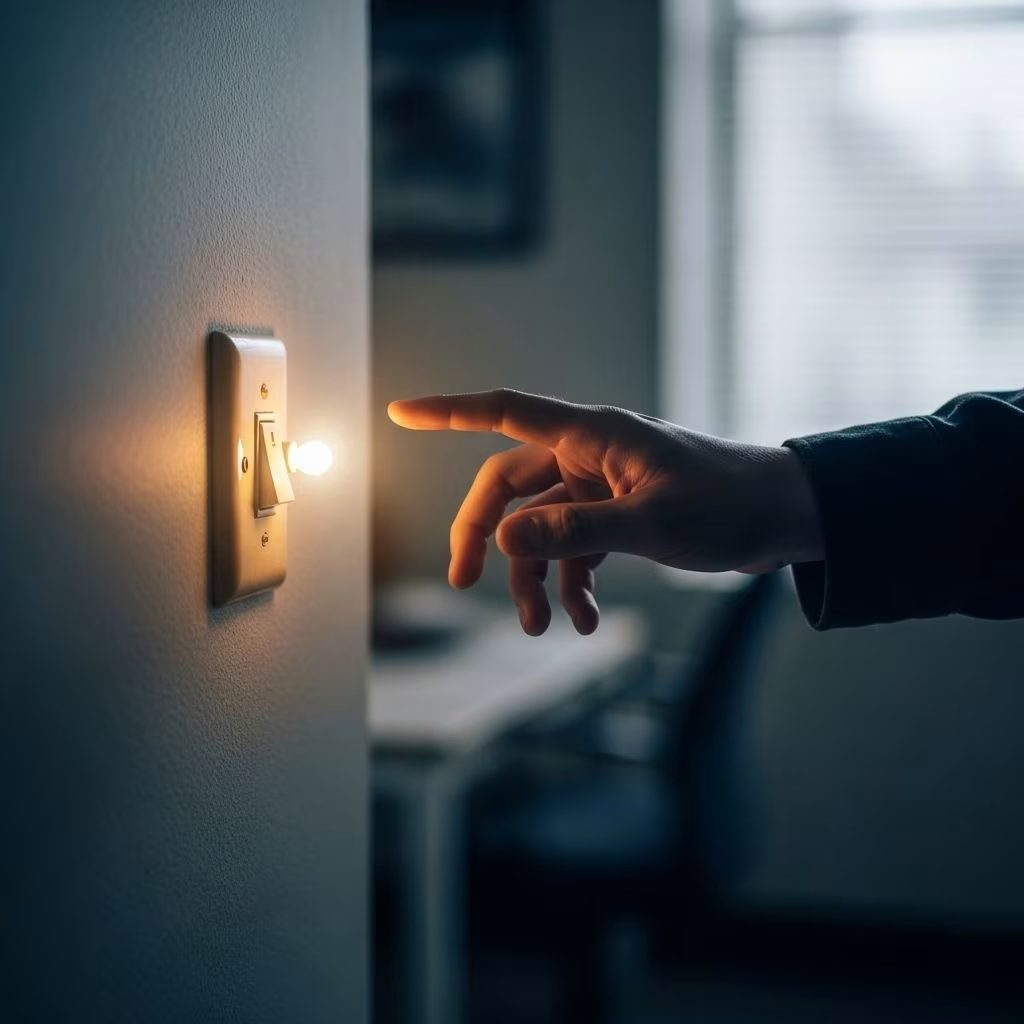
Should You Ask People to Turn Off the Lights?
For many individuals focused on sustainability, the simple act of turning off the lights when not needed has long symbolized common-sense conservation. Yet, asking others to do the same can spark a surprising mix of reactions—enthusiasm, resistance, guilt, even conflict. This article explores whether you should ask people to turn off unnecessary lights, diving into the energy, ecological, social, and psychological dimensions of this everyday behavior.
Why Turning Off Lights Matters
Turning off lights when they are not in use is often viewed as a low-effort means of reducing energy consumption. While modern lighting—especially LED bulbs—consumes far less electricity than incandescent bulbs of decades past, the cumulative effect of millions of lights left on still has substantial impacts. These impacts extend beyond your electric bill, reaching into the realms of ecological health and even social behavior.
Energy Consumption and Climate Change
- Lighting accounts for a significant portion of global electricity use. Even with more efficient bulbs becoming commonplace, lighting still uses about 10-15% of residential energy worldwide.
- Unused lighting amounts to wasted energy. The collective effect of lights left on in homes, offices, and public spaces produces substantial greenhouse gas emissions through increased electricity generation, especially where electricity grids rely on fossil fuels.
- Financial costs scale with usage. The cost of leaving a single LED bulb on throughout the year may seem modest, but on a city or national scale, these costs multiply exponentially.
Ecological and Wildlife Impacts
Light pollution has become a major concern not only for astronomers but also for conservationists and public health experts. Artificial light at night disrupts vital natural cycles in ways that are only recently being fully understood.
- Wildlife disruption: Artificial lighting can alter animal navigation, predation, and reproduction. For example, sea turtle hatchlings and migratory birds often become disoriented by human lights.
- Plant life: Many plants rely on natural light cycles for vital behaviors such as flowering and dormancy. Constant or poorly timed artificial lighting can interrupt these patterns.
- Human health: Long-term exposure to artificial light at night can disrupt human circadian rhythms, contributing to sleep disorders and other health problems.
- Loss of natural darkness: The ability to see stars and experience true night has been lost in many urban and even suburban areas, affecting cultural connections and scientific observation.
The Social Dynamics of Asking Others
While the environmental reasons for turning off lights are substantial, the practice of asking others to flip the switch is fraught with potential for social tension. Understanding the psychology and etiquette of such requests can make or break their effectiveness.
Social Friction and Perceived Judgment
- Responsibility and resentment: Requests to conserve resources, even as simple as turning off a light, can elicit feelings of being policed or judged. Some people may feel these reminders question their intelligence or personal habits.
- Generational and cultural divides: Attitudes toward conservation and energy use may differ widely across age groups and backgrounds. What seems obvious or necessary to one group may appear trivial or even intrusive to another.
- Authority, context, and relationships: The success of a request often depends on the relationship between the parties. A family member, coworker, or friend may interpret reminders differently depending on tone, frequency, and prior dynamics.
The Guilt Complex and “Virtue Signaling”
- Repeated reminders about energy saving can inadvertently foster guilt, especially if individuals feel powerless over larger sources of waste.
- Requests may be interpreted as “virtue signaling”—an attempt to demonstrate one’s morality at another’s expense—if not handled thoughtfully.
- This dynamic can backfire, leading to social avoidance or undermining broader sustainability initiatives if individuals become fatigued by perceived moralizing.
Is Asking Really Effective?
Before making a habit of reminding others to turn off the lights, it is worth considering how effective this strategy truly is. Does it actually lead to meaningful energy savings and behavior change, or do the personal and social costs outweigh the benefits?
Marginal Gains Versus Systemic Impact
- The direct energy saved by flipping off lights continues to decrease relative to other household loads as LED technology improves.
- Larger sustainability wins may come from systemic changes, such as improved building codes, motion sensors, smart home systems, and broader community initiatives.
- Small actions can inspire broader awareness. While the absolute energy savings of switching off an unused lamp may be small, it can create a culture of mindfulness around resource use that extends to bigger-impact behaviors.
When a Small Action Speaks Loudest
For some, taking visible, simple actions like turning off the lights can set a norm in shared spaces—schools, workplaces, community centers. These actions send a cue that conservation is valued, particularly if coupled with inclusive, nonjudgmental communication.
As culture gradually bends toward greater ecological consciousness, such cues can nudge more significant shifts. But they work best when paired with systems and policies that make sustainable choices the default, not just a personal preference.
Common Situations and How to Respond
All contexts are not equal when it comes to conservation requests. Here, we break down several common scenarios with guidance on approaching them effectively.
| Situation | Risks/Challenges | Recommended Approach |
|---|---|---|
| At home with family | Can trigger power struggles, especially with children or elders; may be seen as “nagging” | Model behavior; use collaborative language; discuss energy goals as a shared value. |
| Office or workplace | Colleagues may have competing priorities; may not see energy costs as their concern | Advocate for organization-wide policies, such as signs, motion sensors, or automatic timers as systemic solutions. |
| Shared common spaces (e.g., dorms, gyms) | Lack of clarity about responsibility; risk of social awkwardness | Promote group agreements or create friendly reminders together, so expectations are clear and mutual. |
| Public or outdoor spaces | Personal requests ineffective; lighting often for safety; public decision-making required | Participate in local discussions about lighting policy and advocate for downward-facing, motion-activated, or wildlife-friendly options. |
Best Practices for Making the Request
If you decide to ask someone to turn off unnecessary lights, how you make the request can matter as much as (or more than) the request itself.
- Lead by example: Make turning off lights a quiet, consistent habit that others can observe without feeling policed.
- Frame positively: Instead of “You left the light on again,” try “Let’s save some energy together by remembering to turn off the lights.”
- Avoid accusation: Assume the oversight was unintentional. Use humor or lightness where appropriate.
- Highlight broader impact: Connect the request to values you share—reducing bills, caring for wildlife, or enjoying a better night’s sleep.
- Offer solutions: Suggest installing timers, motion sensors, or stickers as reminders to take the pressure off individuals.
Addressing Safety, Accessibility, and Equity Concerns
Any discussion of turning off lights must also acknowledge legitimate needs for illumination. Lighting provides more than just visibility; it can also shape how secure and included we feel, especially in shared or public spaces.
- Safety first: Dark hallways, staircases, and outdoor areas should be adequately lit to prevent accidents or deter crime. Energy efficiency should never come at the expense of personal or community safety.
- Inclusive decision-making: Individuals at higher risk—for example, night shift workers or those with limited vision—should be included in conversations about lighting policies.
- Context matters: The right lighting solution for a family home may differ from that in a large apartment building, hospital, or city street. Equity and accessibility must be a central concern.
Beyond the Light Switch: Systemic Solutions
Ultimately, while individual efforts make a difference, the largest gains in energy savings and ecological stewardship often come from systemic changes. Communities and institutions can address lighting waste and pollution at scale through thoughtful design and policy.
- Smart lighting: Automated systems, such as occupancy sensors and timers, can ensure lights are used only when needed, reducing dependence on individual vigilance.
- Better design: Use of full cutoff fixtures, downward-directed outdoor lighting, and warmer color temperatures minimizes disruption to wildlife and night skies.
- Public education: Outreach campaigns and school initiatives help create new norms of energy use and appreciation for the value of darkness.
- Government regulation: Policy changes—such as building codes setting efficiency requirements or urban lighting plans—allow for citywide impact.
Frequently Asked Questions (FAQs)
Is leaving lights on overnight really that wasteful with modern bulbs?
While modern LED bulbs are far more efficient, leaving them on continuously still adds up over time—economically and ecologically. LEDs use less energy, but even small, habitual waste multiplied across millions of homes can become significant. Furthermore, the impact goes beyond energy, also affecting wildlife and circadian rhythms.
What about safety concerns—should I leave exterior lights on?
Safety is vital. Whenever security lighting is required, prefer motion-activated or timed lights, and prioritize designs that minimize light spill and glare while providing adequate illumination. In most situations, targeted lighting is more effective and less impactful than indiscriminately leaving lights on all night.
How can I encourage family or coworkers to save energy without conflict?
Model energy-saving behaviors yourself, introduce the topic in a collaborative rather than accusatory manner, and suggest solutions that don’t rely solely on individual vigilance. Framing the effort as mutually beneficial and open to input can reduce pushback.
Are there laws or guidelines about outdoor lighting?
Many cities have enacted “dark sky” ordinances limiting unnecessary or misdirected outdoor lighting. Check with local government for regulations and guidance, especially if you live near sensitive habitats or astronomical facilities.
What are the ecological consequences of light pollution?
Light pollution disrupts migration, reproduction, and feeding patterns in many species, from insects and amphibians to birds and mammals. Its effects extend up food webs and can alter entire ecosystems, in addition to obscuring our own views of the night sky.
Key Takeaways
- Turning off unused lights still matters, especially where energy is fossil-fuel derived or ecological impacts are high.
- Requests to save energy are most effective when framed positively, inclusively, and as part of a larger community effort.
- Systemic interventions—smart tech, good design, regulation—unlock the biggest benefits and minimize social friction.
- Balance conservation with real needs for safety and accessibility; ensure decision-making is inclusive.
- Even simple acts can inspire wider changes when they are visible, voluntary, and rooted in shared values.
References
- https://www.treehuggerpod.com/episodes/ecology-of-light
- https://www.oklahoman.com/story/news/2025/09/24/edmond-ok-deals-with-racist-past-and-looks-ahead-okc-retail-development-walmart-bucees-environment/85875307007/
- https://open.spotify.com/show/1C1K2d5fZdqQDolXYo5iLP
- https://www.patagonia.com/stories/the-original-tree-huggers/story-71575.html