


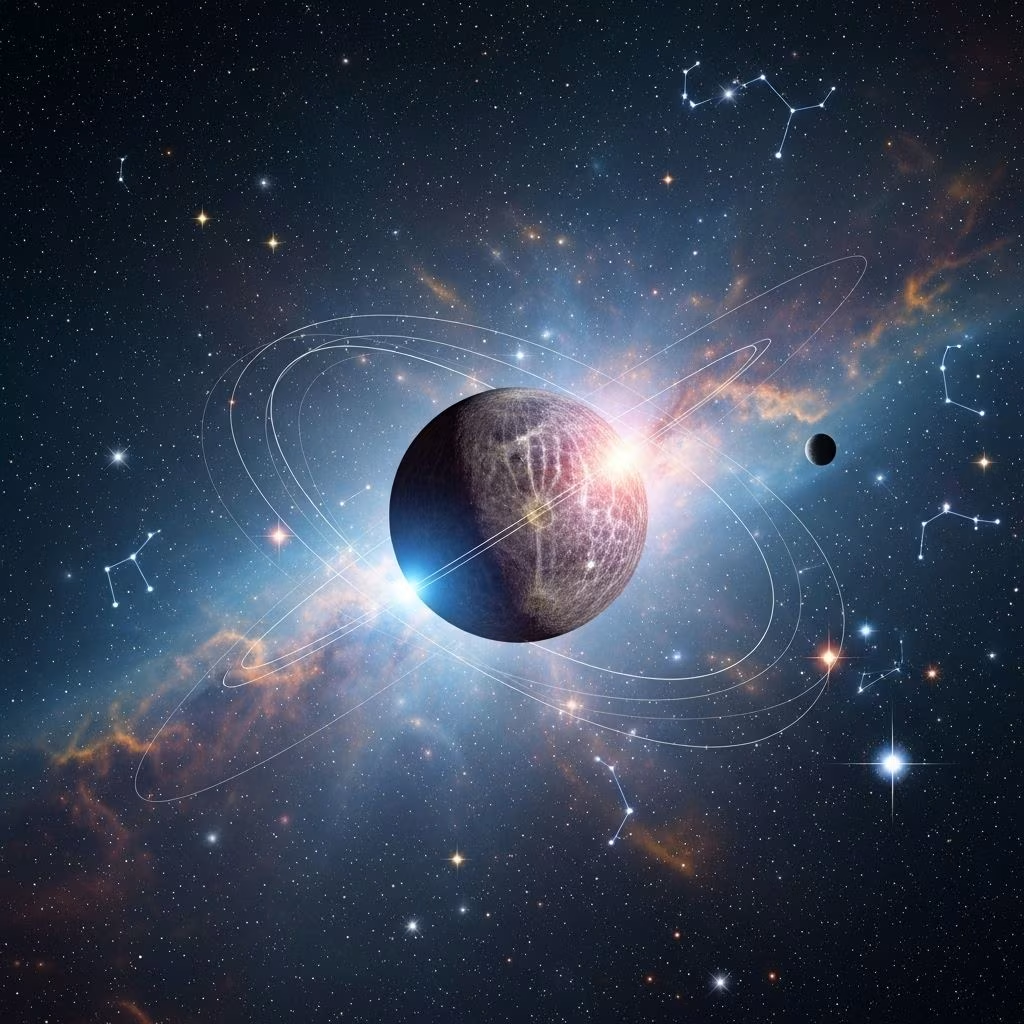
Mercury retrograde—a phrase that inspires both fascination and anxiety. For some, it is a handy scapegoat for everyday chaos; for others, it’s an excuse to retreat and reflect. But what does Mercury retrograde really mean? Is it a celestial phenomenon with tangible effects, or simply an astrological myth?
Understanding Mercury Retrograde: The Basics
Mercury retrograde occurs when the planet Mercury appears to reverse its direction in the sky, traveling backward rather than forward. Of course, no planet actually reverses its orbit; this is an optical illusion resulting from the relative positions and motions of Mercury and Earth in the solar system.
- Frequency: Mercury retrograde happens about three to four times each year, lasting roughly three weeks per cycle.
- Astrological significance: Mercury rules communication, travel, technology, and commerce, according to astrology.
- Popular belief: Many claim that during retrograde, misunderstandings, delays, and technological hiccups occur more frequently.
The Science Behind the Illusion
To understand retrograde motion, picture both Earth and Mercury orbiting the Sun. Mercury’s orbit is much smaller and faster, completing one lap in just 88 days, compared to Earth’s 365 days. When Mercury laps Earth, it appears from our perspective as if Mercury is moving backwards.
- This apparent backward movement is called retrograde motion.
- It is not unique to Mercury—all planets can appear to exhibit retrograde motion at times, depending on their position relative to Earth.
- From a physics standpoint, retrograde is an optical illusion with no known effect on human lives or events on Earth.
| Aspect | Astrology Perspective | Scientific Perspective |
|---|---|---|
| What happens? | Mercury appears to move backward in the sky | Optical illusion due to relative orbits |
| How often? | 3-4 times/yr, ~3 weeks each | Same frequency; based on orbital cycles |
| Effects | Communication, travel, tech glitches | No measurable impact on Earth |
| Advice | Reflect, avoid new ventures | No special precautions needed |
Why Does Mercury Retrograde Matter in Astrology?
Astrologers believe Mercury governs how we communicate, think, and process information, as well as our technology and daily routines. When Mercury is retrograde, these functions are thought to become more challenging or prone to disruption.
- Communication: Misunderstandings, missed emails or messages, and confusion may increase.
- Travel: Delays, canceled plans, missed connections.
- Technology: Unexpected glitches, lost files, or malfunctioning electronics.
The astrological advice is to avoid starting major new projects or making big purchases during retrograde. Instead, it’s seen as a time for reflection, review, and recalibration—a pause in the usual flow to reassess and tie up loose ends.
Common Experiences During Mercury Retrograde
- Confusing conversations and misunderstandings
- Technical issues with computers, phones, and other electronics
- Travel delays or last-minute plan changes
- Resurfacing of old friends, ex-partners, or unfinished business
Recent Cycle: Mercury Retrograde in 2025
In 2025, Mercury retrograde is expected from July 17 to August 10. Astrologers suggest this period may be especially intense for those with key placements in Gemini and Virgo (the signs Mercury rules), or for anyone with major activities planned.
What to Expect
- Heightened sensitivity around communication and emotions
- Potentially triggering unresolved issues or old patterns
- Increased importance of self-reflection and patience
How to Thrive During Mercury Retrograde
Despite its reputation for chaos, Mercury retrograde can be a productive and clarifying period if approached mindfully. Here are tips from astrologers and self-development experts on navigating the days ahead:
- Double-check everything: Review your plans, confirm appointments, and proof emails or texts before sending.
- Embrace flexibility: Be prepared to adapt if things don’t go as expected—patience reduces frustration.
- Back up data: Guard against technical glitches with frequent backups.
- Reflect and recharge: Use the time to revisit old projects or rework existing plans rather than launching new ventures.
- Practice self-care: Pause when overwhelmed, breathe deeply, and keep perspective—cosmic cycles are temporary.
Rituals and Practices for Mercury Retrograde
- Journaling: Reflect on recurring patterns or unresolved issues.
- Meditation: Softens emotional triggers and builds clarity.
- Space clearing: Declutter your physical and digital life for renewed focus.
- Protective rituals: Some turn to crystals, protective symbols, or affirmations for peace of mind.
Pop Culture, Myths, and Misconceptions
For many in Gen-Z and beyond, Mercury retrograde has become a pop culture phenomenon—explained with memes, blamed for everything from relationship troubles to bad haircuts. It has entered the language as shorthand for unexpected disruption.
- Myth: Mercury retrograde causes chaos.
Fact: It’s an optical illusion that astronomers say has no direct impact on life on Earth. - Myth: Avoid all travel or communication during retrograde.
Fact: While astro advice suggests slowing down, there’s no scientific basis for actively avoiding plans.
Why does the myth persist? Humans naturally seek explanations for patterns in life, and Mercury retrograde neatly ties together a common set of challenges we all periodically face. As such, it functions as a cultural metaphor for those “off” periods when plans unravel or messages go astray.
The Scientific Viewpoint: Does Mercury Retrograde Really Affect Us?
Most astronomers and scientists emphasize that there’s no evidence Mercury retrograde influences daily life. The concept is viewed as a coincidence-based interpretation: because retrograde cycles are regular and frequent, it’s easy to link them to unrelated frustrations.
- Gravity from Mercury is far too weak and distant to affect people or technology on Earth.
- Apparent patterns during Mercury retrograde may actually reflect confirmation bias: noticing more mistakes during retrograde because people expect them.
Why Mercury Retrograde Endures
Despite scientific evidence, the allure of Mercury retrograde remains strong. Astrologers argue it provides a useful framework for reflection, while many enjoy its role as both a warning and an excuse.
- It encourages people to slow down and be more mindful of their actions.
- It offers a shared cultural reference for discussing daily mishaps and uncertainty.
- Its cyclical nature means there’s always another chance to pause, review, and reset.
Practical Dos and Don’ts During Mercury Retrograde
- DO double-check plans, schedules, and technical matters.
- DO revisit earlier decisions and unfinished business.
- DO use the time for personal reflection, creative revision, and relationship repair.
- DON’T impulsively launch major new projects or make large purchases if possible.
- DON’T blame retrograde for every mishap—life’s quirks occur year-round!
FAQ: Mercury Retrograde Explained
What is Mercury retrograde?
It’s when Mercury appears, from Earth, to move backward in its orbit relative to the stars—an optical illusion with astrophysical origins.
How often does Mercury go retrograde?
Roughly three or four times per year, each lasting about three weeks.
Does Mercury retrograde really affect my life?
Astrologers say yes; scientists say no. Any effects are likely psychological or coincidental, rather than physically caused by the planet.
What should I avoid during Mercury retrograde?
Astrology suggests delaying new contracts or launches, but there’s no scientific reason to postpone day-to-day plans.
How can I benefit from Mercury retrograde seasons?
Use the period as a cue to reflect, review old projects, reconnect with people from the past, and resolve lingering issues.
Key Takeaways
- Mercury retrograde is an optical illusion reflecting planetary motion—not an actual reversal.
- Astrology assigns it significance for communication, travel, and technology, even as science finds no tangible effect.
- The event is best used as a prompt for reflection, patience, and mindful navigation of daily life’s ups and downs.
- Its cultural staying power demonstrates our fascination with cosmic cycles and the need for frameworks to understand uncertainty.
Further Reading and Reflection
- For those interested in astrology, track Mercury retrograde periods and observe personal patterns during these phases.
- If you’re more scientifically inclined, use the event as a reminder of the wonders of our solar system—and humanity’s creativity in making sense of cosmic movements.
References
- https://timesofindia.indiatimes.com/astrology/planets-transits/surviving-mercury-retrograde-the-cosmic-chaos-explained/articleshow/112426629.cms
- https://www.livescience.com/54675-mercury-retrograde-will-not-mess-up-your-life.html
- https://www.youtube.com/watch?v=ZfJDT_vc6nU
- https://www.youtube.com/watch?v=n4rLQ8OikYQ
- https://www.yogajournal.com/teach/survive-mercury-retrograde-during-eclipse-season/
- https://www.refinery29.com/en-us/mercury-retrograde-november-2024-meaning-effects


