


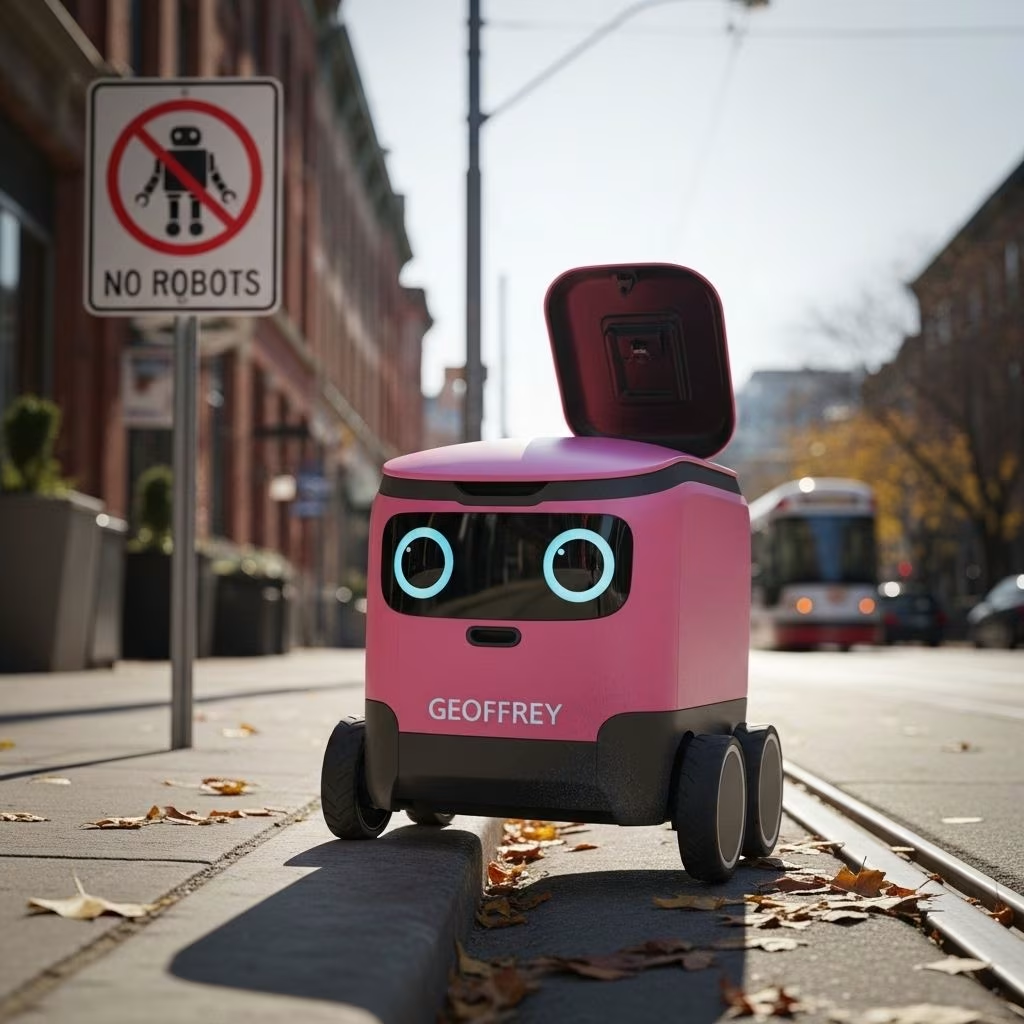
Why Toronto Banned Geoffrey, the Cute Pink Delivery Robot, from City Sidewalks
Geoffrey, the heart-eyed pink robot, symbolized innovation in food delivery across Toronto—until, in late 2021, city officials voted to remove him (and all delivery robots like him) from public sidewalks. This move highlighted a deep debate about the future of urban mobility, public safety, and how cities balance technology with accessibility for all citizens.
Meet Geoffrey: The Face of Food Delivery Robots in Toronto
Launched by Tiny Mile in 2020, Geoffrey was a small, pink, remotely operated robot designed to deliver takeout from local restaurants to homes and businesses. Outfitted with a pair of heart-shaped eyes and an unmistakable color, Geoffrey quickly became a recognizable figure in several downtown neighborhoods.
Key features of Geoffrey and similar delivery robots:
- Remote human operation (not fully autonomous)
- Lightweight and compact design, tailored for urban environments
- Limited speed—well below that of bicycles or scooters
- Equipped with cameras, sensors, and navigation lighting for city navigation
While Geoffrey became a symbol of technological optimism for some, for others he represented a hazard and a troubling precedent for urban policy.
Toronto’s Accessibility Backlash: Concerns Over Sidewalk Robots
Despite Geoffrey’s popularity among certain restaurant patrons and tech enthusiasts, the Toronto Accessibility Advisory Committee led a campaign against the presence of delivery robots on city sidewalks. The committee argued that:
- Delivery robots pose serious risks for people with low mobility or vision impairments, who may have difficulty perceiving, avoiding, or maneuvering around such obstacles.
- Children and seniors are particularly vulnerable to collisions or blockages caused by stopped or malfunctioning devices.
- Effective regulation and enforcement would be nearly impossible, especially in cases of injury or damage, since robots often lack clear points of contact or insurance identification.
- Allowing devices other than wheelchairs or other mobility aids on sidewalks could establish a dangerous precedent for clutter and accessibility barriers.
Kristyn Wong-Tam, the City Councillor who helped advance the motion, clarified that the intent was not to stifle innovation, but to “remove external barriers so that people can participate in public life.” She emphasized that the right to participate should not be compromised by emerging technologies that haven’t yet demonstrated adequate safety and accessibility measures for all users.
The Proposed Ban: What It Covers and Why
In December 2021, Toronto’s Infrastructure and Environment Committee moved forward with a recommendation to ban all robots operating on sidewalks and public walkways that are not powered by muscle (i.e., excluding wheelchairs and mobility scooters for the disabled). Key elements of the proposed ban include:
- Scope: Applies to all non-human-powered, automated or remotely controlled robots outside of private property and not transporting people.
- Public walkways: Includes sidewalks, bike paths, and other rights-of-way.
- Penalties: Fines for violations, potential seizure and disposal of the offending robots.
The committee’s stance was that there are currently no effective safeguards or regulatory mechanisms to fully protect vulnerable populations from the risks these robots present.
Notably, the ban does not prevent use of delivery robots on private property, such as within malls or campus environments. It is also not directed toward personal mobility devices, which remain permissible for people with disabilities.
Voices in the Debate: Disability Advocates vs. Tech Innovators
| Accessibility Advocates | Tech and Delivery Companies |
|---|---|
| Concerned about increased hazards for people with disabilities, seniors, and children. | Argue robots can provide benefits such as reduced emissions, expanded service for those with limited mobility, and job creation in tech. |
| Believe only a total ban can prevent accessibility issues on public sidewalks. | Support pilot projects with strict speed and safety requirements, including clear labeling and pedestrian right-of-way. |
| Question enforceability; victims of incidents may not know whom to sue or hold accountable. | Highlight transparency measures, insurance, and remote human monitoring to mitigate risks. |
| See robots as an unnecessary addition to the already-complicated urban pedestrian environment. | See robots as part of a smarter, more sustainable urban delivery solution. |
Tiny Mile, Geoffrey’s operator, asserted that its robots have mechanisms that promote safe operation and are controlled by humans at all times. The company expressed willingness to collaborate with city authorities and accessibility groups to refine regulations and safety protocols, instead of facing an outright ban. On social media and through petitions, Tiny Mile described the ban as “illogical” and as a blow to innovation and local business support.
What Changed: From Pilot Programs to a Ban
Toronto’s move to ban robots came amidst a planned 10-year pilot project that would have allowed delivery robots on sidewalks under strict conditions:
- Maximum speed of 10 km/hr
- Obligatory operator labeling and contact information on each robot
- Mandatory audible signals, reflectors or lights, and functional brakes
- Robust insurance policies
- Requirement that robots always yield to pedestrians
Accessibility advocates argued that even under these stipulations, the risks remained too high and enforcement would be impractical, leading to the city council overriding the pilot and choosing a full ban instead.
How Does Toronto Compare: Other Cities Tackling Robot Regulation
Toronto’s decision echoes similar moves by other cities in recent years—but approaches diverge significantly across jurisdictions:
- San Francisco: Banned almost all sidewalk delivery robots in 2017, later allowing restricted permits for certain pilots after city backlash.
- Virginia: Became the first U.S. state to legalize sidewalk delivery robots in 2017, with speed and weight limits, updating regulations in 2020 to permit heavier and faster robots, provided certain conditions are met.
- Pennsylvania: In 2020, classified sidewalk robots as “pedestrians” under state law, allowing up to 12 mph on sidewalks, and extending similar permissions in 21 different states by 2021.
Some jurisdictions permit carefully regulated pilot programs; others—especially dense urban centers—have imposed almost total bans due to accessibility and liability concerns.
The Broader Conversation: Urban Innovation versus Accessibility
The debate over Geoffrey and his fellow robots sparks much larger questions about the direction of urban innovation and rights in public spaces. Fundamental issues include:
- Safety: Ensuring sidewalks remain predictable and safe for all, particularly the most vulnerable users.
- Equity: Balancing convenience for able-bodied users and business interests with access and safety for people with disabilities.
- Regulation: Creating clear rules and enforcement mechanisms that do not overburden one group or sector.
- Liability: Ensuring that responsibility for harm or damage is clearly assignable and enforceable.
- Urban life: Determining how much technological innovation should change the character and daily operation of city living.
Tiny Mile’s Response and the Future for Delivery Robots
Following the recommendation for a citywide ban, Tiny Mile agreed to halt robot operations in Toronto. The company stated that, “in the spirit of good faith and the desire to get it right, we will temporarily take all our robots off the streets, to have time to collaborate with authorities and the accessibility community to showcase all the safety mechanisms we have put in place and get feedback on product improvements.”
This pause doesn’t mean the end of delivery robots in Toronto—or elsewhere. Instead, it marks a potentially important recalibration, with innovators and regulators now challenged to develop new approaches that reconcile the best aspects of convenience and inclusion.
Looking Ahead: Can Sidewalk Robots Return to Toronto?
The path forward for sidewalk delivery robots in Toronto will likely depend on ongoing dialogue among stakeholders, real-world data from pilot programs in other cities, and advancements in both robotics safety and regulatory technology.
Possible conditions for a return could include:
- Advanced obstacle detection and real-time pedestrian avoidance systems
- Mandatory operator identification, insurance, and accountability frameworks
- Community-based pilots co-designed with accessibility groups
- Urban design adaptations to accommodate (or manage) novel delivery devices
Such measures could create a more inclusive pathway for both technological progress and urban accessibility—though, as Toronto has shown, innovation will not be allowed to outpace public safety in Canada’s largest city.
Frequently Asked Questions (FAQs)
Why did Toronto ban delivery robots like Geoffrey?
The ban was motivated primarily by accessibility and safety concerns, particularly for people with disabilities, seniors, and young children who may be at increased risk from devices operating on sidewalks or public pathways.
Are all robots banned from public spaces in Toronto?
No—the ban specifically applies to robots operating on sidewalks, bike paths, and other public walkways. Robots on private property and personal mobility aids like wheelchairs or scooters are not affected.
How are other cities handling sidewalk delivery robots?
Responses vary widely: some, like San Francisco, have strict bans; others, like states in the U.S. (e.g., Virginia, Pennsylvania), have legalized sidewalk robots with regulations on speed, weight, and operation.
Is this ban permanent?
The city ban is in effect as of 2021, with no fixed sunset. However, changing technology, public consultation, and policy evolution could see future revisions or new pilot programs developed under strict guidelines.
Could delivery robots return to Toronto in the future?
Yes, if accessibility advocates and city policymakers can be satisfied that safety and accountability concerns have been fully addressed—potentially through new designs, regulations, or pilot projects aligned with community input.
References
- https://www.therobotreport.com/toronto-considers-banning-sidewalk-robots/
- https://www.aoda.ca/tell-toronto-city-council-to-ban-robots-from-sidewalks-because-they-endanger-people-with-disabilities-seniors-children-and-others/
- https://torontolife.com/city/self-driving-delivery-bots-are-hitting-the-streets-of-toronto/
- https://toronto.citynews.ca/2025/05/30/markham-food-delivery-robots-skip-the-dishes/


