


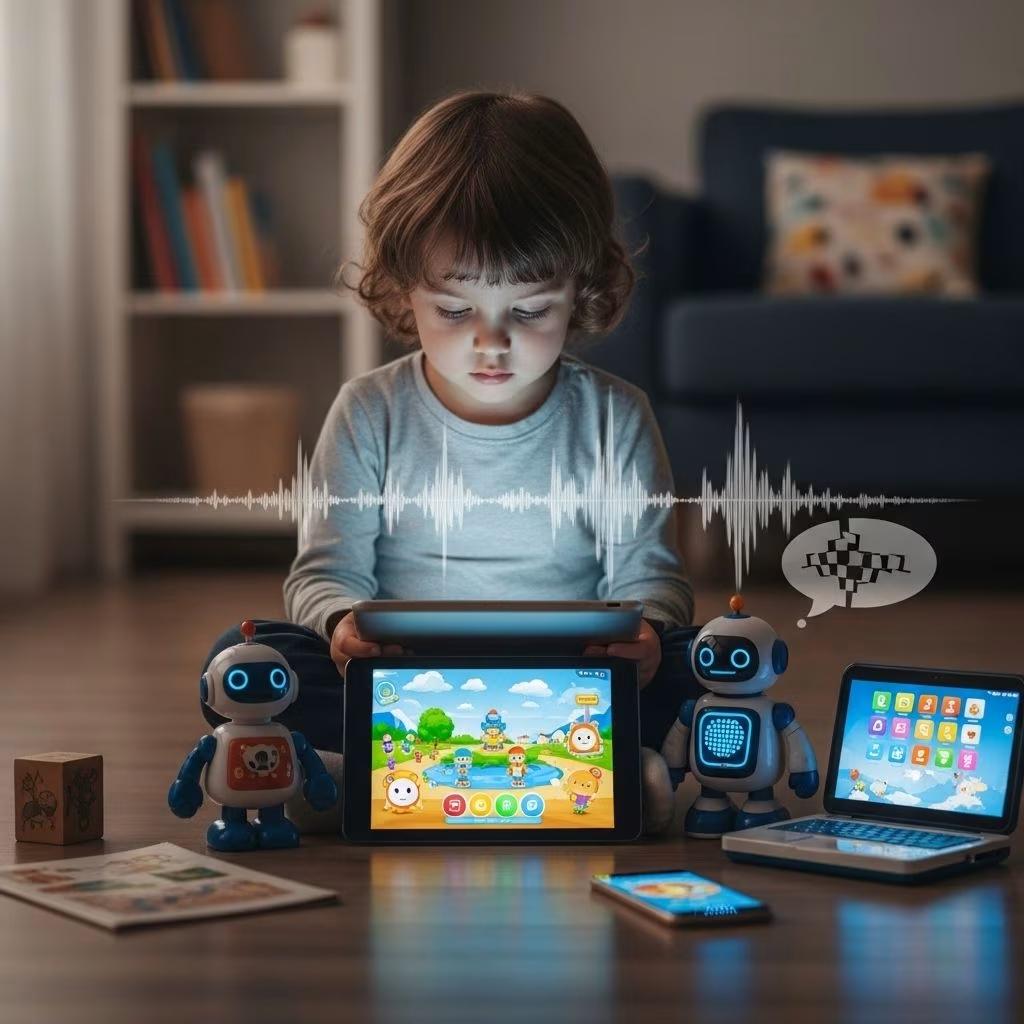
How Electronic Toys Can Hinder Children’s Language Development
Electronic toys have become a ubiquitous presence in children’s lives, promising educational benefits through music, flashing lights, and interactive features. However, recent research suggests that these toys may actually reduce opportunities for meaningful language development in young children. This article examines how electronic toys influence child-parent interactions and language learning, drawing from scientific studies and expert recommendations for families seeking the best for their child’s growth.
Electronic Toys: Popularity and Promises
Bright colors, catchy tunes, and interactive features make electronic toys appealing to both children and parents. Advertised as tools to spark curiosity and accelerate learning, these toys claim to boost vocabulary, early literacy, and cognitive skills. Major retailers market electronic toys as ‘smart’ or ‘educational,’ blurring the line between entertainment and instruction.
- Designed to attract and hold a child’s attention with sound, speech, music, and lights.
- Popular products include electronic shape sorters, talking plush animals, learning tablets, and electronic building sets.
- Marketing frequently highlights brain development and school readiness, appealing to parents seeking a head start for their children.
What the Science Says: The Impact on Language
Despite their popularity, research increasingly shows electronic toys may impede natural language development, especially for younger children at crucial stages of vocabulary and speech acquisition. To understand why, it’s important to examine how children actually use language during play, and how electronic toys affect this process.
Reduced Quantity and Diversity of Speech
In studies comparing electronic and traditional toy play, children generally:
- Spoke less frequently when playing with electronic toys than with traditional toys like blocks, puzzles, or dolls.
- Used a lower variety of words and shorter phrases during electronic toy play, suggesting more limited language exposure and practice.
For example, one study found that both typically developing children and those with autism spectrum disorder (ASD) produced significantly fewer utterances and unique words with electronic toys. Some children in the study produced only a single utterance in a 10-minute session with electronic toys, but many more during the same length of time with traditional toys.
Interference With Parent-Child Interaction
The richness of children’s language development depends heavily on responsive, reciprocal conversations with adults. Electronic toys often disrupt these natural exchanges by:
- Dominating the interaction with prerecorded sounds, speech, or music, which leaves little room for children to initiate or respond verbally.
- Reducing the need for parents to describe, question, or expand on the play since the toy ‘does the talking.’
- Interrupting conversations between parent and child, decreasing opportunities for language modeling and turn-taking.
As a result, adult caregivers may become passive observers, letting the toy lead the interaction rather than actively engaging with the child. Studies consistently find that when parents and children play with traditional toys, there are more opportunities for shared attention, elaboration, and longer dialogues—all factors crucial for language learning.
The Illusion of Education
Why do so many parents believe electronic toys foster learning? Partly, it’s a matter of clever marketing. The cause-effect feedback from lights or music creates the sense that a child is “doing something educational,” even if they are not actively using or expanding language.
- Many electronic toys recite the same songs or animal sounds, limiting exposure to new vocabulary.
- The child may press buttons to elicit sound effects, but these are typically one-way interactions that do not require the child to use or comprehend more complex language.
- Research finds that actual learning does not always align with the educational claims presented on packaging.
Traditional Toys: The Language Advantage
Traditional toys—such as wooden blocks, nesting cups, puzzles, or dolls—tend to encourage more interactive, creative play and richer language experiences. Unlike electronic toys, they:
- Require children and adults to provide narration, explanation, or imagination during play.
- Promote back-and-forth conversations, as there is no prerecorded voice or automatic response to fill in the silence.
- Encourage problem-solving, storytelling, and negotiation of pretend scenarios, stimulating language use and comprehension.
For example, pushing a toy car allows for adult commentary—”You’re driving the blue car! Where is it going next?” Building a tower with blocks creates opportunities to talk about size, shape, and color. These moments foster vocabulary growth, syntax, and conversational skills.
Why Interaction Matters Most
Language is learned in social contexts. Decades of research support the idea that responsive, face-to-face interactions—with parents talking, listening, and responding to their child—are far more beneficial than passive exposure to prerecorded words or electronic sounds.
Key reasons traditional toys foster richer language:
- Child-led play encourages children to experiment, ask questions, and use their own words.
- Parents are more likely to respond to children’s verbalizations, expanding on their ideas and vocabulary.
- Without electronic distractions, children and adults can maintain “joint attention,” a critical building block for learning new words and concepts.
Are All Electronic Toys Equally Limiting?
Not every electronic toy has the same impact. Some provide valuable multisensory feedback aligned with a child’s actions, encouraging active engagement. However, toys that insert random, unrelated noises or scripted speech, or that engage the child passively, are most likely to suppress quality language opportunities.
| Type of Toy | Language Opportunities | Typical Interaction |
|---|---|---|
| Traditional (Non-electronic) | High | Parent-child narration, open-ended conversation, creativity |
| Electronic (Music/Talking) | Low to Moderate | Mainly toy-led sound or scripted speech, less room for child/adult interaction |
| Feedback Toys (response to input) | Varies | Can encourage engagement if response is contingent and simple |
Special Considerations for Children with ASD
Children with Autism Spectrum Disorder (ASD) often require additional support in language development. Research indicates that these children are even more sensitive to interruptions in parent-child play caused by electronic toys.
- Some children with ASD produced only a single utterance during electronic toy play, versus several during traditional play.
- Children at the earliest stages of language development experience outsized negative effects from diminished opportunities for reciprocal communication.
For these children, the value of face-to-face, turn-taking interactions during play cannot be overstated. Interventions and therapy often emphasize precisely these conversational skills—skills less likely to be fostered by electronic toy-led play.
Recognizing the Parent’s Role
Electronic toys may be marketed as educational, but no gadget can replace the role that parents and caregivers play in nurturing language. Meaningful conversation, joint exploration, and warm, engaged play are the foundation for lasting language skills. The most effective toys are those that function as tools for human connection, not as substitutes for adult interaction.
- Parents can transform any play situation into a language-rich experience by labeling actions (“Let’s stack the blocks!”), describing (“This truck is big and red!”), and responding (“Tell me what happens next”).
- The value of a toy is measured in how much shared attention and conversation it invites, not in how many lights or sounds it produces.
Tips for Choosing Language-Fostering Toys
- Favor simple, open-ended toys like blocks, nesting cups, balls, dolls, and pretend play sets.
- Look for toys that encourage problem-solving, storytelling, or turn-taking.
- If using electronic toys, choose those with minimal distraction and where the child’s input drives the feedback.
- Prioritize time for unstructured, face-to-face play with your child, without electronic interruptions.
- Model language during play by describing, questioning, and expanding your child’s comments.
Frequently Asked Questions (FAQs)
Do electronic toys have any benefits for children?
Some electronic toys offer multisensory experiences or reinforce cause-and-effect relationships. However, research shows these benefits do not match the language-boosting power of toys that encourage open-ended, conversation-rich play with adults.
How can I tell if a toy is supporting my child’s language?
Observe whether the toy sparks conversation and imaginative play. Good language-supporting toys invite questions, descriptions, and storytelling—not just button-pressing followed by a prerecorded sound.
Are traditional toys always better than electronic toys?
Traditional toys most often foster higher-quality child–parent interaction. However, a small number of well-designed electronic toys that respond to the child’s input can complement, but not replace, real conversation and face-to-face play.
What if my child mostly wants to play with electronic toys?
Balance is key. Offer a mix of traditional and electronic toys, but ensure plenty of time for interactive play with adults. Engage with your child, narrate what’s happening, and follow their interests to make any playtime a rich language-learning opportunity.
Key Takeaways
- Electronic toys often reduce the quantity and diversity of children’s spoken language by dominating play with sound and speech.
- Language develops best through interactive, responsive play with caring adults, which traditional toys more readily facilitate.
- The right toys are those that encourage back-and-forth communication, imagination, and shared attention, not those that do the ‘talking’ for your child.
- Parents play the most important role in fostering early language—no toy can replace face-to-face, language-rich interaction.
References
- https://pmc.ncbi.nlm.nih.gov/articles/PMC9286016/
- https://www.youtube.com/watch?v=do5YC0LAjDY
- https://adventureswithkelly.com/2022/11/11/my-favorite-toys-as-a-mom-and-slp/
- https://parentingtranslator.substack.com/p/are-electronic-toys-bad-for-childrens
- https://www.knau.org/knau-and-arizona-news/2016-01-08/nau-study-electronic-toys-wont-help-babies-learn-language


