


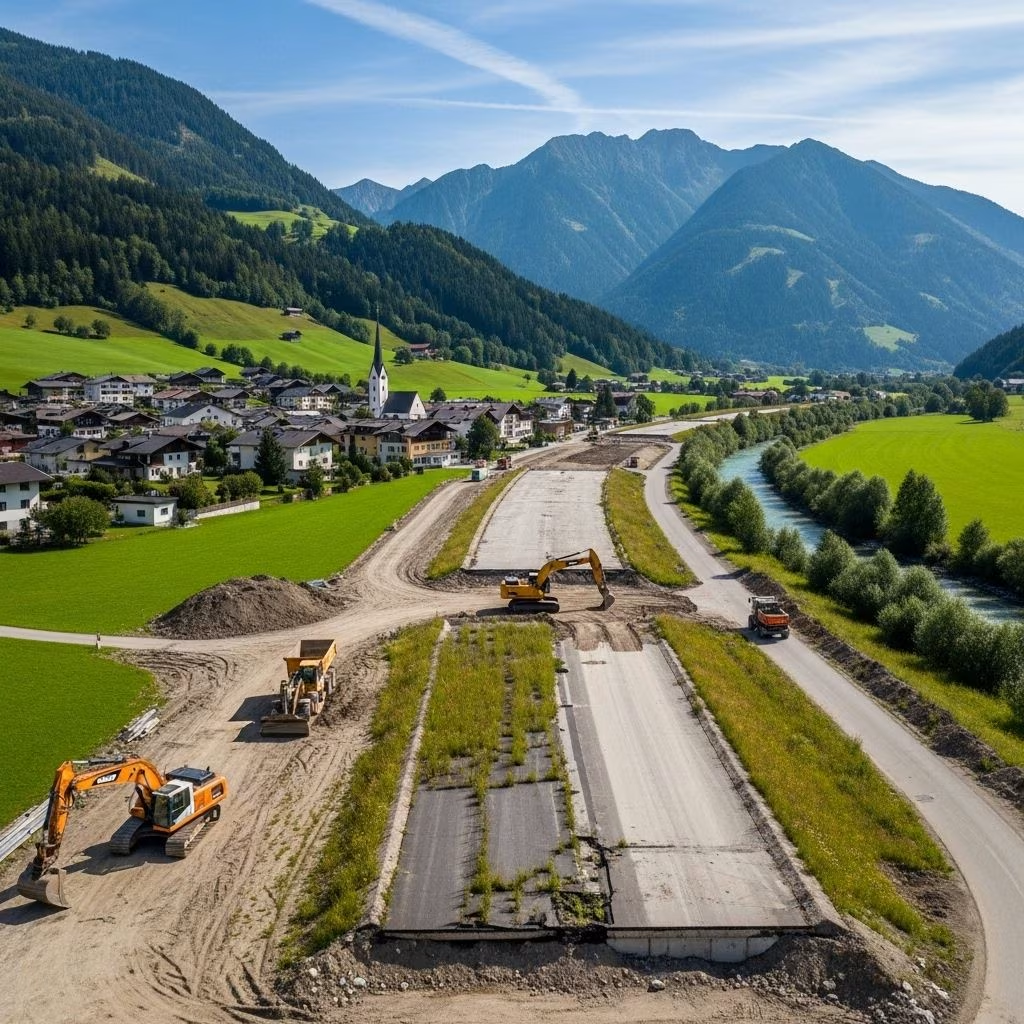
Austria’s Radical Rethink: Canceling Highway Projects to Fight Climate Change
In a historic and headline-making decision, Austria’s government has announced a halt to multiple longstanding highway construction projects, positioning itself on the frontlines of European nations willing to make bold sacrifices for the sake of climate strategy and sustainability. Central to this shift are the cancellation of high-profile roads, most notably the proposed Lobau tunnel, which was intended to punch through sensitive ecosystems east of Vienna. This article explores the context, political motivations, environmental arguments, urban planning debates, and international implications of Austria’s game-changing course correction.
The Cancelled Projects: What Was at Stake?
The Austrian government, propelled by its Green Party environmental ministry, has put a stop to several major new highway projects. Chief among them was the Lobau tunnel: an eight-kilometer (approximately five-mile) highway tunnel that would have run beneath the Lobau, a precious floodplain area forming part of northern Vienna’s treasured national park ecosystem. This tunnel was designed to relieve congestion, alleviate east Vienna’s traffic flow, and improve connectivity between the city and its suburbs.
These cancelled projects form part of a broader review of all road-building initiatives that were planned by ASFINAG, Austria’s highway construction and maintenance authority. The review extended to other proposed highways and tunnels that would have increased overall motorway mileage and placed further pressure on ecologically sensitive areas.
- Lobau Tunnel: Planned to cut under the national park to ease traffic in Vienna’s east.
- Additional Highways and Extensions: Multiple projects throughout Austria slated for expansion paused or abandoned.
- Investment Status: Billions of euros of public investment reprioritized.
A New Era: Government’s ‘Historical Duty’ to the Climate
Central to the decision to halt highway projects is a philosophical shift in how government conceives its role in the midst of the climate emergency. Environment minister Leonore Gewessler, from the Green Party, positioned the move as a response to the “historic duty” of present generations to prevent irreversible climate breakdown. She argued persuasively that “more roads mean more cars, more traffic,” linking highway development directly to increased carbon emissions, air pollution, and environmental degradation.
Austria’s stopping of these road projects is aligned with its ambitious plan to achieve carbon neutrality by 2040. Policymakers are increasingly recognizing that investments in car-centric infrastructure run counter to goals to reduce greenhouse gas emissions. Redirecting funds, attention, and engineering toward public transport, cycling, and pedestrian infrastructure is becoming not just an aspiration but state policy.
Spotlight on the Lobau: Vienna’s National Park Under Threat
At the heart of the controversy is the Lobau, a UNESCO-protected floodplain stretching along the Danube and unique as “the only example of a national park in the heart of a European capital,” according to Green advocacy. The area provides vital wetlands, wildlife habitats, and a buffer against urban heat, performing crucial ecological functions that would be compromised by intrusive construction tunnels and associated traffic.
The proposed Lobau tunnel faced heavy resistance from scientists, conservation groups, local residents, and international campaigners who cited these major concerns:
- Wildlife Disruption: The tunnel risked disturbing sensitive ecosystems, threatening native plant and animal species.
- Urban Flooding: The floodplain acts as an important bulwark against floods; its integrity is crucial to protect Vienna.
- Environmental Integrity: Any new road would undermine the park’s role as a breeding ground and recreational haven.
Mayor Michael Ludwig of Vienna, however, remained in favor of the infrastructure, arguing that the city needed the tunnel to ensure traffic relief for growing suburbs, and asserted that the design would not threaten the park’s conservation values. This set up a classic clash between development and preservation priorities.
Political Tensions and the Green-Driven Agenda
Austria’s government is a product of a coalition between the conservative People’s Party (ÖVP) and the Green Party. This unusual partnership has led to both creative compromises and emerging tensions. The highway cancellation is a direct result of Green Party influence, and it has raised eyebrows among the more traditionally pro-growth, infrastructure-focused members of the coalition.
Key points in the political debate include:
- Green Party Leadership: Leonore Gewessler led the charge, citing her activism background and willingness to confront difficult decisions for the climate’s sake.
- Coalitional Tensions: Conservative leaders have voiced fears about economic growth and regional connectivity, but have been unable to override the environmental agenda.
- Stakeholder Dialogue: The government expressed readiness to work with local authorities and ASFINAG to design sustainable alternatives and transition strategies.
The coalition, inaugurated in early 2020, positioned Austria at the vanguard of EU climate policy with its 2040 neutrality goal. The current debate sharpens the distinction between rhetoric and tangible policy change.
Rethinking Urban Mobility: Alternatives to Road Building
Stopping the highway expansions forced policymakers, planners, and communities to revisit core assumptions about city growth, mobility, and economic opportunity. Rather than simply replacing car conduits with new ones, the government’s vision pivots toward investments in public transportation, active travel, and smart urban design.
Key alternatives discussed or implemented include:
- Expanded Public Transit: Increasing train, tram, and bus connectivity for Vienna and its satellites, reducing car dependency.
- Active Travel Infrastructure: Upgrading cycling lanes and pedestrian networks alongside ‘slow streets.’
- Mobility as a Service (MaaS): Integrating digital solutions to couple shared vehicles, e-scooters, bike rentals, and ride-hailing with mass transit options.
- Urban Growth Strategies: Promoting higher density mixed-use neighborhoods that shrink commute distances and lower transport carbon footprint.
- Emphasis on Equity: Ensuring that transportation alternatives serve all residents, including those in outer districts and lower-income areas, addressing concerns that abandonment of highways could disadvantage peripheries.
Austria is aiming for a ‘post-highway’ mobility paradigm that is no longer driven by assumptions from the car-dominated era.
Activist Support and Public Reaction
The decision to cancel major highways was celebrated and spearheaded by a new generation of climate activists, especially those associated with Fridays for Future, which chronicled months of occupation and protest in the construction zone. Activists declared the move a “climate policy tipping point,” though they have vowed to maintain their presence at project sites until city authorities formally agree to dismantle and rewild affected zones.
- Activist Arguments:
- Austria’s move demonstrates real-world prioritization of long-term planetary health over short-term mobility gains.
- It holds that climate and biodiversity are best served by permanent cessation—not delay—of new road construction in ecologically sensitive landscapes.
- Local Division: Some suburban residents, commuters, and business leaders fear longer trip times and persistent congestion without new highways but also voice desire for innovative alternatives.
- Media Spotlight: Austrian and European media broadly characterized the move as a watershed for European infrastructure policy and climate stewardship.
Regional and International Implications
Austria’s decision echoes through the halls of European environmental policy, especially as other countries weigh how to achieve their own Paris Agreement commitments and net-zero benchmarks. It is seen as a bellwether for similar debates about road expansion in sensitive areas, including other EU member states with vulnerable forests, wetlands, and urban green spaces.
| Country | Highway Policy | Climate Ambition |
|---|---|---|
| Austria | Moratorium/cancellation of new urban and parkland motorways | Net-zero by 2040 |
| Germany | Debate over highway extensions; priority for rail | Net-zero by 2045 |
| France | Some highways delayed, re-examined; focus on low-carbon alternatives | Net-zero by 2050 |
For cities around the world, Vienna’s shift represents a template for 21st-century urban planning that affirms the importance of climate, community cohesion, and ecological restoration over the logic of continual road expansion.
Frequently Asked Questions
Q: Why did Austria cancel the Lobau tunnel and other highway projects?
A: Austria’s government, led by its environmental ministry, determined that new highways would increase car usage, traffic, and emissions, directly undermining its push to become carbon neutral by 2040 and threatening sensitive natural areas, especially the Lobau national park.
Q: What alternatives are being considered to improve mobility in Vienna?
A: Policy is shifting towards expanded public transport, comprehensive cycling networks, and digital mobility solutions instead of new highways. Authorities are working to ensure accessibility and efficiency for residents in all districts.
Q: How have activists influenced the decision?
A: Climate activists, notably Fridays for Future, escalated public pressure with direct action campaigns and occupation of construction areas, amplifying environmental and scientific arguments against the highway projects.
Q: Does stopping these projects mean Austria won’t build any more highways?
A: The current moratorium covers particularly ecologically sensitive and highly contested routes; some infrastructure upgrades and maintenance will continue, but new road construction faces heightened scrutiny.
Q: What is the significance of this decision beyond Austria?
A: Austria’s stance is being watched internationally as a sign that advanced economies can and must align infrastructure decisions with ambitious climate policies, providing a potential model for other nations balancing growth, livability, and ecological stewardship.
References
- https://www.spacedaily.com/reports/Austrias_Greens_halt_controversial_highway_projects_999.html
- https://www.globalhighways.com/news/austrias-challenging-highway-bridge-replacement
- https://www.indopremier.com/ipotnews/newsDetail.php?jdl=Austria_greenlights_motorway_project_despite_environmental_objections&news_id=1702216&group_news=ALLNEWS&taging_subtype=AUSTRIA&name=&search=y_general&q=AUSTRIA%2C+&halaman=1
- https://www.arabnews.com/node/2616746
- https://www.nampa.org/text/22743611


