


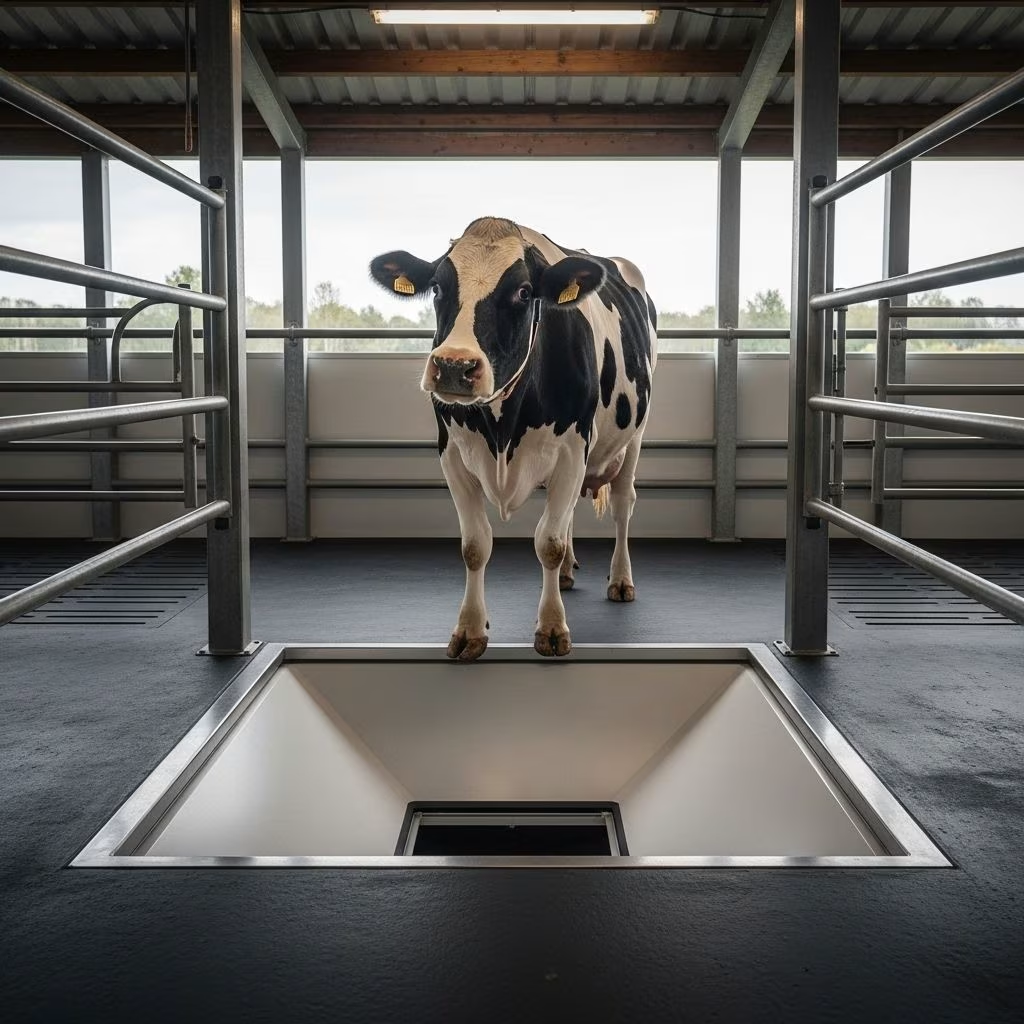
Potty-Training Cows: A Novel Approach to Climate Change and Farm Pollution
The battle against climate change has spurred scientists to consider innovative methods, some of which challenge longstanding agricultural assumptions. Among these, the concept of potty-training cows has emerged as a surprising yet promising strategy to reduce farm pollution, limit ammonia emissions, and improve the sustainability of livestock operations. This approach, supported by recent international research efforts, blends cognitive animal science with environmental engineering for a fresh take on climate mitigation.
Why Cow Waste Matters: The Pollution Problem Explained
Across the globe, cattle are free to relieve themselves wherever they please. This seemingly innocuous behavior carries serious environmental consequences:
- Urine and feces combine to produce ammonia, a harmful pollutant that can contaminate soil and water bodies, and also enter the air as a precursor to acid rain and nitrous oxide, a potent greenhouse gas.
- Agriculture is responsible for over half the world’s ammonia emissions, with livestock operations as major contributors. Every day, the planet’s 1.4 billion cows collectively produce vast amounts of urine and manure, which drive pollution.
- The mixing of urine and feces in confined spaces (such as barns) amplifies ammonia formation. Outside, runoff can pollute waterways and soil, raising further health and ecological concerns.
- Cattle are implicated in 9% of global greenhouse gas emissions, producing methane and nitrous oxide that are up to 25 times more damaging to the atmosphere than CO2.
How Does Ammonia Harm the Environment?
Ammonia forms when microbes in soil convert cow urine and feces. This compound:
- Pollutes air, contributing to acid rain.
- Leads to creation of nitrous oxide (N2O), a greenhouse gas.
- Contaminates streams, rivers, and groundwater, impacting aquatic life and drinking supplies.
The “MooLoo” Study: Training Cows to Use Latrines
In an international collaboration, researchers from Germany and New Zealand developed a method known as MooLoo training to teach cows to urinate in designated latrine areas. The process is surprisingly reminiscent of how young children are potty-trained.
Core Steps in MooLoo Training
- Calves are confined to a “bathroom stall” fitted with artificial turf, resembling a latrine.
- Successful urination in the latrine earns the calf a treat, such as crushed barley or a molasses mixture.
- Urinating outside the designated area results in a mild deterrent, like a spritz of cold water.
- Within 10 days, 11 out of 16 calves learned to enter the latrine to urinate about 75% of the time.
This research demonstrates that cattle are much smarter than commonly assumed, capable of managing their urinary reflex and responding to training nearly as effectively as children.
The Science Behind Cattle Cognition
According to Dr. Jan Langbein, a leading animal psychologist, potty-training is a “complex chain of behaviors,” requiring:
- Awareness of bladder fullness.
- Control over immediate reflexes to urinate.
- Intentional delay and action to find and use the latrine.
“We have shown that the calves are able to receive internal signals. So they think, ‘Well, I have to urinate in a few minutes, seconds, whatever,’ and they enter the latrine,” explained one of the study’s authors.
Why Not Just Confine Cows Indoors?
Some might argue for keeping cattle confined, as this directly manages manure. However, this approach comes with its own drawbacks:
- Decreased animal welfare due to limited mobility and natural behavior.
- Mixing of urine and feces in barn conditions produces even more ammonia, escalating pollution.
- Higher disease risk and maintenance costs for farmers.
MooLoo training, on the other hand, offers a way to mitigate pollution without restricting cows’ movement or comfort.
Environmental Impact: Quantifying the Benefits
What would happen if potty-training were deployed at scale?
- Studies estimate that capturing 80% of cattle urine could reduce ammonia emissions by 56%, drastically decreasing pollution from farms.
- Waterways would be less likely to be contaminated, safeguarding aquatic life and human health.
- Limiting pollutants like ammonia and nitrous oxide would help slow climate change, especially when paired with other emission-control strategies.
Other Pollution Solutions Investigated
- Innovative livestock diets, such as seaweed feed, that reduce methane release from burps and farts.
- Engineering solutions, such as machines that capture CO2 or large-scale restoration of natural carbon sinks like seagrass meadows.
However, potty-training presents a unique, behavior-based approach that requires relatively little technological investment and leverages existing animal skills.
Challenges and Next Steps in Potty-Training Bovines
While promising, this solution faces several practical challenges:
- Labor-Intensive Training: The experimental setup required daily hands-on effort—enclosing calves for 45 minutes, monitoring their actions, and responding with treats or deterrents.
- Scaling Up: Training billions of cows manually is impractical. Automation through sensors, robotics, and programmed rewards could one day make mass potty-training feasible.
- Optimal Training Age: Ongoing studies are examining whether younger calves are easier to train and retain their skills longer, similar to early childhood learning in humans.
Dr. Neele Dirksen, a research co-author, notes the need for developing automated training protocols: “With our procedure, it’s not practical for the farmers because it takes a lot of labor and time. But if we can automate the training procedure, then it could be possible.”
Farm Hygiene and Animal Welfare
In addition to environmental benefits, potty-training cattle offers distinct advantages for farm management and animal welfare:
- Cleaner living conditions for cows, protecting hooves and minimizing exposure to waste.
- Reduced spread of pathogens due to more controlled waste elimination.
- Improved barn air quality, decreasing respiratory problems for animals and humans alike.
Comparing Toilet Training Across Species
| Species | Potty-Training Feasibility | Common Methods |
|---|---|---|
| Cats | Very high | Litter box training, positive reinforcement |
| Dogs | High | Scheduled outdoor breaks, rewards, crate training |
| Pigs | High | Designated area training, treats |
| Cows | Now proven feasible | Latrine with artificial turf, treats and deterrents |
This comparison highlights the cognitive versatility of farm animals. Cows, once thought to lack urinary control, have now matched or outperformed very young children in potty-training experiments.
Potential for Sustainable Agriculture
If integrated with existing farm management practices, potty-training could:
- Transform manure management, simplifying the collection and treatment of waste.
- Enable targeted fertilizer application, improving resource efficiency and crop yields while minimizing runoff.
- Lower the carbon and nitrogen footprint of animal agriculture, making livestock farming more climate-friendly.
Industry experts believe that, with sufficient investment in training methods and automation technologies, potty-trained cows could one day become standard on progressive farms worldwide.
Frequently Asked Questions (FAQs)
Q: Can adult cows be potty-trained, or does it work only with calves?
A: The initial studies focused on calves, as younger animals tend to learn new behaviors more readily. However, ongoing research is examining approaches for training adult cows. Early results show promise for all ages, especially with repeated positive reinforcement.
Q: Does potty-training affect cow health or milk production?
A: No negative effects on health or productivity were observed during the study. In fact, cleaner living conditions and reduced ammonia exposure may even support long-term animal health and milk output.
Q: Is potty-training cows practical for large-scale farms?
A: While the current process is labor-intensive, researchers are working on automating training using sensors, AI, and robotics. If successful, this could enable standardization on large farms.
Q: How much can ammonia emissions be reduced?
A: Modeling exercises have estimated up to a 56% reduction in ammonia emissions if 80% of cattle urine is captured in latrines. This would significantly decrease pollution from industrial-scale livestock operations.
Q: Do cows require ongoing training, or do they retain the skill?
A: Once trained, cows have demonstrated strong retention of the behavior, particularly when reinforcement continues intermittently. Like other domesticated animals, periodic rewards support maintenance of learned habits.
The Road Ahead: Research, Automation, and Policy Considerations
For potty-trained cows to become a widespread reality, further steps are needed:
- Automate potty-training with technology (sensors for detecting urination, self-reward systems, automated cleaning).
- Refine training protocols to minimize labor and maximize cost-effectiveness.
- Engage farmers and policymakers to incentivize adoption, possibly with carbon credits or pollution permits.
- Educate the public to reduce stigma and encourage interest in sustainable farming innovations.
As climate action becomes more urgent, creative approaches like potty-training cattle demonstrate that solutions sometimes lie in unexpected places. By leveraging animal intelligence and behavioral science, researchers are opening new avenues toward cleaner, healthier, and more sustainable agriculture.
Resources and Further Reading
- Current Biology (Journal): Detailed report on the MooLoo experimental study and results
- Research Institute for Farm Animal Biology: Insights into cognitive training for farm animals
- University of Auckland, Lindsay Matthews: Interviews on animal behavior and practical farm innovation
- Environmental Protection Agencies: Information on ammonia, methane, and agricultural pollution
References
- https://www.thebrighterside.news/post/scientists-are-toilet-training-cows-to-save-the-planet-2/
- https://www.discovermagazine.com/toilet-trained-cows-could-be-a-new-pollution-solution-43045
- https://reasonstobecheerful.world/mooloo-cows-toilet-trained-methane-urine-emissions/
- https://insideclimatenews.org/news/25092021/warming-trends-katherine-hayhoe-talks-about-hope-potty-training-cows-and-can-woolly-mammoths-really-fight-climate-change/
- https://www.discovery.com/nature/potty-trained-cows-could-reduce-pollution
- https://www.youtube.com/watch?v=FUkBe-c17Jw
- https://www.youtube.com/watch?v=wiOhciS1rIw


