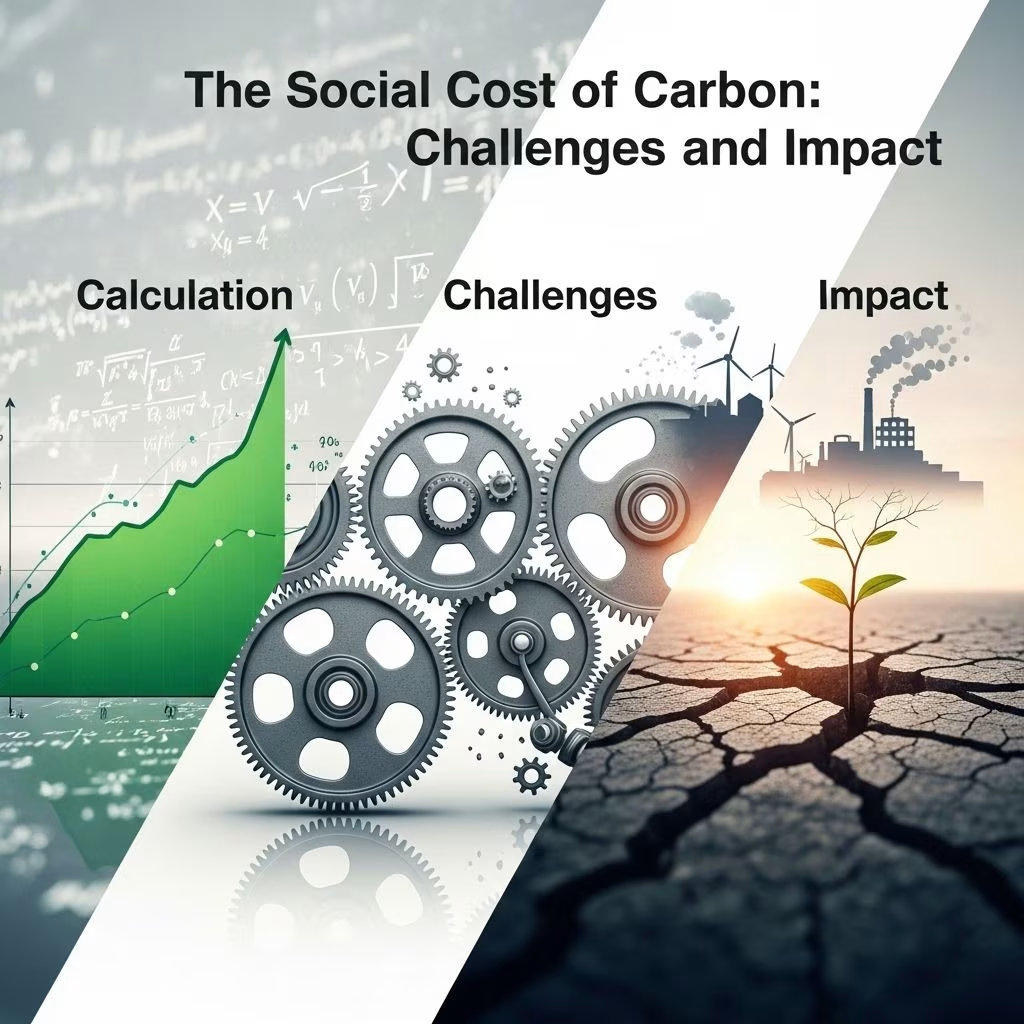
The Social Cost of Carbon: What It Means and Why It Matters
The concept of the social cost of carbon (SCC) is central to understanding the economic impacts of climate change. It provides a crucial measurement in U.S. and global policymaking, representing an estimate in dollars of the economic damages caused by emitting one additional ton of carbon dioxide (CO2) into the atmosphere. Policymakers, economists, and environmental advocates rely on SCC values to weigh the benefits and costs of climate regulations, inform carbon pricing schemes, and assess the societal wisdom of projects and investment decisions that affect greenhouse gas emissions.
What Is the Social Cost of Carbon?
The social cost of carbon is defined as the total value of damages caused by releasing one more ton of carbon dioxide into the atmosphere, expressed in monetary terms. It encompasses a wide range of economic impacts, including:
- Decreased agricultural productivity
- Health harms due to air pollution and climate-driven diseases
- Costs from incrementally higher sea levels, including property loss and coastal defenses
- Reduced labor productivity due to temperature increases
- Environmental damage and biodiversity loss
In practical terms, the SCC translates these future damages into a single dollar value so policymakers can compare the costs of reducing emissions today against the expected benefits of avoided climate damages in the future.
The Rationale Behind Measuring the SCC
The SCC is grounded in the principle that each additional ton of CO2 increases the burden of climate change damages, creating a ‘negative externality’ that is not accounted for in private markets. Assigning a monetary value prompts governments and industries to recognize and address these hidden costs, making the decision-making process more rational and equitable for both present and future generations.
How Is the Social Cost of Carbon Calculated?
Calculating the SCC is a complex endeavor, requiring the intersection of climate science, economics, statistics, and policy analysis. The basic framework involves estimating how much incremental future harm results from present-day CO2 emissions, then expressing that harm in current dollars. Here is a step-by-step outline of the process:
- Socioeconomic Projections: Forecasts of future population, economic growth, and emissions trajectories are generated under various scenarios.
- Climate Modeling: These projections are fed into climate models to estimate the corresponding rise in atmospheric CO2, temperature changes, and other associated climate variables.
- Economic Impact Assessment: Models assess the physical impacts of warming (such as effects on agriculture, health outcomes, sea level rise, and infrastructure) and translate these into monetary damages.
- Discounting: The final SCC value uses a discount rate to convert future damages into present-day dollars, reflecting how we value costs and benefits accrued to future generations.
The results represent the present value of climate damages associated with an additional ton of CO2.
Main Modeling Approaches
Integrated Assessment Models (IAMs) are the primary tools for SCC estimation. Three widely used IAMs are:
- DICE (Dynamic Integrated Climate-Economy): Created by William Nordhaus, it links economic growth with climate change impacts through a straightforward structure.
- FUND (Framework for Uncertainty, Negotiation and Distribution): Focuses on sectoral and regional detail in climate damages.
- PAGE (Policy Analysis of the Greenhouse Effect): Used for uncertainty analysis and policy simulation, especially in Europe.
Each model takes socioeconomic scenarios, simulates the resultant climate impacts, and estimates the associated economic damages to arrive at a dollar figure per ton of CO2 emitted.
Key Factors in the Calculation of the SCC
While the general structure of SCC estimation is settled, the actual values can vary widely depending on a few critical inputs and assumptions:
Discount Rate
The discount rate determines the present value of future damages. A lower discount rate results in higher SCC values, emphasizing the well-being of future generations, while a higher rate does the opposite. In the U.S., a discount rate of 3% has been widely used, but experts debate values between 1% and 7%:
- Lower discount rate (e.g., 1-2%): Yields a higher SCC, valuing future harm almost as much as today’s.
- Higher discount rate (e.g., 5-7%): Yields a lower SCC, emphasizing immediate costs over long-term benefits.
Climate Sensitivity
Climate sensitivity refers to how much global temperature rises with increases in CO2 concentrations. Uncertainty about sensitivity to emissions leads to broad SCC ranges — higher sensitivity means potentially more severe damages, increasing the SCC.
Damage Functions
Damage functions quantify the economic impact of specific physical changes, such as the cost to crops or property. Given the complexity and unpredictability of how climate change will play out locally and globally, these functions inevitably carry a degree of uncertainty.
Socioeconomic Scenarios
Calculations often use several scenarios (Shared Socioeconomic Pathways, or SSPs) to consider possible future worlds with varying population, income, and emission patterns. This exploration helps policymakers see how the SCC could shift under different assumptions about human development, technology change, and climate policy action.
Why Is the Social Cost of Carbon Important?
The SCC acts as an essential guide for climate policy in the United States and around the world. Here’s why it matters:
- Guides regulatory decisions, helping agencies like the U.S. EPA and Department of Transportation evaluate the climate impact of proposed rules or actions.
- Establishes a benchmark for carbon pricing — taxes, cap-and-trade, or internal company pricing, shaping incentives to reduce emissions.
- Enables investment decisions that reflect not just immediate costs, but longer-term climate risks.
- Helps society weigh the pros and cons of climate mitigation, adaptation, and innovation strategies more transparently and consistently.
Role in Climate Economics
By converting non-market environmental damages into a monetary metric, SCC allows for the integration of climate costs into cost-benefit analyses and regulatory impact statements, which are standard in economic policy evaluation. This means governments can more rigorously justify rules that reduce emissions, or conversely, understand the hidden costs of continuing with business as usual.
Historical Development of the SCC
While the basic concept has long roots in environmental economics, the SCC became a focus for rigorous and practical estimation in the early 21st century, particularly in the United States. Key historical moments include:
- 2009: The Obama administration established the Interagency Working Group (IWG) on the Social Cost of Carbon to standardize its use.
- 2010: IWG releases the first detailed SCC estimates for use in federal regulations, providing a baseline figure.
- Ongoing Updates: Values are regularly revisited and refined as scientific and economic understanding advances, with ongoing debate over appropriate modeling assumptions and ethical considerations.
Challenges and Uncertainties in SCC Calculation
Despite its utility, the SCC is subject to substantial debate and sources of uncertainty. Some of the main challenges include:
- Model Uncertainty: Differences in IAM structure and parameter choices can lead to varied results.
- Data Gaps: Climate damages to many sectors, especially biodiversity and human migration, can be difficult to quantify accurately.
- Ethical Debate: The choice of discount rate involves value judgments about the rights and interests of future generations.
- Equity Issues: Global vs. domestic cost attribution can significantly affect outcomes and political acceptance.
- Nonlinear and Catastrophic Risks: Some damage functions may underestimate the risk of tipping points and extreme, unpredictable outcomes.
Notable Estimates of the Social Cost of Carbon
| Source / Entity | Estimated SCC (per ton CO2) | Year/Context |
|---|---|---|
| U.S. Interagency Working Group | $51 (central value, 3% discount rate) | 2021 |
| EPA (Proposed update) | $190 (reflecting new scientific/economic data) | 2022 (pending finalization) |
| Range in Academic Studies | $10 – $400+ | Varies by model/scenario |
Note: SCC estimates can change as modeling improves, climate science advances, and societal risk tolerance evolves.
Policy Implications and Real-World Applications
SCC values influence key government actions and private sector strategies:
- Federal Rulemaking: SCC figures are used to design fuel efficiency standards, power plant regulations, and cost-benefit assessments of major infrastructure.
- Carbon Pricing: SCC guides design of policies like carbon taxes and emissions trading, translating scientific findings directly into market action.
- Business Strategy: Companies use internal carbon pricing—often based on SCC estimates—in investment analysis, risk management, and sustainability goals.
- International Negotiation: SCC supports rationale for global agreements, showing the scale of potential avoided costs through joint action.
Critiques and Limitations
While invaluable, SCC is not without critique. Points of contention include:
- Omission of Certain Impacts: Many ecological and human impacts remain uncertain or unmonetized.
- High Sensitivity to Assumptions: Small changes in model inputs (e.g., climate sensitivity, discount rate) can dramatically shift SCC outcomes.
- Ethical Concerns: Discounting the future can downplay harm to people not yet born.
- Domestic vs. Global Damages: Some argue for focusing only on domestic costs, while many experts advocate for a global approach due to the worldwide consequences of emissions.
Frequently Asked Questions (FAQs)
Q: Why does the social cost of carbon change over time?
A: SCC values typically rise over time as climate change impacts accumulate, the economy grows, and uncertainty regarding future risk increases. Revised scientific and economic knowledge may also drive updates.
Q: What is the connection between SCC and a carbon tax?
A: The SCC sets a logical benchmark for carbon taxes—if governments set a tax rate equal to or above the SCC, polluters would face the full societal costs of emissions, incentivizing reductions in line with their true impact.
Q: How reliable are current SCC estimates?
A: While SCC modeling is grounded in robust science and economics, significant uncertainty remains due to unknowns in future scenarios, climate sensitivity, and how damages will play out, especially over centuries.
Q: Do SCC values account for all climate impacts?
A: No, current SCC estimates mostly capture quantifiable economic damages and may omit hard-to-measure effects, such as loss of biodiversity, cultural impacts, and unpredictable systemic risks.
Q: Should SCC calculations be based on global or national costs?
A: This is debated; some argue for a domestic focus for policy relevance, but most experts say global accounting reflects the universal nature and cross-border consequences of emissions.
Conclusion
The social cost of carbon remains a vital, evolving tool for policymakers, economists, and advocates seeking rational approaches to climate action. Its careful calculation, use, and continual reassessment will play a central role in the ongoing global effort to mitigate climate change and build sustainable economies for future generations.
References
- https://news.climate.columbia.edu/2021/04/01/social-cost-of-carbon/
- https://news.stanford.edu/stories/2021/06/professors-explain-social-cost-carbon
- https://carbontrail.net/blog/social-cost-of-carbon-what-is-it-and-how-to-calculate-it/
- https://19january2021snapshot.epa.gov/sites/static/files/2014-12/documents/the_social_cost_of_carbon_made_simple.pdf
- https://www.rff.org/publications/explainers/social-cost-carbon-101/
- https://en.wikipedia.org/wiki/Social_cost_of_carbon
- https://cepr.org/voxeu/columns/new-way-price-carbon-understanding-social-cost-carbon
- https://costofcarbon.org/calculator