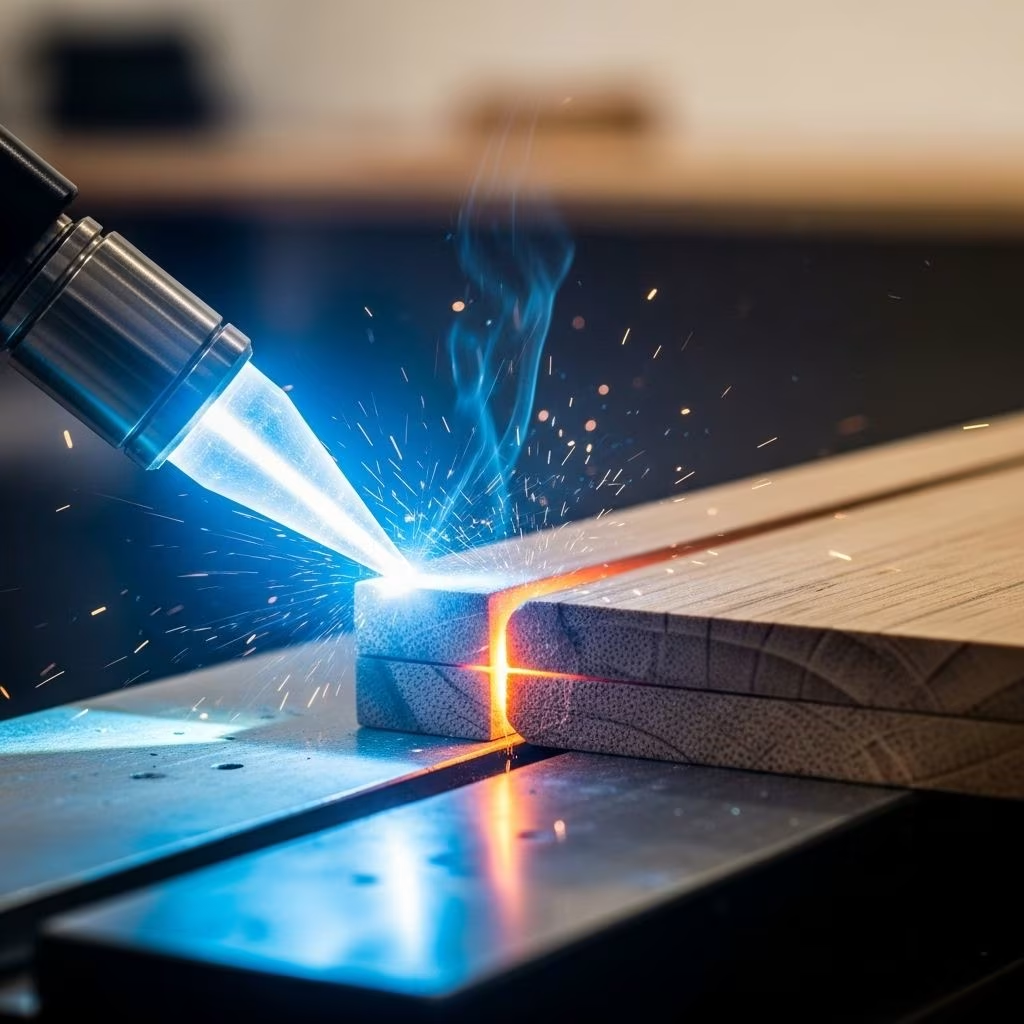
Welding Wood: A Revolutionary Approach to Timber Joining
The practice of welding wood—joining timber using frictional heat rather than adhesives or fasteners—is reshaping how we think about construction, furniture making, and sustainable material science. From laboratories to construction sites, this process opens new horizons for rapid, eco-friendly, and robust wood connections that reduce our reliance on glues and metals, while boosting recyclability and decreasing environmental impact.
Understanding Wood Welding: Moving Beyond Metals and Glues
Traditional welding is a process for joining metals using intense heat and sometimes filler materials. Wood welding, by contrast, employs friction to heat the surfaces of two pieces of wood, softening their natural polymers so that as they cool under pressure, the bond is virtually seamless and stronger than many conventional glued joints.
This innovation leverages the inherent chemistry of wood—including lignin and cellulose—as the ‘glue’ activated by heat. Most commonly, linear friction welding rubs two wooden elements together at high speeds, rapidly raising their interface temperature and fusing them in seconds.
Key Principles of Wood Welding
- Frictional Heat: Mechanical rubbing generates heat at the interface.
- Polymer Activation: Lignin and cellulose soften and mix, forming a strong bond upon cooling.
- Pressure: Applied force ensures close contact and effective fusion.
- No Adhesives: The bond is achieved by wood’s own constituents—no glues or solvents required.
The Science Behind Joining Timber Without Glue
Wood’s complex anatomy makes welding possible without synthetic binders. Lignin, a natural polymer, behaves like an adhesive when activated, while cellulose and hemicellulose contribute to a viscous interface layer during welding.
The process occurs in two broad categories:
| Method | Process | Advantages | Limitations |
|---|---|---|---|
| Low-Temperature Ultrasonic Welding | High-frequency vibration melts a dowel (plastic/wood) inserted between two timber pieces. | Energy efficient, rapid cycle, automated production line compatible. | Requires at least one transparent element; less sustainable with plastic; expensive equipment. |
| High-Temperature Friction Welding | Rubbing timber surfaces at low frequency to activate lignin, creating adhesion. | Fast, strong joints, no adhesives needed, applicable to panels or dowel joints. | Higher energy consumption versus glue; parameter optimization needed for each wood type. |
Linear Friction Welding in Focus
- Joins timber elements in 2-3 seconds.
- Produces bonds as strong as or stronger than conventional adhesives.
- No drying times or hazardous chemicals.
- Scalable for building construction and mass manufacturing (furniture, packaging).
Speed and Efficiency: How Wood Welding Outpaces Traditional Methods
A major benefit of wood welding lies in its speed:
- Conventional adhesives require hours to cure and can suffer from inconsistency in strength, especially under variable humidity.
- Wood welded joints are formed in seconds and maintain high tolerance and repeatability.
- No waiting for glue to set; assembly lines can dramatically accelerate production.
This efficiency allows for off-site prefabrication of timber components and rapid on-site assembly, greatly reducing construction time for buildings and furniture.
Environmental and Health Impacts: Why Welding Is Greener
Transitioning from glue-based joints to welded wood can reduce health hazards and advance sustainability goals:
- No Volatile Organic Compounds (VOCs): Eliminates reliance on chemical adhesives, reducing exposure to harmful emissions.
- Recyclability: Welded timber can be more easily disassembled, reused, or recycled than glued wood.
- Carbon Storage: Timber buildings act as long-term carbon sinks; rapid welding could speed adoption of mass timber systems.
- Energy Use: Although high-temperature friction welding can consume more energy than glue application, overall ecological footprint is less when VOCs and end-of-life disposal are considered.
Applications: From Furniture to Buildings
Wood welding is not limited to small-scale joinery; its scope spans a wide range of industries:
- Furniture Manufacturing: Quick joining of frame parts, panels, and decorative surfaces for rapid assembly and streamlined manufacturing.
- Building Construction: Mass timber elements can be efficiently joined, enabling robust prefabricated modules for green construction.
- Packaging: Wood welding offers high-speed bonding for sustainable packaging solutions.
- Cabinetry and Storage: Welded connections can replace screws, nails, or chemical adhesives, simplifying assembly.
Benefits and Challenges of Wood Welding
Every emerging technology brings both advantages and hurdles. The major benefits of wood welding include:
- Structural Integrity: Welded joints are exceptionally strong, often matching the wood’s own strength.
- Design Flexibility: Allows creative assembly geometries; no need to design around glue lines or fastener placement.
- Aesthetics: Seamless, metal-free joints preserve natural wood beauty; ideal for minimalist and eco-designs.
- Functionality: Joints can be formed for moving parts—hinges, pivots, slides—improving practicality in furniture and cabinetry.
- Durability: Friction-welded joints resist fatigue and environmental degradation better than some adhesives.
Challenges remain, such as:
- Optimization of welding parameters (frequency, pressure, time) for each wood species and joint type.
- Energy requirements, especially for high-volume industrial applications.
- Capital cost of specialized machinery.
- Making the technology accessible and affordable for small-scale or developing-world users.
Future Directions: Research and Commercialization
Research collaborations such as those between TWI Ltd, University of Cambridge, and industry partners are advancing practical wood welding methods for widespread commercial use.
Key avenues for future innovation include:
- Equipment Development: Improving high-speed friction welding machines for different wood types and joint geometries.
- Parameter Databases: Creating comprehensive guides for optimal welding based on wood species, moisture content, and intended use.
- Automation Integration: Streamlining the process for robotics and industrial manufacturing lines.
- Accessibility: Making wood welding viable for small workshops, builders, and furniture makers in developing regions.
- Circular Economy: Enhancing disassembly and recycling of welded wood products.
Frequently Asked Questions (FAQs)
Q: How does wood welding compare with traditional glue joints in terms of strength?
A: Welded joints often match or exceed the strength of glue joints, as the bond relies on natural polymers within the wood itself.
Q: What types of wood are suitable for welding?
A: Most woods can be welded, but each species requires different machine settings. Research is ongoing to catalog the best parameters for all common timbers.
Q: Is wood welding environmentally friendly?
A: Yes. By avoiding synthetic adhesives, wood welding reduces chemical pollutants, supports recyclability, and encourages sustainable construction practices.
Q: Is specialized equipment needed for wood welding?
A: Specialized friction welding machines are required, and these are currently more common at industrial scale than in small workshops.
Q: Can welded wood products be recycled or reused?
A: Welded wood is generally easier to recycle and repurpose at end of life compared to glued joints, which often contaminate material recycling streams.
Summary Table: Wood Welding Versus Traditional Timber Joining
| Feature | Wood Welding | Glue/Adhesive Joining | Mechanical Fasteners |
|---|---|---|---|
| Speed | Seconds per joint | Hours to cure | Minutes per joint |
| Environmental Impact | Low, no chemicals | Potentially high (VOC, chemicals) | Material-intensive (metal, plastic) |
| Strength | High (equal to wood) | High but variable (depends on cure conditions) | High, may degrade over time |
| Aesthetics | Seamless, natural look | Possible glue lines | Visible fasteners |
| End-of-Life Reuse/Recycling | Easy, minimal contamination | Problematic due to adhesives | Easy, but requires hardware removal |
Conclusion: Welding Wood for a Sustainable Future
Welding wood offers a compelling alternative to adhesives and fasteners, delivering rapid, strong, and eco-friendly joints that empower sustainable design and construction. As research advances and industry adoption grows, this technology promises to alter the way we build with timber—potentially making wood welding as integral to future construction as nail guns or glue pots are today.
References
- https://makersworkshop.com/blogs/information/the-benefits-of-welding-for-woodworkers
- http://www.proligno.ro/en/articles/2015/4/Dumitrascu_final.pdf
- https://www.cdbb.cam.ac.uk/news/developing-wood-welding-rapid-timber-joining-technique
- https://www.neit.edu/blog/what-is-welding
- https://www.youtube.com/watch?v=aiJAGuTtvic
- https://www.forum.weldingtipsandtricks.com/viewtopic.php?t=4219