


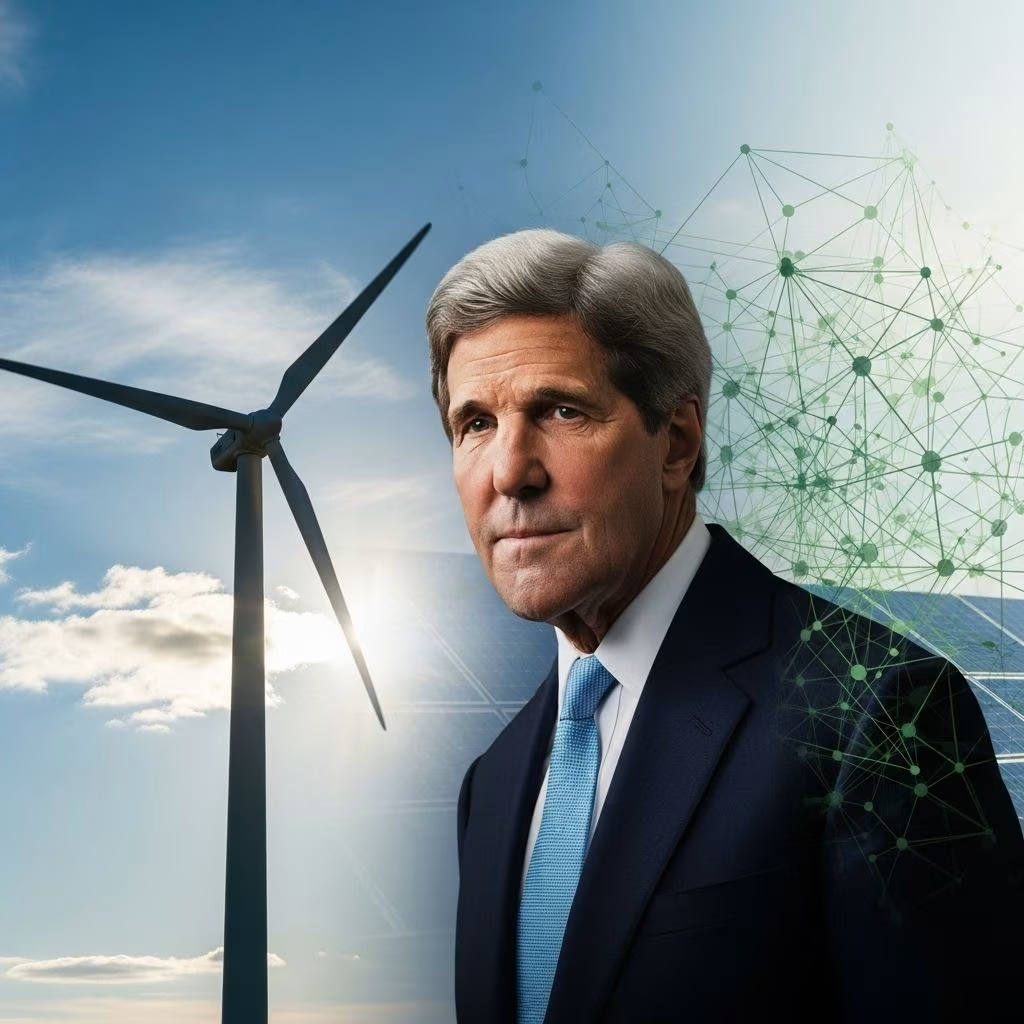
John Kerry’s Stark Message: The Race to Cut Carbon Requires Technologies Yet to Be Invented
In a world grappling with the mounting threats of climate change, John Kerry, United States climate envoy, has issued some of the most blunt and urgent calls for carbon cuts the globe has yet heard. As nations roll out increasingly ambitious emissions targets for 2030 and 2050, Kerry conveys a hard truth: half of the technological solutions needed to hit these goals do not exist today .
Kerry’s remarks reflect both the daunting challenge and innovative spirit of the current climate movement, linking scientific uncertainty with opportunity. Drawing parallels with historic endeavors like the race to develop COVID-19 vaccines, the space race, and the birth of the Internet, he maintains that the path to net-zero emissions will require the swift invention and deployment of revolutionary systems and processes. The following article explores the multi-faceted dimensions behind Kerry’s message—policy context, technological requirements, innovation strategy, market forces, and global justice—framing the climate crisis as not just an environmental threat, but a driver of transformation.
Major Polluters: The Scale of the Challenge
Kerry frequently points out the concentration of emissions commitments among a handful of nations. The twenty largest polluters contribute about 81% of global emissions, creating outsized responsibility for international heavyweights such as the United States, China, Russia, India, the European Union, Korea, and Japan. Kerry’s approach emphasizes both accountability and urgency:
- High-emitting countries must lead the transformation, setting examples for others.
- The global effort requires deep cooperation, from phasing out coal (as seen in the UK) to rejecting new projects that undermine progress.
Insisting that “the marketplace has made a decision that coal is not the future,” Kerry frames fossil fuel phase-out as an economic inevitability, not just a policy choice.
The Technological Innovation Gap: ‘Tech That Does Not Exist’
According to Kerry, 50% of the emissions reductions needed to reach net-zero by 2050 must come from innovations that are currently hypothetical or in early development stages. This observation reframes climate action from a question of deployment to one of aggressive invention, placing unprecedented emphasis on:
- Research and Development: Accelerating investment in laboratory breakthroughs and early-stage engineering.
- Risk Capital: Incentivizing private sector and philanthropic funding for unproven technologies.
- Quick Deployment: Rapid scaling of successful prototypes before mid-century deadlines.
Kerry draws inspiration from global vaccine development and historic innovation, arguing that a “moonshot” mentality is required: “We know how to invent and innovate. And we’re going to put every effort we have into making this transition happen as fast as possible.”
Examples of Potentially Transformative Technologies
- Green Hydrogen: Hydrogen produced by splitting water via renewable-powered electrolysis, seen as a future replacement for fossil fuels.
- Next-Generation Nuclear: Small modular reactors, like those pursued by Bill Gates’ TerraPower, offering cleaner energy options.
- Direct Air Capture: Machines that literally pull carbon dioxide out of the atmosphere (e.g., Swiss startup Climeworks).
- Geoengineering: Techniques like cloud thinning and albedo modification (reflective materials) to cool the earth intentionally.
- Methane Mitigation in Agriculture: Innovations that reduce emissions from meat and dairy production, which account for 14.5% of global emissions.
Market Forces: The Marketplace is Deciding
Kerry underscores the pivotal role of market dynamics in shaping the climate response. He notes that major corporations, from General Motors (committing to all-electric vehicles by 2035) to oil giants investing in carbon capture and storage, are moving proactively. These shifts are seen as irreversible, driven less by political mandates and more by:
- Profit Opportunities
- Consumer and investor pressure
- Anticipated regulatory shifts
- Long-term risk management
Carbon capture and storage (CCS)—the process of sequestering industrial carbon in underground reservoirs—is being explored at industrial scale, with pilot projects like BP’s Teesside operation in the UK. While CCS is “hugely expensive” and has yet to achieve widespread adoption, government support and private capital are rising rapidly. The US Department of Energy, for instance, recently committed more than $75 million to industrial efficiency and carbon capture projects.
Net-Zero Targets: 2050 and the Scope of Change
The term net-zero has emerged as the global benchmark for climate ambition. Most developed economies and many large corporates have pledged to achieve net-zero emissions by 2050 or sooner, requiring every sector—energy, transportation, agriculture, industry—to transform.
| Country / Region | Annual Emissions per Citizen (CO2 Tons) | Target Net-Zero Year |
|---|---|---|
| United States | 17.63 | 2050 |
| China | 5.98 | 2060 |
| India | 1.76 | 2070 |
| EU | 7.9 | 2050 |
This data underscores the uneven distribution of emissions and responsibility: the average American produces ten times more CO2 annually than Indian citizens. Kerry notes, “It depends on where the energy source is. We are producing too much carbon, no question about it.”
Climate Action: Science, Politics, and Innovation
Over 97% of climate scientists agree that climate change is occurring due to human activity. Kerry conveys that the real challenge is not technical feasibility but political and economic will. He calls on governments to calculate the full cost of continued reliance on coal and oil, noting:
- The immediate costs of fossil energy are dwarfed by the long-term toll of carbon pollution.
- Clean energy investments now are far cheaper than the price of climate-related damage in the future.
He maintains that “the technology is out there,” reinforcing confidence in humanity’s inventive capacity.
Societal Impact: Lifestyle Change or Technological Leap?
A contentious question is whether ambitious emission cuts mean major lifestyle sacrifices. Kerry contends that Americans “not necessarily” need to reduce meat consumption or make dramatic changes in day-to-day life, if the right technologies are developed. He points to:
- Lab-grown meats and methane-reducing feed for cattle.
- Zero-emission vehicles and cleaner electricity options.
- Building materials with lower carbon footprints.
There is ongoing debate about whether technological optimism risks downplaying the need for behavioral and systemic change—yet for policymakers, promising people that technology alone can carry the burden helps secure wider public support.
Security and Climate: Destabilizing Forces
Kerry is outspoken about the link between climate change and national security. Rising sea levels, unpredictable storms, wildfires, and flooding destabilize economies and threaten communities. Sherri Goodman, senior strategist at the Center for Climate and Security, describes the phenomenon as “a destabilizing force” that upends livelihoods and geostrategic balance.
- Climate risks intensify political instability, affecting migration, food security, and resource competition.
- Addressing climate change is increasingly seen as central to military, economic, and diplomatic strategy.
Kerry argues that the green economy’s rise is “being done for all the rational reasons,” and that “no politician is going to come in four years from now and suddenly undo that.” The vitality of the market and broad realization of climate’s impact make the transformation irreversible.
Funding and Incentives: Unlocking Innovation
To spur the necessary technological breakthroughs, massive funding is being mobilized from governments, companies, and philanthropy. Recent examples include:
- XPrize’s $100 million competition for carbon removal technologies.
- ExxonMobil’s $3 billion investment in low-carbon initiatives.
- US Department of Energy’s grants for industrial efficiency and carbon capture projects.
- Significant research on methane reduction and alternative proteins.
Innovators tread a fine line between idealism and pragmatism, focusing on solutions that can rapidly scale while attracting enough market interest to ensure financial viability.
FAQs: Understanding Kerry’s Climate Call
Q: What does Kerry mean by ‘tech that does not exist’?
A: Kerry refers to the fact that half the required solutions to reach net-zero emissions by 2050 are not yet invented or mature enough for global scale, necessitating a rush in R&D and innovation.
Q: Is it possible to reach net-zero emissions relying only on current technology?
A: Experts, including Kerry, suggest that existing technologies can make valuable progress but cannot entirely achieve net-zero. Future solutions are pivotal for sectors such as heavy industry, aviation, shipping, and large-scale agriculture.
Q: Will meeting climate targets mean sacrificing comfort and lifestyle?
A: Kerry argues that Americans “will not necessarily” have to sacrifice lifestyle thanks to anticipated technological advances in clean food, vehicles, and energy. Critics note that alongside invention, behavioral changes may still be essential.
Q: Why is carbon capture and storage important?
A: Carbon capture traps industrial CO2 at source or directly from the air and stores it underground, offering a way to offset emissions that are hard to eliminate. High costs and technical challenges remain, but investments and pilot projects are expanding rapidly.
Q: How does climate change threaten security?
A: Extreme weather, sea-level rise, and resource scarcity fueled by climate change can intensify migration crises, food shortages, and geopolitical tensions.
Conclusion: Urgency and Optimism in the Climate Race
John Kerry’s assertion—that achieving global net-zero will depend on “technologies we don’t yet have”—captures the gravity and opportunity of the climate challenge. It places human ingenuity, science funding, and market forces at the core of climate strategy, invoking a spirit not just of necessity but of hope and collective ambition. The transition to a decarbonized economy will test the limits of innovation, resource allocation, and political will, but the accelerating convergence of public pressure, business interest, and governmental commitment creates a window for transformation—one that must be seized before time runs out.
References
- https://www.carbonbrief.org/daily-brief/kerry-urges-top-polluters-to-cut-emissions-now/
- https://www.dezeen.com/2021/05/17/climate-change-technologt-john-kerry/
- https://news.harvard.edu/gazette/story/2021/04/john-kerry-discusses-relationship-between-climate-change-and-security/
- https://2009-2017.state.gov/secretary/remarks/2014/02/221704.htm


