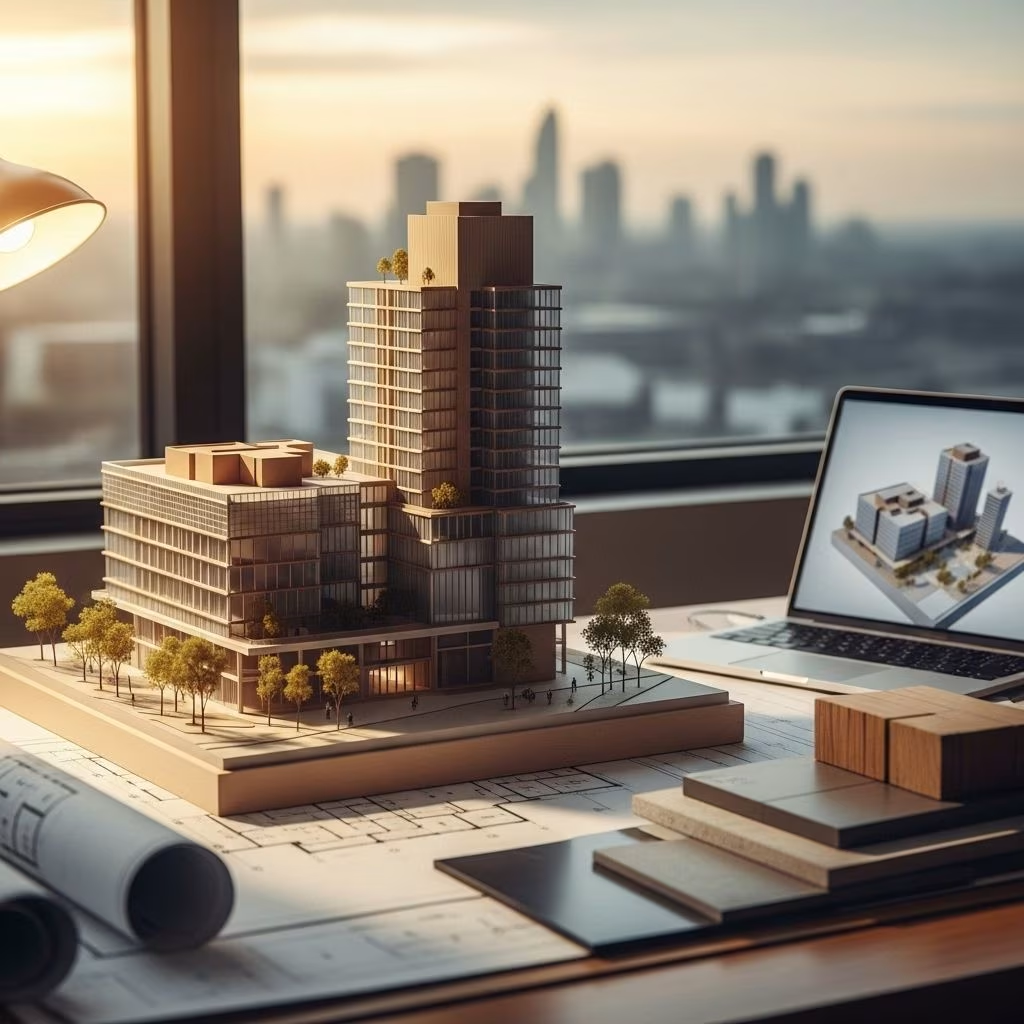
Designing With Upfront Carbon Emissions in Mind
In the pursuit of sustainable architecture and climate resilience, upfront carbon emissions have emerged as a critical consideration. These are the emissions generated during the extraction, manufacture, transportation, and installation of building materials—released before a building is even operational. While much attention has been paid to reducing operational energy use, the early stages of design and construction present the greatest opportunity to mitigate the climate impacts of the built environment.
What Are Upfront Carbon Emissions?
Upfront carbon emissions, commonly classified as a subset of embodied carbon, refer specifically to the greenhouse gases emitted through material production and construction processes that occur before a building is occupied. These emissions are distinct from operational carbon, which relates to activities such as heating, cooling, and lighting over the building’s lifetime.
- Embodied Carbon: Total carbon from material extraction, manufacturing, and installation.
- Upfront Carbon: Initial embodied carbon released before the building enters service.
- Operational Carbon: Emissions from the building’s ongoing use (energy, maintenance).
- Whole-Life Carbon: The sum of all embodied and operational emissions throughout a building’s life.
Why Are Upfront Carbon Emissions So Important?
Although operational carbon has traditionally received more focus, upfront carbon accounts for as much as 11% of global energy-related CO₂ emissions and up to half of a new building’s footprint before it is even used. This front-loaded climate cost cannot be offset by future operational energy savings, making early design decisions crucial.
- Irreversible Impact: Once embodied carbon is released, it cannot be reclaimed or offset through building operation.
- Immediate Climate Consequences: Reducing upfront emissions delivers faster climate benefits compared to strategies focused solely on operational emissions.
- Long-Term Value: Choosing low-carbon strategies now embeds sustainability in the fabric of our cities.
How Early Design Decisions Shape Upfront Carbon
The initial stages of planning and design—when the building’s form, materials, and structure are determined—provide the best opportunity to reduce upfront environmental impacts. Once these choices are finalized, changing them becomes expensive and disruptive.
- Material Selection: The biggest single factor in upfront carbon comes from choices about concrete, steel, timber, insulation, and glazing.
- Building Form: Massing, orientation, and structural logic influence not only how much material is used, but also the type and sourcing.
- Design Collaboration: Early cross-disciplinary teamwork underpins informed decisions for sustainability, ensuring carbon data is part of the conversation.
Using Data and Technology for Embodied Carbon Analysis
Recent advances have enabled architects and engineers to model and understand the potential carbon impact at the earliest design phases. Tools like Autodesk Forma’s Embodied Carbon Analysis integrate real-time feedback into the design process, making carbon intelligence accessible to all stakeholders.
- Data-Driven Decisions: Evaluate multiple design options, balancing carbon, cost, sun access, comfort, and more.
- Predictive Modeling: Use databases (like C.Scale API) and Building Information Modeling (BIM) systems to compare materials and construction processes upfront.
- Transparency: Embodied carbon analysis democratizes expertise, no longer the exclusive domain of specialists.
Key Strategies to Minimize Upfront Carbon Emissions
Sustainable architects and developers are adopting strategies that target the sources of upfront carbon. Effective solutions are multidisciplinary, involving design, procurement, construction, and operations teams.
- Specifying Low-Carbon Materials: Prioritize products produced with renewable energy, recycled content, or efficient technologies.
- Reducing Material Quantities: Optimize structural spans, use innovative layouts, and avoid overspecification.
- Flexible Structural Solutions: Select forms and systems allowing adaptability or future reuse, prolonging the useful life of materials.
- Local Sourcing: Use nearby suppliers to cut transportation emissions and support regional economies.
- Adaptive Reuse: Renovating or upgrading existing buildings typically saves 50–75% of embodied carbon versus new construction.
- Design for Disassembly: Enable components to be easily removed, reused, or recycled, minimizing demolition-related emissions.
Whole-Life Carbon Perspective
Whole-life carbon expands beyond upfront emissions, considering maintenance, renovation, replacement, and end-of-life processes. Designing for minimized whole-life carbon ensures the building remains sustainable for generations.
| Stage | Carbon Type | Typical Emissions Source |
|---|---|---|
| Planning & Design | Upfront Embodied Carbon | Material production, delivery, site prep |
| Construction | Upfront Embodied Carbon | Installation, construction-site energy use |
| Operation | Operational Carbon | Heating, cooling, lighting, occupancy |
| Renovation | Additional Embodied Carbon | Replacement materials, retrofits |
| End-of-Life | Embodied Carbon | Demolition, recycling, disposal |
Benefits of Upfront Carbon Conscious Design
Designing with upfront carbon in mind creates measurable value for individuals, organizations, and society.
- Sustainability Leadership: Early action differentiates companies in a fast-evolving climate-conscious market.
- Financial Risk Management: Reducing emissions mitigates future liabilities as carbon neutrality becomes the new benchmark.
- Improved Reputation: Responsible design attracts investors, tenants, and partners aligned with ESG goals.
- Cost Savings: Lower emissions generally lead to material and energy efficiency, reducing direct and indirect costs over time.
Organizations that actively minimize upfront carbon not only meet evolving regulations but also strengthen their position for future carbon trading, offsetting, or credit schemes.
Tools and Collaboration for Upfront Carbon Reduction
Efforts to reduce embodied and upfront carbon emissions are supercharged by open data, collaboration platforms, and integrated modeling tools:
- Building Information Modeling (BIM): Ensures all project stakeholders share carbon data and work from a synchronized platform.
- Cloud Collaboration: Enables real-time updates and decision tracking, minimizing miscommunication and supporting carbon reduction at every phase.
- Lifecycle Assessment (LCA): Provides quantitative feedback on material choices, helping teams optimize for lowest possible emissions.
Case Studies and Emerging Best Practices
The industry is rapidly evolving with new benchmarks and standards for embodied carbon. Leading projects demonstrate the value of early intervention:
- Net-zero construction: Achieved by specifying ultra-low-carbon materials and maximizing reuse.
- Pioneering digital tools: AI-powered carbon modeling enables rapid comparison of designs, making sustainability a standard part of the architect’s toolkit.
- Transparent reporting: Documenting carbon emissions at every stage helps inform stakeholders and guides future policy.
Challenges to Implementation
Despite the benefits, barriers remain:
- Data Availability: Reliable carbon data on materials, products, and processes is still fragmented.
- Cultural Change: Integrating carbon analysis requires adjusting workflows, priorities, and client expectations.
- Economic Factors: While many low-carbon solutions are cost-effective over time, budget constraints may lead to short-term choices with higher climate costs.
Industry leaders, standards organizations, and software developers are working to overcome these hurdles with better datasets, smarter tools, and targeted education.
Frequently Asked Questions (FAQs)
Q: What is the difference between upfront carbon and embodied carbon?
A: Upfront carbon is the portion of embodied carbon emitted during material manufacture, transportation, and construction—released before the building is occupied. Embodied carbon includes all material-related emissions, covering a building’s entire lifecycle.
Q: How does early design planning reduce carbon emissions?
A: Early design planning allows teams to choose low-carbon materials, efficient structures, and smart building forms—decisions that lock in lower emissions for the entire life of the building.
Q: Why can’t we offset upfront carbon with future operational energy savings?
A: Upfront carbon is released before the building is occupied and is therefore immediately contributing to atmospheric CO₂. While operational energy savings help, they cannot remove or reverse the upfront emissions already released.
Q: What tools are available to architects for estimating and reducing upfront carbon emissions?
A: Innovations like Autodesk Forma’s Embodied Carbon Analysis and BIM-based databases empower designers to visualize and compare the impacts of materials and forms in real time, supporting carbon-intelligent design choices.
Q: Is retrofitting or upgrading old buildings more sustainable than constructing new ones?
A: Absolutely. Renovation and adaptive reuse typically save 50–75% of embodied carbon emissions compared to building new, as the existing structure’s emissions are already ‘paid’ and locked in.
Conclusion: Achieving Climate-Resilient, Net-Zero Construction Starts Upfront
By integrating upfront carbon awareness into the earliest phases of design and planning, architects, engineers, and developers set the course for sustainable, climate-friendly buildings. Empowered by robust data, collaborative platforms, and whole-life thinking, the built environment can minimize its contribution to global warming and become a catalyst for positive change.
References
- https://blogs.autodesk.com/forma/2024/04/02/embodied-carbon-analysis/
- https://www.cundall.com/ideas/blog/three-benefits-of-thinking-about-embodied-carbon-in-project-planning
- https://www.cmaanet.org/sites/default/files/resource/Embodied%20Carbon.pdf
- https://www.desapex.com/blog-posts/upfront-carbon-the-early-impact
- https://www.rpsgroup.com/services/environment/sustainability-and-climate-resilience/what-is-embodied-carbon/
- https://worldgbc.org/article/worldgbc-net-zero-carbon-buildings-commitment-expands-to-include-embodied-carbon/
- https://se2050.org/resources-overview/structural-materials/lean-design-guidance/
- https://www.eli.org/vibrant-environment-blog/why-we-must-focus-embodied-emissions-immediately-practice-policy-and