


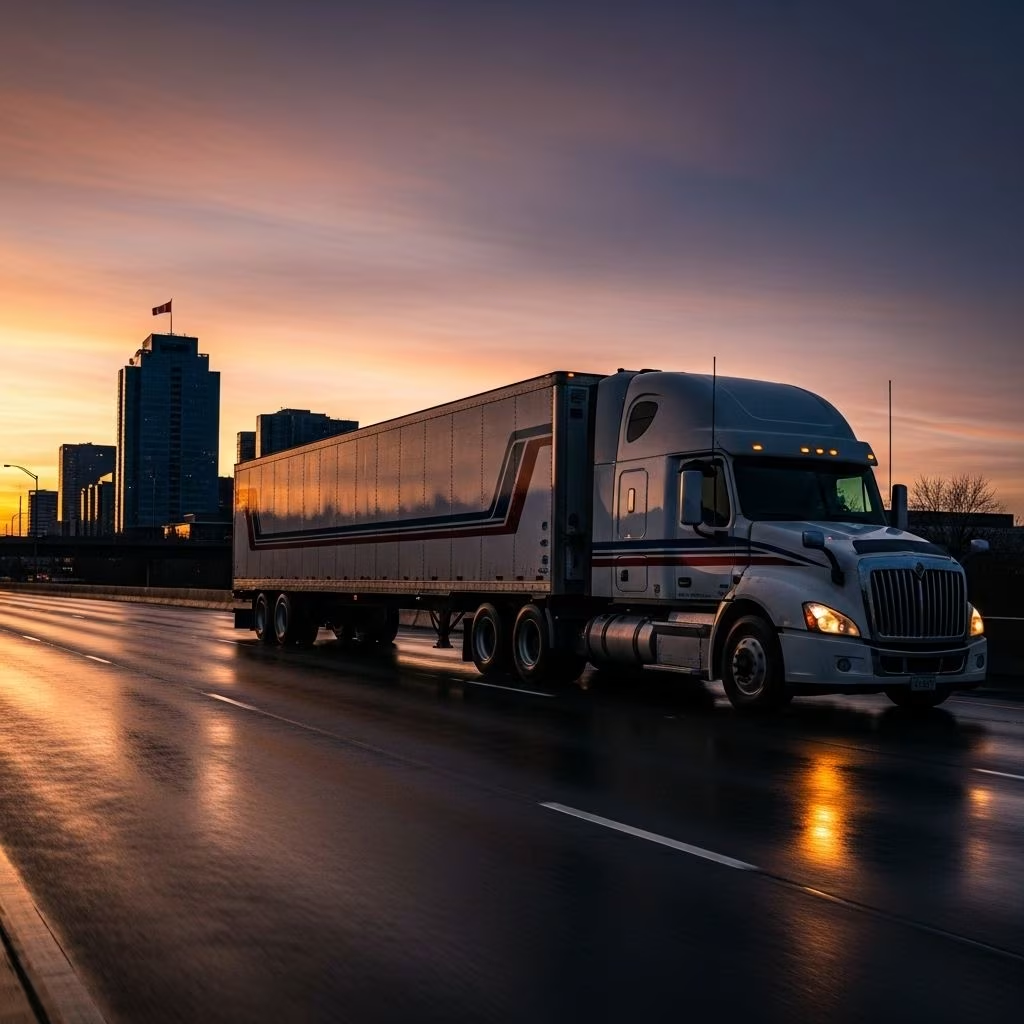
Canadian Government Once Again Rejects Side Guards on Trucks
In the ongoing fight to improve road safety, particularly for vulnerable road users like cyclists and pedestrians, the debate over side guards for commercial trucks in Canada has persisted for decades. Side guards—physical barriers mounted between a truck’s wheels—are designed to prevent people from being pulled under the rear wheels in collisions. Despite mounting evidence and continued advocacy, the Canadian government has repeatedly declined to make these safety devices mandatory.
Understanding Side Guards: What Are They?
Side guards, also known as lateral protective devices, are rails or barriers fitted to the side of large trucks. Their primary purpose is to block the dangerous gap between the truck’s wheels, drastically reducing the risk that cyclists, motorcyclists, or pedestrians will be dragged under during side-impact collisions. Side guards have been mandatory on European trucks for over 25 years, resulting in a marked reduction in cyclist fatalities in countries like the UK, where such deaths dropped by 61% after the law’s implementation.
- Function: Prevent under-ride deaths by physically blocking access to wheels during a crash.
- Primary beneficiaries: Cyclists, pedestrians, and motorcyclists sharing urban and suburban roads with trucks.
Historical Context: Calls for Regulation in Canada
Advocacy for truck side guards in Canada dates back decades. Safety activists and concerned politicians have repeatedly urged the federal government to introduce regulations under the Motor Vehicle Safety Act, often prompted by tragic fatalities like the death of Toronto cyclist Jenna Morrison. Former MP Olivia Chow was instrumental in this movement, introducing motions and speaking out for mandatory side guards to prevent needless deaths.
- Legislative attempts: Multiple motions for side guard regulations have been tabled in Parliament, typically rejected regardless of governing party.
- Advocacy: Persistent calls from politicians, cycling organizations, and urban planners.
- Response: Government responses often cite cost, international alignment, and jurisdictional issues as reasons for refusal.
The Argument for Side Guards: Evidence and Impact
Research from multiple countries underscores the efficacy of truck side guards in saving lives:
- UK data: 61% reduction in cyclist fatalities post-mandate.
- Australian & Dutch studies: Estimated 62% decrease in cyclist deaths, 20% drop in pedestrian fatalities, and a 6% reduction in serious cyclist injuries after adoption.
- City Implementations: Toronto has retrofitted 30 solid waste vehicles with side guards and is investigating broader use as part of its Vision Zero initiative, despite lacking national authority.
A table comparing international impacts:
| Country | Mandate Year | Cyclist Fatality Reduction | Pedestrian Fatality Reduction |
|---|---|---|---|
| United Kingdom | 1998 | 61% | Estimated 20% |
| Australia | Varied (regional) | ~62% | 20% |
| Netherlands | 2003 | ~62% | 20% |
Canadian Government’s Rationale for Rejection
Despite these findings, the Canadian government’s position has remained largely unchanged. Below are the core arguments cited:
- Cost Concerns: Government and industry sources claim that mandating side guards would impose significant costs on operators, ranging from hundreds to thousands of dollars per truck, with alleged minimal lives saved in comparison to investment.
- International Harmonization: There are no such requirements in the United States, and Canada’s freight market is tightly integrated with the US. Authorities argue that singling out Canadian regulations would create economic and logistical challenges for international carriers.
- Industry Influence: Investigative reports show that both American and Canadian regulators have deferred to industry lobbyists, with objections centered on cost and regulatory burden.
- Technological Alternatives: Trucking groups often push back against physical fixes in favor of high-tech solutions such as collision sensors or improved mirrors, although evidence for these as replacements is limited.
Sample Rhetoric Used in Government Rejections
- “The freight business is international, and the Americans don’t require side guards.”
- “Mandatory side guards would be prohibitively expensive for the trucking industry.”
- “Alternative safety technologies are available that address the problem differently.”
Lobbying and Regulatory Process: The Influence of Industry
Investigative reporting by ProPublica and FRONTLINE has illuminated the significant role that trucking industry lobbyists play in shaping (and stalling) safety regulations for side guards. Stakeholders from the American Trucking Associations (ATA) have actively lobbied federal agencies to remove or weaken side guard recommendations, citing costly burdens and downplaying potential life-saving impacts. Federal reports have sometimes been rewritten after consultation with industry representatives, further impeding reform.
- Notably: Internal Department of Transportation (DOT) documents show language on side guards removed following industry review.
- Opposition within agencies: Career officials have challenged researchers’ claims on safety and cost, ultimately minimizing the estimated benefits.
Technological Alternatives and the Arguments Against Mandates
Trade groups and some government officials have asserted that non-structural technologies—such as electronic sensors, 360-degree cameras, improved mirror systems, and urban-focused vehicle design—can substitute for physical side guards. While these systems contribute to safety by alerting drivers and mitigating some collision risks, research has yet to demonstrate they match the effectiveness of dedicated lateral protection.
- Sensor-based systems: May provide warnings but won’t stop a cyclist or pedestrian from being dragged under a truck.
- Camera/convex mirror upgrades: Improve visibility but cannot serve as a physical barrier.
- Urban vehicle design: Some city-centric trucks use side guards, but this is voluntary and not standard across fleets.
The International Landscape: Comparative Regulations
While Canada and the United States have resisted mandates, much of Europe, Australia, and parts of Asia require truck side guards. The contrast in fatality reduction statistics is stark and serves as a key argument for advocates:
- Mandates: Europe, Australia, and the Netherlands have national requirements for all large trucks.
- Impact: These regions report substantially lower rates of cyclist and pedestrian deaths involving large vehicles.
- Adoption obstacles: Coordinated regulation across borders and trade blocs facilitates these mandates. Canada’s integration with the US complicates unilateral action.
Local Actions: The Toronto Case Study
The City of Toronto has taken steps to outfit municipal solid waste trucks with side guards, seeking to improve safety within its jurisdiction despite limitations imposed by federal standards.
- Fleet retrofitting: 30 municipal vehicles now feature side guards, in line with Vision Zero goals.
- Design changes: Additional improvements include cabover chassis for better visibility, brightly colored vehicles, and improved mirrors and camera systems.
- Safety outcomes: Early findings suggest reduced collision risks for urban users near these vehicles.
Legacy and Remembrance: High-Profile Cases and Advocacy
Cyclist Jenna Morrison’s death remains a rallying point for Canadian advocates. The persistence of advocates like Olivia Chow highlights the enduring demand for side guard mandates. Despite past government dismissals, the issue remains at the forefront of urban safety debates as cycling becomes more popular and cities densify.
- Advocacy milestones: Motions in Parliament, increased news coverage, and municipal pilot programs.
- Ongoing resistance: No federal or provincial movement towards binding regulations as of 2025.
Frequently Asked Questions (FAQs)
Q: What are side guards on trucks?
A: Side guards are protective barriers fitted between the wheels of large trucks designed to prevent cyclists and pedestrians from being pulled under the truck in a collision.
Q: Are side guards mandatory in Canada?
A: No. There are currently no federal or provincial laws in Canada requiring side guards on trucks or trailers, though some local governments have voluntary programs for specific fleets.
Q: Have side guards proven effective in other countries?
A: Yes. Statistical evidence from the UK and other European countries shows that mandating side guards leads to a significant reduction in road fatalities among cyclists and pedestrians.
Q: Why does Canada resist the mandate?
A: Primary reasons include concerns over cost, the lack of similar regulations in the US, and arguments by industry lobbyists that other technology can replace physical barriers.
Q: What alternatives to side guards are promoted?
A: Alternatives include collision-avoidance sensors, convex mirrors, and improved driver training, but none match the proven efficacy of physical side guards in severe side impacts.
Conclusion: The Path Forward
Despite powerful data and persistent advocacy, the Canadian government has once again chosen not to mandate side guards for trucks. This decision highlights the tension between empirical safety evidence, regulatory harmonization, and industry lobbying. Local actions and international comparisons suggest a clear safety benefit, but changes at the federal level remain elusive.
- Key takeaway: Side guards save lives, but policy inertia persists in Canada.
- What’s next: Urban jurisdictions may continue piloting side guard retrofits until national standards evolve.
- Advocacy: Continued pressure from safety groups and city officials keeps the issue alive in public debate.
As cycling and pedestrian traffic increase in Canadian cities, the debate over truck side guards will likely remain a contentious—and urgent—policy challenge.
References
- https://www.ttnews.com/articles/nhtsa-side-underride-guard
- https://lloydalter.substack.com/p/its-time-to-make-side-guards-mandatory
- https://www.toronto.ca/legdocs/mmis/2024/ie/bgrd/backgroundfile-250547.pdf
- https://www.propublica.org/article/dot-rejected-truck-side-guards-trucking-lobbyists-safety
- https://www.volpe.dot.gov/sites/volpe.dot.gov/files/docs/side-guards-for-trucks-and-trailers-phase-1-background-investigation-jd-patten-canada.pdf
- https://www.volpe.dot.gov/LPDs


