


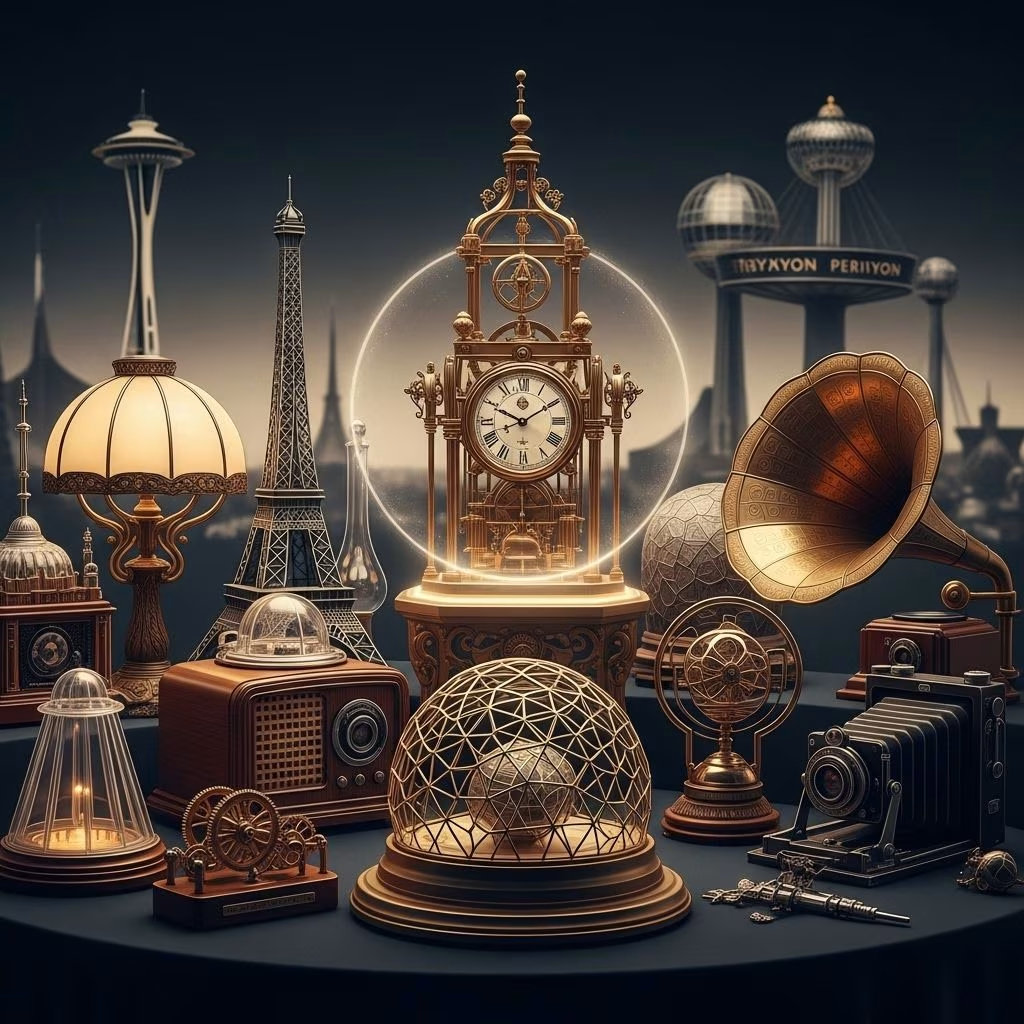
Legendary Relics: The Lasting Legacy of World’s Fairs
Since the mid-19th century, World’s Fairs have introduced revolutionary ideas, architectural wonders, and cultural milestones to the world stage. Though conceived as temporary sites for exploration and innovation, some fairground structures have outlived their original purpose and endure today as icons of urban landscapes and reminders of a more optimistic age. This article traces the journey of these remarkable “leftovers”—monuments, museums, and avant-garde creations that continue to captivate and inspire.
What Is a World’s Fair?
The World’s Fair, also called an exposition or expo, is a global event rooted in the industrial era aimed at commemorating progress, trade, and international cooperation. Originating in 1851 with the London Great Exhibition and its legendary Crystal Palace, these gatherings have since served as platforms for debuting architectural wonders, novel technologies, and design innovations. While most exhibits and pavilions were designed for short-term use, a select few remain as legacies to the enduring spirit of innovation.
Architectural Remnants: From Temporary to Timeless
Several grand structures, originally intended as short-lived attractions or centerpieces, have transcended their ephemerality. Below are the most notable survivors of World’s Fairs, demonstrating how visionary design can influence city skylines and cultural heritage for generations.
Eiffel Tower – Paris, 1889
The Eiffel Tower was constructed for the 1889 Exposition Universelle, celebrating the centennial of the French Revolution. Gustav Eiffel’s 1,083-foot iron lattice tower was initially met with resistance from Parisians, yet it soon became one of the most recognized and beloved landmarks in the world. Although intended as a temporary structure, the Eiffel Tower was spared from demolition partly due to its value as a radio transmission tower. Today, it is not only the defining symbol of Paris but also a testament to visionary engineering and design.
- Height: 1,083 feet (330 meters)
- Constructed by: Engineer Gustave Eiffel
- Current status: Thriving as both a tourist site and a global emblem of France
Space Needle – Seattle, 1962
Rising 605 feet above Seattle, the Space Needle was built for the 1962 Century 21 Exposition, which sought to evoke the spirit of “The Age of Space.” Its unique, flying saucer-like design heralded the future, and the tower was engineered to withstand both hurricanes and earthquakes. Today, the Space Needle remains a defining feature of Seattle’s skyline, an enduring symbol of science, optimism, and regional identity.
- Observation deck and rotating restaurant
- Extensively renovated to enhance visitor experience
- Engineered for resilience against natural forces
Atomium – Brussels, 1958
The Atomium was the architectural centerpiece of Expo 58 in Brussels. Designed to symbolize a crystal of iron magnified 165 billion times, this 335-foot (102 meter) structure comprises nine interconnected spheres and offers sweeping panoramic views. While few anticipated its longevity, the Atomium today serves not only as a stunning museum but also as a powerful statement about mid-century optimism and scientific progress.
- Composed of nine steel spheres connected by tubes
- Originally temporary, now home to science exhibits and a museum
- Represents atomic age and Belgian engineering pride
Palace of Fine Arts – San Francisco, 1915
The Palace of Fine Arts was designed by Bernard Maybeck for the 1915 Panama-Pacific International Exposition. Its grand rotunda and colonnades stood out among the exposition’s otherwise ephemeral structures, so much that it was restored permanently in 1965 after falling into disrepair. The Palace remains a beloved public space, blending classical architecture with modern urban life.
- Features a monumental rotunda and artificial lagoon
- Preserved due to public admiration
- Hosts community events, art, and cultural activities
Museum of Science and Industry – Chicago, 1893
The Museum of Science and Industry occupies the former Palace of Fine Arts, one of the few buildings to survive the 1893 World’s Columbian Exposition in Chicago. Initially built sturdily with brick and plaster, it became the Field Museum and was later redesigned in the 1930s to house the current science museum. Its continued presence reflects the fair’s profound influence on Chicago’s identity and educational mission.
- Only surviving building from the World’s Columbian Exposition
- Transitioned from art to science museum in the 20th century
- Retains historic exterior with modernized interior for science exhibitions
Habitat 67 – Montreal, 1967
Conceived by architect Moshe Safdie for his McGill University thesis and unveiled at Montreal’s Expo 67, Habitat 67 reimagined urban living with its modular, prefabricated units stacked in cascading formations. Intended as a solution to urban density—with each unit featuring its own terrace—Habitat 67 became an enduring experiment in architecture and continues to be a working residential complex. Its influence on modernist architecture and pre-fab design remains notable.
- 146 self-contained residential units with private outdoor spaces
- Inspired global discussion on affordable, high-density housing
- Still occupied and maintained as a landmark of innovative design
Grand Palais and Petit Palais – Paris, 1900
The Grand Palais and Petit Palais were constructed for the 1900 Exposition Universelle in Paris, featuring glass-domed roofs and ornate Beaux-Arts architecture. Both buildings survived and have been reinvented as cultural institutions housing art museums, exhibitions, and major public events, ensuring their continued relevance over a century later.
- Grand Palais: Houses art exhibitions and events, known for its iconic glass roof
- Petit Palais: Functions as a municipal art museum, hosting permanent and temporary collections
Unisphere – New York, 1964
The Unisphere, an enormous stainless steel representation of the Earth, was the focal point of the 1964 New York World’s Fair in Flushing Meadows-Corona Park. Surrounded by fountains and walkways, it symbolized “Peace Through Understanding” against the backdrop of the space age. The Unisphere remains a much-loved Queens landmark and backdrop for festivals, movies, and city events.
- 120 feet diameter, weighing almost 700,000 pounds
- Key site for community gathering and cultural pride in New York
Queens Museum – New York, 1939 & 1964
Originally built as the New York City Pavilion for the 1939 World’s Fair and reused in 1964, the building now houses the Queens Museum. It features exhibits dedicated to both World’s Fairs and displays the renowned Panorama of the City of New York, a massive scale model still on show for visitors.
- Houses memorabilia from both the 1939 and 1964 World’s Fairs
- Renovated and expanded to serve as a major urban museum
Montreal Biosphere – 1967
The dramatic geodesic dome designed by Buckminster Fuller for Expo 67 became the U.S. Pavilion, embodying “Man and His World.” Though the original acrylic shell was lost to a fire in 1976, the steel dome remains intact and now hosts an environment museum—serving as a striking example of futuristic engineering and the adaptability of fair architecture.
- Diameter: 76 meters (250 feet)
- Focus on environmental science and education
Tower of the Americas – San Antonio, 1968
The Tower of the Americas in San Antonio was erected for HemisFair ‘68 as an emblem of the city’s modernization and ambition. Rising 750 feet, it remains a signature feature of the San Antonio skyline, offers observation decks, and continues to draw visitors for its views and revolving restaurant.
- Height: 750 feet
- Survived alongside the Institute of Texan Cultures and the city’s convention center
Sunsphere – Knoxville, 1982
The Sunsphere, a gold-tinted glass sphere atop a steel stem, was constructed for the 1982 World’s Fair in Tennessee. Intended as a symbol of renewable energy and hope, it spent years underused after the fair’s conclusion but now welcomes tourists and locals alike with its observation deck and event space.
- Notable example of fair architecture outliving its intended use
- Revitalized after years of neglect for new public functions
China Pavilion – Shanghai, 2010
The China Pavilion, the centerpiece of Expo 2010 in Shanghai, echoes ancient Chinese architectural techniques with its bold, modern form. Conceived as a link between tradition and future, the pavilion is now the China Art Museum, exemplifying how even the most contemporary expositions aim to leave a lasting physical and cultural legacy.
- Combines ancient dougong (interlocking wooden brackets) with futuristic form
- Hosts art exhibitions and cultural programming
Adaptive Reuse and Preservation: The Fate of Other Remnants
Not every World’s Fair structure has been as fortunate or celebrated:
- Many pavilions and grand halls were dismantled, lost to fire, or left abandoned—such as London’s Crystal Palace or other fairgrounds in New York and Chicago.
- Some buildings have found second lives as museums, educational centers, offices, or even homes.
- In select cases, elements of multiple fairs merge—as with San Francisco’s Japanese Tea Garden, which incorporates ornate gates and a pagoda brought from two different expositions.
Why Do Some World’s Fair Structures Endure?
There are myriad reasons why these landmark constructions survive while others vanish:
- Public affection: Structures beloved by locals, such as the Palace of Fine Arts, often inspire preservation efforts long after their intended purpose has passed.
- Architectural ingenuity: The technical marvels and iconic forms—think Eiffel Tower, Atomium, or Space Needle—become too significant to simply tear down.
- Urban identity: These buildings often become intrinsic to the character and cultural narrative of their host cities.
- Repurposing potential: Many are adaptable to new uses, becoming museums, housing, or public spaces.
Frequently Asked Questions (FAQ)
Q: Were most World’s Fair structures meant to be temporary?
A: Yes, most pavilions and iconic installations were constructed for temporary exhibitions, often with no plan or budget for their long-term use.
Q: Why do some buildings survive while others do not?
A: Factors include local advocacy, historical or artistic importance, adaptability to new functions, and the vision of city planners or private owners. Sometimes, chance and circumstance play a role, too.
Q: What is the oldest World’s Fair structure still standing?
A: While several structures have been preserved, the Eiffel Tower (1889) is the most famous and among the oldest enduring edifices from a major exposition.
Q: Can you visit all of these World’s Fair leftovers today?
A: Most are open to the public, serving as museums, observation points, or residential complexes, though access varies depending on the structure and current use.
Table: Summary of Notable World’s Fair Leftovers and Their Current Uses
| Structure | Year & City | Current Use |
|---|---|---|
| Eiffel Tower | 1889, Paris | Observation deck, National landmark |
| Space Needle | 1962, Seattle | Observation deck, Restaurant, City icon |
| Atomium | 1958, Brussels | Museum, Event space |
| Palace of Fine Arts | 1915, San Francisco | Cultural center, Event venue |
| Museum of Science and Industry | 1893, Chicago | Science museum |
| Habitat 67 | 1967, Montreal | Residential complex |
| Unisphere | 1964, New York | Public sculpture, Park centerpiece |
| Montreal Biosphere | 1967, Montreal | Environmental museum |
| Tower of the Americas | 1968, San Antonio | Observation deck, Restaurant |
| China Pavilion | 2010, Shanghai | Art museum |
Conclusion
The scattered yet impressive survivors of past World’s Fairs tell the story of people striving to imagine a better world. Whether through dazzling displays of engineering or enduring spaces for reflection and celebration, these structures prove that what was once considered temporary can form the bedrock of collective, cultural memory. As new expositions arise and cities continue to evolve, the remnants of yesterday’s fairs will continue to captivate and inspire future generations.
References
- http://theantiquesalmanac.com/remnantsofworldsfairsgoneby.htm
- https://savingplaces.org/stories/state-of-the-fairs-worlds-fair
- https://www.businessinsider.com/12-incredible-worlds-fair-leftovers-2015-8
- https://galeriemagazine.com/9-amazing-examples-of-worlds-fair-architecture-that-still-stand-today/
- https://alexandracharitan.com/blog/2014/01/remnants-of-new-york-worlds-fair.html


