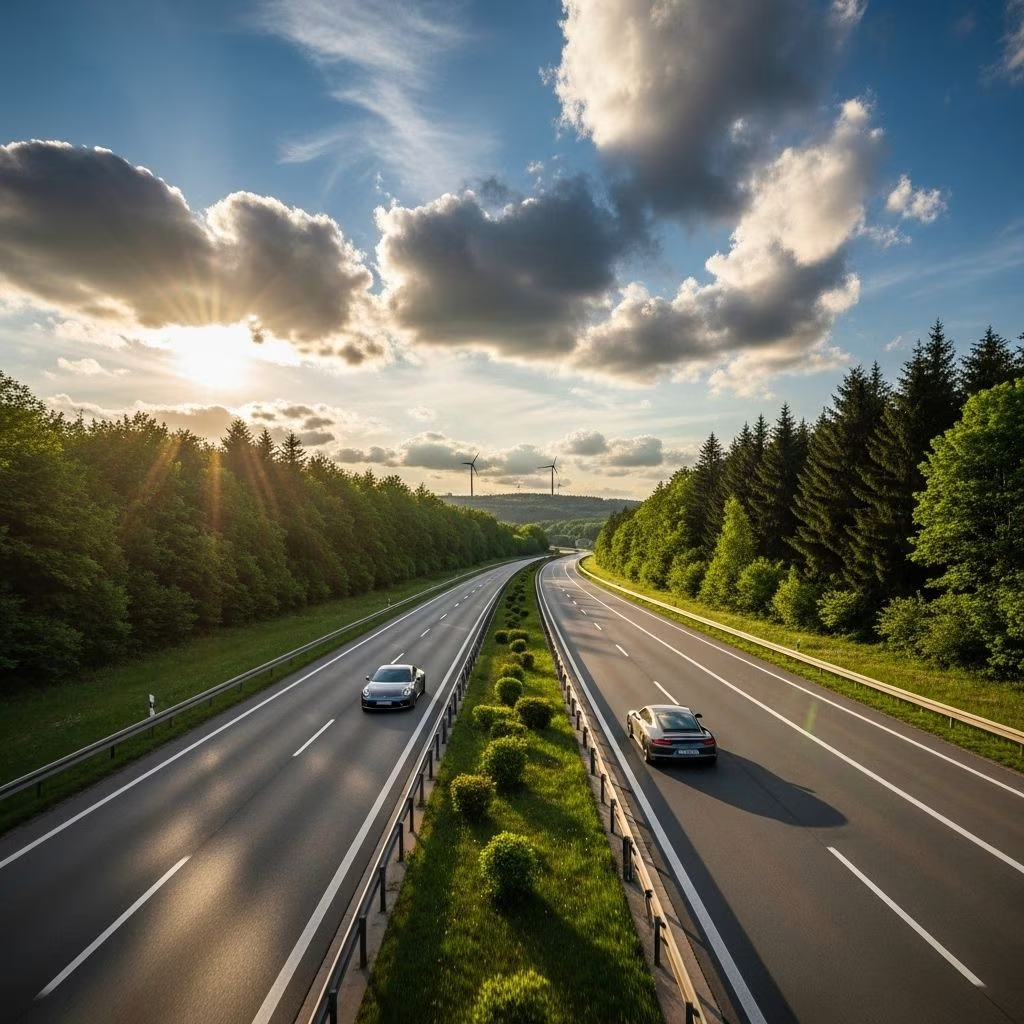
The German Autobahn is globally renowned for its stretches of highway lacking mandatory speed limits, but its legacy runs much deeper. Combining cutting-edge engineering, strict safety enforcement, unforgettable driving experiences, and unique environmental initiatives, the Autobahn holds a special place in the collective imagination of automotive enthusiasts and global travelers alike. Below, we investigate the essential – and often misunderstood – realities behind the Autobahn’s most famous features.
What Exactly Is the Autobahn?
The term Autobahn refers to Germany’s distinctive federal controlled-access highway network, officially called the Bundesautobahn. With over 13,000 kilometers (about 8,000 miles) of road, it is one of the world’s densest and most intensively used expressway networks. The name “Autobahn” can be translated as “auto rail” or “motor road” in English, emphasizing its status as a thoroughfare built specifically for automobiles.
- Construction started in the late 1920s; many stretches remain architectural icons today.
- Not all Autobahn sections are without speed limits—roughly 60% are unrestricted, the rest have dynamic or static speed regulations.
- The Richtgeschwindigkeit or recommended speed is 130 km/h (about 81 mph), above which drivers may be found partially liable in the event of an accident, even if there’s no posted limit.
The Origins: From An Urban Vision to Mythic Status
Though often associated with the Nazi regime and its propaganda, the Autobahn’s roots reach back to pre-war Germany. In the 1920s, plans emerged for high-speed roads, but large-scale development accelerated in the 1930s. Historians agree that beyond its practical transport potential, political leaders saw the Autobahn as a flagship project, symbolizing progress and technological might.
- The Nazi Myth: While Nazi propaganda claimed credit, planning had started years before. However, much of the network’s expansion did occur during their regime.
- Expansion boomed again in the 1960s to 1980s, reflecting West Germany’s consumer-driven affluence and the explosion of car ownership.
A key point: the vision was as much about psychological and cultural effect as about mobility, combining dramatic vistas and scenic route design with speed.
Unrestricted Speed: Reality vs. Legend
The most famous – and controversial – fact about the Autobahn is its lack of speed limits on many stretches. However, this reality is more nuanced than many foreign observers realize.
- About 60% of the Autobahn network does not have an enforced speed limit; the rest impose dynamic or static limits due to traffic, environmental, or safety concerns.
- A 130 km/h (Richtgeschwindigkeit) limit is recommended and can affect insurance liability.
- Heavy vehicles, particularly trucks, must adhere to lower speed limits (typically 80 km/h or about 50 mph), creating significant speed differentials.
- Limits are regularly instituted following accidents, construction, weather conditions, or in high-density urban regions.
Is It Really a Free-for-All?
Despite the enduring image of unlimited-speed highways, the reality is a complex mix of unrestricted sections, variable speed zones, and high driver discipline. Modern traffic volume and a massive number of trucks, which Germany hosts as the heart of Europe’s freight network, make full-throttle driving rare. Instead, skill, awareness, and caution are prized.
Engineering and Design: Built for Speed and Safety
The Autobahn is not simply about speed – it’s about safety at speed. Decades of investment in engineering excellence and strict maintenance underpin its legendary reputation. Here’s what sets it apart:
- Road surface: Specially constructed using thick, high-quality materials to resist deformation at high speeds and under heavy trucks.
- Gentle curves and broad lanes allow drivers to maintain stability and control even at very high velocities.
- Extensive guardrails, barriers, and visibility enhancements further reduce accident risk.
- No intersections, pedestrian crossings, or roadside businesses; entry and exit are controlled via ramps only.
- Constant maintenance: Due to heavy use, ongoing construction is common, and infrastructure is regularly resurfaced or upgraded.
Vehicle Standards
Strict vehicle inspection protocols (the TÜV test) ensure that all cars driving on the Autobahn are mechanically sound, especially in terms of brakes, tires, and emissions.
Safety First—The Hidden Discipline Behind the Speed
Contrary to stereotypes, the Autobahn is governed by one of the world’s most stringent highway safety cultures.
- Licensing requirements: German drivers must be at least 18 and undertake rigorous, costly theoretical and practical tests – far higher than most countries demand.
- Lane discipline: Overtaking on the right is strictly forbidden. Slower vehicles must stay in the rightmost lanes unless passing.
- No phones: Distracted driving laws are firmly enforced.
- Police patrols and cameras: Enforcement of seatbelt laws, sobriety, and speed limits (where posted) is robust.
- Emergency lanes: Motorists are expected to form an emergency corridor in traffic jams, giving first responders instant access to incidents.
Accidents and Fatalities: How Safe Is the Autobahn?
Despite high speeds, fatality and accident rates per mile on the Autobahn are often lower than U.S. highways, largely thanks to design, maintenance, disciplined drivers, and strict vehicle inspections. However, high-speed accidents that do occur are often more severe.
| Factor | Description |
|---|---|
| Speed | Above 130 km/h increases liability and potential accident severity. |
| Truck Traffic | Heavy trucks capped at lower speeds, creating a large differential. |
| Dynamic Controls | Speed restrictions applied based on weather, traffic, and construction. |
Engineering Marvels and Scenic Design
The Autobahn offers much more than speed. Early designers intentionally routed stretches through or next to landscapes renowned for their beauty. Panoramic mountain views, sweeping valleys, and even tree-lined avenues are key features—emphasizing not only efficiency but a memorable travel experience.
- Curvy sections were sometimes created to maximize scenic vistas—balancing aesthetics with driver safety.
- Linden-lined approaches, mountain panoramas, and strategic open views make many stretches uniquely picturesque.
- This approach has led to certain iconic routes notorious for their dramatic visuals but also for significant traffic jams, especially during peak holiday periods or inclement weather.
The ‘Green Autobahn’: Environmental Myths and Realities
Given its scale and computation, the Autobahn also represents a major environmental management challenge. Contrary to myths that the entire network was intended to be ‘green,’ actual sustainability measures have evolved over time:
- Landscaping and extensive tree planting—both as sound barriers and to integrate the road into the surrounding countryside—have long been used to soften the environmental impact.
- Wildlife crossings (green bridges) and tunnels are deployed in sensitive areas to allow animal migration without vehicle conflict.
- Water runoff management and pollution controls are routine parts of new construction and maintenance projects.
Driving the Autobahn: What Should You Know?
Driving on the Autobahn can be exhilarating but demands a high level of focus and preparation. Foreign drivers should note the following:
- Stay to the right: Only use the left lane for passing, and return to the right promptly.
- Check mirrors frequently: Vehicles traveling over 200 km/h can appear suddenly.
- Be alert for trucks: Speed differentials between trucks and cars can be dramatic, especially on inclines.
- Plan for construction: Regular maintenance means detours, narrow lanes, and sudden slowdowns.
- Watch for ‘Stau’: Traffic jams are common, especially near cities or popular holiday routes.
- Use of navigation: Many European radios and GPS devices provide real-time traffic bulletins, helping drivers avoid delays.
Frequently Asked Questions (FAQs) About the German Autobahn
Is it true that anyone can drive as fast as they want on the Autobahn?
No. Only certain sections allow unrestricted speeds, and even then, drivers are recommended to follow the 130 km/h Richtgeschwindigkeit for safety and insurance reasons. High speed is tolerated, but so are strict rules about behavior, vehicle condition, and road etiquette.
What happens if I get into an accident above the recommended speed?
German law stipulates that if you crash while traveling faster than 130 km/h—even where no limit is posted—you may be found partially liable for damages, regardless of who is at fault.
Is overtaking on the right ever allowed?
No. Passing on the right except in rare, congested situations is illegal and heavily fined. Lane discipline is strictly enforced.
Why do trucks sometimes block the left lane?
Trucks are regimented to the right two lanes, but when overtaking slower vehicles (especially on grades), they may temporarily enter the middle lane, creating congestion and significant delays.
Are there any environmental protections in place for the Autobahn?
Yes. Measures such as wildlife crossings, sound barriers, rainwater filtration, and extensive landscaping all play a role in reducing the highway’s ecological impact. Nonetheless, environmental advocacy remains a persistent part of policy discussions.
In Summary: The Enduring Mystique of the Autobahn
The Autobahn’s legend is much more than unlimited speed—it’s a symphony of engineering, regulation, discipline, and scenic design. Its rigorous standards, progressive traffic management, and environmental awareness make it a complex, ever-evolving icon of Germany’s commitment to safe and effective mobility. As technology continues to evolve, so too will the Autobahn, adapting to new challenges and expectations from both its users and its critics.