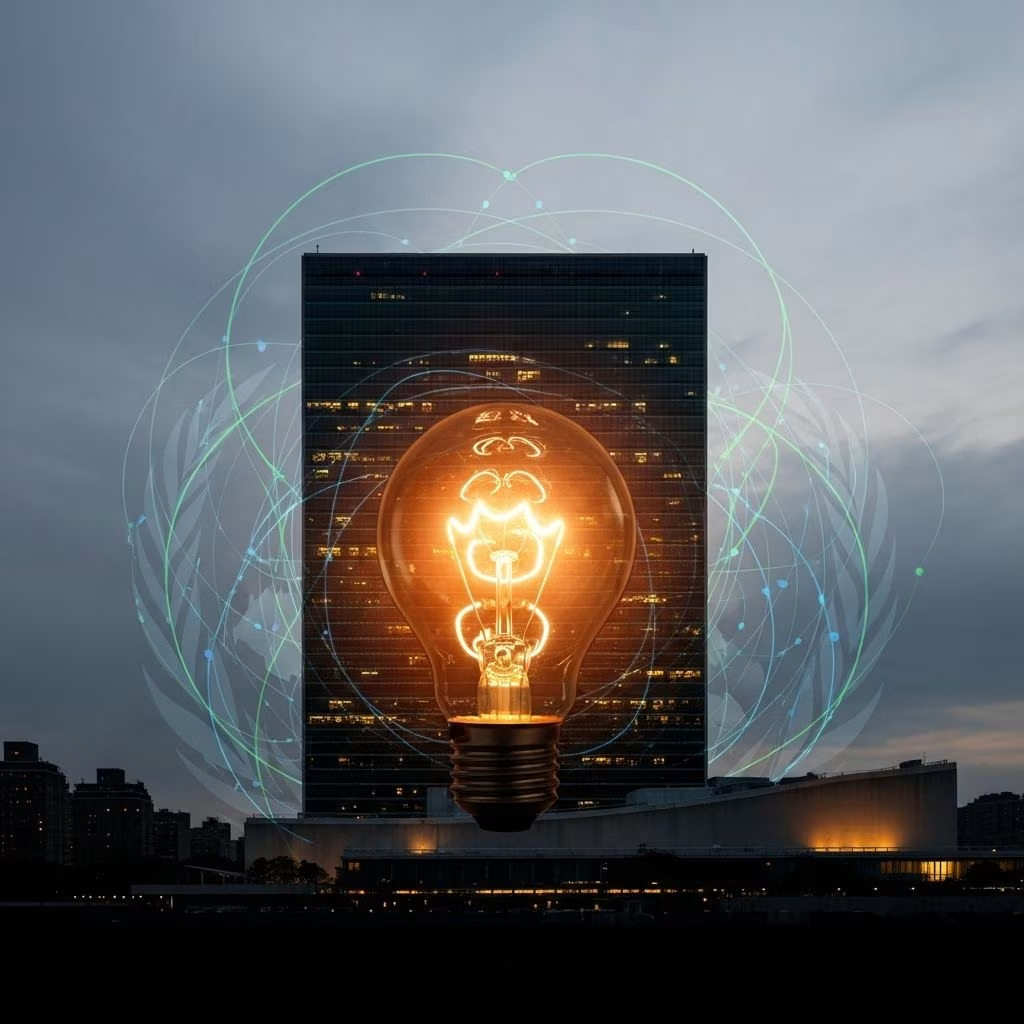
The Real Story Behind the UN and the Light Bulb Controversy
Recent discussions about household lighting have reignited a debate that burns nearly as brightly as a light bulb itself: Is the United Nations seeking to control what kind of bulbs you can buy for your home? The subject has garnered passionate opinions, but the reality is nuanced and sits at the intersection of international standards, domestic regulations, and a persistent wave of misinformation.
Where Did the ‘UN Light Bulb Ban’ Claim Come From?
Rumors about a sweeping United Nations-led ban on incandescent light bulbs have circulated widely, especially in North America and Europe. The narrative is simple, even sensational: A distant international authority is dictating whether you can use a classic incandescent bulb. However, a closer examination reveals a different story, rooted in how international guidelines are created, and how actual laws are written and enforced.
To understand the origins, it’s important to recognize that the United Nations itself does not have the authority or mechanism to enforce mandatory bans on consumer products within its member states. Instead, it serves as a forum for international discussion and standard setting. Claims about a UN ban typically stem from misunderstandings—or deliberate distortions—of voluntary standards proposed by sub-bodies such as the United Nations Environment Programme (UNEP) or technical projects like the United Nations’ en.lighten initiative. These frameworks encourage, but do not mandate, energy efficiency improvements.
The Role of International Standards in Domestic Energy Policy
Global organizations, including the UN, often publish voluntary guidelines to promote energy efficiency and environmental responsibility. However, these guidelines are not enforceable laws. Local or national governments can choose whether, and how, to enact them as part of their regulatory codes.
A typical pathway for a lighting standard is as follows:
- International experts, governments, and industry groups contribute to setting guidelines for energy-efficient products.
- The guidelines are distributed through collaborative projects or advisory documents.
- Individual countries or regions (such as the European Union) review these guidelines and develop legislation—if any—that fits their own energy security, environmental, or economic needs.
- The resulting laws vary considerably in their implementation and stringency.
For example, the European Union and countries like the United States, Canada, Australia, Brazil, Russia, and Argentina have introduced measures to phase out inefficient lighting by enacting particular performance standards. These standards typically specify a minimum luminous efficacy (the number of lumens per watt), which older incandescent bulbs cannot meet efficiently. While these regulatory changes have occurred in parallel with some UN initiatives, they are domestically enacted, debated, and enforced (see ).
Why Were Incandescent Light Bulbs Targeted?
Traditional incandescent bulbs are simple, inexpensive, and pleasant in the warm quality of their light. However, they are vastly inefficient: less than 5% of the energy they consume is converted into visible light, with the rest lost as heat (see ).
This inefficiency leads to two main issues:
- Higher Energy Consumption: Incandescent bulbs draw more power for the same light output compared to modern Compact Fluorescent Lamps (CFLs) and Light Emitting Diodes (LEDs).
- Increased Environmental Impact: Increased electricity demand means higher emissions of CO2 and other pollutants, especially where coal or gas is the main energy source. The European Commission estimates that replacing inefficient lighting could save up to 40 TWh of electricity yearly across the EU, avoiding 15 million tonnes of CO2 emissions (see ).
No, the United Nations Is Not Forcing Your Hand
It bears repeating: The UN does not impose direct bans on products within member countries. Rather, its role is advisory, providing research, consensus, and broad objectives around sustainability. The enforcement of any product phase-out—including light bulbs—is entirely up to national or regional governments.
In the United States, for example, efficiency standards for lighting were included as part of the 2007 Energy Independence and Security Act. The law set minimum requirements for bulb efficacy; as such, inefficient bulbs gradually disappeared from the market as manufacturers adapted to the new thresholds. The impetus for these legal changes did not come from the UN, but from domestic bipartisan consensus on energy and environmental policy.
What International Organizations Actually Do About Lighting
One illustrative initiative is the UNEP’s en.lighten project, which launches public-private partnerships to accelerate the global switch to energy-efficient lighting. The en.lighten initiative provides technical advice and resources to countries, but does not have any legislative power.
Key activities of organizations like UNEP include:
- Sharing best practices for lighting efficiency to help countries lower greenhouse gas emissions.
- Supporting capacity-building and training for manufacturers and regulators.
- Providing financial and technical assistance to developing countries for updating manufacturing or regulatory infrastructure.
- Helping develop standards that address not just efficiency, but also environmental safety, including mercury content in some alternatives like fluorescent lamps.
These global activities are collaborative, intended to help countries that choose to improve efficiency do so more quickly and effectively, rather than to dictate products or force compliance.
Critics: Concerns Over Choice, Light Quality, and Cost
Despite the environmental and energy savings, the transition away from traditional incandescents has generated criticism and resistance:
- Consumer Choice: Some view the regulations as an overreach, arguing for the right to choose any bulb, regardless of efficiency or environmental impact.
- Quality of Light: Early LED and Compact Fluorescent bulbs were criticized for harsh color rendering compared to the soft glow of incandescent bulbs. Advances in bulb technology have since improved these characteristics.
- Cost Concerns: CFLs and LEDs typically cost more upfront, though their much longer lifespans and lower energy use often result in savings over time. The initial investment can discourage adoption among lower-income households.
- Health and Environmental Issues: Some worry about mercury in fluorescent bulbs, or flicker and blue-light risks from LEDs, although improved design and recycling programs have addressed many of these concerns.
The Efficiency Comparison: Old vs. New Technologies
| Type | Luminous Efficiency (%) | Luminous Efficacy (lm/W) |
|---|---|---|
| 40 W Incandescent (120 V) | 1.9% | 12.6 |
| 60 W Incandescent (120 V) | 2.1% | 14.5 |
| Quartz Halogen | 3.5% | 24 |
| CFL (Compact Fluorescent) | 7–10% | 45–75* |
| LED (Light Emitting Diode) | ~15–22% | 65–120* |
*Typical modern values. Actual performance varies based on bulb model and use-case.
As shown, LEDs and modern CFLs are dramatically more efficient than incandescent bulbs, producing far more light for the same amount of electrical power. This efficiency directly translates to energy savings for households and businesses.
Efforts to Reinvent the Incandescent Bulb
Some manufacturers sought to address concerns about efficiency while retaining the prized qualities of incandescent bulbs. Innovations included “high efficiency incandescent” (HEI) projects and hybrid designs, such as the Philips Halogena Energy Saver. These bulbs used reflective capsules to recycle infrared energy, achieving up to twice the efficiency of traditional incandescents.
However, even these improved designs struggled to match the best LEDs and CFLs in efficacy, and commercial programs to further improve incandescent bulbs were largely discontinued due to technical and economic barriers (see ).
The Real-World Impact: Energy, Economy, and the Environment
- The EU ban on inefficient lighting alone has been estimated to save billions of euros annually and cut emissions by millions of tonnes of CO2.
- Energy-efficient lighting is one of the lowest-cost, easiest ways to reduce national power demand.
- Consumers benefit from lower bills over time, despite higher initial costs for modern bulbs.
- Larger-scale adoption of energy-efficient technologies helps countries achieve international climate goals and energy independence.
Light Bulbs, Bugs, and Biodiversity: The Untold Chapter
The discussion on lighting standards extends beyond economics and energy. Recent research has highlighted the environmental impact of artificial lighting on insect populations. For instance, studies show that amber-filtered bulbs attract fewer insects, reducing harm to ecosystems while also minimizing the risk from disease-carrying bugs (see ).
- Amber-filtered LEDs attract 60% fewer insects than standard white lights.
- This can reduce disruptions to nocturnal wildlife and lower public health risks.
- However, certain bioluminescent species may actually be more drawn to amber light, highlighting the need for nuanced approaches to environmental lighting.
Frequently Asked Questions (FAQs)
Q: Is the United Nations banning incandescent bulbs in my country?
A: No. The UN does not have legislative power over member states’ commerce; lighting bans are developed and enforced by national or regional governments, not international agencies.
Q: Why did some countries ban incandescent bulbs?
A: Countries introduced bans or efficiency standards to reduce energy use, lower greenhouse gas emissions, and promote affordable, sustainable energy. Incandescent bulbs are very inefficient compared to modern alternatives.
Q: Are modern LED and CFL bulbs better for the environment?
A: Yes. They use less electricity for the same light output, reducing emissions and energy costs over time. Some types, like CFLs, contain small amounts of mercury, but proper recycling mitigates these risks.
Q: Can I still buy incandescent bulbs for specialty or decorative uses?
A: In many jurisdictions, specialty incandescents (e.g., for ovens or decorative purposes) remain legal. Bans and standards typically target general-purpose household lighting.
Q: Will global guidelines ever take away my right to choose lighting?
A: Energy standards reflect a balance of efficiency, consumer demand, and market innovation. Guidelines inform, but do not dictate, national policy. Choice will continue to reflect local regulations and market offerings.
Summary
- The UN does not and cannot force countries to ban or regulate specific light bulb types; such regulations are local decisions, often for reasons of energy efficiency and climate.
- Modern lighting technologies like LEDs greatly outperform incandescent bulbs in efficiency and lifespan, offering economic and environmental benefits.
- Both economic and ecological concerns inform lighting standards—ranging from electricity costs to biodiversity impacts.
- Consumers typically enjoy brighter, longer-lasting light and lower power bills as a result of the transition to more efficient lighting.
- The conversation about lighting is ongoing, reflecting changing technology, environmental needs, and public values.
References
- https://en.wikipedia.org/wiki/Incandescent_light_bulb
- https://www.smithsonianmag.com/smithsonian-institution/using-amber-filtered-bulbs-instead-of-white-light-attracts-fewer-bugs-180977495/
- https://besjournals.onlinelibrary.wiley.com/doi/full/10.1111/1365-2745.14489
- https://www.ionaconner.com/wp-content/uploads/2024/03/Treehuggers-7.pdf