


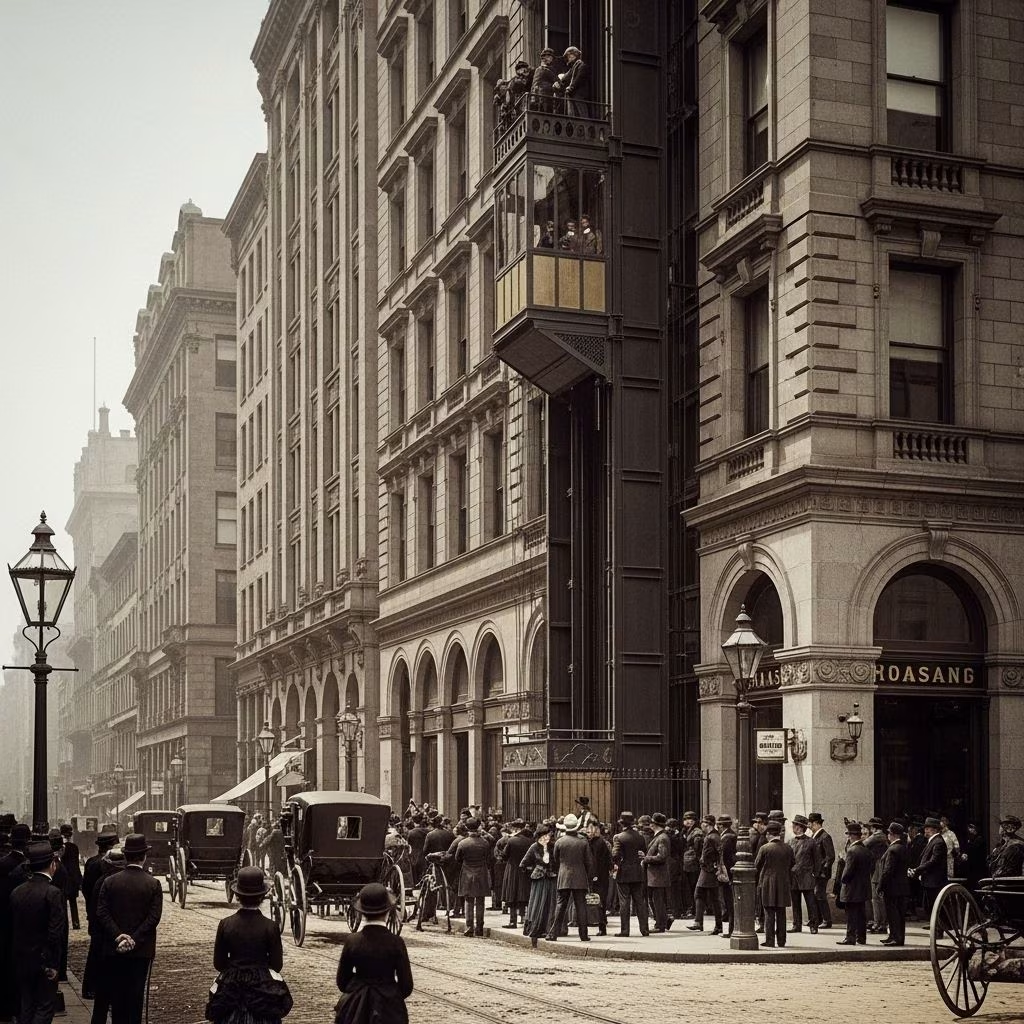
The Birth of the Passenger Elevator
On March 23, 1857, a pivotal innovation forever transformed cities and buildings: the installation of the world’s first successful passenger elevator in the E.V. Haughwout Building at 488 Broadway, New York City. This game-changing device, designed by Elisha Graves Otis, set modern urbanization in motion and became a catalyst for the skyscraper age.
Elevators Before Otis: Ancient and Pre-Industrial Lifts
Long before the modern elevator, civilizations devised various systems to move people and goods between levels:
- Ancient Rome: The architect Vitruvius described Archimedes’ rope-and-pulley lift in 236 BC, a foundation for future designs.
- Roman Colosseum: Utilized about 25 elevators, raising wild animals for games; each was powered by manpower and could haul heavy loads.
- Medieval and Renaissance Innovations: From the Book of Secrets by Ibn Khalaf al-Muradi (c. 1000 AD) to Leonardo da Vinci’s and Ivan Kulibin’s vertical lifts, the concept advanced slowly, mainly for royalty and warfare.
- 17th-18th centuries: Devices like France’s ‘flying chair’ (Louis XV, 1743) and the mechanical screw drive appeared in palaces but lacked practical safety or mass appeal.
These early inventions set important precedents, but the main barrier remained: elevator safety. Until this was solved, elevators remained dangerous, unreliable curiosities.
Elisha Otis and the Safety Elevator
The leap from dangerous hoisting platforms to trusted people-movers occurred thanks to Elisha Otis’s safety brake mechanism. A skilled mechanic and problem solver, Otis conceived an elegant answer to a deadly problem: what happened if the rope snapped?
- 1852–1853: Otis invents the safety brake, a spring-loaded device that clamps onto guide rails if tension is lost.
- 1854: To prove its reliability, Otis stages a dramatic demonstration at the New York Crystal Palace Exhibition. Perched high above the audience, he orders the rope cut; the brake stops his platform instantly, and no harm befalls Otis. The crowd is both stunned and convinced.
- Business Growth: Initial skepticism gives way to brisk sales. Eight elevators in 1854, 15 in 1855—mostly for freight, but the potential for passenger service becomes clear.
This breakthrough becomes the foundation for the Otis Elevator Company, which would soon dominate the industry and reshape the cityscape.
The Haughwout Building: A Revolution in Retail and Urban Form
Otis’s first passenger elevator found its home in New York’s E.V. Haughwout department store, a stylish, cast-iron building catering to a wealthy clientele (including Mary Todd Lincoln). This choice was no accident: merchant Haughwout understood the power of attraction. The futuristic novelty would draw crowds—potential customers—on every floor.
- Design Features: The elevator was powered by a steam-driven winding drum, using pulleys and counterweights for a smooth ride across five stories.
- Safety First: The crucial safety brake clamped onto guide rails if the cable failed, turning a potentially fatal drop into a drama-free pause.
- Urban Impact: Suddenly, upper floors were desirable for both shops and offices, which was a radical shift—previously, ground floors held the most value.
The Elevator’s Ripple Effect: Skyscrapers and Modern Urban Life
Otis’s invention ignited a vertical revolution:
- Skyscraper Boom: Safe, reliable elevators uncoupled building height from walkability, freeing architects and developers. The skyline could—and did—rise higher and faster.
- Social Changes: Elevators made upper-floor apartments and offices attractive, democratizing access to air, light, and views.
- Economic Growth: Business could pack more tenants into a single address, supercharging urban density, property values, and opportunities.
- Architectural Innovations: Modern architecture’s vertical logic—central cores, glass walls, open floor plates—all became possible because elevators could safely and conveniently carry crowds between floors.
By the late 19th and early 20th centuries, the elevator was not just a convenience—it was essential to city life.
Timeline: Key Milestones in Elevator Innovation
| Year | Milestone |
|---|---|
| 236 BC | Archimedes creates first recorded lift in ancient Greece |
| 80 AD | Colosseum elevators raise animals for arena spectacle |
| 1743 | ‘Flying chair’ built for Louis XV in Versailles |
| 1793 | Ivan Kulibin’s screw-drive elevator in Russia |
| 1852 | Otis invents safety brake |
| 1854 | Otis’s public demonstration in New York |
| 1857 | First passenger elevator installed in Haughwout Building |
| 1870 | Equitable Life Building, first office with passenger elevators |
| 1880 | Werner von Siemens invents first electric elevator |
| 1890s | Frank Sprague expands electric elevator technology, enabling multiple cabs in a single shaft |
Safe, Fast, Everywhere: The Legacy of Otis’s Elevator
Otis’s brake quickly became industry standard, but the elevator continued evolving:
- Transition to Electric: By the 1880s, steam and hydraulic drives were replaced by electric elevators, thanks to innovators like Werner von Siemens and Frank Sprague. This made them faster, more efficient, and able to handle larger crowds.
- Automatic Controls: Sprague’s inventions allowed for automatic operation, acceleration control, and floor selection, paving the way for today’s effortless systems.
- Design Diversity: Multiple elevator cars in a shaft, glass-walled cabs, and reliable, computer-driven safety systems are all part of the modern elevator’s legacy.
Today’s Otis Elevator Company, still bearing the founder’s name, operates worldwide, moving millions of people safely every day. The company’s story is one of continual improvement and adaptation.
Frequently Asked Questions about Elevators
Who was Elisha Otis, and why is he important?
Elisha Otis was an American inventor and mechanic who created the first effective elevator safety brake. His 1857 installation of a passenger elevator in New York City made vertical urban living and skyscrapers possible.
Why was Otis’s demonstration in 1854 so significant?
His public test, where the hoisting rope was cut and the platform didn’t crash, convinced the public and industry leaders that elevators could be safe for passengers.
How did elevators change building design?
Elevators allowed tall buildings to be practical, shifting valuable office and apartment space to higher floors. This enabled the birth of the skyscraper and dense, vertical cities.
What was unique about the Haughwout Building’s elevator?
It was the first passenger elevator installed for commercial use, steam-powered, and protected by Otis’s patented safety brake, serving five floors of retail in the heart of New York.
Are there any early elevators still in use?
While most original 19th-century elevators have been replaced or modernized for safety, some historic cabs—with modernized machinery—still operate in landmark buildings.
Enduring Symbol of Progress
The elevator is more than a mechanical device: it stands as a symbol of urban progress, safety, and modernity. The invention and demonstration by Elisha Otis rendered the impossible—safe vertical travel—into routine daily life.
Every time we step into an elevator, we ascend not just to a new floor, but to a new era Otis helped create. From ancient ropes to state-of-the-art smart elevators, his spirit of practical innovation continues to lift the world.
References
- https://www.youtube.com/watch?v=Ig25XrSxVUs
- https://www.otis.com/en/us/our-company/history
- https://en.wikipedia.org/wiki/Elevator
- https://blog.ansi.org/ansi/history-of-elevators/
- https://blog.stannahlifts.co.uk/lift-or-elevator-the-history-and-origin
- https://www.otis.com/en/us/news?cn=this-day-in-otis-history
- https://empirestateplaza.ny.gov/first-safety-passenger-elevator-otis-elevator


