


Do Menu Calorie Counts Really Help You Eat Less?
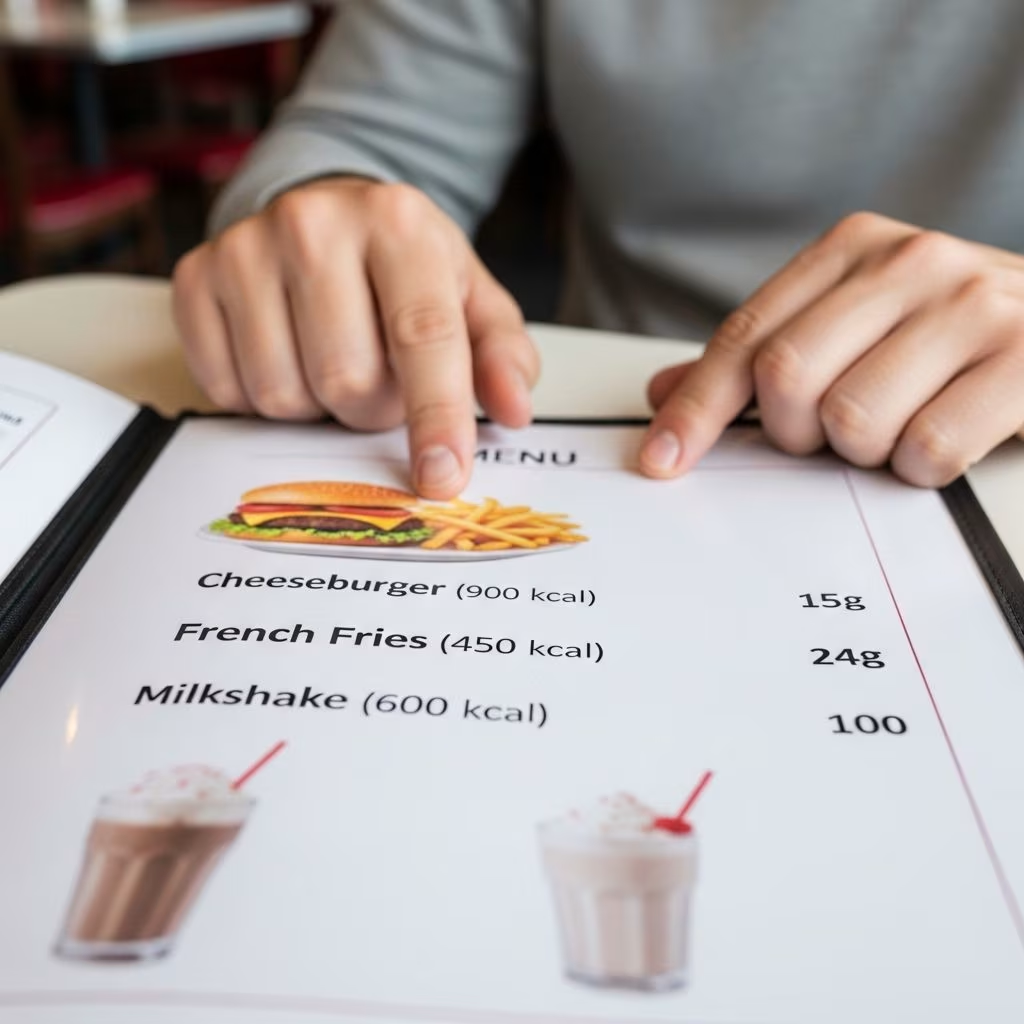
In recent years, many restaurants have begun listing calorie counts next to their menu items. The expectation is straightforward: when people see how many calories are in their burgers, salads, and desserts, they will make healthier choices and ultimately eat less. But is this assumption actually true? Do menu calorie counts genuinely change dining behaviors and help with weight loss, or does human psychology complicate the picture?
Why Menu Calorie Counts Became Popular
As the obesity crisis gained national attention, public health advocates pushed for greater transparency in food labeling. Placing calorie counts prominently on menus was meant to empower customers to make informed decisions, potentially leading to healthier choices and reduced calorie intake. The initiative was also supported by research showing that most adults underestimate the calories in their meals and often have no idea how many they should consume daily.
- Federal and regional regulations have required large fast-food chains and restaurants to post calorie information.
- Early studies suggested customers might respond to this knowledge by ordering lower-calorie items.
- Public health organizations touted this as a simple policy intervention with widespread benefits.
What the Latest Research Shows About Calorie Counts and Eating Choices
The effectiveness of menu calorie counts at helping people choose lower-calorie meals is not as straightforward as hoped. Recent studies reveal a nuanced reality:
- Calorie information alone does not guarantee healthier choices. While some diners do notice and use the calorie counts, many do not significantly change their decisions.
- The format of menu labeling counts. Listing calorie information within the food category (e.g., pasta, meat, seafood) is more influential than grouping low-calorie items together in a separate section.
- Negative perceptions influence decisions. People can quickly dismiss low-calorie menu sections, especially when pressed for time or facing many choices. This ‘menu simplification’ leads to early elimination of the “healthy” category in favor of comfort or routine eating.
Study Spotlight: Category Placement vs. Calorie Listing
A Journal of Consumer Research study found that:
- Menus with low-calorie dishes grouped together led people to skip that category almost immediately. Both calorie-labeled menus and traditional non-labeled menus resulted in similar calorie selections.
- Diners paying attention to calories across categories (rather than as a special section) chose the lowest-calorie meals overall.
- Negative associations with “low-calorie” labels may subconsciously sabotage healthy intentions.
| Menu Type | Typical Calorie Outcome | Decision Influences |
|---|---|---|
| Calories per item (integrated) | Lowest calorie choices | Subtle reminders, less negative association |
| Low-calorie section only | Often dismissed, similar to no calorie labeling | Negative perception, category elimination |
| No calorie labeling | Moderate to high calories | Habit, taste, familiarity |
Psychology: Why Calories on Menus Don’t Always Lead to Eating Less
Researchers suggest several psychological factors at play:
- People tend to simplify complex menus by eliminating entire categories early (especially those labeled healthy or low-calorie), focusing on what feels familiar or appealing.
- Negative stereotypes about “diet” foods can trigger resistance—even when a diner intends to eat healthily.
- Time pressure: Quick decisions increase reliance on habit, taste preferences, or menu design, not calorie logic.
- Subconscious associations between low-calorie and less satisfying options undermine healthy choices.
Jeffrey R. Parker, a marketing professor and co-author of the research, explains that our brains use shortcuts to manage choices—often sidelining the very categories that might help us eat less. He recommends that diners slow down and take their time deciding, which can improve outcomes by reducing automatic, emotionally-driven exclusions.
What Actually Works for Weight Loss in the Real World?
Despite the limited effectiveness of menu calorie counts in isolation, research consistently shows that total calorie intake is a core driver of weight loss. Learning how to manage calories—whether at home or dining out—remains essential.
Understanding Your Personal Calorie Needs
- The Dietary Guidelines for Americans recommend average intakes ranging between 1,600–2,400 calories per day for women and 2,000–3,000 for men, adjusted for physical activity, age, and health status.
- A daily deficit of roughly 500 calories can lead to about one pound of weight loss per week—but this is a broad estimate and highly individual.
- Most adults are unaware of both their actual needs and the calorie content of common foods, often underestimating intake.
Strategies to Manage Calories Without Fixating on Numbers
- Portion control: Learning what a healthy portion looks like is more practical for many than calorie counting.
- Mindful eating: Focusing on hunger signals, fullness, and satisfaction can reinforce better choices (see the debate between calorie counting and intuitive eating).
- Quality over quantity: Emphasizing nutrient-dense foods (whole grains, lean proteins, vegetables) can help maintain lower calories and higher satisfaction.
Diets and Weight-Loss Plans That Incorporate Calories
Some structured approaches blend calorie awareness with habit-building:
- The 400 Calorie Fix plan restricts individual meals to about 400 calories each, which provides enough variety and satiety for sustainable eating.
- Tracking macros (protein, carbs, fats) alongside calories can support balanced nutrition. Popular apps make tracking easier for tech-savvy users.
- Food journals can reinforce awareness—not just of calories, but of emotional eating patterns and hunger cues.
Intuitive Eating vs. Calorie Counting: Which One Wins?
While calorie counting led to more consistent weight loss in short-term studies, intuitive eating offers greater sustainability and psychological comfort for many. According to registered dietitians:
- Calorie counting produces faster initial weight loss but can be tedious and hard to maintain.
- Intuitive eating teaches people to respect hunger and fullness, and may prevent bingeing or yo-yo dieting, though weight loss is slower.
- A blend of techniques may provide the best long-term success, promoting both awareness and emotional well-being.
Restaurant Strategies Beyond Calorie Counts
Restaurants deploy other tactics that influence what and how much we eat, often without us noticing:
- Placement and prominence of high-calorie dishes on menus
- Portion sizes that far exceed healthy norms
- Descriptive language and value deals
- Social cues from dining companions
As a customer, slowing down the ordering process and comparing nutritional values within categories—rather than relying solely on the presence of calorie counts—can help overcome these subtle influences.
Expert Tips for Making Healthier Restaurant Choices
- Don’t rush: Take a few extra minutes to review the menu and nutrition details; this can minimize impulsive, habit-driven choices.
- Compare across food types: Look for lower-calorie options within your favorite categories, rather than defaulting to a special ‘diet’ section.
- Share portions: Consider splitting high-calorie entrees or desserts with companions.
- Ask for modifications: Request sauces on the side, grilled rather than fried, and extra vegetables instead of fries.
- Hydrate first: Drink water before ordering and eating—it helps curb excess hunger.
Frequently Asked Questions (FAQs)
Q: Does seeing calorie counts on menus lead most people to eat less?
A: Not consistently. Calorie labeling can help some diners choose lower-calorie meals, but the effect is limited when calories are grouped in a “diet” section or when diners act out of habit or under time pressure.
Q: Is calorie counting better than intuitive eating for weight loss?
A: Calorie counting typically produces faster and more consistent initial weight loss, but intuitive eating is more pleasant and sustainable. A blend of approaches may provide the best results.
Q: How many calories should I eat per day to lose weight?
A: The average adult woman needs 1,600–2,400 calories per day, and men 2,000–3,000, depending on activity, age, and health conditions. A deficit of around 500 calories per day can lead to about 1 pound per week loss, but individual needs vary greatly.
Q: Are there easier ways to manage calories than counting every single one?
A: Yes, strategies like portion control, mindful eating, and focusing on meal patterns or tracking macros can simplify the process while supporting weight management.
Q: What can I do to avoid ordering high-calorie dishes?
A: Review the menu slowly, compare calorie totals within categories, ask for healthy modifications, and don’t let “low-calorie” labels discourage you from exploring better choices outside the diet section.
Conclusion: The Real Impact of Menu Calorie Counts
Menu calorie counts alone are not a panacea for healthier eating or successful weight loss. The psychology of choice, menu design, and personal eating habits play significant roles. Still, integrating calorie awareness with mindful eating, practical portion control, and a focus on quality can make a measurable difference—both in the restaurant and beyond. Establishing individualized strategies, taking time to decide, and blending proven tools (like food tracking or intuitive cues) offer the best path forward for wellness and weight management.
References
- https://www.prevention.com/weight-loss/a20456360/400-calorie-meals-how-to-get-started/
- https://www.prevention.com/weight-loss/diets/a19804935/macros-diet/
- https://www.prevention.com/weight-loss/diets/a20437109/calorie-counting-is-better-for-weight-loss/
- https://www.prevention.com/weight-loss/a20471565/are-calorie-counts-on-menus-actually-making-us-fatter/
- https://www.prevention.com/weight-loss/a28400225/how-many-calories-to-lose-weight/
- https://www.prevention.com/weight-loss/a20455268/menu-calorie-counts-wont-make-you-eat-less/
- https://www.prevention.com/food-nutrition/g41055022/low-calorie-meals/
- https://www.prevention.com/food-nutrition/g20428211/25-ridiculously-low-calorie-foods/
- https://www.prevention.com/weight-loss/diets/a20460983/weight-loss-meals-and-snacks/
- https://www.prevention.com/food-nutrition/g29504714/weight-loss-foods/


