It Began With an Ordinary Day
I never expected the faintest sign—just a slight discomfort, a twinge that felt as mundane as any other fleeting ache—to be the beginning of a journey that would unravel much of what I thought I understood about myself and my body. At thirty-five, with routines, ambitions, and relationships in place, the rhythm of my days held no space for catastrophe. That morning, I felt normal. By evening, I was changed.
The Diagnosis That Changed Everything
The words “You have cancer” hovered in the sterilized air of the doctor’s office, echoing with an intensity that blanketed every other sound. I was thrust into a world governed by biopsy results, dense medical terminology, and a future as uncertain as the test results still trickling in. Statistic after statistic—and none comfortably fitting my version of reality.
The onslaught of procedures—ultrasounds, mammograms, MRI scans, bloodwork—became my new workweek. The professionals around me wielded an impossible blend of empathy and efficiency. They scheduled appointments with the unhesitating rhythm of people who do this daily, but to me each event felt surreal, as if I were shadowing my own life.
What It Means to Be Sick
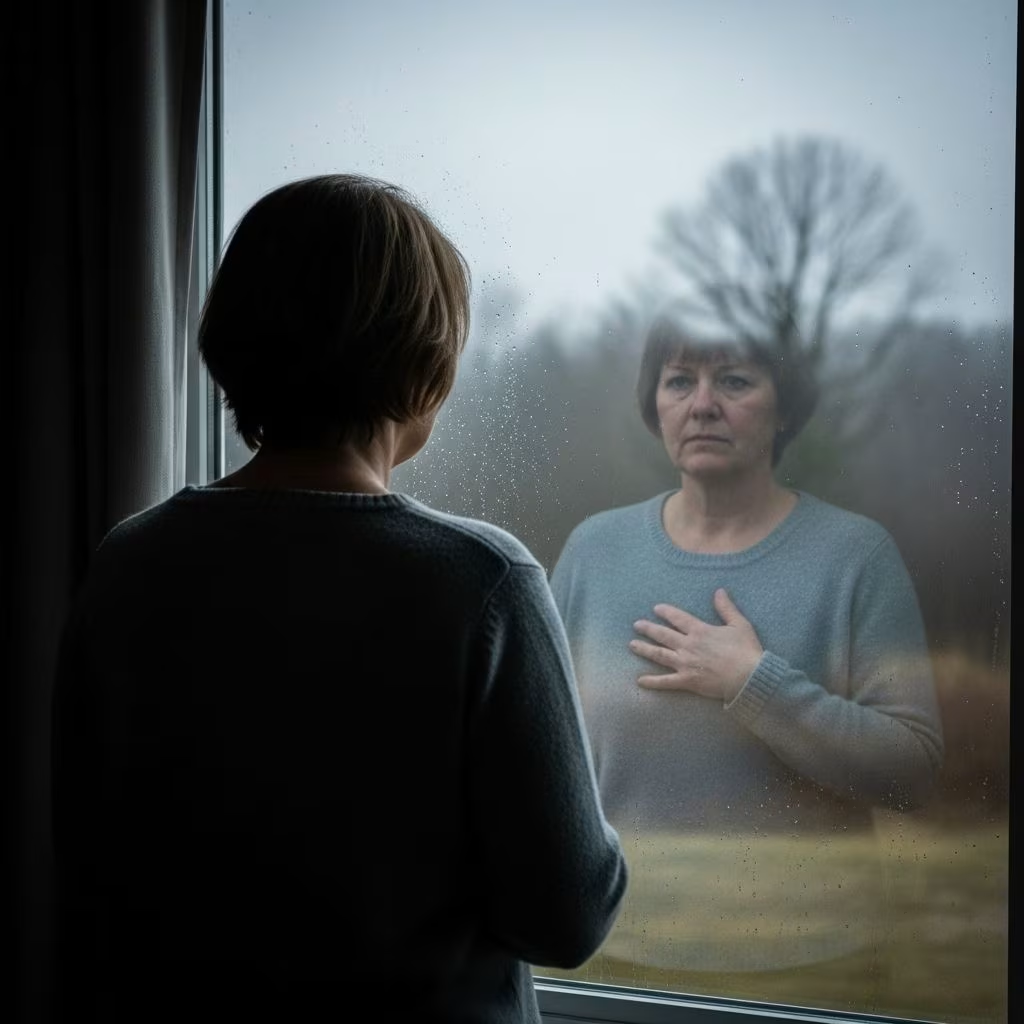
There is an abrupt transition when one goes from healthy to “sick person.” Before the diagnosis, I had regarded my body as a reliable partner, predictable if not always appreciated. Afterward, I felt betrayed—a vessel I couldn’t trust, carrying a threat I couldn’t see. Every glance in the mirror was a cautious inventory for signs of further rebellion within.
The world responded with sympathy and platitudes; words like “brave,” “strong,” and “fighter” peppered every conversation. I learned quickly that these labels, though well-meaning, constructed a narrative that didn’t always fit my reality. Some days, I was neither brave nor strong—I was scared and exhausted.
Procedures, Treatment, and Navigating the Unknown
- Biopsy and Staging: The waiting was almost worse than the procedures themselves, each pause filled with intrusive thoughts. Was it contained? Was it spreading? Each result redefined my risk, my prognosis, and the tone of every conversation thereafter.
- Chemotherapy: Familiar with its reputation, I feared chemotherapy most. The prospect of losing my hair, my vitality, and my appetite for life was daunting. Chemo brought waves of nausea, a fatigue that no sleep could abate, and a mental fog that blurred the borders between days.
- Surgery: Facing surgery was to confront the physicality of loss. The thought of a lumpectomy or mastectomy forced me to reconcile the meaning of breasts, womanhood, and survival. The scars, I realized, would not just be physical.
- Radiation: Compared to chemo, radiation seemed almost benign in reputation, but the daily trips to the clinic created their own rhythm of monotony and anticipation. Each session marked an invisible tally in the war being waged deep within my body.
The doctors presented options. Each path carried risks, tradeoffs, and the acknowledgment that medicine can offer strategy, not certainty. I learned that healing is rarely linear, and side effects are as much a psychological battle as a physical one.
The Emotional Fallout
Beneath the clinical regimens and medical interventions, the emotional landscape was uncharted and treacherous. The diagnosis acted as a fault line, splitting my life into “before” and “after.” Simple joys became elusive. Laughter felt guilty, self-care intrusive, and social events hollow. People did not know how to approach my new reality. Some friends rushed toward me, eager to help in any way they could; others retreated, unsure how to navigate the terrain of illness.
I became familiar with grief—not only for the possibility of loss of life, but for the smaller, daily losses: stamina, appetite, confidence, and, at times, hope. Grief crept into every crevice, uninvited and impossible to banish through mere willpower or “positive thinking.”
Losing Her: Grieving My Mother in the Midst of Cancer
Grief does not wait for a convenient time. My mother died as I was battling cancer—a dual loss that left me untethered. Navigating treatment while also tending to the rawness of fresh grief made everything sharper, heavier. She had been my fiercest protector, the one who would have asked the right questions, sat by my bed, braided my hair as it fell out—not just my mother, but my anchor to all things safe.
Losing her during this time felt careless, like being evicted during a thunderstorm. The urge to call her, to hear her tell me I’d survive, was overwhelming. Grief and fear became indistinguishable, a constant ache that made each medical update feel larger, each setback more consequential.
Facing the World, Changing Relationships
The world moves on, even when yours has stalled. Some friends drifted away, finding the gravity of illness too much. Others surprised me with simple acts of kindness—remembering my favorite snacks, waiting with me through appointments, listening as I voiced my worst fears without judgment. I learned to be patient with loved ones: to allow awkwardness and imperfection, to appreciate intentions rather than flawless execution.
Intimacy changed, too. My partner and I navigated a new reality of scars, drains, and anxieties. There were moments of quiet tenderness and others of miscommunication. Cancer is as much a test of love as of strength.
- Loved ones may not always say the right thing. Forgiveness is vital.
- Vulnerability is both the cost and the power of real connection.
- Sometimes, the best support comes from unexpected places.
Who Am I Now? The Identity Crisis of Illness
Major illness doesn’t just alter the body; it reshapes identity. After months of treatment, my hair thinned, my skin bore the evidence of battle, and my energy waned. But the most enduring change was internal—a seismic shifting of self. I could no longer define myself by past accomplishments or future plans. Instead, I learned to live in the fragments of the present.
The external markers of “health”—appearance, productivity, cheerfulness—did not always apply. There is pressure, especially for women, to “bounce back,” to be inspirational, to assure others we are unchanged. But I was changed. It took time, and therapy, to accept that it was not weakness to be different, to crave space, quiet, and solitude.
| Before Cancer | During Treatment | After Recovery |
|---|---|---|
| Ambitious, future-oriented | Day-by-day survivor | More self-aware, cautious but hopeful |
| Barely noticed my body | Hyper-aware of every sensation | Learning to trust my body again |
| Planned milestones | Measured survival in milestones of treatment | Redefining goals, embracing uncertainty |
How I Started Healing
Recovery was not a straight line. While the world expected me to return to “normal,” my body and mind demanded patience. Healing required less comparison and more compassion. I allowed for rest, for tears, and for angry days. I sought out fellow survivors and found solace in shared stories—there was power in voices that echoed my truth, not just the “triumphant” ones.
Therapy helped me untangle the mesh of grief and trauma. Meditation and writing became lifelines. I learned to ask for help, even when it was difficult. There was wisdom in vulnerability, and each step of progress, however minor, counted as a victory.
- Joining support groups (virtual or in-person) provided connection and understanding.
- Creative outlets like journaling or art therapy fostered healing.
- Small rituals—morning tea, walks in nature, favorite music—restored a sense of normalcy.
Redefining Beauty and Self-Worth
Even when medicine declared me “cancer-free,” the psychological scars lingered. My relationship with my body was uneasy—I saw loss where others saw survival. Accepting my changed appearance required profound inner work, dismantling the myths society tells about beauty and worth. To love myself as I was—scarred, thinner-haired, and weary—was an act of rebellion against every expectation baked into our culture.
Slowly, I learned to see strength in vulnerability. To see stretch marks, incisions, and radiation tattoos as badges of endurance. My beauty no longer relied on being whole but on being alive, present, and real.
Living Forward: Lessons, Hopes, and Advice
- Embrace the unpredictable: Illness postponed my plans, but it also deepened my gratitude for ordinary moments.
- Redefine resilience: Survival is not just about fighting; it is about allowing space for fear, grief, and transformation.
- Ask for help, give yourself grace: Your pain is valid. Recovery does not follow a timetable.
- Celebrate small victories: Finishing treatment, a walk outdoors, returning appetite, laughter after tears—all matter.
- Honor your losses: Grieve, remember, and find meaning in your own way. No two journeys are identical.
Frequently Asked Questions (FAQs)
What are the psychological effects of a breast cancer diagnosis?
Many individuals experience shock, anxiety, and grief after a diagnosis. The sense of lost control, changing self-image, and fear of the future are common. Seeking therapy or support groups can be beneficial.
How do relationships change during cancer treatment?
Illness often changes communication patterns within couples, families, and friendships. Some relationships may strengthen, while others might become strained. Vulnerability, honesty, and patience are key to navigating these shifts.
Is it normal to struggle with body image after cancer treatment?
Absolutely. Surgery, hair loss, and other visible changes can impact self-esteem. Healing emotionally from these physical reminders often takes time and self-compassion.
What helped you heal, emotionally and physically?
A combination of therapy, gentle physical activity, creative expression, supportive friends, and the passage of time. Learning to ask for and accept help is crucial.
What advice do you have for others newly diagnosed?
Take it one day at a time. Allow yourself to feel your emotions without judgment. Seek support, keep asking questions, and trust that healing—though winding—is possible.
Final Thoughts
This journey was not one I would have chosen, but it revealed to me the depths of my own resilience, the fragility and strength of the body, and the unpredictable shape of survival. I continue to learn, to stumble, to grow. There is life after cancer—and it is as complex, beautiful, and ordinary as ever.
References
- http://ndl.ethernet.edu.et/bitstream/123456789/69152/1/234.pdf
- https://elischolar.library.yale.edu/context/yale_med_alumni_newsletters/article/1002/viewcontent/yalemedicinealum1968_69yale.pdf
- https://pdxscholar.library.pdx.edu/cgi/viewcontent.cgi?article=1806&context=open_access_etds
- https://www.law.uchicago.edu/faculty/epstein
- https://www.gs.columbia.edu/sites/default/files/content/News/columbia-gs-owl-magazine-2017-2018.pdf
- https://inside.ccsi.org/CCSIPortal/media/content/PDFs/hidden-rules-of-race.pdf
- https://careers.uw.edu/channels/graduate-school/
- https://www.stjohnsprep.org/uploaded/pdf_files/todayspring08r3.pdf
- https://www.ncpathinktank.org/pdfs/NRarticle052509.pdf