


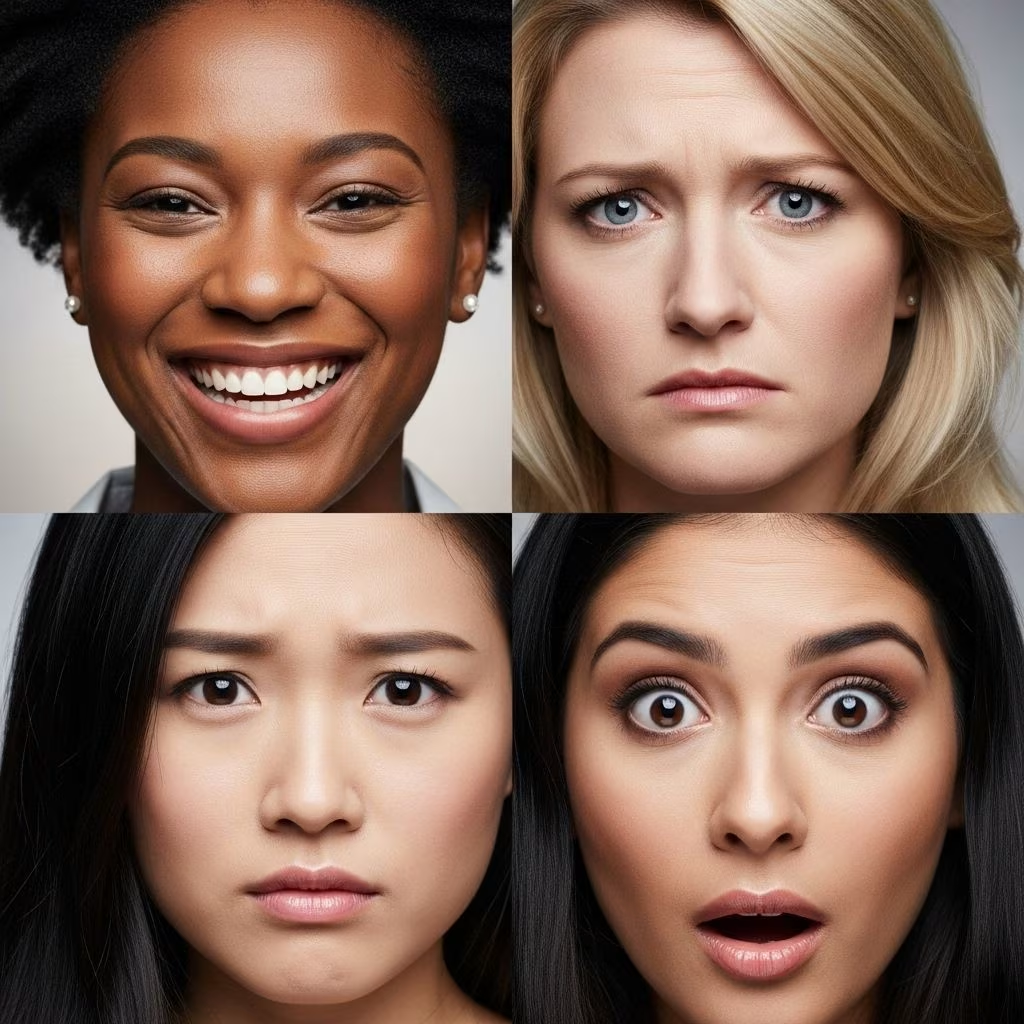
Facial expressions are among the most powerful tools humans use to communicate feelings, intentions, and responses in social contexts. They serve as a universal language that transcends words, making them an essential focus in the science of emotion and nonverbal communication. This article delves into the complexities behind how emotions are expressed and interpreted through facial cues, examining the psychology, biology, cultural context, and modern applications of this fascinating phenomenon.
The Science Behind Facial Expressions
At their core, facial expressions are the result of coordinated muscle movements that reflect our inner emotional states. From the subtle arch of an eyebrow to the full smile of joy, each facial movement can convey a wealth of information with remarkable efficiency. According to leading psychologists, these expressions serve not only to share one’s emotional state but also to influence the perceptions and behaviors of those around us .
Charles Darwin was one of the first to systematically study facial expressions, suggesting that they evolved as adaptive responses to social and environmental pressures . Contemporary neuroscience corroborates this idea, showing that the brain processes emotional cues from faces through specialized neural circuitry, especially in regions such as the amygdala, which plays a crucial role in interpreting ambiguous or intense emotional faces .
Basic Emotions and Their Facial Expressions
Psychologists Paul Ekman and Carroll Izard famously proposed that a set of basic emotions—each with a characteristic facial expression—are universally recognized across cultures. The basic emotions generally include:
- Happiness
- Sadness
- Anger
- Fear
- Surprise
- Disgust
- Contempt (sometimes included as a seventh universal emotion)
These emotions are typically associated with distinct facial patterns. For instance, happiness is marked by upward-curving lips and crinkling around the eyes, while fear often involves widened eyes and raised eyebrows .
The Role of Facial Expressions in Social Communication
Facial expressions offer direct and immediate cues to another person’s emotional state, often before a single word is spoken. In many cases, these cues help us interpret the intentions and behavioral tendencies of others—distinguishing between approach (e.g., smiling, suggesting openness) and avoidance (e.g., anger, implying potential conflict) . The understanding and response to these cues play a fundamental role in effective social interaction:
- Building Trust: Genuine smiles and open expressions foster feelings of warmth and trust in social and business environments.
- Resolving Conflict: Recognizing fear, anger, or sadness can prompt empathic and conciliatory behaviors.
- Signaling Intentions: Expressions may indicate willingness to cooperate, compete, or disengage.
Universality versus Cultural Influence
Ekman’s early work argued for the universality of basic facial expressions, citing cross-cultural studies in both literate and non-literate societies. However, later research suggests that the perception and expression of emotion are not entirely universal. Culture shapes both how faces are displayed and interpreted:
- Some cultures encourage emotional restraint, leading to more subdued facial displays.
- The meaning attributed to specific expressions can vary across societies.
- Language plays a crucial role; how we label and categorize emotions can shift perception .
Table: Universality and Cultural Specificity of Facial Expressions
| Emotion | Universal Expression? | Cultural Influences |
|---|---|---|
| Happiness | Yes | Intensity and context may vary |
| Anger | Yes | Display rules regulate public expression |
| Disgust | Yes | Some variations in triggers for disgust |
| Fear | Yes | Display norms and suppression in some cultures |
| Sadness | Yes | More acceptable to show in some societies |
| Surprise | Yes | May blend with positive/negative emotions contextually |
How Facial Expressions Are Recognized
The process of recognizing emotions from faces is rapid and often unconscious. Research shows that humans can interpret certain emotions—such as happiness and sadness—within milliseconds of seeing a face. This rapid recognition enables quicker and more adaptive social responses.
Key mechanisms involved include:
- Facial Muscle Patterns: The Facial Action Coding System (FACS) identifies specific muscle movements—called action units—linked to distinct emotional states.
- Brain Processing: The amygdala and other areas detect and assess facial emotions, even when faces appear ambiguous or emotionally mixed .
- Social Learning: Children learn to recognize and interpret emotions by observing caregivers and others, with accuracy improving alongside language development .
Genuine vs. Posed Facial Expressions
Not all facial expressions truthfully reveal our underlying feelings. Sometimes, people pose or mask expressions to conceal their true emotions or convey socially appropriate reactions :
- Genuine expressions involve involuntary muscle movements, particularly around the eyes (e.g., the Duchenne marker of a true smile).
- Posed expressions often focus on the mouth and may lack the ‘crow’s feet’ or subtle changes seen in authentic emotional displays.
Understanding the difference is vital in diverse settings, from psychology and counseling to business negotiations and law enforcement.
Facial Expressions and the Brain
The brain contains specialized circuits for processing facial and emotional cues:
- Amygdala: Responds to intensity and ambiguity of emotions in faces, vital for social decisions and the recognition of fear or happiness .
- Prefrontal Cortex: Involved in interpreting and regulating emotional reactions, linking facial input to context.
- Mirror Neuron System: May help us empathize by “mirroring” the emotional states we see in others.
Recent findings show two types of neurons in the amygdala: emotion-tracking neurons (monitors the degree of specific emotions) and ambiguity-coding neurons (signals when an emotion in a face is unclear or mixed) .
Function and Impact of Facial Expressions
Facial expressions are crucial for:
- Regulating Social Interactions: They enable turn-taking, express feedback, and guide conversational flow .
- Safety and Warning: Expressions like fear or anger can alert others to threats.
- Empathy and Understanding: Recognizing emotions fosters compassion and strengthens social bonds.
- Nonverbal Communication: Essential in cross-language situations and for those with speech impairments.
Applications and Modern Research
Analysis of facial expressions now benefits numerous fields:
- Clinical Psychology: Helps diagnose mood and anxiety disorders.
- Business and Marketing: Identifies authentic customer reactions to products or advertisements .
- Security and Law Enforcement: Assists in detecting deception and understanding intent.
- Artificial Intelligence: Computer vision and deep learning enable automatic emotion recognition from facial cues .
Limitations and Misinterpretations
While powerful, facial expressions are not infallible guides to emotional states. Challenges include:
- Deception: Some people are adept at controlling their expressions to hide true feelings.
- Cultural Differences: Misinterpretation can occur when cultural norms about display and perception clash .
- Ambiguity: Subtle or mixed emotions may not appear clearly on the face, leading to misjudgment .
- Context Dependence: External factors (e.g., setting, relationship) influence how we interpret faces.
Frequently Asked Questions (FAQs)
What are the seven universal facial expressions of emotion?
According to many psychologists, happiness, sadness, anger, fear, surprise, disgust, and contempt (sometimes listed as the seventh) are universally recognized through facial cues .
Are facial expressions always an accurate reflection of emotions?
Not always. While spontaneous expressions often reveal genuine feelings, people can deliberately pose expressions for social reasons, masking their true emotions .
Do facial expressions have the same meaning in every culture?
Basic expressions appear in all cultures, but the rules for displaying and interpreting them vary. Language, norms, and social context all impact perception and meaning .
How does the brain process emotional facial expressions?
Specialized neural circuits, especially in the amygdala, rapidly decode facial cues and guide our social judgments and reactions .
Can technology accurately read emotions from facial expressions?
Advances in AI and computer vision can detect facial cues with increasing accuracy, but context and subtlety still present challenges for automated systems .
Key Takeaways
- Facial expressions are fundamental to communicating emotion and intent.
- While some expressions are universal, culture and context significantly affect interpretation.
- The brain processes facial emotions quickly, enabling adaptive social behavior.
- Not all facial expressions reveal true feelings; genuine versus posed distinctions matter.
Resources for Further Reading
- “Facial Expressions: A Complete Guide” – Introduction to nonverbal communication and practical applications
- “Perceptions of Emotion from Facial Expressions are Not Culturally Universal” – In-depth look at cultural influences
- “Detection of Genuine and Posed Facial Expressions of Emotion” – Research on authenticity in facial expressions
- “Facial Expression and Recognizing Emotions” – Educational overview on recognizing and interpreting emotions
References
- https://pmc.ncbi.nlm.nih.gov/articles/PMC2852199/
- https://www.caltech.edu/about/news/facial-expressions-how-brains-process-emotion-54800
- https://www.frontiersin.org/journals/psychology/articles/10.3389/fpsyg.2020.580287/full
- https://imotions.com/blog/learning/research-fundamentals/facial-expressions-a-complete-guide/
- https://pmc.ncbi.nlm.nih.gov/articles/PMC4752367/
- https://online.uwa.edu/news/emotional-psychology/
- https://opentextbc.ca/psychologymtdi/chapter/facial-expression-and-recognizing-emotions/
- https://spctrm.design/columns/how-do-voice-and-facial-expressions-represent-emotions-among-cultures/


