


What Is the Mandela Effect?
The Mandela Effect refers to a phenomenon in which large groups of people remember events, facts, or details differently from how they actually occurred. These collective false memories are robust and persistent, often leading entire communities to believe in an alternate version of events despite contradictory evidence.
- People recall entire events that never happened.
- Memories may be warped, partly or wholly false.
- Unrelated groups share almost identical inaccurate memories.
Named after former South African President Nelson Mandela, this effect gained popularity due to widespread misremembering of his death.
Origins and History of the Mandela Effect
The term “Mandela Effect” was coined by paranormal researcher Fiona Broome in 2009. Broome and many others falsely remembered Nelson Mandela dying in prison during the 1980s, recalling details such as his widow’s emotional speech and widespread riots. Upon confirming Mandela was alive at that time, Broome discovered that these memories were shared by many people. She created a website where individuals could discuss similar experiences, causing the phenomenon to go viral online.
Key historical facts:
- Nelson Mandela was imprisoned for 27 years.
- He was released in 1990, became the first elected president of South Africa in 1994, and died in 2013.
- The misconception about his death in prison gave the phenomenon its name.
- The Mandela Effect became an internet sensation and inspired the 2019 film The Mandela Effect.
Why Is It Called the Mandela Effect?
The name captures the paradox of collective false memory: Fiona Broome and others vividly remembered Mandela dying in prison, details of the aftermath, speeches, and even riots—none of which matched reality. This false memory, shared by hundreds and later thousands, provided a concrete and striking example of the effect.
Understanding False Memories: The Science Behind the Mandela Effect
At its core, the Mandela Effect is a manifestation of false memories—recollections of events or details that are either incorrect or misstated.
Scientific studies underscore the frailty of human memory:
- In a 2020 study published in Psychological Science, 76% of adults made at least one detectable error when asked to recall information.
- Researchers found evidence for misidentification of certain pop culture images.
The Visual Mandela Effect
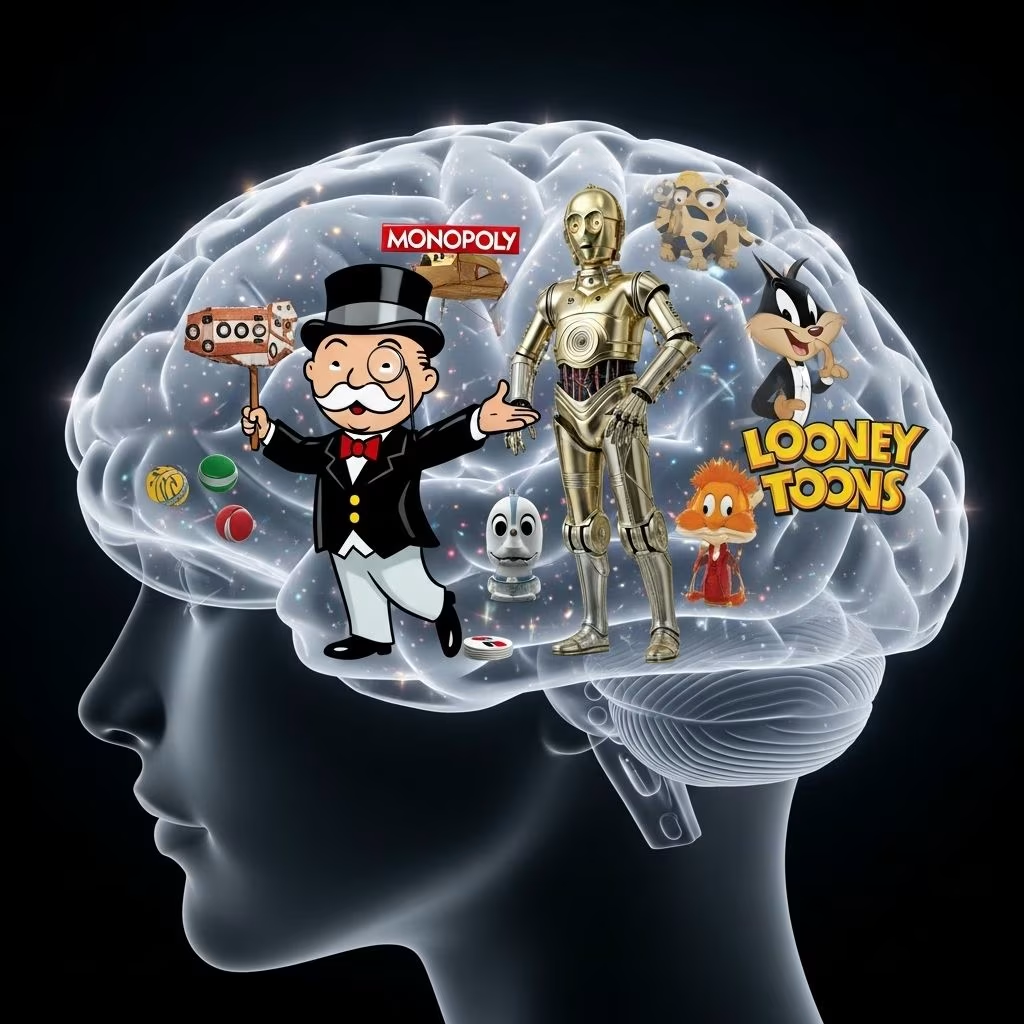
The visual Mandela Effect describes collective false memories that relate specifically to images, logos, or characters. A 2022 study by Wilma Bainbridge and Deepasri Prasad had participants draw well-known visuals—such as logos or cartoon characters—from memory. Many people made strikingly similar errors, such as adding a black stripe to Pikachu’s tail or a monocle to Mr. Monopoly, reflecting collective visual misconceptions.
In such experiments:
- Participants consistently mistook altered images for the original.
- Errors were repeated across individuals, indicating a shared bias.
- People expressed medium to high confidence in their mistaken memories.
What Causes the Mandela Effect?
Researchers and psychologists contend that the reasons behind the Mandela Effect are manifold. Among the most prominent scientific explanations:
- Confabulation: Unintentionally giving a false explanation of a memory. Confabulation involves unwittingly fabricating or distorting memories, sometimes associated with memory disorders, but it can also occur in healthy individuals.
- False Memories: Internal distortions where events may be wholly or partly misremembered. These can be influenced by suggestion, exposure to incorrect information, or simply the malleability of human memory.
- Priming: The process by which mentioning an object cues related ideas in memory. For example, hearing the word “garden” might make people visualize flowers even if none were present in a specific event.
- Personal Bias: Emotions and personal experience coloring how a memory is encoded or recalled, which can skew factual accuracy.
For some believers, *parallel universe theory* offers an imaginative explanation, positing that alternate realities might intersect with our own, leading to divergent memories. While not supported by scientific evidence, this theory remains popular in certain circles.
Popular Examples of the Mandela Effect
The Mandela Effect is most frequently observed in the realm of popular culture, cinematic quotes, literary passages, and brand logos. These examples highlight how groups may misremember the same details:
- Nelson Mandela’s prison death — Many recall him dying in the 1980s, though he lived until 2013.
- Movie quotes: Commonly misquoted film lines, such as “Luke, I am your father,” which is incorrect.
- Children’s book series: The Berenstain Bears—often wrongly remembered as the “Berenstein Bears.”
- Popular logos and icons: Altered images of Pikachu, Mr. Monopoly, and famous logos are frequently mistaken for the originals.
- Non-existent pop culture references: Instances where people insist on the existence of a song, phrase, or event that never occurred.
Why Do We Experience the Mandela Effect?
There is no single answer, but several cognitive and psychological factors play a role:
| Scientific Explanation | Description | Example |
|---|---|---|
| Confabulation | Unintentional fabrication of memories, sometimes influenced by suggestion or trauma. | Misremembering Mandela’s death due to repeated stories. |
| False Memory | Internal distortions, often based on exposure to incorrect information or repeated hearsay. | The “Berenstein” Bears spelling error. |
| Priming | Association of related concepts triggered by prompts. | Imagining a monocle on Mr. Monopoly after hearing about wealth. |
| Personal Bias | Emotional significance altering how an event is remembered. | Recalling details differently based on personal impact. |
| Social Contagion | Spread of false memory due to communal reinforcement or popular media. | Sharing wrong movie quotes online propagates error. |
The Mandela Effect and Popular Culture
The rapid spread of the Mandela Effect across social media and pop culture has made it a cultural phenomenon. Discussions on forums, articles, and media highlight new examples and explanations.
- The Mandela Effect Film (2019): The topic inspired a feature film illustrating the intersection of memory, perception, and reality.
- Internet Communities: Fiona Broome’s website and Reddit forums have become hubs for people to share Mandela Effect experiences and debate possible causes.
How Does the Mandela Effect Influence Psychology?
The Mandela Effect has prompted renewed research into the accuracy of human memory. Scientists now examine how groups can not only make identical errors in recall but also reinforce those errors through communal validation.
- Memory studies reveal systematic patterns in the way people collectively misremember details.
- False memories can be surprisingly consistent across diverse populations, suggesting underlying cognitive mechanisms.
- Real-world implications extend to eyewitness testimony, legal cases, and historical narratives.
Debates and Pseudoscientific Explanations
While most scientists attribute the Mandela Effect to cognitive errors, some theories—such as parallel universes and alternate timelines—have captured public imagination. Such explanations, though not scientifically substantiated, speak to the mysterious and unsettling effect of collective false memory.
- Parallel Universes: Suggests alternate realities overlap, leading people to recall events from another universe.
- Pseudoscientific Controversy: Intense debate exists over whether these explanations have merit; the scientific consensus remains skeptical.
Frequently Asked Questions (FAQ) About the Mandela Effect
Q: What is a real-world example of the Mandela Effect?
A: The belief that Nelson Mandela died in prison during the 1980s is widely cited. In reality, he was released in 1990 and died in 2013.
Q: How common are false memories?
A: False memories are extremely common. Studies show more than three-quarters of adults make detectable errors in recall.
Q: Does the Mandela Effect mean people are lying?
A: No. Most false memories are not deliberate lies but honest mistakes in how the brain encodes or retrieves information.
Q: Is there evidence for parallel universes causing the Mandela Effect?
A: No scientific evidence supports the parallel universe theory; most research points to cognitive and psychological mechanisms.
Q: Can the Mandela Effect impact important decisions?
A: Yes. Misremembered facts can influence social attitudes, legal decisions, and collective historical narratives.
Conclusion
The Mandela Effect sheds light on the imperfections of human memory—demonstrating that recollections can be powerful but frequently inaccurate. It reminds us that our brains are susceptible to distortion, suggestion, and communal reinforcement, inviting both scientific inquiry and cultural fascination.
- Understanding the Mandela Effect helps us appreciate the complexities of cognition and recall.
- Its popularity continues as people seek new examples and potential explanations.
- Above all, the Mandela Effect serves as a compelling case study in the fallibility and shared nature of human memory.
References
- https://www.allaboutvision.com/resources/human-interest/visual-mandela-effect/
- https://www.simplypsychology.org/what-is-the-mandela-effect.html
- https://www.britannica.com/science/Mandela-effect
- https://www.britannica.com/science/Why-Is-It-Called-the-Mandela-Effect
- https://www.youtube.com/shorts/dV2cR4_fwcI


