


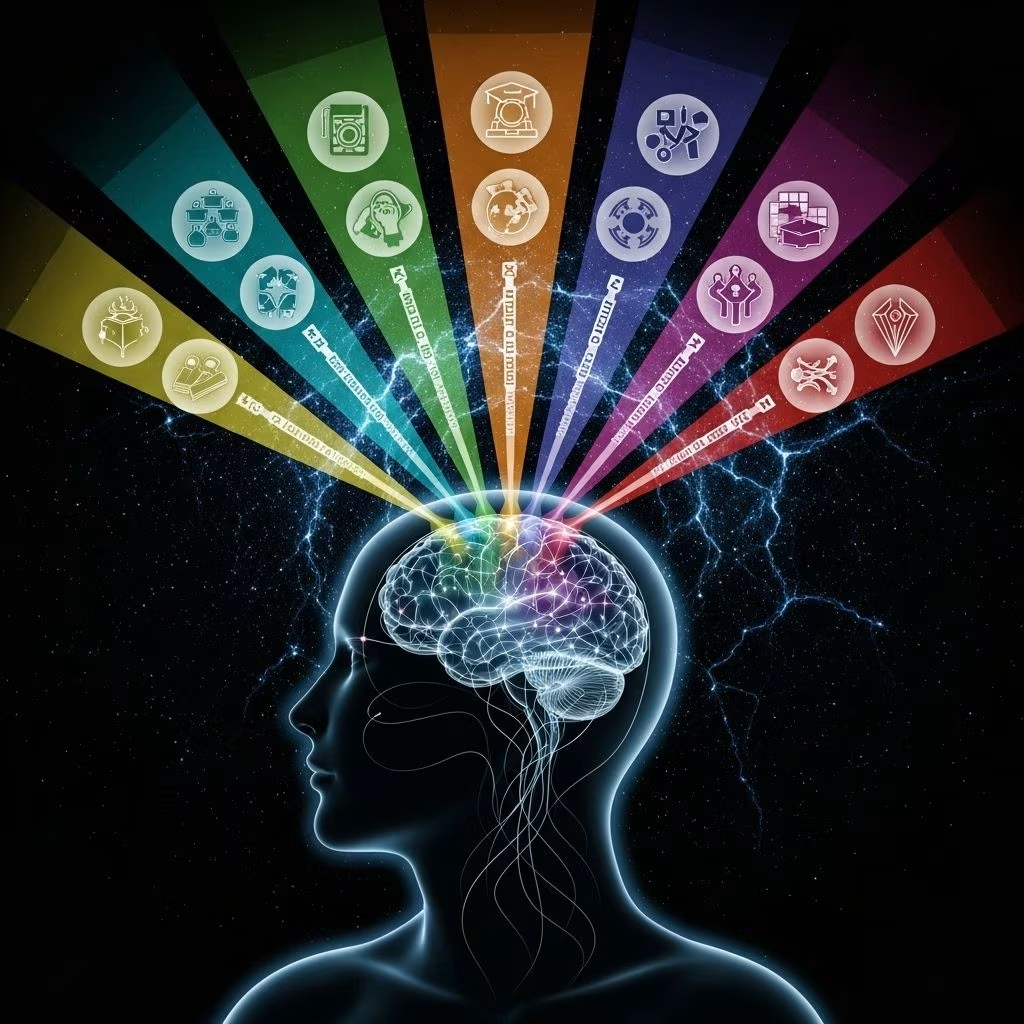
Gardner’s Theory of Multiple Intelligences: A New Perspective on Human Abilities
For much of the twentieth century, intelligence was often thought of as a single, measurable quality, usually captured by IQ tests. However, in 1983, developmental psychologist Howard Gardner revolutionized our understanding with his Theory of Multiple Intelligences, first presented in Frames of Mind. Gardner proposed that intelligence is not a monolithic trait, but a collection of distinct, biologically rooted capacities. This new paradigm reshaped educational approaches, challenged societal norms, and acknowledged the diversity of human potential.
Key Takeaways
- Intelligence is not unitary; it is comprised of multiple independent types.
- Gardner identified eight core intelligences, each with unique features, strengths, and real-world applications.
- The theory promotes personalized education and values talents often overlooked by conventional assessment.
What is the Theory of Multiple Intelligences?
Howard Gardner’s theory emerged as a response to the limited view of intelligence promoted by traditional IQ testing. Rather than measuring only linguistic and logical skills, Gardner argued that humans possess several independent ways to process information, solve problems, and create valued products. Each intelligence is seen as a relatively autonomous system in the brain, shaped by individual genetics, environment, and culture.
Gardner defines intelligence as a “biopsychological potential to process information that can be activated in a cultural setting to solve problems or create products that are of value in a culture.”
Historical Context and Motivation
Gardner’s theory was motivated by three main concerns:
- Traditional IQ tests captured only a narrow slice of human intellectual capacities.
- People show strengths in areas unrecognized by academic testing.
- There was a need to empower all learners by acknowledging diverse talents and learning styles.
Gardner’s Criteria for Identifying an Intelligence
Not every ability qualifies as an intelligence under Gardner’s rigorous standards. He established several scientific criteria to distinguish genuine intelligences from learned skills or talents.
| Criterion | Description |
|---|---|
| Isolation by Brain Damage | It should be possible for brain injury to selectively impair this intelligence. |
| Evolutionary History | Evidence that the intelligence existed early in evolution and aided human adaptation. |
| Identifiable Core Operations | There are basic information-processing components unique to the intelligence. |
| Symbol System | The intelligence can be symbolically expressed (e.g., language, numbers, music notation). |
| Developmental Progression | Skills in the intelligence emerge and develop predictably in children. |
| Existence of Prodigies/Savants | Exceptional performance in the intelligence is observed in prodigies or savants. |
| Support from Experimental Psychology | Validated by experimentally-based psychological research. |
| Psychometric Evidence | Ability to be (at least partially) measured through objective assessment. |
The Eight Intelligences Proposed by Gardner
Gardner originally identified seven core intelligences; later, he added an eighth (naturalistic) and suggested possible others. Let’s examine each established type, their characteristics, and implications.
1. Linguistic (Verbal) Intelligence
Linguistic intelligence is the capacity to use language effectively, in writing, speaking, or understanding. People with high linguistic intelligence excel at manipulating words, understanding semantics, syntax, and meanings.
- Enjoys reading and writing
- Can easily memorize information
- Thinks in words and notices subtle differences in language
- Excels in storytelling, debate, or explanation
Common professions: Writers, journalists, lawyers, teachers
2. Logical-Mathematical Intelligence
Logical-mathematical intelligence involves reasoning, quantifying, and recognizing abstract patterns. This intelligence is traditionally associated with mathematical talent and scientific thinking.
- Enjoys solving puzzles and logical problems
- Ability to reason, spot patterns, and manipulate numbers or equations
- Thinks conceptually and abstractly
- Tends to excel academically in math and science
Common professions: Scientists, engineers, accountants, computer programmers
3. Spatial Intelligence
Spatial intelligence is the ability to perceive, manipulate, and think in three-dimensional space. People strong in this intelligence visualize relationships and transform perceptions in their minds.
- Enjoys drawing, diagrams, and visual puzzles
- Understands maps, charts, and spatial layouts easily
- Mentally rotates objects and foresees changes in shape or space
- Has a good sense of direction
Common professions: Architects, artists, pilots, engineers
4. Bodily-Kinesthetic Intelligence
Bodily-kinesthetic intelligence is the skill in using one’s body to express ideas, feelings, or solve problems. It’s characteristic of athletes, dancers, surgeons, and craftspersons.
- Enjoys physical movement and hands-on activities
- Has good control over body movements and fine motor skills
- Learn best through doing, rather than observing
- Often successful in drama, sports, or manual tasks
Common professions: Athletes, actors, surgeons, builders
5. Musical Intelligence
Musical intelligence describes the sensitivity to melody, rhythm, tone, and musical patterns. People with this intelligence may easily discern pitch, timbre, and musical structure.
- Remembers and creates melodies easily
- Responds emotionally to music
- Can distinguish subtle differences in sounds
- May play several instruments or compose music
Common professions: Musicians, composers, conductors, sound engineers
6. Interpersonal Intelligence
Interpersonal intelligence refers to the skill of understanding and interacting with others. This intelligence enables empathy, reading social cues, and effective communication.
- Good at gauging people’s moods, motivations, and intentions
- Enjoys group work and social situations
- Effective at resolving conflicts and facilitating cooperation
- Often chosen as a leader or mediator
Common professions: Teachers, therapists, managers, politicians, counselors
7. Intrapersonal Intelligence
Intrapersonal intelligence is the capacity to understand oneself: one’s emotions, motives, beliefs, and desires. Those with high intrapersonal intelligence possess strong self-awareness and are often reflective.
- Enjoys introspection and independent work
- Ability to identify personal strengths and weaknesses
- Highly motivated to pursue personal goals
- Good at regulating emotions and personal decision-making
Common professions: Philosophers, psychologists, writers, theologians
8. Naturalistic Intelligence
Naturalistic intelligence is the ability to identify, categorize, and interact with elements of the natural world. People high in this intelligence recognize flora, fauna, weather patterns, and other features of the environment.
- Enjoys exploring nature and learning about plants and animals
- Quickly perceives patterns in the natural world
- Often attuned to climate or environmental changes
- May enjoy gardening, hiking, wildlife observation
Common professions: Biologists, farmers, botanists, environmentalists
Possible Additional Intelligences
Gardner speculated about other “candidate” intelligences, such as existential (concerned with life’s big questions) or moral intelligence, but felt they lacked sufficient evidence to include as core types.
How Gardner’s Theory Differs from Traditional IQ
Traditional intelligence tests (such as IQ tests) focus predominantly on linguistic and logical-mathematical skills, neglecting the variety of other human talents. Gardner’s model highlights strengths that are not typically measured, promoting a broader, more inclusive understanding of competence. As a result, people who may not flourish under standard academic or cognitive tests may demonstrate profound ability in other areas, such as art, music, sports, or social relations.
Applications and Implications of Multiple Intelligences Theory
Gardner’s theory has deeply influenced education, parenting, workplace practices, and self-understanding.
- Personalized Learning: Curricula can be adapted to engage students’ strongest intelligences, making learning more effective and enjoyable.
- Assessment Methods: Recognizes various forms of achievement, moving beyond standardized tests.
- Career Guidance: Encourages individuals to identify and pursue careers aligned with their intelligence profiles.
- Workplace Training: Teams benefit from diverse intelligences when tackling complex projects.
Classroom Strategies for Multiple Intelligences
- Incorporating music or rhythm to teach concepts (musical intelligence)
- Using role-play or physical activities to reinforce lessons (bodily-kinesthetic)
- Providing logical challenges and puzzles (logical-mathematical)
- Fostering group discussions and collaborations (interpersonal)
- Encouraging journaling and personal goal-setting (intrapersonal)
- Facilitating nature walks or environmental projects (naturalistic)
Criticisms and Limitations of Multiple Intelligences Theory
Despite its popularity and widespread application, the Multiple Intelligences Theory has not escaped critique:
- Lack of Empirical Support: Critics argue that there is insufficient empirical evidence and that the intelligences often overlap with talents or learning styles rather than discrete intellects.
- Measurement Issues: Objective assessment tools for most intelligences are lacking, making comparisons and standardized evaluation difficult.
- Misapplication: In some educational settings, the theory has been oversimplified or misused, such as labeling students exclusively by one intelligence.
Nevertheless, the theory continues to inspire more holistic, student-centered educational practices and greater appreciation of human diversity in ability.
Frequently Asked Questions (FAQs)
Q: What is the main idea behind Gardner’s Theory of Multiple Intelligences?
A: The core idea is that intelligence is not a single general ability, but rather a set of distinct modalities through which individuals process information and solve problems.
Q: How many intelligences are there according to Gardner?
A: Gardner initially identified seven intelligences, later adding an eighth (naturalistic). Other types, like existential intelligence, remain speculative.
Q: Can a person excel in more than one intelligence?
A: Yes. Every person has a unique profile with varying strengths across the eight intelligences. Most people excel in several areas.
Q: Is the theory scientifically proven?
A: While the theory is widely influential in education, it has drawn criticism for limited empirical validation and difficulties in measurement. However, it aligns well with observations of individual talent and learning variation.
Q: How can I discover my own intelligence strengths?
A: Reflecting on your interests, successes, and favorite learning activities can offer clues. Many online inventories and quizzes are inspired by Gardner’s model, though they are informal.
Conclusion
Howard Gardner’s Theory of Multiple Intelligences has transformed thinking about learning, talent, and educational practice. By embracing the diversity of human capacities, this approach encourages individuals, educators, and workplaces to recognize, nurture, and respect each person’s unique potential. Whether in the classroom, the boardroom, or everyday life, understanding the spectrum of intelligences can foster success, collaboration, and personal fulfillment.
References
- https://www.simplypsychology.org/multiple-intelligences.html
- https://www.growthengineering.co.uk/multiple-intelligences/
- https://slidemodel.com/gardners-theory-8-multiple-intelligences/
- https://mybrightwheel.com/blog/gardners-theory-of-multiple-intelligences
- https://www.youtube.com/watch?v=rOoyRYkhabY
- https://www.niu.edu/citl/resources/guides/instructional-guide/gardners-theory-of-multiple-intelligences.shtml
- https://www.learningeverest.com/howard-gardners-multiple-intelligences-theory/
- https://www.uthsc.edu/tlc/intelligence-theory.php


