


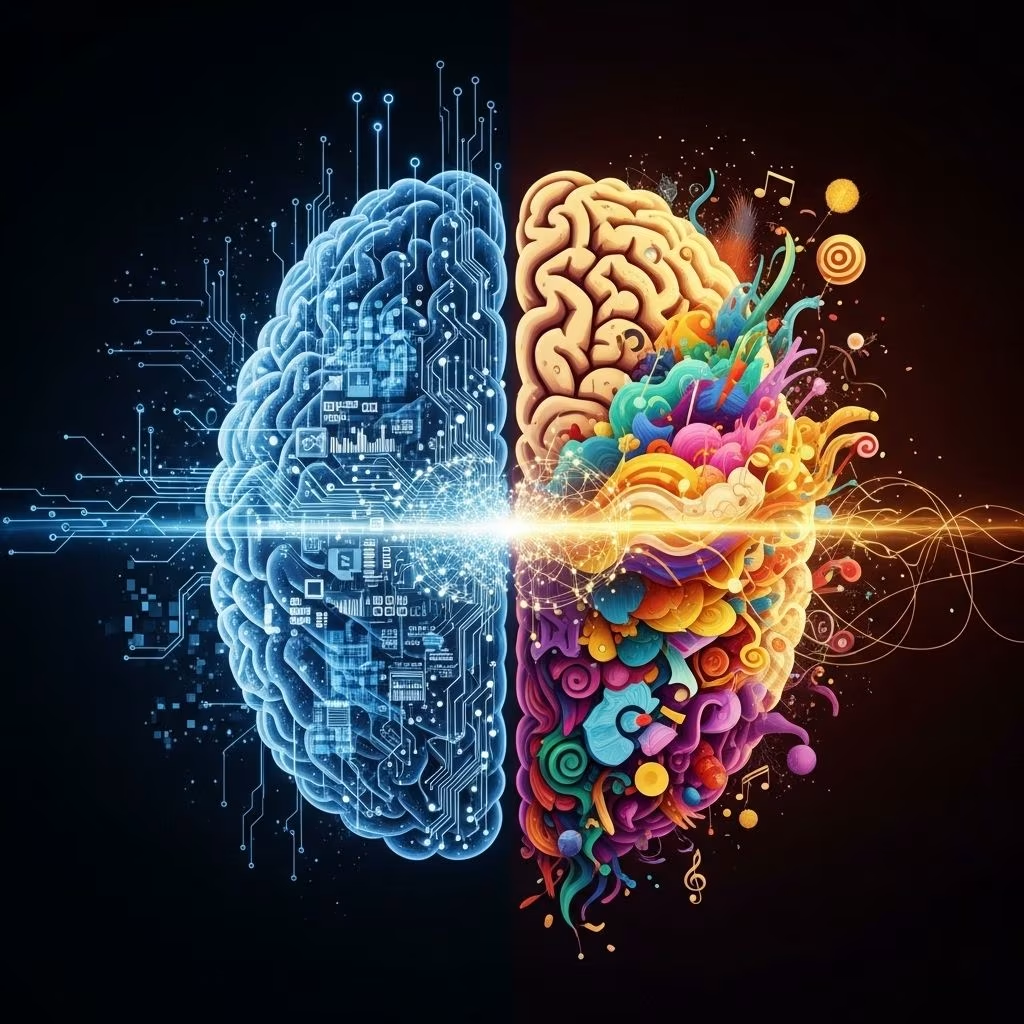
The idea that people can be strictly classified as “left-brained” (logical, analytical) or “right-brained” (creative, intuitive) has gained massive popularity in education, pop psychology, and self-help. But how much truth is there to the idea that one hemisphere of the brain shapes who we are or how we think? This article investigates the history, scientific evidence, real differences between brain hemispheres, and common myths associated with left-brain vs. right-brain theory.
What Is Left Brain vs. Right Brain Theory?
The left brain vs. right brain theory suggests that individuals have a dominant hemisphere that dictates their personality, learning style, and strengths. According to this theory, the left hemisphere governs analytic, logical, and language-based tasks, while the right hemisphere controls creativity, intuition, and visualization. This concept traces back to research by Nobel Prize winner Roger W. Sperry in the 1960s, whose studies on split-brain patients revealed some intriguing differences in how the brain’s hemispheres process information.
In popular culture, this theory has been interpreted—often oversimplified—as a clear split in both ability and personality:
| Left Brain | Right Brain |
|---|---|
| Logical reasoning | Creativity |
| Analytical thought | Imagination |
| Language processing | Visual-spatial skills |
| Mathematics | Art & music |
| Sequencing | Holistic or “big picture” thinking |
| Facts & logic | Intuition & nonverbal cues |
History of the Theory: Roger W. Sperry and Split-Brain Research
The origins of the left- and right-brain theory lie in Roger W. Sperry‘s experiments with split-brain patients. These were individuals who had their corpus callosum—the thick bundle of nerves connecting the hemispheres—severed, usually to reduce severe epileptic seizures. Sperry’s Nobel-winning research in the 1960s and 1970s revealed some hemispheric specialization: tasks like language production often resided in the left hemisphere, while certain visual and spatial functions concentrated in the right.
Sperry’s work showed that when disconnected, each hemisphere could process information differently and often nonverbally. For example:
- Left hemisphere: Specialized in verbal tasks—such as speaking, reading, and writing.
- Right hemisphere: Could process images, spatial relationships, and interpret emotional cues—but had limited capacity for language.
However, Sperry’s research never suggested that people use only one hemisphere, nor that the entire range of personality or cognitive ability is determined by hemispheric dominance.
Core Functions: How the Hemispheres Work
The human brain is divided into two hemispheres, each connected by the corpus callosum—a vast bundle of nerve fibers allowing constant communication. While certain functions may be lateralized (specialized in one hemisphere), most everyday activities require both sides to work in tandem.
Left Hemisphere
The left hemisphere is often associated with:
- Language: Processing words, grammar, and analytical aspects of communication.
- Logic and reasoning: Engaging in sequencing, mathematical calculations, categorical thought.
- Order and Detail: Structured, detail-focused work such as factual recall and step-by-step problem-solving.
- Scientific and mathematical thinking: Using numbers, formulas, and objective analysis.
- Control of right side of body: Movements and sensations on the right side are managed by the left hemisphere.
Right Hemisphere
In contrast, the right hemisphere primarily governs:
- Creativity: Appreciation and production of art, music, and creative thought processes.
- Holistic thinking: Seeing the “big picture,” understanding context and nonverbal cues.
- Visuospatial skills: Recognizing faces, interpreting maps or images, processing spatial relationships.
- Emotional processing: Understanding tone, emotional context, and metaphors.
- Control of left side of body: Movements and sensations on the left side of the body.
Debunking the Myth: What the Science Really Says
For decades, the notion of left- or right-brain dominance has been a mainstay in education, personality coaching, and everyday conversation. However, extensive modern neuroscience evidence shows that this concept is an oversimplification—if not a complete myth.
- Brain activity is holistic: Neuroimaging studies demonstrate that both hemispheres are almost always involved in complex cognitive processes. Whether solving math problems, composing music, or reading a novel, both sides share workloads.
- No evidence for dominance: Research consistently finds that while specific tasks (e.g., language, visuospatial processing) may show lateralization, no one uses only one side of their brain, nor is personality reliably predicted by hemispheric usage.
- Skills require both hemispheres: Tasks attributed to the “right brain” (creativity, artistic ability) and “left brain” (logic, language) are complex and involve networks that spread across both halves.
Summary: The left-brain/right-brain dichotomy is based on outdated research and exaggerated interpretations. People do not neatly divide into “right-brained” or “left-brained” types.
How the Hemispheres Communicate: The Role of the Corpus Callosum
The two hemispheres communicate via the corpus callosum, containing over 200 million nerve fibers. This structure ensures that each side is constantly sharing information, making it possible to integrate various types of data. When one hemisphere is damaged, the other can sometimes compensate—showing the brain’s remarkable adaptability.
Lateralization of Function: Real Differences Between Hemispheres
Though complete hemispheric dominance is a myth, lateralization—where some functions are located more in one hemisphere than another—is real. Examples include:
- Language: In most right-handed people, the left hemisphere houses the Broca’s area (speech production) and Wernicke’s area (language comprehension). However, left-handed individuals may have these functions located in either hemisphere, or distributed symmetrically.
- Emotion: The right hemisphere often takes a primary role in processing emotional content, facial expressions, and nonverbal cues.
- Spatial Awareness: Right hemisphere damage can significantly impair a person’s navigational or spatial abilities (a condition known as spatial neglect).
Key Point: While specific brain functions may be lateralized, efficient cognition requires both hemispheres working together in real time.
Popular Traits Attributed to Each Hemisphere
| Left Brain Traits | Right Brain Traits |
|---|---|
| Logical thinking | Imagination |
| Sequencing | Holistic thinking |
| Facts and analysis | Intuitive reasoning |
| Language & words | Visualizations |
| Mathematics | Art and rhythm |
| Strategy | Nonverbal cues detection |
| Scientific reasoning | Daydreaming |
Why the Left-Brain/Right-Brain Myth Persists
Despite scientific evidence to the contrary, the public continues to embrace the idea of “left-brained” and “right-brained” people. Why?
- Simplicity and appeal: The theory provides a simple and attractive explanation for individual differences.
- Self-identification: People like to categorize themselves and others, making learning styles and personality types easier to understand.
- Influence in education and pop culture: The myth has been widely taught in classrooms and referenced in media, often appearing in self-help and management advice.
However, embracing this myth risks overlooking individual strengths and the complexity of brain-based learning processes.
The Brain’s Anatomy: How the Hemispheres Structure Function
Each hemisphere is nearly a mirror image in its major anatomical regions but specializes in different ways.
- Occipital lobes: Process visual information from the opposite visual fields (right lobe sees left field from both eyes, and vice versa).
- Frontal lobes: Critical for decision-making, voluntary movements, and language production (Broca’s area).
- Temporal lobes: Integrate sounds and auditory information; also process language and memory.
- Parietal lobes (sensory/motor strips): Control touch, sensation, and voluntary motion on the body’s opposite side.
Handedness, Brain Structure, and Individual Differences
Recent research reveals some variation in brain function tied to a person’s dominant hand and brain anatomy:
- Left-handedness: Left-handed people are statistically more likely to have language centers on the right side or symmetrically distributed between hemispheres.
- Gray matter differences: Structural differences (like more right-hemisphere gray matter in left-handers) suggest some functional differences, but these do not indicate dominant personalities or strengths.
This diversity underlines that while lateralization of function is real, the whole-brain perspective best explains how we actually think and learn.
FAQs: Left Brain vs. Right Brain
Q: Am I either left-brained or right-brained?
A: Research shows that people do not have a dominant “left” or “right” brain. Both hemispheres integrate for almost all mental tasks.
Q: Are there real functional differences between the hemispheres?
A: Yes, some functions like language or spatial visualization are often lateralized, but both hemispheres are needed for most cognitive activities.
Q: What happens if one hemisphere is damaged?
A: The other hemisphere can sometimes compensate due to neuroplasticity, although some specific abilities may be impaired depending on the area affected.
Q: Is creativity or logic exclusive to the right or left brain?
A: No, creative and logical tasks activate networks in both hemispheres—the brain works as a whole.
Q: Why does the myth persist?
A: Its simplicity and appeal have led to widespread cultural adoption, even though science has demonstrated its inaccuracy.
Conclusion: Understanding Your Whole Brain
The left brain vs. right brain theory is compelling, but scientific research demonstrates that our capabilities aren’t constrained by one hemisphere or the other. Instead, the cooperation and communication between both sides define the flexibility and power of the human brain. Appreciating this complexity helps us move beyond stereotypes, embrace our brain’s full potential, and foster richer educational and personal growth strategies.
References
- https://www.medparkhospital.com/en-US/lifestyles/are-you-a-left-brain-or-right-brain-thinker
- https://www.medicalnewstoday.com/articles/321037
- https://www.healthline.com/health/left-brain-vs-right-brain
- https://health.clevelandclinic.org/left-brain-vs-right-brain
- https://www.health.harvard.edu/blog/right-brainleft-brain-right-2017082512222
- https://dana.org/resources/right-brain-left-brain-a-misnomer/
- https://www.youtube.com/watch?v=ZMSbDwpIyF4


