


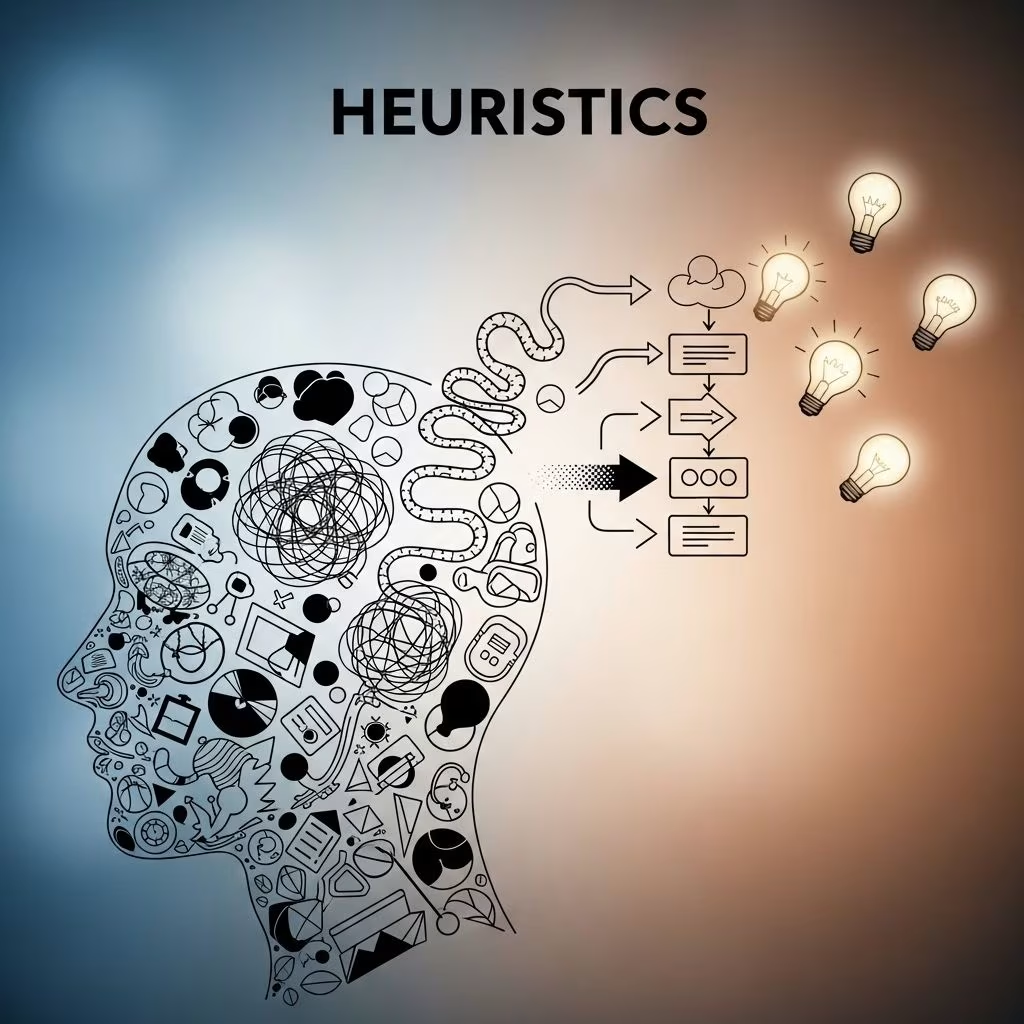
Every day, we make countless decisions, from minor choices like what to eat for breakfast to significant life-changing ones such as choosing a career. While some decisions are made logically and deliberately, most are the result of rapid, intuitive judgments. These quick decisions often rely on heuristics—mental shortcuts that allow us to process information efficiently and effectively, even when faced with complex or ambiguous situations. But what are heuristics, why do we use them, and how do they both help and hinder us?
What Is a Heuristic?
A heuristic is a simple, efficient rule or mental shortcut that people use to form judgments and make decisions quickly, often when time is short, information is incomplete, or the situation is complex . Rather than systematically analyzing every piece of data, humans rely on these cognitive strategies to reach conclusions that are “good enough” for most purposes. While heuristics save time and ease cognitive effort, they can sometimes lead us astray and produce biases or errors .
Heuristics vs. Algorithms
| Feature | Heuristic | Algorithm |
|---|---|---|
| Approach | Intuitive, rule-of-thumb, shortcut | Step-by-step, systematic procedure |
| Speed | Very fast, relies on minimal data | Slower, thorough and exhaustive |
| Accuracy | “Good enough” solution, not always optimal | Optimal and correct solution (when procedure is known) |
| Effort | Low cognitive load | High cognitive load |
| Example | Guessing the route with less traffic based on recent memory | Using GPS data to calculate the exact shortest path |
Why Do We Use Heuristics?
Heuristics are an essential part of human cognition. Since our brains have limited processing ability and we often must act quickly, heuristics help us to:
- Streamline decision-making: They reduce the mental effort needed for complex judgments .
- Manage information overload: Rather than analyzing every option or piece of data, heuristics help filter out what’s less important.
- Enable rapid responses: In situations requiring swift action—like avoiding danger—heuristics can be life-saving.
- Conserve mental energy: They free up cognitive resources for other tasks.
However, this efficiency comes at a cost—relying on heuristics can sometimes cause us to make systematic mistakes, known as cognitive biases .
Types of Heuristics
Several common types of heuristics have been identified in psychological research. Among the most studied and influential are:
1. Availability Heuristic
The availability heuristic is a mental shortcut where people estimate the frequency or likelihood of an event based on how easily examples come to mind . If something can be recalled quickly or is vivid in memory, we tend to believe it is more common or likely.
- For instance, after hearing recent news about airplane crashes, people may overestimate the risks associated with flying .
- Similarly, if you have experienced an earthquake or seen disaster footage, you might believe that earthquakes happen more often than they really do .
Key Point: The more “available” an example is in your memory, the more likely you are to overestimate its real-world frequency or significance.
2. Representativeness Heuristic
The representativeness heuristic involves judging the probability of an event by how much it resembles a prototype or stereotype, rather than using actual statistical reasoning .
- Suppose someone is described as quiet and loves books. Using this heuristic, you might assume they are a librarian rather than a salesperson, even though salespeople are more common .
- This effect underlies many social stereotypes, as people jump to conclusions based on superficial similarities rather than base rates or factual data.
- It also affects behaviors; patients may believe that only “representative” symptoms are serious, or take medications in a way that matches their expectations rather than instructions .
3. Anchoring and Adjustment Heuristic
The anchoring heuristic occurs when individuals rely too much on the first piece of information (the “anchor”) when making decisions . Once an anchor is set, all subsequent judgments are made in reference to this anchor, even if it is arbitrary or irrelevant.
- For example, if the first price you see for a pair of shoes is $200, you will perceive a $150 price as a good deal—even if the true value is much lower .
- In healthcare, patients presented with a high frequency of injections as an anchor are more open to a lower frequency when offered .
- The anchor shapes how all further information is judged, even when more accurate data becomes available.
How Heuristics Influence Decision-Making
Heuristics play a crucial role in a wide range of decision-making contexts:
- Consumer decisions: Influences which products people consider a “good value” based on first impressions or recent experiences.
- Risk assessment: Dictates which dangers are taken seriously, often resulting in overestimation of rare but dramatic risks (e.g., shark attacks) and underestimation of everyday risks (e.g., car accidents) .
- Medical adherence: Patients who have recently experienced symptoms or received positive feedback about a treatment are more likely to comply, showing the effect of salience in the availability heuristic .
- Stereotyping: Quick judgments about people are shaped more by representativeness than by statistical reality .
Heuristics: Benefits and Risks
| Benefits | Risks |
|---|---|
|
|
Heuristics in Everyday Life: Practical Applications
Understanding heuristics can empower us to improve decision quality, recognize potential errors, and navigate daily life more effectively. Some practical applications and strategies include:
- Identify scenarios where you use heuristics: Notice when you make snap decisions or rely on gut feelings.
- Reflect on past experiences: Consider whether past outcomes influenced your perception of risk or choice.
- Beware of information overload: Use heuristics to filter information, but supplement with careful evaluation when stakes are high.
- Check for biases: Watch for overconfidence, anchoring to irrelevant numbers, or generalized stereotypes.
- Embrace creativity in problem-solving: Heuristics can help generate rapid solutions in brainstorming or innovation contexts.
Famous Experiments and Studies
- Kahneman and Tversky’s Pioneering Work: Psychologists Daniel Kahneman and Amos Tversky conducted foundational research on heuristics and cognitive biases, illustrating how people use simple rules in complex situations—and how this can systematically deviate from logic or probability .
- Word Frequency Judgments: In a classic study, people were asked whether there are more words in English that start with the letter “R” or have “R” as the third letter. Most guessed the former, since words starting with “R” are easier to generate—but the correct answer is the latter. The study highlighted the availability heuristic .
- Anchoring in Negotiation: Research shows that in bargaining and pricing, the first figure mentioned (anchor) dramatically influences the outcome, regardless of its relevance .
Heuristics and Cognitive Biases
While heuristics are useful, they are closely tied to cognitive biases—systematic patterns of deviation from rationality that can lead to errors in judgment .
- Confirmation Bias: Tendency to notice and remember information that justifies pre-existing beliefs.
- Overconfidence Effect: Belief that our judgments or abilities are more accurate than they actually are.
- Framing Effect: Influenced by how information or choices are presented rather than their actual substance.
Many biases can be traced to our reliance on heuristics, illustrating the trade-off between speed and accuracy in human cognition.
Improving Decisions: Using Heuristics Wisely
Since heuristics are unavoidable, it helps to be aware of when and how they are active. Here are strategies to harness their benefits and minimize errors:
- Slow down for major decisions: When stakes are high, take time to gather more complete information and scrutinize your initial impressions.
- Ask for external perspectives: Others may notice blind spots caused by your own heuristics.
- Challenge stereotypes and assumptions: Examine whether judgments are actually supported by facts, not just resemblance or availability.
- Use checklists for complex problems: Supplement intuition with structured approaches in technical or professional contexts.
Frequently Asked Questions About Heuristics
- Q: What exactly is a heuristic?
- A heuristic is a mental shortcut or “rule of thumb” that helps people make decisions or solve problems quickly, often without needing to analyze all available information .
- Q: How are heuristics different from algorithms?
- Algorithms are systematic, step-by-step procedures that guarantee a correct answer if followed properly. Heuristics are faster and require less information, but they do not guarantee a correct solution .
- Q: Can heuristics lead to bad decisions?
- Yes. While heuristics are essential for quick judgment, they can lead to cognitive biases, errors in probability, and overgeneralizations .
- Q: Are there ways to avoid bad outcomes from heuristics?
- You can reduce errors by slowing down for important decisions, seeking diverse input, and being mindful of potential biases and anchors affecting your judgment .
- Q: Why are heuristics important for survival?
- Heuristics allow humans to make split-second decisions necessary in dangerous or rapidly changing environments, increasing our chances of reacting effectively.
Summary Table: Major Heuristics
| Heuristic | Definition | Example |
|---|---|---|
| Availability | Judging frequency or likelihood based on how easily instances come to mind. | Believing fatalities from shark attacks are common due to recent news coverage. |
| Representativeness | Estimating probability by comparing to a prototype or stereotype. | Assuming someone who is quiet and studious is likely a librarian. |
| Anchoring | Relying too heavily on an initial piece of information when making decisions. | Perceiving a product as a good deal because it’s “marked down” from a higher price. |
Conclusion
Heuristics are an inescapable and invaluable part of thinking and everyday life. They equip us with mental tools to simplify choices, respond to challenges, and operate with limited information. Yet, they carry the risk of predictable errors and cognitive traps. Cultivating awareness of how heuristics function, their advantages, and their limitations can help us make better decisions, both quickly and wisely.
References
- https://www.britannica.com/topic/heuristic-reasoning
- https://acarepro.abbott.com/articles/central-nervous-system/heuristics-and-decision-making-what-are-the-effects-on-adherence-for-patients-with-neurological-disorders/
- https://focuskeeper.co/glossary/what-is-heuristics
- https://drpress.org/ojs/index.php/HBEM/article/view/2548
- https://www.cliffsnotes.com/study-notes/27360647
- https://cognitioncommerce.ca/2023/08/07/2061/


