


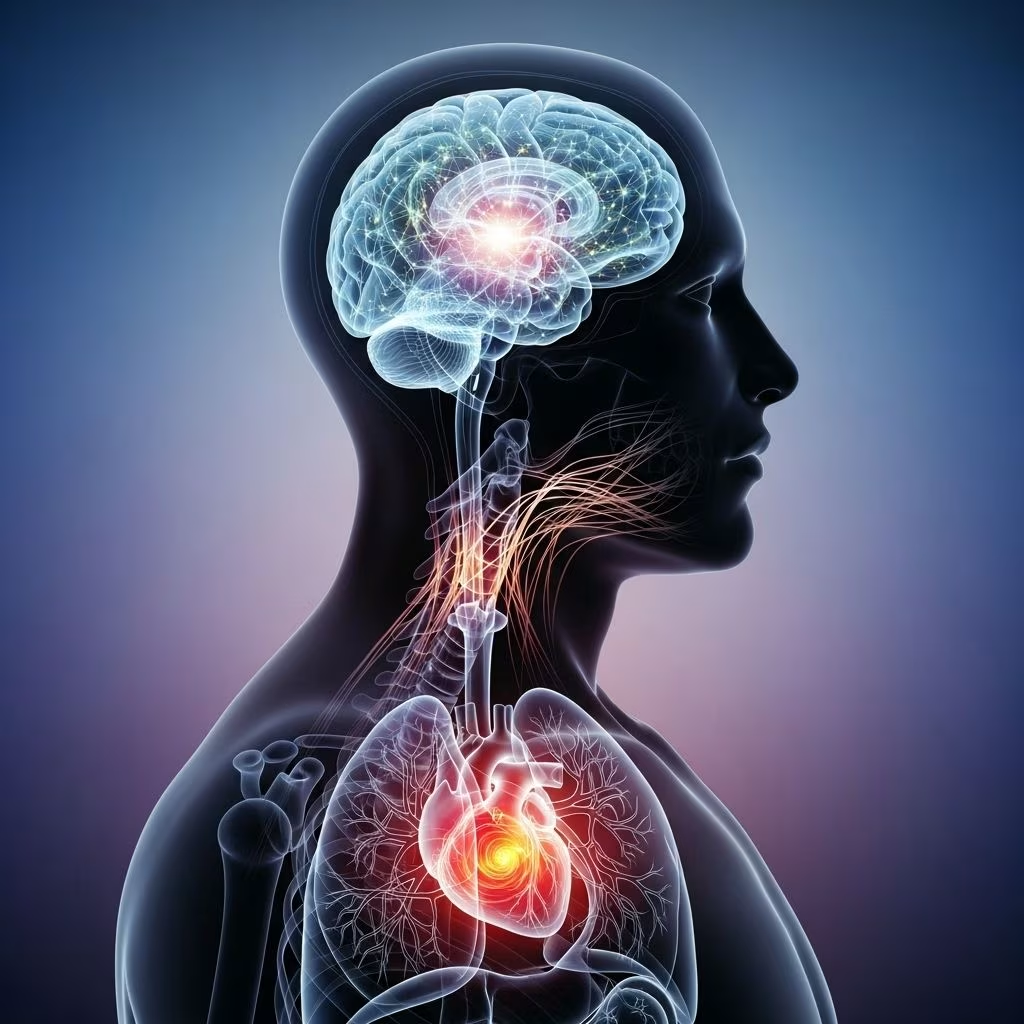
The question of what emotions are, and how they arise, has intrigued philosophers and scientists for centuries. One of the most significant early psychological theories in this area is the James-Lange theory of emotion. Developed independently in the late 19th century by American psychologist William James and Danish physiologist Carl Lange, this theory sparked a new wave of debate in the field by challenging existing assumptions and laying the groundwork for future emotion research.
What Is the James-Lange Theory of Emotion?
The James-Lange theory suggests that emotions are experienced as a result of physiological reactions to events or stimuli in the external environment. Put simply: we do not cry because we are sad or tremble because we are afraid. Instead, the theory posits that we feel sad because we cry, or afraid because we tremble. Our emotional experiences are, in this view, the conscious interpretation of physical sensations in the body.
- An event or stimulus occurs (e.g., seeing a snake on the trail).
- This triggers an automatic physiological reaction (e.g., increased heart rate, sweating).
- We experience an emotion as we become aware of these bodily changes (e.g., recognizing our heart racing leads to the feeling of fear).
This sequence departs from what most people intuitively believe. Rather than experiencing fear and then reacting (trembling, running away), the James-Lange theory argues that our body’s response comes first, and then our mind interprets these changes as emotion.
The Origins and History of the Theory
Before James and Lange’s work, conventional wisdom held that emotion was a mental state that prompted a bodily reaction—emotional response followed subjective feeling. James and Lange flipped this notion on its head by suggesting the opposite order. Their work built on discoveries about the nervous system and bodily feedback, proposing that without physiological responses, emotional experiences would be “colorless,” bereft of affective intensity.
James presented his ideas in his seminal book, The Principles of Psychology, in 1890. Carl Lange proposed similar concepts around the same time, giving physiological arousal a central role as the root of emotion. Over time, their combined perspectives became known as the James-Lange theory, which remains a touchstone in psychological science to this day, even as newer theories have built upon or challenged it.
How the James-Lange Theory Works: A Step-by-Step Breakdown
- Perception of the Stimulus: An event is encountered—such as meeting a growling dog on a walk.
- Physiological Arousal: The encounter causes automatic bodily changes—heartbeat increases, muscles tense, breathing quickens.
- Conscious Interpretation: The mind becomes aware of these bodily changes; it is at this point that emotion is recognized (consciously feeling fear, in this example).
In summary: Event → Physiological Reaction → Emotional Experience.
This theory is grounded in the belief that each emotion is associated with a unique pattern of physiological arousal—different bodily responses for fear, anger, joy, and so on. The feeling of emotion, in James’ famous phrasing, is the feeling of physiological changes that occur in the body.
Everyday Examples of the James-Lange Theory
To better understand how this theory works, consider these common scenarios:
- Encountering a Dangerous Animal: You see a barking dog rush toward you. Your body tenses, your heart races, you may begin to sweat. According to James-Lange, you notice these changes, and then feel fear as a result.
- Public Speaking: You’re about to give a presentation. Your palms become sweaty, your stomach churns, and your voice might shake. You become aware of these sensations, and this awareness is the experience of nervousness.
- Crying at a Sad Movie: Tears begin to flow as you watch an emotional scene. According to the theory, the act of crying itself informs you that you are sad, rather than the sadness triggering the tears.
This perspective often feels counterintuitive, but it has inspired decades of research on the interplay between body and emotion.
Comparison: James-Lange Theory vs. Common Sense Theory
| Theory | Order of Events | Core Claim |
|---|---|---|
| Common Sense | Event → Emotion → Physiological Response | Feeling causes bodily reaction (e.g., we cry because we’re sad) |
| James-Lange | Event → Physiological Response → Emotion | Bodily reaction causes feeling (e.g., we’re sad because we cry) |
The Science Behind the Theory
At the heart of the theory is the belief that specific bodily responses (such as changes in heart rate, breathing, and muscle tension) are directly tied to the emotional label we assign to them. The theory originated as a response to the idea that emotions are “felt” independently of what’s happening in the body, suggesting instead that physiological feedback is crucial.
Later research, including studies by Laird and Lacasse (2014), has supported the concept that bodily feedback and situational context both help shape emotions, providing some empirical endorsement for aspects of the James-Lange framework. However, most psychologists now acknowledge that emotions are the result of both physical changes and cognitive appraisal of events and context.
Strengths of the James-Lange Theory
- Groundbreaking Shift: It challenged prevailing ideas, sparking substantial research into the role of bodily feedback in emotional experience.
- Integration of Physiology: Highlighted the importance of physiological reactions in the formation of emotions, paving the way for new fields like affective neuroscience.
- Insight into Emotion Recognition: Helped explain why paying attention to bodily states can influence emotional awareness.
Criticisms and Limitations
Despite its revolutionary impact, the James-Lange theory has received significant criticism over the years, both from contemporaries and modern psychologists. Some of the most prominent critiques include:
- Lack of Distinct Physiological Patterns: Not all emotions are marked by unique bodily responses. Many physiological changes (like increased heart rate) can occur with different emotions (e.g., anger, fear, excitement), making it hard to pinpoint which emotion is being felt on bodily changes alone.
- Timing Issues: Physiological responses often occur too slowly to account for how quickly we experience emotions, or conversely, bodily changes might follow the emotional feeling in some contexts.
- Neurological Evidence: Cannon-Bard theory, introduced in the 1920s, argued that emotions and physiological reactions occur simultaneously and independently, casting doubt on the strict sequential model proposed by James-Lange.
- Role of Cognition: Modern research emphasizes cognitive appraisal (how we think about and interpret events) as a crucial component in emotional experience, something not addressed by the James-Lange theory.
- Environmental Context: Some scholars argue that emotions are as much about the environment and social interaction as about internal bodily states.
Modern Perspectives and Legacy
Despite its limitations, the James-Lange theory has had an enduring influence. It opened up new ways of thinking about the mind-body connection, shaping later theories of emotion and inspiring experiments on how physiology, cognition, and context interact.
- Contemporary Theories: Most modern theories recognize that emotion involves the interplay of bodily reactions, conscious interpretation, and situational context. Theories such as the Schachter-Singer (two-factor) theory and constructivist approaches integrate physiological arousal with cognitive appraisal, creating more holistic models.
- Support in Current Research: While few accept a strict James-Lange model, recent neuroscientific findings confirm that bodily feedback (like facial expressions or heart rate) can indeed influence felt emotion.
Key Figures: William James and Carl Lange
William James (1842–1910) was an American philosopher and psychologist, often referred to as one of the founding figures of modern psychology. His groundbreaking work in emotion and consciousness shaped the way subsequent generations of psychologists thought about mental processes.
Carl Lange (1834–1900), a Danish physiologist, emphasized the role of bodily changes, particularly in the vasomotor system (which controls blood vessel dilation), in producing emotions. While James and Lange developed their ideas independently, their theories shared a focus on the primacy of physical reactions.
James-Lange Theory in Everyday Life and Research
Whether or not you agree with the James-Lange theory in its entirety, it has real-world implications for how people understand and manage emotions. Practices like mindfulness, which encourage individuals to pay close attention to bodily sensations, draw upon the theory’s insight that our awareness of physical states can inform our emotional experience.
- Applications:
- Biofeedback therapies use physiological data to teach clients self-regulation, emphasizing awareness of bodily states.
- Mindfulness meditation encourages people to notice bodily sensations as part of emotional awareness.
- Research into embodied emotion shows how facial and bodily movements feed back to shape emotions (e.g., the “facial feedback hypothesis”).
Frequently Asked Questions (FAQs)
What is the James-Lange theory of emotion in simple terms?
The James-Lange theory says that emotions happen because of physical changes in your body. If you encounter a scary situation, your heart might race—according to the theory, you feel fear because you notice your heart beating faster.
How does it differ from other emotion theories?
It differs by suggesting bodily reactions come first, and emotional experiences follow. Other theories (like the Cannon-Bard theory) propose that feeling and body changes occur at the same time or that feelings originate mentally before a physical response.
Can emotions exist without physiological changes?
The James-Lange theory contends that without bodily responses, emotional experiences would lack intensity and feel “colorless.” However, critics argue that emotions can sometimes be experienced even if the body does not register marked changes.
Is the James-Lange theory still accepted today?
Most psychologists agree that bodily feedback is important for emotion, but the theory in its original form is considered too simplistic. Modern theories integrate physiological, cognitive, and contextual factors for a fuller explanation of emotional life.
What are examples of the James-Lange theory in practice?
Situations like feeling happiness after smiling, or sensing fear when noticing your own trembling hands, are real-world instances that echo the theory’s principles.
Takeaway: James-Lange Theory’s Lasting Impact
The James-Lange theory challenged prevailing views about the mind-body relationship. While research has highlighted its shortcomings and inspired modern, multifaceted theories of emotion, the idea that body and mind are closely linked in the experience of feeling continues to shape our understanding of emotion and therapy. The legacy of James and Lange lives on in ongoing research exploring just how much of what we feel begins in the body itself.
References
- https://en.wikipedia.org/wiki/James%E2%80%93Lange_theory
- https://www.simplypsychology.org/what-is-the-james-lange-theory-of-emotion.html
- https://opentextbc.ca/psychologymtdi/chapter/theories-of-emotions/
- https://emotion.wisc.edu/wp-content/uploads/sites/1353/2021/08/Cannon_1927AmJPsych.pdf
- https://psu.pb.unizin.org/psych425/chapter/james-lange-theory/
- https://pmc.ncbi.nlm.nih.gov/articles/PMC3431612/
- https://www.youtube.com/watch?v=l3UQdq5O_H4
- https://media.lanecc.edu/users/kime/Psy202EandME.pdf


