


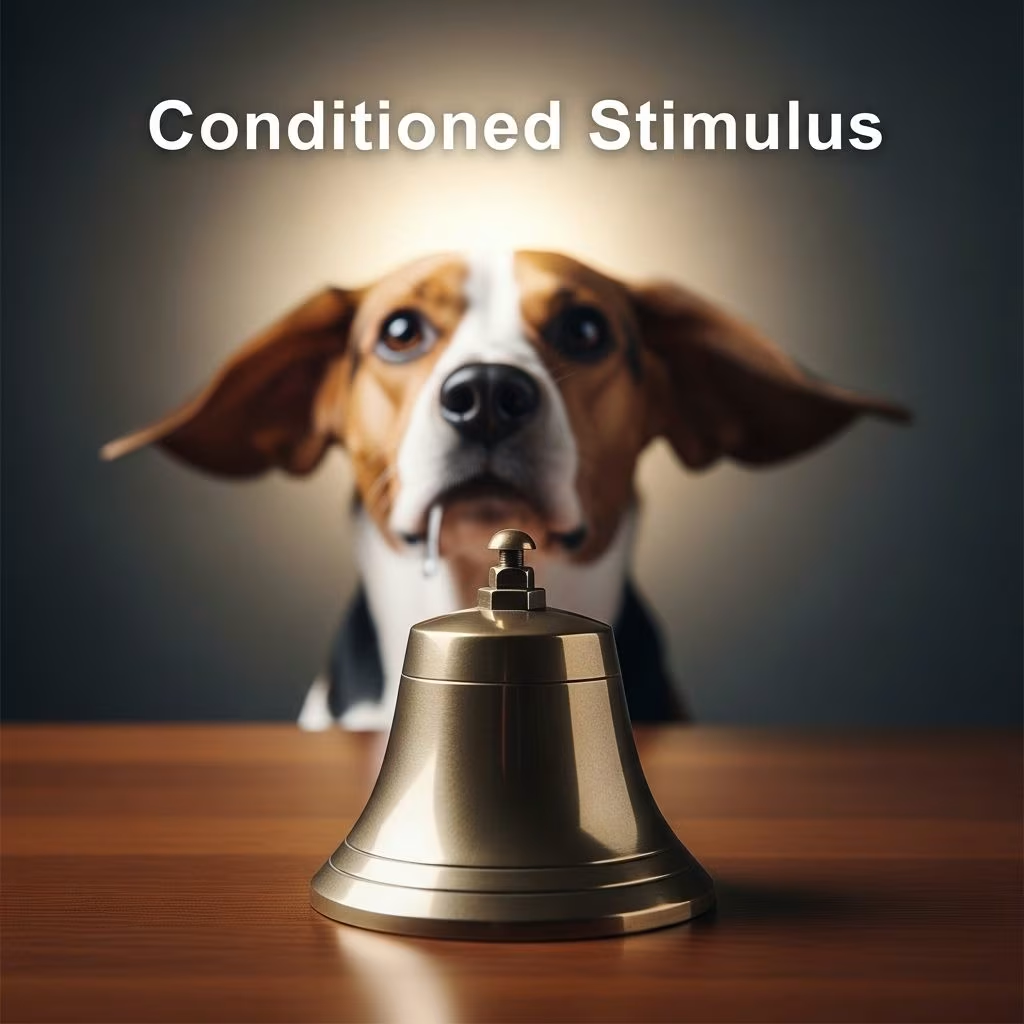
What Is a Conditioned Stimulus?
A conditioned stimulus (CS) is a previously neutral stimulus that acquires the ability to elicit a learned response after being repeatedly paired with an unconditioned stimulus (US). This transformation is a central concept in classical conditioning, a major theory in behavioral psychology first introduced by Ivan Pavlov.
Before conditioning, the neutral stimulus produces no relevant response. Through repeated association with an unconditioned stimulus—one that naturally evokes a response—the neutral stimulus becomes conditioned, meaning it can provoke a conditioned response (CR) even in the absence of the original unconditioned stimulus.
- Neutral Stimulus (NS): A stimulus that initially produces no specific response.
- Unconditioned Stimulus (US): A stimulus that innately produces a reaction (unconditioned response).
- Conditioned Stimulus (CS): The former neutral stimulus that, after association, triggers the learned (conditioned) response.
- Conditioned Response (CR): The learned response produced by the conditioned stimulus.
How Conditioned Stimulus Works: The Process of Classical Conditioning
The transformation of a neutral stimulus into a conditioned stimulus unfolds in systematic phases:
- Pre-Conditioning Phase: The neutral stimulus (e.g., a bell) elicits no response; the unconditioned stimulus (e.g., food) naturally produces an unconditioned response (e.g., salivation).
- Conditioning Phase: The neutral stimulus is consistently paired with the unconditioned stimulus. The organism begins to associate the two.
- Post-Conditioning Phase: The neutral stimulus is now a conditioned stimulus, capable of triggering the conditioned response on its own.
| Phase | Stimulus | Response | Explanation |
|---|---|---|---|
| Pre-Conditioning | Neutral Stimulus (Bell) | No response | Bell does not elicit any reaction initially |
| Pre-Conditioning | Unconditioned Stimulus (Food) | Unconditioned Response (Salivation) | Food naturally makes the dog salivate |
| Conditioning | Bell + Food | Salivation | Bell repeatedly paired with food leads to association |
| Post-Conditioning | Conditioned Stimulus (Bell) | Conditioned Response (Salivation) | Bell alone now causes salivation |
Pavlov’s Experiments: The Origins of Conditioned Stimulus
Ivan Pavlov is credited with distinguishing the concept of the conditioned stimulus. While originally studying digestion in dogs, Pavlov noticed that his subjects would salivate not only at the sight of food, but also at the sound of cues associated with food preparation—such as the footsteps of lab assistants or the ringing of a bell that preceded mealtime.
Pavlov systematically demonstrated that by repeatedly pairing a neutral stimulus (a bell) with the delivery of food (an unconditioned stimulus), the bell alone could trigger salivation. This established the principle of classical conditioning and provided a foundation for much subsequent research into learning and behavior.
- Bell = neutral stimulus (initially no salivation)
- Food = unconditioned stimulus (triggers salivation: unconditioned response)
- Bell + Food = association forms
- After conditioning, Bell = conditioned stimulus (triggers salivation: conditioned response)
Conditioned Stimulus in Everyday Life
Conditioned stimuli pervade day-to-day existence, subtly influencing reactions and habits:
- Phone notification sound: Once neutral, it becomes a conditioned stimulus as it predicts new messages, prompting an urge to check the device.
- School bell: Students rise and leave at the sound, not because of the bell itself, but due to its association with time to change classes.
- Traffic lights: Drivers stop at a red light—a learned, conditioned response ensuring road safety.
- Coffee shop bell: A barista reacts to the bell above the door, knowing it signals a customer’s arrival, not because the bell inherently demands a response.
- Favorite song before a party: Feeling excited when hearing a tune repeatedly played before fun events, as the song becomes linked with pleasurable anticipation.
Human Emotional Conditioning
Emotional responses can also be conditioned. For instance, a person who associates a particular cologne with a loved one may feel happiness or nostalgia upon smelling that scent, even if the individual is absent.
Negative experiences may also result in conditioned stimuli. Suffering food poisoning from sushi can make the mere sight or smell of sushi prompt nausea in the future, even without any actual illness.
Anatomy of Classical Conditioning: Key Terms Defined
- Unconditioned Stimulus (US): A stimulus that elicits a natural, unlearned response (e.g., food makes a dog salivate).
- Unconditioned Response (UR): The automatic response to the US (e.g., salivation caused by food).
- Conditioned Stimulus (CS): A formerly neutral stimulus that, after pairing with the US, triggers a learned response.
- Conditioned Response (CR): The learned response to the CS (e.g., salivation in response to the bell).
- Extinction: The weakening or disappearance of the conditioned response when the CS is presented repeatedly without the US.
- Spontaneous Recovery: The reappearance of a conditioned response after a period of extinction.
The Science Behind Conditioned Stimulus: Neural Mechanisms
Recent research has illuminated how specific brain structures contribute to the formation and persistence of conditioned stimuli:
- Amygdala: Central to fear conditioning; helps link neutral cues to emotional reactions.
- Cerebellum: Involved in motor conditioning; coordinates learned physical responses.
- Synaptic Plasticity: The “rewiring” in the brain that facilitates the association, allowing the CS to trigger responses formerly reserved for the US.
The development of new neural pathways is essential for transforming an initially neutral stimulus into a conditioned stimulus capable of eliciting a learned response.
Factors that Influence Effective Conditioning
Not every neutral stimulus becomes a conditioned stimulus. Several factors determine the success and strength of conditioning:
- Frequency of Pairing: The more often the CS and US are paired, the stronger the association.
- Timing: Conditioning is most effective when the CS is presented immediately before the US.
- Consistency: Reliable pairing creates robust learning; inconsistency decreases association strength.
- Relevance: Some stimuli are more easily associated with certain responses (biological preparedness).
Conditioned Stimulus vs Unconditioned Stimulus
| Conditioned Stimulus (CS) | Unconditioned Stimulus (US) |
|---|---|
| Learned/Previously neutral; triggers response after association | Natural/Innate; automatically triggers response |
| Requires repeated pairing with US | Does not require prior learning |
| Elicits conditioned response (CR) | Elicits unconditioned response (UR) |
| Example: Bell after being paired with food | Example: Food presented to hungry animal |
Undoing Conditioning: Extinction and Counterconditioning
Conditioned responses are not always permanent. When the conditioned stimulus is presented repeatedly without the unconditioned stimulus, the association weakens—a process known as extinction. In some cases, new learning (counterconditioning) is introduced, replacing the old association with a new response.
For example, after food poisoning, repeated exposure to sushi without subsequent illness may gradually diminish the negative response. Similarly, therapists can use counterconditioning techniques to help patients overcome phobias and negative associations.
Conditioned Stimuli in Practical Contexts
- Therapy: Counterconditioning helps replace maladaptive learned associations (e.g., fear of dogs) with neutral or positive ones.
- Marketing: Brands use logos, jingles, and repeated exposure to create positive associations in consumers’ minds.
- Education: Bells, lights, and signals create structured routines for students through conditioned responses.
- Health: Conditioned taste aversion is a defense mechanism; food associated with illness is avoided afterward.
Frequently Asked Questions (FAQs)
Q: What is a conditioned stimulus in classical conditioning?
A conditioned stimulus is a formerly neutral cue that, after being repeatedly paired with an unconditioned stimulus, acquires the ability to trigger a learned response on its own.
Q: Can conditioned stimuli be found in daily life?
Yes. Common examples include phone notifications prompting device checking, school bells signaling class changes, and traffic lights dictating the behavior of stopping and going.
Q: What factors make conditioning effective?
- Frequency and consistency of stimulus pairing
- Immediate pairing (timing)
- Relevance or biological preparedness of the stimuli
Q: Can conditioned responses be undone?
Conditioned responses may fade (through extinction) if the conditioned stimulus is repeatedly presented without the unconditioned stimulus, or be replaced with new associations by counterconditioning techniques.
Q: How do conditioned and unconditioned stimuli differ?
Unconditioned stimuli produce natural, innate responses without learning, while conditioned stimuli require repeated association with unconditioned stimuli before eliciting a learned response.
Summary Table: Overview of Classical Conditioning Terms
| Term | Meaning | Example |
|---|---|---|
| Unconditioned Stimulus (US) | Triggers natural response without learning | Food causes salivation |
| Unconditioned Response (UR) | Innate reaction to US | Dog salivates to food |
| Conditioned Stimulus (CS) | Learned trigger after association | Bell signals food |
| Conditioned Response (CR) | Learned reaction to CS | Dog salivates to bell |
References to Conditioning in Modern Psychology
Research and therapeutic practice continue to apply principles of classical conditioning, particularly the power of conditioned stimuli, in treating phobias, shaping behavior, and understanding human learning. From Pavlov’s foundational work to modern neuroscience, the role of conditioned stimuli is indispensable in explaining why we react as we do to certain signals, sounds, and environments.
Key Takeaways
- Conditioned stimulus is central to classical conditioning, illustrating how associations are learned.
- Everyday behaviors, emotional reactions, and even phobias often result from learned associations between neutral stimuli and experiences.
- Pavlov’s experiments remain a textbook example, but the science continues to evolve, shedding light on the complexity of brain mechanisms and applications in therapy, education, and business.
References
- https://therapy-unlocked.com/conditioned-stimulus/
- https://thriveworks.com/help-with/psychology/conditioned-stimulus/
- https://www.simplypsychology.org/conditioned-stimulus.html
- https://www.youtube.com/watch?v=K2cj-hUKNU8
- https://fiveable.me/key-terms/ap-psych/conditioned-stimulus
- https://dictionary.apa.org/conditioned-stimulus
- https://study.com/academy/lesson/conditioned-stimulus-examples-definition-quiz.html


